Tag: hybrid workplace

  • The Risk of Unmanaged AV Endpoints in Banking Environments

    The Risk of Unmanaged AV Endpoints in Banking Environments

    Financial institutions have invested heavily in cybersecurity over the past decade. Firewalls are more sophisticated, identity management is stronger, and endpoint protection has become standard across enterprise environments. Yet one category of connected technology is still frequently overlooked: AV systems.

    Today’s conference room cameras, room controllers, digital signage players, interactive displays, and video conferencing appliances are no longer standalone pieces of hardware. They are network-connected endpoints that communicate with cloud services, receive firmware updates, and integrate with enterprise collaboration platforms. In other words, they deserve the same level of governance as any other connected device on the network.

    For banks, credit unions, and investment firms operating under strict regulatory requirements, treating AV separately from IT is becoming an increasingly risky assumption.

    AV Is No Longer Just Meeting Room Technology

    Hybrid work, virtual client meetings, and digitally connected branch offices have transformed how financial institutions communicate. Collaboration spaces now rely on technologies like Microsoft Teams Rooms, Zoom Rooms, networked cameras, digital signal processors (DSPs), wireless presentation systems, and room scheduling panels.

    Each of these devices has an IP address, runs firmware, connects to enterprise networks, and often communicates with cloud-based services.

    That means every AV device expands an organization’s technology footprint.

    While cybersecurity teams routinely inventory laptops, servers, and mobile devices, AV systems can sometimes fall outside established endpoint management practices. It’s not because they’re inherently less secure, but because they’re often viewed as facilities equipment rather than enterprise infrastructure.

    That distinction is becoming increasingly outdated.

    Every Connected Device Deserves Attention

    Modern cybersecurity strategies emphasize visibility. Organizations cannot effectively secure assets they don’t know exist.

    This principle, reinforced by frameworks such as the National Institute of Standards and Technology (NIST) Cybersecurity Framework 2.0, applies equally to AV technology.

    When AV endpoints are excluded from routine governance, common operational issues begin to emerge:

    • Firmware updates are delayed or overlooked.
    • Default administrative credentials remain unchanged.
    • Unsupported devices stay connected long after vendor support ends.
    • Equipment purchased outside standard IT processes creates “shadow AV.”
    • Device inventories become incomplete or outdated.

    None of these challenges are unique to AV. They mirror the same lifecycle management concerns IT departments already address across other enterprise technologies.

    The difference is that AV often exists in an ownership gap between facilities, IT, and cybersecurity teams.

    Compliance Doesn’t Stop at the Data Center

    Financial institutions operate in one of the world’s most heavily regulated industries. Guidance from organizations such as the Federal Financial Institutions Examination Council (FFIEC) consistently emphasizes asset management, access controls, software maintenance, and ongoing risk assessment.

    Although these frameworks don’t specifically call out AV equipment, they focus on something broader: every connected technology that could affect the organization’s security posture.

    If a conferencing appliance authenticates users, it belongs in governance discussions.

    If a room controller connects to the corporate network, it should be included in asset inventories.

    If digital signage players receive remote updates, they should follow documented lifecycle management practices.

    Regulators aren’t concerned with whether a device is labeled “AV” or “IT.” They’re concerned with whether organizations understand and manage the risks associated with connected systems.

    Security and User Experience Can Work Together

    Some organizations worry that stronger security controls create a more complicated meeting experience. In reality, standardization often improves both.

    When collaboration platforms are consistently deployed, centrally managed, and maintained through documented processes, employees experience fewer technical issues while IT teams gain greater visibility into system health.

    That consistency delivers benefits across multiple departments:

    • Employees spend less time troubleshooting meeting rooms.
    • IT teams simplify firmware management and monitoring.
    • Security teams gain better endpoint visibility.
    • Compliance teams have clearer documentation for audits.

    Rather than competing priorities, security and usability frequently reinforce one another when systems are designed with long-term management in mind.

    For financial institutions, where confidential conversations occur daily between advisors, executives, and customers, dependable collaboration technology is as much a business requirement as it is a technical one.

    AV Is a Shared Responsibility

    One of the biggest challenges isn’t technology, it’s ownership.

    Facilities teams typically manage meeting spaces.

    IT departments oversee enterprise infrastructure.

    Cybersecurity teams establish security policies.

    Compliance officers ensure governance requirements are met.

    Modern AV sits at the intersection of all four.

    Questions like who manages firmware updates, who approves device purchases, or who retires unsupported equipment don’t always have clear answers. Without defined ownership, devices can gradually drift outside standard operational processes.

    Financial institutions increasingly benefit from treating AV as shared enterprise infrastructure rather than assigning responsibility to a single department.

    When facilities, IT, security, and compliance collaborate throughout the technology lifecycle, from procurement to retirement, organizations gain stronger visibility, greater consistency, and fewer surprises during audits.

    Questions Every Financial Institution Should Ask

    As collaboration technology becomes more integrated into enterprise operations, banking leaders should periodically evaluate their AV environment by asking:

    • Do we maintain a complete inventory of network-connected AV devices?
    • Are firmware updates included in our patch management process?
    • Who owns the security and lifecycle management of AV systems?
    • Can IT monitor collaboration devices remotely?
    • Are AV endpoints included in vulnerability assessments where appropriate?
    • Do our collaboration platforms follow the same security standards as other enterprise technologies?

    These aren’t simply technical questions, they’re governance questions.

    Treat AV Like Enterprise Infrastructure

    The convergence of AV and IT is no longer a future trend; it’s today’s reality. Every connected display, conferencing appliance, room controller, and networked camera contributes to the organization’s overall technology environment.

    Financial institutions that recognize this shift are better positioned to reduce operational risk while supporting secure collaboration across branches, executive boardrooms, and customer meeting spaces.

    That doesn’t necessarily require reinventing existing security programs. Instead, it means extending familiar IT principles, asset visibility, standardized deployments, lifecycle management, centralized monitoring, and documented governance, to technologies that have traditionally been managed separately.

    Experienced AV integration partners can play an important role in that process by helping organizations design environments that align with both enterprise IT strategies and the operational realities of regulated industries.

    Ultimately, the strongest cybersecurity strategies begin with visibility. Financial institutions already apply that philosophy to servers, laptops, and cloud platforms. As AV systems continue evolving into software-driven, IP-connected endpoints, they deserve the same attention.

    The conference room camera may not be the first device discussed during a cybersecurity review, but in today’s banking environment, it has become part of the enterprise network, and it should be managed accordingly.
  • Collaboration Takes Center Stage with Jabra, Shokz and Steelcase at InfoComm 2026

    Collaboration Takes Center Stage with Jabra, Shokz and Steelcase at InfoComm 2026

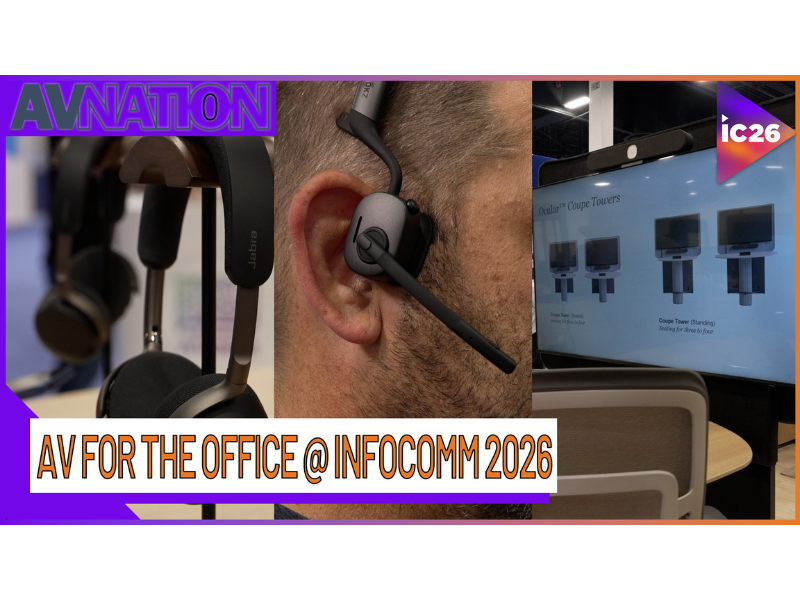
    While massive LED walls and large-scale displays often dominate the show floor, many of the technologies that shape the everyday meeting experience are much closer to the user. During InfoComm 2026, AVNation’s Patrick Norton explored several collaboration-focused solutions from Jabra, Shokz and Steelcase, highlighting how improvements in audio and workspace design can enhance hybrid meetings.

    Jabra showcased its latest flagship headset lineup, the Evolve 85 and Evolve 75. The over-ear Evolve 85 is designed with a slimmer profile while remaining lightweight at approximately 220 grams. The headset delivers up to 120 hours of music playback and 25 hours of talk time, with a quick five-minute charge providing up to five additional hours of listening.

    Beyond battery life, Jabra focused on improving voice clarity through advanced microphone processing. Norton noted the headset’s ability to isolate a speaker’s voice even in crowded environments, making it well suited for professionals working in busy offices, open spaces or trade show floors. The Evolve 85 is available now with pricing starting around $650, while the Evolve 75 is priced around $470 before street pricing.

    Shokz introduced the OpenMeet 2, bringing its bone conduction technology into the business communications market. Unlike traditional headsets, the OpenMeet 2 combines bone conduction with an open-ear speaker to provide improved low-frequency audio while keeping the user’s ears open to their surroundings. The headset includes a boom microphone and is certified for Cisco Webex and Zoom, with Microsoft Teams certification in progress. Scheduled to ship in July, the OpenMeet 2 is expected to retail for approximately $250.

    Steelcase made its first appearance at InfoComm, showcasing furniture designed specifically for hybrid collaboration. The company demonstrated its Ocular Series huddle room solution, which focuses on improving camera sightlines for small group meetings. Rather than placing participants along a traditional rectangular table, the seating arrangement helps ensure everyone remains visible on camera, creating more natural interactions for remote participants.

    The demonstrations reflected a growing trend across the commercial audiovisual industry: improving meeting experiences extends beyond cameras and displays. From intelligent headset technology to alternative audio solutions and thoughtfully designed collaboration spaces, manufacturers are addressing the practical challenges users encounter every day.

    To watch the full show floor coverage and explore more from InfoComm 2026, visit AVNation.tv.

  • Chin Hin Group Builds a Scalable Hybrid Workplace with Crestron

    Chin Hin Group Builds a Scalable Hybrid Workplace with Crestron

    introduction

    Chin Hin Group Berhad is a leading Malaysia-based conglomerate with a diverse portfolio in trading, manufacturing, property, and hospitality. Established in 1974 as a building materials trader, it has grown into a robust group of companies with six publicly listed entities. Chin Hin manages the entire construction value chain, from supplying building materials to constructing and furnishing homes.

    the challenge

    Chin Hin faced significant challenges as teams struggled with balancing multiple collaboration platforms, making meetings and connectivity inefficient. The lack of standardization hindered seamless communication across the group. With a move to a new headquarters in Sri Petaling, a suburb of Kuala Lumpur, Chin Hin aimed to create a hybrid workplace that would support their diverse workforce and foster innovation while encouraging inclusive collaboration through the right technology and space.

    the solution

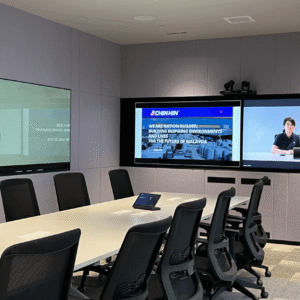
    Chin Hin selected Crestron to provide systems certified for Microsoft Teams® Rooms, enabling one-touch meeting launches, intelligent cameras with speaker tracking, and integrated controls for lighting and motorized curtains.

    “We have a clear vision and roadmap of the Hybrid Workplace transformation, and with strong partners like Crestron and committed teams, we’re getting closer every day.”
    -Abel Saw
    Group Chief Transformation Officer,
    Chin Hin Group Berhad

    the technology

    Designed to enhance synergy among the Group’s divisions, the headquarters features three learning hubs, a multifunctional space, 18 meeting rooms, and various wellness facilities. However, challenges persisted: executives required confidential meeting spaces, branch offices needed streamlined scheduling, and IT teams struggled with managing multiple communication platforms. The traditional meeting rooms lacked modern capabilities, and employees faced limitations compared to what could be possible with new technology and AI.

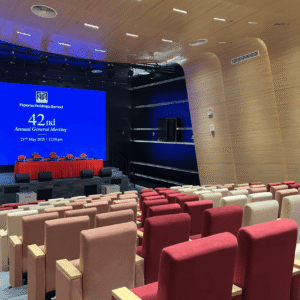
    Advanced AV and control technologies from Crestron play a pivotal role in enhancing collaboration at Chin Hin Group Berhad’s new headquarters. At the heart of this solution is the Crestron DM NVX® AV-over-IP platform, which facilitates efficient content distribution throughout the facility. In the Stellarium auditorium, DM NVX technology enables seamless sharing of presentations on large screens and distribution to training rooms, ensuring scalability for future needs.

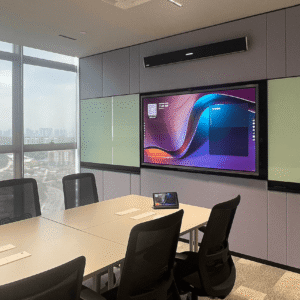
    The Learning Hub employs the DM NVX platform to support flexible room configurations for hybrid training scenarios, while Crestron Flex UC and intuitive touch screens simplify control over lighting and video settings across different room offerings. The Signature Microsoft Teams® Room creates an engaging environment for remote participants, the Idea Teams Lab supports quick collaboration in smaller settings, and the Creative Teams Lab is equipped with tracking technology. The Large Executive Boardroom features multiple cameras to provide an immersive video conferencing experience.

    To support each of these spaces, Chin Hin deployed a range of Microsoft Teams® Rooms-certified devices, including the Crestron Flex videoconferencing , Crestron 1 Beyond cameras, Jabra® Panacast® 50 video bar, and ceiling microphones—each tailored to different room sizes and collaboration needs. These technologies enable one-touch meeting launches, intelligent speaker tracking, and automated room configuration, allowing employees to walk into any space and start a meeting instantly, without technical hassle. For example, the Creative Teams Lab uses advanced tracking and framing to follow speakers naturally, while the Executive Boardroom combines multiple cameras and ceiling microphones to deliver a premium conferencing experience.

    To streamline scheduling and reduce friction, Chin Hin implemented a centralized meeting room booking system using Crestron scheduling panels. These touch panels are integrated with the company’s internal app, enabling employees to check room availability and book instantly. The system also connects with other building services—such as the cafeteria and wellness facilities—creating a unified digital experience. The result is a dramatic improvement in operational efficiency: meeting rooms are now set up over 50% faster, and average room utilization has reached 91%. Employees report significantly reduced tech stress, improved audio and video quality, and greater confidence in using the technology—contributing to a 93% post-implementation satisfaction rate.

    “One of our leaders told me, ‘We’ve managed to integrate technology so naturally into the workplace that people barely notice it and it just works.’ And I think that’s the best result you can ask for.”

    -Abel Saw
    Group Chief Transformation Officer,
    Chin Hin Group Berhad

    the results

    The implementation of advanced AV and collaboration technologies at Chin Hin has led to increased room occupancy and a significant return on investment through time savings and reduced travel. A unified user experience has enhanced the corporate image and empowered staff capabilities within the modern workplace, boosting productivity and efficiency in daily operations.

    By aligning people strategy with business goals, Chin Hin Group is building the future of work. The creation of hybrid workplace along with hybrid workforce across the organization, equipped with the latest technology, positions staff to stay ahead of market trends and maximize collaboration benefits.

  • AVIXA Research Forecasts Pro AV Industry Set to Reach $402 Billion by 2030

    AVIXA Research Forecasts Pro AV Industry Set to Reach $402 Billion by 2030

    The global pro AV industry is forecasted to reach $402 billion by 2030, according to AVIXA’s latest Industry Outlook and Trends Analysis (IOTA). While growth has slowed slightly from earlier projections due to global economic pressures like tariffs, interest rates, and geopolitics, the sector continues to outperform global GDP. Key drivers include the hybrid workplace and the growing demand for immersive experiences in live events, retail, hospitality, and venues.

    India has emerged as a major growth leader in the APAC region, overtaking China thanks to rising infrastructure investment and demand for advanced technology-enabled experiences. Innovations such as AV over IP, software and cloud platforms, AI, and extended reality (XR) are reshaping the industry, with strong growth in broadcast AV and security solutions alongside conferencing. Despite slower corporate spending, other sectors like government, military, and utilities are ramping up investments, making the industry resilient and future-ready.

    AVIXA’s Industry Outlook and Trends Analysis (IOTA) predicts pro AV revenue will grow from $332 billion in 2025 to $402 billion by 2030. Previously, the IOTA predicted market growth to reach $325 billion in 2024, but growth was slower than previously predicted, reaching $321 billion instead. However, the pro AV industry remains resilient, with a forecasted increase of $70 billion over the next five years.

    The IOTA report is a comprehensive analysis of the pro AV market, using data from the previous five years and input from various market stakeholders. By providing a snapshot of end user spending, the report presents data on the size of the pro AV industry with a global perspective, segmented by geography, vertical markets, solution areas, and product categories.

    Based on discussions with industry experts along with observations of macroeconomic pressures, the previous 5-year projection of a 5.3% growth was revised to 3.9%. Even with this notable decrease in the growth rate due to the dampening effect of uncertainty in tariffs, geopolitics, and high interest rates, pro AV is expected to outpace the global GDP growth by 0.8 percentage points.

    “The data highlights that the pro AV industry remains well positioned for long-term success even as we navigate a more cautious growth environment. Strategic investment in emerging technologies, regional diversification, and cross-industry collaborations will be key to unlocking more opportunities in the future,” said Sean Wargo, Vice President of Market Insight, AVIXA. “While the sector continues to outperform global GDP, the pace of expansion has slowed, reflecting a shift from post-pandemic recovery to more stabilized, experience-driven markets – such as live events, retail, venues, and hospitality.”

    Two forces continue to shape and drive demand in the pro AV industry: the hybrid workplace and the experience economy. By investing in AV tech to enhance engagement and collaboration in and out of the office, businesses are fostering a symbiotic relationship between workplace transformation and entertainment-driven experiences.

    Globally, India has emerged as the standout performer in the Asia-Pacific (APAC) region, which remains the engine of pro AV growth. Previously a position led by China over last few years, India’s rise to the lead performer was formed from an increase in infrastructure investment and a growing need for immersive technology-enabled experiences. Other regions experiencing high growth are the Middle East and Latin America.

    The pro AV industry also continues to evolve through innovations in how audio and visual experiences are delivered. Key innovations are four technologies: AV over IP, software and cloud, artificial intelligence (AI), and extended reality (XR). Now a mainstream aspect of AV installations, AV over IP enables content distribution and system control via IP networks. Market drivers are operation efficiency, cost reduction, and immersive experiences.

    Software and cloud are increasingly central to AV operations, enabling remote management and scalability. AI is enhancing system intelligence, aiding in design, programming, and labor augmentation, while XR is gaining traction in entertainment, retail, and education. For products, content management hardware and services dominate. Standalone software, especially AI-powered tools, is the fastest-growing category. This trend highlights a broader shift toward value-added services and intelligent infrastructure.

    The corporate sector continues to be the largest buyer segment, although its growth is slowing while government, military and energy, and utilities are all accelerating. This reflects recession-resilient investment patterns.

    From an AV solutions perspective, conferencing and collaboration tech still leads, but security/surveillance, and broadcast AV are rapidly climbing the ranks. Broadcast AV has now become the second largest solution area behind conferencing and collaboration technologies. This rise shows the growing interest among enterprises in developing video content creation capabilities. It also offers another facet of the experience economy in which audiences are engaged on both digital platforms and in-person, which leads to companies viewing corporate events as capturable and shareable content.