Tag: JBL loudspeakers

  • JBL SRX900 System Powers The All-American Rejects “House Party Tour”

    JBL SRX900 System Powers The All-American Rejects “House Party Tour”

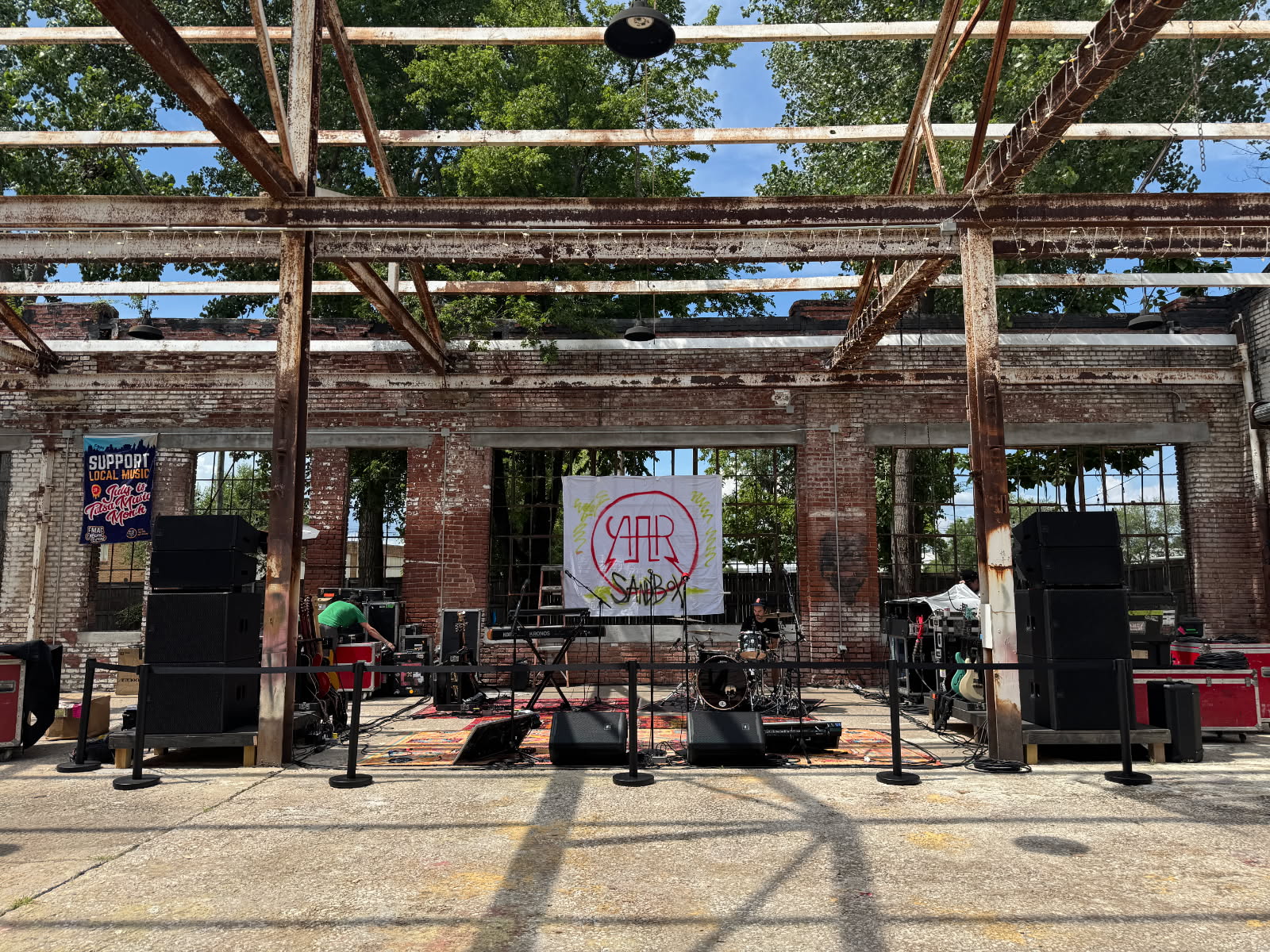
    For the All-American Rejects’ offbeat and energetic “House Party Tour,” production manager and front-of-house engineer Brendan Goers knew the traditional big-rig approach wouldn’t cut it. With pop-up shows in backyards, skating rinks and compact event spaces, including a standout performance at a skating rink in Arkansas, the band needed gear that was compact, powerful and flexible enough to adapt to whatever space they landed in.

    “We’ve had to fit where we fit,” said Goers. “Some of these shows have been in literal backyards. It’s been a lesson in rolling with the punches and putting the motto ‘the show must go on’ into practice.”

    Goers relied on a JBL Professional system comprising of JBL SRX906 loudspeakers, SRX918 subwoofers, and PRX912 wedges, products he hadn’t used before the tour but quickly came to trust. “I had never heard the SRX boxes before this run of house shows, but our entire team was very impressed with them right out of the box,” he said. “We used another brand for the first few shows, and plain and simple, they just didn’t cut it. We ended up blowing multiple speakers. But once we got the JBL SRX rig up and running, it was a night and day difference.”

    According to Goers, even The All-American Rejects frontman Tyson Ritter took notice. “He came down from the green room to mention the difference he noticed just while I was tuning the PA before soundcheck,” he added.

    In addition to delivering impressive sound quality, the system provided much-needed versatility. For example, the team pole-mounted the SRX906s during a pop-up show in Tulsa, aiming them to cover a second-floor VIP area. “It was exactly what we needed,” Goers said. “The pole-mount plates for the 906s allowed us to aim the top box up to the top level to ensure the people in VIP heard everything just as well.”

    The JBL PRX912 wedges, while not used by the band itself (which runs on IEMs), proved ideal for the tour’s support acts. “The 912s were perfect to give them a few mixes on stage, and then we flipped the front two around and used them as ‘front fill/Tyson Ritter barrier,’” Goers explained. “It kept the audience from encroaching on his space and allowed them to hear a full mix while being so close to the band and out of the main PA pattern.”

    One of the most unexpected challenges Goers faced was power. “All of these pop-up shows have been a power nightmare,” he said. “At our most recent show in Tulsa, we were told all outlets were dedicated circuits. We later found out they were all on one circuit. The entire PA and backline power was on a single 20A circuit.”

    The system performed so efficiently that it managed to keep the show going, even after the breaker tripped mid-song. “Although that led to an incredibly moving moment with the crowd singing along on their own, I panicked,” Goers admitted. “We got the breaker reset and continued on…on one circuit. If that’s not a show of how efficient the power of these speakers is, I don’t know what is!”

    The audience and crew reactions reflected the quality of the gear. “Almost any video you see online of these shows has comments that mention how good the band sounds,” said Goers. “Many factors there, but it certainly couldn’t have been done without the JBL PA we had.”

    Having previously used JBL A12 and A8 systems on past shows, Goers sees a consistent through line in the brand’s reliability and sound. “What holds true across all of them is that they’re just easy. Sounds great out of the box. Didn’t take much to get them to sound the way I needed them to.”

    With JBL Professional products supporting the stripped-down but high-energy House Party Tour, The All-American Rejects continue to bring professional audio to unexpected places – proving that with the right rig and the right attitude, the show can go on anywhere.

  • JBL SRX Series Delivers Scalable, Consistent Audio for High-Energy Fitness Competition Tour with Vantage Production Group

    JBL SRX Series Delivers Scalable, Consistent Audio for High-Energy Fitness Competition Tour with Vantage Production Group

    When HYROX, the global fitness racing competition, launched its U.S. tour in 2021, the production setup was modest: a few events, smaller venues and one JBL VRX rig. But just four years later, HYROX has exploded in popularity, with events spanning multiple days and filling over 250,000 square feet of convention space, drawing in thousands of fans and elite athletes from around the world.

    “We started that gig in the spring of 2021 when COVID was still lingering, and we only had a few events in the U.S.,” said Daniel Nickleski, COO of Vantage Production Group by Sound Works and lead on the project. “Now it’s a global brand, and HYROX U.S. events alone take over massive convention centers. We needed an audio system that could scale with that growth while staying reliable and consistent.”

    To meet those demands, Nickleski and his team turned to the JBL SRX900 Series. The compact size, networked control, and full-range response made the SRX906LA the perfect solution to cover wide open floor plans filled with spectators, competitors, MCs and DJs. As the show scaled up, so did the rig. From just two tower lifts in the “rock zone” (where the competition happens) to now six tower lifts with four SRX906LA loudspeakers per lift, covering up to 300,000 square feet of space with clarity.

    Two of the largest HYROX events this season underscored the system’s scalability and performance. At Pier 76 in New York City, an open-air venue posed environmental challenges and required precise directional control and robust output – tasks the SRX906LA handled with ease. The HYROX World Championships 2025 at Navy Pier in Chicago pushed the system even further, transforming the sprawling convention space into a high-energy arena with powerful audio coverage throughout multiple zones.

    “The client immediately noticed the difference when we switched to JBL SRX,” said Nickleski. “They started saying, “these sound great’ and pointed to the towers we were using so they asked for even more.”

    The team deployed JBL VRX932LA-1 loudspeakers at the finish stage and four JBL VRX918S subwoofers to energize the final moments of competition, while JBL SRX906LA towers handled the majority of the event space. With minimal acoustic treatment in large, boomy rooms, the team avoided deploying subwoofers elsewhere, instead relying on the SRX906LA’s extended low-end capabilities. “I was walking through the venue and thought I was standing near a sub,” said Nickleski. “But it was just four JBL 906s on a tower 50 feet away. That’s a testament to the product.”

    System design was handled in JBL Venue Synthesis by systems engineer Brian Rutter, who received venue layouts from HYROX and used the software to best plan speaker positions and coverage zones. “We get Vectorworks or PDFs of each space,” said Rutter. “I drop them into Venue Synthesis and figure out the best

    coverage without blocking sight lines or pathways. The delay finder is probably the best I’ve used, we’re within five milliseconds of perfect from the first push.”

    Once the system is mapped, everything is exported to JBL Performance Manager, where Rutter and the team tune each zone in real-time. The system is powered via networked Crown amplifiers and connected using Dante, with remote access to make adjustments during the event.

    “With JBL, it’s not just the sound, it’s the ecosystem,” said Nickleski. “JBL Venue Synthesis and Performance Manager talk to each other. We don’t have to jump between platforms like we do with other brands. It’s accurate, scalable, and makes a huge difference.”

    HYROX events span multiple zones, including seating for thousands, walk-around spectators, and MCs covering hundreds of feet via RF mics connected over fiber. The team’s four-person crew travels with the tour and integrates with local labor to set up audio, video and wireless coverage.

    “The whole system scales beautifully,” added Nickleski. “If we have a bigger room, we just send another case of JBL 906s. It clicks onto the lift and we’re up and running. And the coverage…what we model is what we hear in the venue. That’s what our client hears too.”

    From the bleachers to the rock zone to the final sprint on the finish stage, the JBL SRX900 Series has proven to be the right tool for HYROX’s high-energy, high-stakes format. “It’s grown from three U.S. events in 2021 to 16 and counting,” said Nickleski. “And JBL has kept up with every step of that growth.”

  • Flyover in Chicago Takes Off With Help From FLUX:: SPAT Revolution and JBL Professional

    Flyover in Chicago Takes Off With Help From FLUX:: SPAT Revolution and JBL Professional

    At its Spring 2024 opening, Flyover in Chicago became the newest of Flyover Attractions’ immersive indoor flying rides, joining existing installations in Las Vegas; Vancouver, Canada; and Reykjavik, Iceland, that transports guests to the planet’s most epic places through exhilarating flying journeys.

    Located within Chicago’s landmark waterfront Navy Pier, the multi-sensory experience, which incorporates leading drone technologies along with impressive aerial shots and first-person narratives, showcases the city from perspectives never seen before. Flyover’s signature Chicago journey is shown on an impressive 65-foot spherical screen with flight motion seats engineered to swoop, dip and turn, giving guests the feeling of flight. The attraction transports 61 guests at a time, with complete sensory immersion using wind, mist and scents, as fliers hang suspended.

    The breathtaking ride employs a massive number of audio sources, which are controlled and dynamically spatialized by the advanced audio object and Wave Field Synthesis features of FLUX:: SPAT Revolution immersive audio software, then played through a highly customized system of JBL loudspeakers in a nearly spherical configuration. The FLUX:: software and JBL Professional loudspeakers are supplemented with Crown amplifiers, BSS loudspeaker processing, and control systems from HARMAN Professional, who also supplied extensive support and expertise to the project.

    Designing and building an attraction like Flyover is a highly complex undertaking, so the thrilling sonic world of Flyover Chicago is the work of a team of experts from several companies working closely together.

    Immersive Entertainment

    An extensive presentation occurs primarily in its own immersive theatre, which features a 10-foot diameter, circular “lollipop” screen in the center (serving guests on both sides), plus an elliptical screen wrapping 360 degrees around the audience. Sound designer/mixer Tim Archer of Masters Digital programmed SPAT Revolution to control the soundtrack, which plays through a system designed by Wels, Austria-based Kraftwerk Living Technologies (KLT), who also designed the main flight ride audio system.

    Speakers are placed behind the perforated screens, with each side of the venue featuring the same speaker configuration: eight JBL COL800 column loudspeakers inside the lollipop facing out (for a total of 16 cabinets), and six JBL AC18/26 compact two-way loudspeakers behind the wraparound screen (for a total of 12). Low-frequency support is provided by four ceiling-mounted JBL ASB6115 subwoofers.

    Crucially, these are not arrays in which every loudspeaker receives the same signal; SPAT Revolution sends a discrete signal to each loudspeaker in order to implement Wave Field Synthesis and other reproduction techniques. Still, a source such as dialogue may need a large contribution of speakers for coverage or perceived sound size reasons, a situation which can create its own problems.

    “When you’ve got eight speakers that are not in a simple array and all are receiving the same content, how do you get away with not having comb filtering?” asks Archer. “The answer is that you run the signal through SPAT. I pop one track of dialogue into SPAT and WFS spreads it across the eight columns. And you can be almost around the side of the lollipop before you lose the character of the sound; it’s extremely wide. WFS is killer. It’s a game changer.”

    A ring of 10 more AC18/26s mounted above the audience (five on each side of the room) acts as the primary source for presenting the music from composer Elliott Wheeler.

    The Main Flight Ride

    For the flight ride, guests are seated on one of three separate moving platforms which are vertically “stacked” in the room. Presenting realistic, well-balanced sound to every guest was the biggest challenge facing both Archer and KLT’s Philipp Hartl, responsible for Sales/Lead Audio System Design & Optimisation.

    “There are three platforms, and that’s critical. We’re talking about people above, in the middle, and below,” reveals Archer. “That is probably the main thing that makes this mix so unique: traditionally, we are all based in the idea that the person mixing is on the same plane as the rest of the audience. You normally don’t have people located on three different planes.

    “But at Flyover Chicago you do, so the guests are having three different experiences. Since everybody doesn’t have the same visual perspective, they should not get the same audio perspective.”

    Complicating things further was the sheer number of moving elements, which defined a massive mix process. “I am sitting down with just over a thousand tracks, about six hundred for music and about four hundred and change for sound effects,” Archer reports. Handling this tremendous load required SPAT Revolution to work side-by-side with a second immersive audio system from Encircled Audio.

    With the platforms in constant motion, object audio was the only way to place a source and have each person hear it properly. Two guests viewing the same visual element from different platforms need separate mixes that accurately localize the sound for their positions, while the platforms continue to move. Traditional multichannel mixes simply cannot accomplish this. For this reason, localization in SPAT Revolution is not viewed in terms of routing sounds into loudspeakers, but, rather, sending them to “pan points” or virtual speakers to synthesize artificial wavefronts.

    What’s more, some musical events relate to visual elements, necessitating moving music sources through space, too. “I’ve got a trumpet player on top of the Wrigley Building, and when the camera flies by him, his trumpet sound has got to whip past us,” Archer details. “Every single thing in the mix moves.” To facilitate this, composer Wheeler and his engineer went to the trouble to deliver the music to Archer already in the form of a SPAT Revolution session.

    In his sound system design, Hartl faced the same issue of trying to supply sound appropriately to three continuously moving platforms. “As a practical matter, it’s not possible to achieve the exact same coverage at every seat on each platform,” Hartl explains, “so one of the really tricky things was to find a middle way to tune the speakers that minimized the amount of compromise made at any individual seat.”

    Hartl used 34 JBL AM7215-series high power two-way loudspeakers, deployed in four different vertical layers, plus four JBL ASB7128 dual 18-inch subwoofers to furnish prodigious amounts of low-frequency effects. As in the pre-show theatre, SPAT Revolution rendered a different signal feed for each loudspeaker. To ensure clear rear localization, a pair of JBL Control 23-1 ultracompact speakers is mounted on each seat back.

    Once the content was generated and the system tuned, the presentation was implemented in a show control system for playback by Miami-based Smart Monkeys.

    Teamwork is Key

    Bringing such an immensely complex project to a successful conclusion involves plenty of tweaking and problem-solving. As a central contributor to the project, HARMAN gave close support to all the teams involved, with Flux’s Hugo Larin being particularly deeply involved in the design and programming of the immersive audio. “Hugo’s involvement was what got the show across the line,” compliments Eric Sambell, Flyover’s Global Director of Construction and Entertainment. “He was knowledgeable and really jumped in, even with issues that weren’t directly involved with SPAT, like some aspects of design and workflow. It was a really great value-add.”

    Teams from Flyover and all of the vendors reported tremendous cooperation and support from all parties, which made a difficult, stressful project actually fun. “It was great to see the different companies work together and not against each other, which was the case at Flyover,” enthuses Hartl. ”We learned from each other, and that was the best thing which could have happened there.”

    Archer was just as impressed. “The spirit of collaboration started right with the management of Flyover, who assembled teams of people that could and would work together.”

    In the end, of course, the effort is not about the sophisticated systems or even the teams, but providing the guests an amazing experience, as Sambell highlights. “The technology has to be so good that it disappears, like it isn’t even there, so that guests enjoy a seamless experience from the moment they walk in the door to when they walk out afterwards,” he asserts. “We don’t want guests thinking about the technology or where they are, we just want them to be present in what’s happening.”