AV interoperability. It’s the dream every AV manager, IT director, and integrator has chased at some point. A single pane of glass. One dashboard to monitor, manage, and maintain every device in an AV ecosystem, no matter the brand or function. Audio, video, control, and lighting. All visible, all connected, all secure.
Yet after decades of innovation, the industry still hasn’t reached that destination. Why?
That was the central question of AVWeek episode 739, where panelists Dawn Mead, Justin Watts, and Sharath Abraham joined me to talk about interoperability, open standards, and whether the industry’s “Wizard of Oz” era is finally coming to an end.
The Ideal vs. The Real
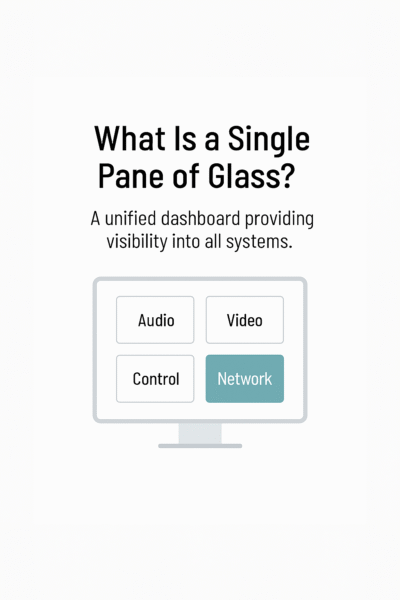
For Dawn Mead, a longtime enterprise AV professional, the appeal of a single unified dashboard isn’t theoretical. It’s survival.
“In an ideal world, it’s highly critical,” she said. “I want those things standardized and accessible in one way because my IT and cybersecurity teams have very strong opinions. If I can get something approved once for AV, that’s invaluable. If I have to do it 10,000 times for every little subsystem, that’s impossible.”
Mead represents a growing number of AV managers who spend more time navigating InfoSec checklists than signal flow diagrams. In organizations where AV rides on the corporate network, standardization is no longer a convenience; it’s compliance.
But the reality, she admits, is still fragmented. “Despite our best efforts, every building goes rogue,” Mead said. “Even if you standardize across a company, someone’s going to do their own thing.”
That tension between vision and execution sits at the heart of the single-pane debate. Everyone agrees it’s the goal. Few agree on how to get there. Or who should own it.
The Problem with Proprietary
For Justin Watts, who manages both AV and IT for a multinational enterprise, interoperability isn’t an abstract principle. It’s a daily decision.
“When I first started, we were under facilities,” Watts said. “We just did our own thing. Now I manage both AV and IT, which means I have to be a good steward in both environments.”
That shift in governance changes everything. From what products he specifies to how he measures value.
“I give more weight now to how a device interacts in my environment,” he explained. “I might trust a brand, but if it can’t meet InfoSec requirements or integrate with my other systems, that’s a problem.”
Watts admits that familiar brands still carry influence, but that comfort comes with a cost. Proprietary ecosystems. Those “walled gardens” built to work best with themselves. They often leave integrators juggling multiple dashboards, credentials, and compatibility issues.
“I focus more on products that act harmoniously in my environment,” he said. “There isn’t a simple solution, but interoperability has to mean more than logos on a box.”
A Manufacturer’s View: The API Imperative
Sharath Abraham of Jabra sees the issue from the manufacturer’s side. He’s worked for major players including Crestron and AVI-SPL, and he knows the pressures both technical and financial that come with opening a platform.
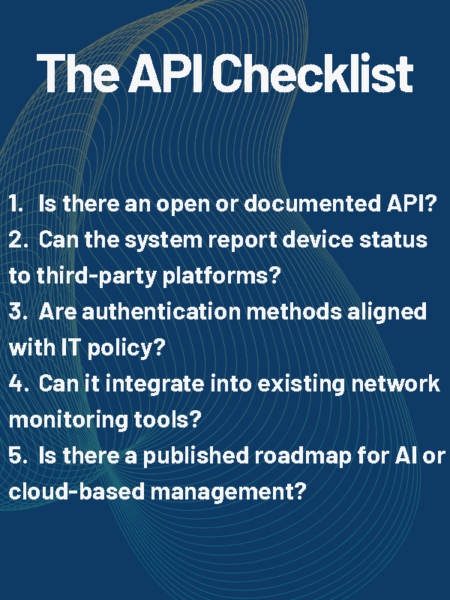
“Every manufacturer needs to have some sort of API available in some function,” he said. “Managing APIs costs money but that’s the cost of interoperability.”
Abraham argues that APIs are the new lifeblood of AV. They’re what allow systems to share data, exchange status, and connect into enterprise monitoring platforms. But for manufacturers, there’s a business calculus: How much openness can they afford before they give away their competitive edge?
That’s where standards come in, and where AV’s track record gets spotty.
“I’ve been advocating for open communication between devices because every client is different,” Abraham said. “If you make or use a standard, each client can build around it. That’s the future.”
What IT Already Figured Out
While AV debates its future, IT’s history provides a roadmap. The Ethernet standard that governs virtually every network device on the planet wasn’t built by one company. It was built by consensus through IEEE, a nonprofit body that defined interoperability first and profit later.
“You can take a switch off the shelf, plug in a cable from anywhere, and data will pass,” I said during the show. “I long for the day that happens in AV over IP.”
Watts laughed but agreed. “We’ve been solving problems the AV way, building our own version every time,” he said. “That’s why we have all these standards now. We can’t get out of our own way.”
The result is a patchwork of protocols like Dante, SDVoE, AVB, and IPMX. Each promising interoperability within its ecosystem, but rarely across them. True unification still feels distant.
The Consumer Pressure Cooker
Outside of AV, the world isn’t waiting. Streaming platforms, gaming hardware, and open-source tools like OBS have already democratized production and distribution.
“Companies outside of AV are realizing they need standards too,” Abraham noted. “Streaming is everywhere. You’ve got Netflix, Elgato, and consumer devices that now expect to work together. They’re figuring it out.”
Mead sees that as both threat and inspiration.
“We’re losing this war,” she warned. “If manufacturers don’t get together and figure it out, we’ll all end up working in IT or residential. The consumer world is setting expectations that we can’t keep ignoring.”
The implication is clear: when users can stream, switch, and share seamlessly at home, they won’t tolerate clunky workflows at work.
The Cost of Complexity
For enterprise teams, the lack of a unified management layer translates into real operational strain. More dashboards mean more logins, more training, and more opportunities for something to break.
Mead summarized the sentiment best: “We have to fill out forms and screenings that were never designed for AV,” she said. “If we could address everything through one approved platform, that would save time, money, and sanity.”
Watts agreed, adding that overcomplication can even erode internal trust. “If I have to knock on my CISO’s door more than three times, they start asking why I’m bothering them,” he said.
For IT, simplicity is security. For AV, it’s still a work in progress.
A Glimpse Ahead
Despite the frustration, Abraham remains optimistic. “Manufacturers are paying attention,” he said. “The issue is speed. The velocity of change is geological.”
But there are signs of momentum: open standards like IPMX gaining traction, cloud-based management platforms emerging, and AI-driven analytics starting to handle first-tier diagnostics. Each step toward openness builds the foundation for the single pane AV has been chasing.
As Watts put it, “We need a unifying force, something that helps us evolve past the mindset of, ‘This is my box; it only talks to my other box.’ Until we do, we’ll keep playing catch-up with the rest of the world.”
The Wizard’s Curtain
“We’ve been the wizards of Oz,” Watts said. “It’s time not to be.”
And maybe that’s the challenge now. Pull back the curtain. Show how it all connects. Make it simple, secure, and interoperable.
Because the real magic isn’t in the black box anymore. It’s in the systems that work together without one.

Tim Albright is the founder of AVNation and is the driving force behind the AVNation network. He carries the InfoComm CTS, a B.S. from Greenville College and is pursuing an M.S. in Mass Communications from Southern Illinois University at Edwardsville. When not steering the AVNation ship, Tim has spent his career designing systems for churches both large and small, Fortune 500 companies, and education facilities.
- Tim Albright
- Tim Albright
- Tim Albright

- Tim Albright