Integrated Systems Europe (ISE) has long been a must-attend event for AV professionals. But in 2026, the message from show leadership is clear: the center of gravity is shifting toward enterprise IT and higher education technology leadership. As collaboration platforms, conferencing, digital signage, and control systems increasingly live on the network, ISE is leaning hard into the reality that AV is no longer a standalone discipline. It’s infrastructure.
“AV/IT convergence is transforming how people communicate, collaborate, and share information, creating smarter and more connected environments,” said Mike Blackman, Managing Director at Integrated Systems Events. “Collaboration platforms, video conferencing, digital signage, and control systems are now routinely deployed on enterprise networks, streamlining management and reducing costs.”
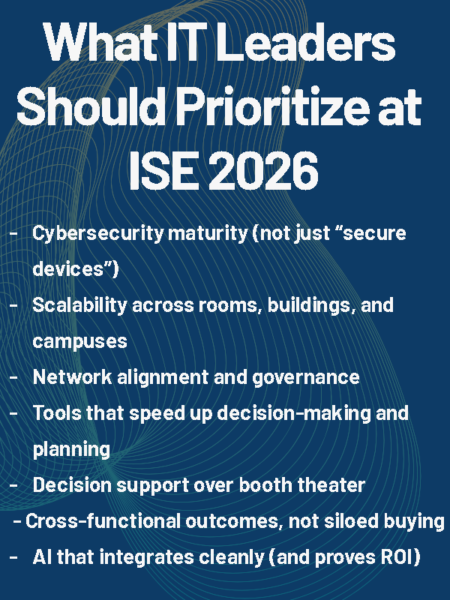
That shift is familiar territory for CIOs, network architects, and campus technology leaders. The difference is that ISE 2026 is intentionally designed to help them navigate it faster, more efficiently, and with better decision support than the typical “walk the floor and hope you find what you need” trade show experience.
Convergence isn’t a trend. It’s the operating model.
For enterprise IT and higher ed IT/AV teams, convergence isn’t theoretical. It’s what drives daily decisions around governance, scalability, security, and user experience consistency across hundreds (or thousands) of spaces.
ISE 2026 is positioning itself as a show where those cross-functional realities are acknowledged from the beginning, not treated as an exception. Blackman noted that IT teams are more directly involved in AV projects than ever, while AV professionals are being pushed to build stronger networking and security skills. The result is “a more unified, cross-disciplinary workforce.”
That matters because the stakes have changed. AV is no longer just about performance in the room. It’s about performance across the organization: uptime, monitoring, policy alignment, access control, compliance, vendor risk, and lifecycle management.
Cybersecurity moves from “IT problem” to “business-critical expectation”
One of the most significant additions to the ISE 2026 program is the CyberSecurity Summit: Securing the Future of Integrated AV Technologies, scheduled for Thursday, 5 February, 09:00–12:00 CET in CC5.1.
Cybersecurity isn’t being positioned as a specialty track. It’s being framed as a baseline competency for anyone deploying integrated AV systems in real environments.
“Cybersecurity has become a business-critical issue,” Blackman said, “influencing regulatory compliance, access to public tenders, and long-term trust, particularly in sectors such as healthcare, transport, education, and government.”
For higher education, that line hits particularly hard. Campus networks are complex, open by design, and under constant pressure from device sprawl. For enterprise leaders, the reality is just as pressing: AV endpoints represent an expanding attack surface, and the risk posture of “one more unmanaged device category” isn’t acceptable anymore.
ISE’s goal with the summit is straightforward: deliver real-world priorities that attendees can translate into action.
“The Summit tackles real-world threats and priorities, helping delegates leave with a clear, adaptable roadmap for their own organizations.”
AI scheduling built for busy IT decision makers
Trade shows reward people with time. But CIOs, architects, and campus leaders rarely have it.
ISE 2026 is addressing that directly with a new AI-powered scheduling tool on the ISE website designed to reduce planning friction and improve relevance for senior decision makers navigating a massive show floor.
“We spent months speaking directly with relevant professionals to understand their priorities, particularly around scalability, security, and seamless integration across complex environments,” Blackman said. “That feedback shaped many of our design decisions for 2026, ensuring the show is highly practical and efficient for senior technology leaders with limited time.”
The tool works by having attendees enter their company and job title, then surfacing sessions, exhibitors, and show features that map to that role.
“By simply entering your company and job title, the tool highlights the sessions, exhibitors, and features most relevant to your role,” Blackman said, “making it much easier to focus on what truly matters and not miss key opportunities on the show floor.”
For IT and campus leaders, that approach is less about “AI wow factor” and more about solving a real operational problem: prioritization.
Decision support, not just demos
ISE has also made changes meant to help attendees move beyond momentary product impressions and toward real-world evaluation.
“End users often struggle to evaluate emerging technologies on a crowded show floor,” and ISE 2026’s response is to provide more structured context: curated show floor organization, guided tours, and realistic showcases that align to actual implementation challenges.
Among the additions:
- Technology Zones to compare solutions in context rather than chasing booth-to-booth conversations
- Show Floor Tours built around themes including collaboration, cybersecurity, and smart campus solutions
- Realistic feature areas like Connected Classroom and Innovation Park to evaluate how systems translate into environments, not just spec sheets
“We’ve focused on helping visitors evaluate technology in context,” Blackman said. “These tours give IT and campus leaders the context and insight needed to assess scalability, and long-term value.”
That’s a key distinction. Most shows provide discovery. ISE 2026 is leaning toward decision support: helping leaders connect technical capability to outcomes like long-term maintainability and operational fit.
EdTech Content and the Connected Classroom return
Higher education continues to carry unique pressures: hybrid teaching expectations, student experience demands, limited staffing, and a constant need to do more with infrastructure already in place.
ISE 2026 is reinforcing its higher ed relevance with the EdTech Congress, now co-hosted with EduTech Cluster and Fira de Barcelona, taking place 4–5 February 2026 alongside ISE at the Palau de Congressos.
Additionally ISE is hosting the EduTech Summit on 3 February. This one day event gives attendees the tools they need to put AV technology to work for their faculty and students.
“Organizations and institutions are under pressure to support hybrid models, deliver consistent user experiences, and do all this securely and at scale,” Blackman said.
Also returning is the Connected Classroom, powered by Logitech, a feature that continues to gain traction because it demonstrates practical design choices rather than theoretical concepts.
“It showcases how classrooms can be designed to support hybrid teaching and active learning,” Blackman said, “using technology that is intuitive for both educators and students.”
For campus leaders, these kinds of environments matter because they bridge the gap between AV planning and teaching outcomes. They also create a more realistic foundation for evaluating products and workflows, especially when “hybrid” is no longer a special case. It’s simply class.
Real AI innovation vs AI-washing
AI will be everywhere at ISE 2026, just like every other technology event in 2026. But the problem for enterprise and higher ed leaders isn’t whether AI exists. It’s whether it delivers measurable value, integrates with existing systems, and reduces operational load without introducing new risk.
Blackman acknowledged the challenge directly: “AI is everywhere right now, but we know it can be hard for attendees to separate genuine innovation from marketing hype.”
ISE is addressing that through its Megatrends program, with AI positioned as one of the major themes.
“Rather than simply showing what’s possible, the programme focuses on how AI delivers tangible benefits, integrates into existing workflows, and addresses operational challenges,” Blackman said.
For IT and campus teams, that’s the right filter. The ROI question isn’t “is this smart?” It’s “does this reduce friction without adding overhead?”
Integrated Teams: IT, AV, security, facilities, and beyond
One of the most common shifts in 2025 and moving into 2026 is that organizations are no longer sending “the AV person” to evaluate systems. They’re sending cross-functional teams: IT, AV, facilities, security, and media production all need visibility and input.
ISE 2026 is adapting to that.
“Collaboration is the name of the game at ISE 2026,” Blackman said. “Recognizing that organisations now send cross-functional teams, we’ve designed the show to give each discipline a clear path while encouraging shared exploration.”
That includes combining structured paths (zones and tours) with shared touchpoints like Innovation Park that naturally encourage interdisciplinary discussion, not siloed buying decisions.
The Spark for Mike Blackman
While cybersecurity and enterprise relevance will draw many IT and higher ed teams to ISE, Blackman’s most enthusiastic answer came when talking about a brand-new show floor addition: Spark.
“I’m really excited for attendees to experience Spark for the very first time on the show floor,” he said. “Designed as a European hub where creativity and technology converge, Spark offers a focused conference and tech showcase for creative professionals, technologists, and decision-makers.”
The concept is positioned as an immersive, innovation-oriented experience, with Blackman describing it as “a launchpad for new perspectives, partnerships, and possibilities.”
For IT leaders, Spark may not be the first stop on the agenda. But it could be one of the more interesting bridges between technical infrastructure decisions and creative outcomes, especially as immersive environments, experience design, and new forms of storytelling increasingly rely on enterprise-grade networks and security frameworks.
(You can explore Spark here: https://www.iseurope.org/spark/ )
Register free with AVNation’s code
AVNation readers can secure FREE registration for ISE 2026 using the registration code: avnation
To follow along with all our coverage from ISE 2026, visit our dedicated landing page.
Tim Albright is the founder of AVNation and is the driving force behind the AVNation network. He carries the InfoComm CTS, a B.S. from Greenville College and is pursuing an M.S. in Mass Communications from Southern Illinois University at Edwardsville. When not steering the AVNation ship, Tim has spent his career designing systems for churches both large and small, Fortune 500 companies, and education facilities.
- Tim Albright

- Tim Albright

- Tim Albright
- Tim Albright