Panasonic Connect at ISE 2026 delivered a message that resonated strongly with higher education and enterprise decision-makers: innovation does not always mean disruption. Sometimes, it means refinement, modularity, and long-term reliability.
For universities and large institutional buyers navigating shrinking budgets, expanding hybrid learning models, and growing expectations for immersive learning spaces, that approach matters.
Rather than chasing short-term trends, Panasonic Connect used ISE 2026 to reinforce its position as a long-term partner in display and projection infrastructure.
Engineering Continuity in a Changing Market
Much of the industry conversation around Panasonic in recent years has centered on structural changes following its acquisition by ORIX Corporation. At ISE 2026, however, the company’s ProAV presence suggested operational stability and technical continuity.
The focus was not on reinventing the brand. It was on strengthening core competencies in projection, LED, and large-format visualization.
For higher education institutions, this consistency reduces risk. Procurement cycles often span multiple fiscal years. Facilities teams need confidence that platforms adopted today will remain supported, serviceable, and upgradeable tomorrow.
Panasonic’s booth and product lineup reflected that reality.
Single-Chip RGB: Precision Without Complexity

One of the most notable technical highlights was Panasonic’s continued development of single-chip RGB laser projection.
While traditional high-end visualization has often relied on three-chip architectures, Panasonic is leveraging single-chip designs combined with three-chip-class lenses to balance image quality, cost efficiency, and operational simplicity.
For lecture halls, auditoriums, and visualization labs, this approach offers several advantages:
- High color accuracy and brightness
- Reduced system complexity
- Lower long-term maintenance overhead
In higher education environments, where AV systems must serve multiple departments and user skill levels, simplified architectures translate into fewer service calls and greater uptime.
The emphasis here is not on headline-grabbing specifications. It is on dependable performance in real-world academic settings.
RQ45K: Modularity as a Strategic Advantage
Another centerpiece of Panasonic’s ISE 2026 presence was the RQ45K projector platform and its modular design philosophy.
Unlike fixed-configuration projectors, the RQ45K allows users to customize and upgrade key components by swapping modules. This enables institutions to tailor projection systems to specific applications, whether for immersive simulation, large-format visualization, or advanced research environments.
From a strategic perspective, modularity delivers three major benefits:
- Lifecycle Extension
Institutions can upgrade components without replacing entire systems. - Application Flexibility
One platform can support multiple use cases across campus. - Budget Optimization
Capital expenditures can be spread across upgrade cycles.
For higher education buyers managing long-term infrastructure plans, this approach aligns closely with multi-year capital planning and sustainability goals.
Mevix LED: All-in-One DVLED for Learning Spaces
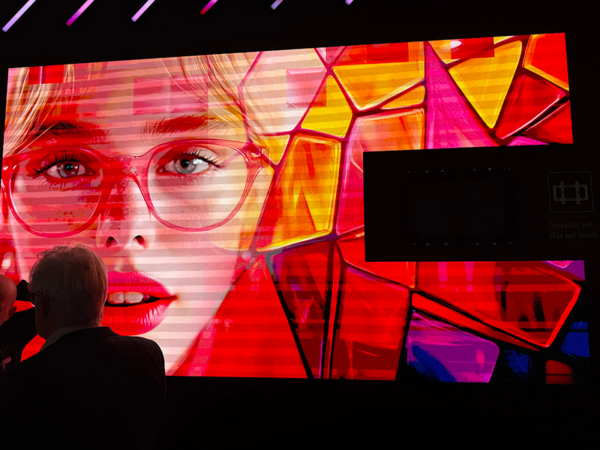
Panasonic’s expansion into direct-view LED continued at ISE 2026 with the Mevix 165-inch all-in-one DVLED wall.
With a 1.2 mm pixel pitch, 800-nit brightness, and modular 55-inch panels, the system targets institutions looking to deploy large-format displays without the complexity of traditional LED installations. Shipping beginning in April further reinforced Panasonic’s intent to move from showcase to deployment.
For universities, these systems open new possibilities:
- Active learning classrooms
- Collaborative research environments
- Simulation and visualization labs
- Digital signage and campus communications
The all-in-one approach lowers installation and commissioning barriers, making LED more accessible beyond flagship facilities.
This reflects a broader industry shift. As LED becomes more turnkey, it is increasingly viewed as a viable alternative to projection and tiled LCD walls in academic environments.
Designing for Long-Term Ownership
Across projection and LED platforms, a consistent theme emerged: design for long-term ownership.
Panasonic’s product strategy emphasized serviceability, upgrade paths, and ecosystem compatibility. Rather than positioning individual products as isolated solutions, the company framed them as components within a broader visualization infrastructure.
For higher education buyers, this matters more than feature lists.
Institutions must consider:
- Service contracts
- Parts availability
- Staff training
- Integration with existing systems
- Long-term vendor relationships
Panasonic’s ISE 2026 portfolio addressed these concerns directly by prioritizing standardization and maintainability.
Strategic Alignment with Higher Education Needs
What made Panasonic’s presence particularly relevant for higher education was how closely it aligned with evolving campus requirements.
Modern learning environments demand:
- Hybrid teaching support
- High-visibility content delivery
- Reliable lecture capture and presentation systems
- Flexible space utilization
Large-format displays, modular projection, and scalable LED walls all support these objectives.
More importantly, they do so without forcing institutions into experimental or unproven platforms.
Panasonic’s approach reflects an understanding that higher education values innovation, but only when it is accompanied by predictability.
Innovation Through Refinement
At ISE 2026, Panasonic Connect did not attempt to redefine ProAV. Instead, it refined it.
Single-chip RGB projection improves efficiency without sacrificing quality. Modular projectors extend system lifecycles. All-in-one LED lowers adoption barriers. And platform consistency supports institutional planning.
For enterprise and higher education decision-makers, this represents a pragmatic vision of innovation.
It is not about chasing every new technology wave. It is about delivering dependable, upgradeable, and scalable visualization systems that support teaching, research, and collaboration over the long term.
That strategy positions Panasonic Connect not just as a technology provider, but as an infrastructure partner for the next generation of learning environments.
To see all of AVNation’s ISE 2026 coverage, visit our dedicated page.

Tim Albright is the founder of AVNation and is the driving force behind the AVNation network. He carries the InfoComm CTS, a B.S. from Greenville College and is pursuing an M.S. in Mass Communications from Southern Illinois University at Edwardsville. When not steering the AVNation ship, Tim has spent his career designing systems for churches both large and small, Fortune 500 companies, and education facilities.
- Tim Albright

- Tim Albright

- Tim Albright

- Tim Albright