At Integrated Systems Europe 2026, Vizrt made a clear statement: professional live production is no longer confined to control rooms. It is moving directly into collaboration platforms, and specifically into Zoom.
The company showcased new tools designed to interactive-fy the Zoom experience by layering professional-grade graphics, augmented reality, and live production control into environments that IT teams already manage and support. For enterprise buyers, one of the most significant details is that this solution becomes available on February 20 and is sold directly through Zoom.
Turning Zoom Into a Production Platform
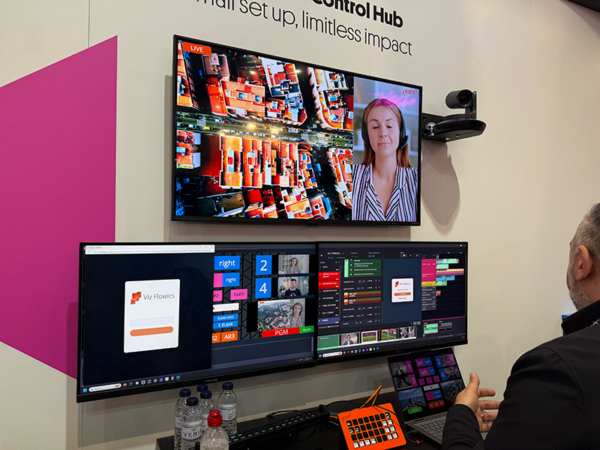
The headline development from Vizrt at ISE was the deeper integration between its production tools and Zoom environments, including Zoom Rooms. Instead of positioning Zoom as a simple conferencing layer, Vizrt presented it as the foundation for broadcast-level experiences.
Demonstrations focused on web-native HTML5 graphics, triggered lower thirds and transitions, AI-powered keying, multi-input switching, instant replay, and AR tools layered directly into Zoom-based workflows. For higher education, corporate communications, and live events teams, this signals a shift away from static hybrid meetings toward dynamic, branded, interactive productions.
This approach is particularly relevant for organizations producing live sports, esports, campus programming, or executive town halls. Vizrt illustrated how a single operator can manage switching, graphics, replays, and distribution through Zoom, creating professional results without traditional production crews.
Simplifying Live Production Workflows
One of the strongest themes in Vizrt’s presentation was operational efficiency. The company emphasized that a single person can now manage multi-input live switching, instant replay, graphics insertion using HTML5 templates, augmented reality enhancements, and transitions powered by its AI keyer.
For IT managers and AV directors, this represents a meaningful shift in how live production is resourced and supported. Reduced staffing requirements, lower operational complexity, fewer specialized systems, and tighter integration with existing collaboration infrastructure all translate into lower barriers to adoption.
In higher education environments, particularly in athletics and media departments, this model opens the door to student-led productions that still meet professional standards. In corporate environments, it enables communications teams to produce high-quality internal and external broadcasts without relying on external vendors.
Professional Graphics Inside Collaboration Environments
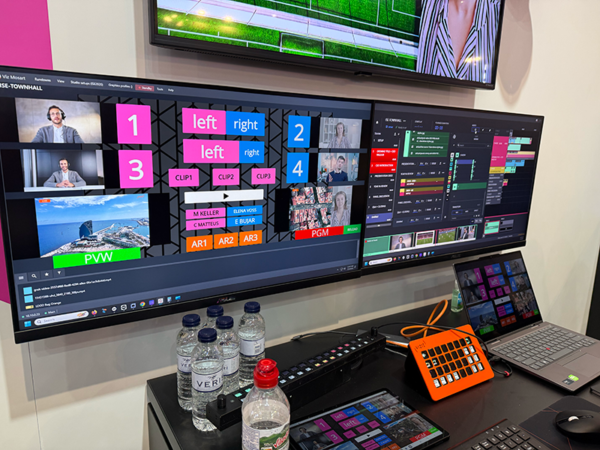
Historically, broadcast-quality graphics required dedicated hardware and separate production chains. Vizrt’s message at ISE was that professional graphics should now exist natively inside collaboration workflows.
By leveraging HTML5-based graphics, organizations gain greater flexibility in template management, cloud deployment, and branding consistency across distributed teams. Lower thirds, triggered graphics, and branded transitions can now be embedded directly into Zoom-powered environments rather than added downstream.
For enterprise communications teams, this elevates the visual quality of investor briefings, leadership updates, and product announcements while minimizing the need for additional infrastructure.
AR, AI Keying, and Virtual Participation
Vizrt also highlighted its augmented reality capabilities and AI-powered keying as core components of this new workflow. These technologies enable clean background removal, seamless AR overlays, and more immersive presentation environments.
The company also demonstrated scenarios in which remote participants appear as virtual or VR-based guests within production scenes. Rather than presenting audiences with grids of video windows, producers can place participants into cohesive, visually unified environments.
For IT leaders, this raises important strategic questions about how far collaboration platforms can be extended beyond traditional meeting use cases and into immersive communication experiences.
Commercial Alignment Through Zoom
The decision to sell this solution directly through Zoom is strategically significant. Procurement and licensing structures often determine whether new technologies gain traction, and Vizrt’s alignment with Zoom simplifies adoption for organizations already standardized on the platform.
For enterprise buyers, this model reduces vendor complexity, streamlines purchasing processes, and aligns live production investments with broader collaboration strategies. Rather than introducing a standalone production system, Vizrt is positioning its tools as an extension of existing enterprise infrastructure.
Implications for AV and IT Decision Makers
The broader takeaway from Vizrt at ISE 2026 presence is that collaboration platforms are rapidly evolving into full-scale production environments.
In higher education, this enables athletics departments, campus media teams, and hybrid learning programs to deliver broadcast-style experiences without building traditional studios. In corporate IT environments, it allows executive communications, global town halls, and product launches to incorporate dynamic, branded, interactive elements inside familiar platforms. For enterprise AV teams, it represents a move from simply enabling connectivity to creating compelling, content-driven spaces.
While technical considerations remain around network capacity, processing requirements, system integration, and security governance, Vizrt’s approach aligns with one of the dominant trends from ISE 2026: software-driven, platform-centric workflows replacing hardware-heavy production stacks.
VIZRT at ISE 2026
Vizrt is no longer positioning itself solely as a provider of broadcast graphics engines. At ISE 2026, the company presented a vision in which professional production tools are embedded directly into enterprise collaboration platforms.
By integrating multi-input switching, instant replay, HTML5 graphics, augmented reality, and AI-powered keying into Zoom workflows, Vizrt is betting that the future of live production lives inside systems organizations already trust and manage.
For AV and IT decision makers, the central question is no longer whether collaboration platforms can support professional production. It is whether their organizations are ready to treat collaboration as content.
To see all of our ISE 2026 coverage, visit our dedicated page.

Tim Albright is the founder of AVNation and is the driving force behind the AVNation network. He carries the InfoComm CTS, a B.S. from Greenville College and is pursuing an M.S. in Mass Communications from Southern Illinois University at Edwardsville. When not steering the AVNation ship, Tim has spent his career designing systems for churches both large and small, Fortune 500 companies, and education facilities.
- Tim Albright

- Tim Albright

- Tim Albright
- Tim Albright