Peavey at ISE 2026 centered its message on a clear priority: scalable, networked installed sound designed for institutions that demand reliability and simplicity.
Through its commercial portfolio and the integration of Crest Audio technologies, Peavey Electronics presented a cohesive ecosystem built for higher education and houses of worship.
The emphasis was not on spectacle. It was on infrastructure.
PoE+ Amplification Meets Dante Networking
One of the most significant introductions came from Crest Audio’s CIP Series, a PoE+ powered amplifier platform designed to simplify distributed audio deployments.
By leveraging Power over Ethernet, the CIP Series reduces the need for local power infrastructure while maintaining performance levels up to 103 dB SPL. For integrators and campus AV teams, that shift matters.
In higher education and worship environments, distributed audio is common:
- Overflow rooms
- Breakout classrooms
- Chapel extensions
- Fellowship halls
- Student centers
PoE+ amplification allows these systems to be deployed using standard network cabling, reducing installation complexity and increasing flexibility in retrofits.
The integration of Dante networking further strengthens the proposition. Audio routing becomes IP-based, scalable, and centrally managed. Instead of isolated analog zones, institutions gain a network-aware audio layer aligned with broader IT standards.
For universities and churches increasingly collaborating with campus IT departments, that alignment reduces friction and accelerates project approval cycles.
Designing for Modern Institutional Audio
Installed sound in 2026 is no longer just about loudspeakers and mixers. It is about ecosystem cohesion.
Peavey’s approach at ISE demonstrated a deliberate strategy: combine networked amplification, DSP processing, and control into a unified framework that institutions can scale across buildings.
The benefit for higher education is operational consistency. When a campus standardizes on a networked platform, training becomes simpler. Troubleshooting becomes centralized. Expansion becomes predictable.
For houses of worship, where volunteer operators often support systems, simplification is equally critical. A networked backbone with predictable behavior reduces the learning curve and improves service continuity week after week.
Rather than pushing highly complex architectures, Peavey’s messaging emphasized accessibility without sacrificing performance.
Bridging Installed and Streaming Environments
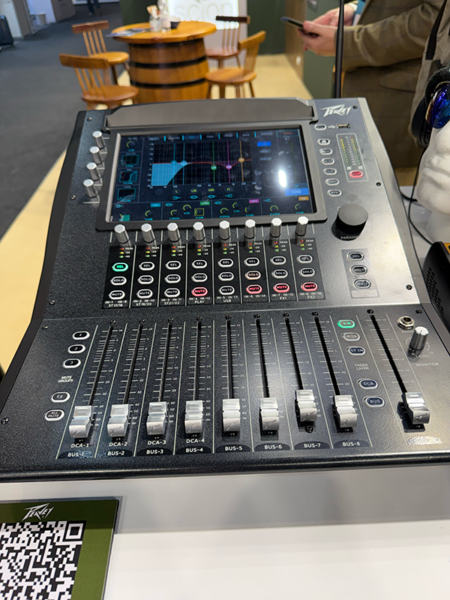
While installed sound dominated the booth narrative, Peavey also acknowledged the continued importance of hybrid communication environments.
The Unity Series online and podcast mixer integrates built-in DSP with two-, six-, and eight-microphone input configurations, complete with phantom power, automixing, and feedback suppression.
For universities running campus podcasts or hybrid classrooms, and for houses of worship streaming services online, this integrated approach reduces the need for layered external processing.
The strategic importance here is not just convenience. It is workflow consolidation.
Institutions can bridge installed sound and streaming environments without deploying entirely separate ecosystems. That continuity simplifies support models and lowers total cost of ownership.
Ecosystem Thinking: Peavey and Crest Together
What made Peavey’s presence particularly relevant was how clearly it framed its portfolio as a multi-brand ecosystem anchored by Peavey and Crest Audio.
Rather than presenting isolated product lines, the company positioned its technologies as interoperable components of a broader installed sound architecture:
- Networked amplification
- Integrated DSP
- Dante-based audio distribution
- User-friendly control
For higher education and worship buyers, ecosystem thinking reduces risk.
Institutions often struggle when mixing disparate vendor solutions that do not communicate seamlessly. By aligning amplification and control under a unified strategy, Peavey and Crest offer a more cohesive deployment path.
This is especially valuable in phased construction or renovation projects common across campuses and church campuses alike.
Strategic Implications for Higher Education and Worship
Both higher education and houses of worship share similar pressures:
- Limited capital budgets
- Growing demand for hybrid participation
- Increased reliance on IT-managed infrastructure
- Need for simple day-to-day operation
Peavey’s ISE 2026 portfolio addressed these pressures through practical engineering decisions.
PoE+ amplification reduces infrastructure cost and complexity. Dante integration aligns audio systems with network standards. Integrated DSP reduces external processing requirements. Simplified mixer platforms bridge installed and streaming environments.
None of these moves are flashy. All of them are pragmatic.
In a market where many conversations revolve around immersive experiences and AI-driven features, Peavey focused on the fundamentals of reliable sound reinforcement.
Installed Sound as Infrastructure
The larger takeaway from Peavey at ISE 2026 is that installed audio is increasingly treated as infrastructure, not equipment.
Network-based amplification, centralized routing, and DSP integration bring audio systems closer to IT-managed services. That shift changes how institutions plan, deploy, and maintain their environments.
For higher education and worship leaders evaluating upgrades in 2026, the question is less about individual hardware features and more about long-term manageability.
Peavey’s strategy reflects that reality.
By combining Crest’s networked amplification with Peavey’s broader installed sound portfolio, the company is positioning itself as a practical partner for institutions that need dependable, scalable audio systems designed to work day after day.
At ISE 2026, that message was clear: installed sound is evolving. And for higher education and houses of worship, the future is networked, simplified, and infrastructure-ready.
To see all of AVNation’s ISE 2026 coverage, visit our dedicated page.
Tim Albright is the founder of AVNation and is the driving force behind the AVNation network. He carries the InfoComm CTS, a B.S. from Greenville College and is pursuing an M.S. in Mass Communications from Southern Illinois University at Edwardsville. When not steering the AVNation ship, Tim has spent his career designing systems for churches both large and small, Fortune 500 companies, and education facilities.
- Tim Albright
- Tim Albright
- Tim Albright
- Tim Albright