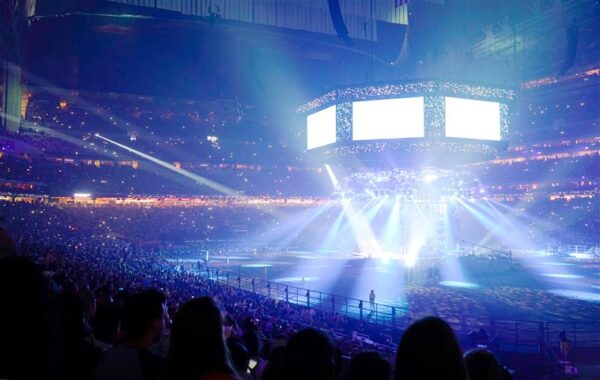
Professional sports venues were once engineered around a simple premise: deliver an unforgettable game-day experience. Massive centerhung displays, ribbon boards, IPTV systems, distributed audio, production control rooms, and high-capacity fiber backbones were justified by their ability to energize 60,000 to 80,000 fans during a handful of marquee events each year.
That model no longer holds.
Today’s venue operators face a more demanding financial reality. Most major league facilities host just 8–12 primary home games per season. Even with playoffs and special events, more than 300 calendar days remain where multimillion-dollar AV infrastructure risks sitting underutilized. When systems representing tens or hundreds of millions of dollars generate revenue fewer than 20 days annually, capital amortization slows and ROI compresses.
The financial lever is no longer spectacle. It is utilization.
For AV integrators, consultants, and IT architects, this shift reframes system design from experiential enhancement to capital productivity strategy. The modern question is not “How immersive can game day be?” It is “How many revenue-generating days can this infrastructure support?”
The Revenue Math Behind Modern Stadium Operations
From a finance perspective, stadium AV is fixed infrastructure with high upfront CapEx and long depreciation schedules. Traditional budgeting models amortize these investments over 7–15 years. But the true determinant of ROI is event density.
Consider a simplified model:
- 15 monetized event days annually
- $X revenue attributable to AV-enabled sponsorship, premium rentals, and broadcast activations
- High fixed operating and maintenance costs
Now compare that to:
- 175 monetized event days
- Expanded sponsorship impressions
- Corporate rentals, esports tournaments, concerts, conferences, hybrid broadcasts
- Automated operational efficiencies reducing per-event labor
The shift from 15 to 175 active days fundamentally alters revenue per square foot and asset productivity. Utilization rate becomes the primary financial variable.
For venue executives, AV infrastructure is no longer evaluated solely on brightness, pixel pitch, or channel count. It is measured against its ability to expand booking calendars and unlock new event categories without requiring proportional increases in operating complexity.
Designing AV Infrastructure as a Revenue Engine
Forward-looking venues now evaluate AV investments based on incremental revenue enablement. The specification phase increasingly includes finance teams alongside technical directors.
Flexible routing architecture allows rapid reconfiguration between sporting events, concerts, and corporate productions. Modular LED deployments enable selective scaling of display surfaces rather than full-system activation. Scalable DSP zoning supports both bowl-wide audio reinforcement and segmented ballroom configurations. Broadcast-ready control rooms facilitate hybrid streaming packages and content capture for monetized digital distribution.
This flexibility translates directly into booking density. Corporate buyouts, community graduations, esports tournaments, product launches, and national touring productions can share a unified infrastructure backbone.
Financial modeling reflects this strategic shift. Operators analyze:
- CapEx amortization over defined lifecycle horizons
- Revenue per event day across categories
- Incremental booking frequency enabled by adaptable systems
- Operating savings derived from automation frameworks
Adaptability shortens payback periods by increasing monetizable days without dramatically increasing staffing or operational burden. AV becomes a multiplier rather than a sunk cost.
Network-Centric Architecture as an Economic Lever
The convergence of AV and IT is central to this transformation.
AV-over-IP ecosystems enable shared signal distribution, centralized control, and scalable routing over high-capacity switching fabrics. Instead of duplicating hardware for separate zones or event types, venues deploy unified switching cores that dynamically allocate resources.
In practical terms, this means:
- Simultaneous activations across VIP lounges, meeting rooms, press areas, and hospitality suites
- Centralized monitoring and diagnostics
- Preset-driven routing profiles for repeatable event types
- Remote configuration reducing on-site engineering hours
Hardware consolidation reduces redundancy at the equipment layer while preserving resilience at the network layer. Shared infrastructure lowers incremental event production cost and improves operating margin.
In large venues, properly engineered network-centric AV directly improves asset utilization. When multiple activations can coexist without additional temporary builds, revenue per square foot increases. For IT teams, this convergence also aligns AV systems with enterprise monitoring, cybersecurity frameworks, and lifecycle governance practices.
The AV rack room is no longer an isolated technical island, it is a node in a revenue-producing data network.
Digital Signage as Programmable Revenue Infrastructure
LED ecosystems have evolved from branding tools into monetizable digital inventory platforms.
Where static signage once delivered a single sponsor message for an entire event, centralized content management systems now enable high-frequency rotation, dayparted messaging, zoned activations, and real-time updates. A single display surface can serve multiple sponsors within one game or event cycle.

This transformation increases sellable impressions without expanding physical footprint.
Impression analytics and engagement metrics further strengthen the value proposition. Venues increasingly leverage data on dwell time, audience density, and viewability to justify premium CPM models. Sponsorship sales teams now collaborate closely with AV and IT departments to align display capabilities with revenue strategy.
In this context, LED systems and CMS platforms are no longer aesthetic enhancements. They are programmable revenue engines.
The sophistication of content workflows, scheduling automation, API integrations with sponsorship systems, dynamic trigger-based updates, directly influences yield optimization. AV professionals play a central role in enabling this monetization ecosystem.
Flexibility, Scalability, and Reliability as Financial Safeguards
Revenue expansion requires architectural discipline.
Rigid, single-use AV systems expose venues to volatility, weather disruptions, market shifts, season variability. IP-based routing, modular display assemblies, and programmable control systems reduce reconfiguration time between events. Faster turnarounds increase annual booking capacity.
Scalability is equally critical. Underbuilt switching cores, insufficient fiber pathways, or non-modular LED designs often force costly retrofits within three to five years. Engineering for bandwidth headroom and processing capacity protects long-term capital strategy and aligns with 10–15 year facility master plans.
Avoiding rip-and-replace cycles preserves predictable ROI timelines.
Reliability and Automation Protect Revenue Continuity
In high-profile venues, downtime equates to contractual and reputational risk. Display outages during nationally televised events impact sponsor obligations and broadcast relationships. Audio system failures during premium corporate rentals jeopardize repeat business.
Redundant signal paths, failover processing engines, backup power distribution, and resilient control layers mitigate catastrophic revenue exposure. Reliability engineering is therefore not simply best practice, it is financial risk management.
Automation frameworks further protect margin. Preset-driven workflows reduce reliance on scarce skilled labor. Centralized monitoring allows proactive intervention before minor issues escalate. Remote diagnostics convert unpredictable repair events into manageable service workflows.
Uptime becomes a financial metric. Automation becomes margin protection.
Labor Constraints and Operational Efficiency
The live events industry continues to navigate skilled labor shortages. Recruiting experienced engineers and technicians for every activation is neither scalable nor cost-effective.
Networked AV systems with standardized control logic reduce training requirements and enable smaller crews to manage larger footprints. Managed service agreements stabilize operating expenses and convert reactive maintenance into predictable OpEx.
For venues operating year-round calendars, operational efficiency is as critical as booking density. Designing infrastructure that minimizes dependency on variable labor pools enhances both reliability and profitability.
What Venues Now Expect from AV Partners
Procurement conversations have matured.
Venues increasingly demand:
- Utilization modeling tied to infrastructure capability
- Lifecycle cost projections aligned with master planning
- Revenue enablement analysis for digital signage and hybrid production
- Uptime guarantees supported by service-level agreements
AV firms are evaluated not only on system performance but on their ability to support revenue continuity and long-term asset productivity.
This evolution shifts the industry from project-based installations to infrastructure partnerships. Integrators and manufacturers must demonstrate fluency in finance, cybersecurity, data governance, and operational modeling, not just display technology.
The conversation now spans IT architecture, revenue analytics, and risk mitigation alongside pixel density and audio coverage.
Designing for Revenue Continuity
The most competitive venues are not merely building immersive game-day environments. They are engineering scalable, networked ecosystems designed to generate revenue 365 days a year.
Year-round venue AV design prioritizes:
- Utilization rate optimization
- Infrastructure flexibility
- Scalable network backbones
- Reliability engineering and redundancy
- Lifecycle cost governance
- Automation-enabled operational efficiency
When these elements align, AV infrastructure transitions from seasonal capital expense to compounding revenue asset.
Game-day performance still matters. Spectacle remains essential. But in an era defined by capital scrutiny and diversified revenue models, year-round monetization defines long-term success.
For the AV and IT professionals shaping the next generation of stadiums and arenas, the mandate is clear: design not just for the crowd in the seats, but for the balance sheet across the calendar.
- AVNation Staff
- AVNation Staff
- AVNation Staff
- AVNation Staff