TYou already know the help desk ticket volume. You’ve seen the frantic emails from faculty five minutes before a lecture. You’ve done the walk of shame across campus to reboot a control panel that decided today was not going to be its day. The love/hate relationship with classroom AV is a daily experience.
What you may not know is the dollar figure attached to all of it.
New joint research from Logitech and AVIXA puts a human face on what you’ve been experiencing as a data point on a support queue. They surveyed 523 AV/IT professionals, 636 faculty members, and 523 students. The findings should reframe how every IT manager in higher education makes the case for AV investment in 2025 and beyond.
The Number That Should Change Your Next Budget Conversation
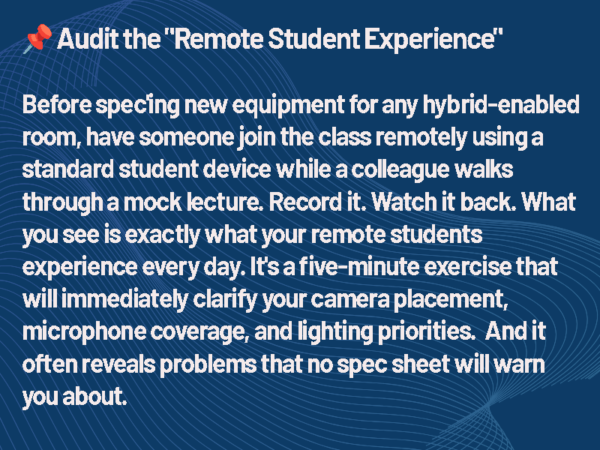
Here’s the hard truth buried in this research. 1 in 3 faculty members and 1 in 4 students have seriously considered leaving their institution because of poor technology.
Let that land for a moment.
Not because of tuition. Not because of faculty pay. Because the projector froze during a midterm review. he remote students couldn’t hear anything for the first eight minutes of class. The login screen ate someone’s session and nobody could fix it in time.
The research backs up what that number implies: 50% of faculty report daily or weekly AV challenges, with hardware malfunctions (77%), video conferencing failures (66%), and software access issues (66%) leading the list. Students aren’t faring better; 61% report connectivity disruptions and 66% struggle with login failures on a regular basis.
These aren’t nuisances. They are retention events.
And here’s the business case kicker: 73% of IT leaders in this survey cite faculty satisfaction as their primary success metric. So the department that owns the infrastructure is also being measured on the human outcome of that infrastructure. If your AV fails at 9:03 AM on a Monday, that is your problem. Even if the projector wasn’t in your procurement order.
The Laminated Datasheet Is Your Real Enemy
Here’s where most AV conversations go wrong: they focus on the gear without addressing the experience.
Walk into almost any lecture hall or mid-size classroom on a U.S. campus today. Next to the control panel on the podium, there is a laminated instruction sheet. It tells the professor which button to press for which input, how to get the screen down, who to call when it doesn’t work.
That laminated sheet is not a feature. It is a confession.
It’s a confession that the system was never intuitive enough to use without instructions. And for the professor who is five minutes from a 200-person lecture, it’s a gauntlet. One wrong tap and the room goes sideways.
Gaurav Bhargava, who led much of the multi-year qualitative research behind this study, put it plainly in conversations leading up to the research publication: “Make the technology go away so I can focus on the teaching.” That sentiment wasn’t from one professor at one institution. It came up across campus visits, roundtables, and student interviews at schools ranging from community colleges to multi-site state universities.
The problem isn’t that faculty are technophobic. The problem is that automation complexity was designed for auditoriums, not classrooms. A 400-seat lecture hall justifies a 15-button control sequence. A 30-person seminar room does not. When you deploy that same complexity at scale across 200 classrooms, you have not modernized your campus. You have distributed 200 failure points. Each one with a laminated apology attached.
When Remote Students Become an Afterthought
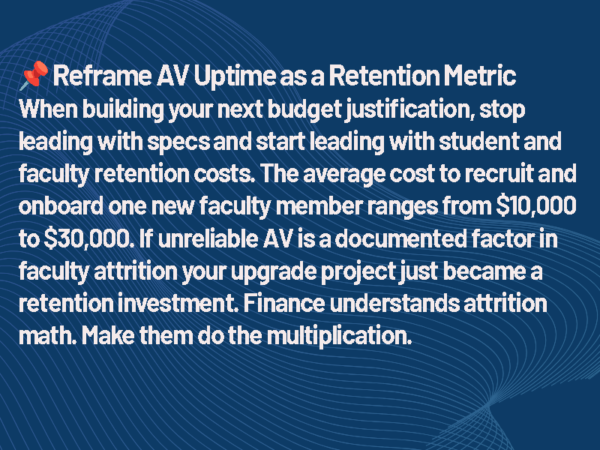
Hybrid learning isn’t going away. 51% of students in this research say the availability of hybrid courses is a factor in choosing which institution to attend. That number alone means your AV infrastructure is now a recruitment asset. Or a liability.
The problem? Most classrooms were never truly designed for hybrid delivery.
The research and accompanying campus observations surfaced a pattern that’s uncomfortably common: professors default to the students in the room and forget about everyone else. The remote participants get a chin shot. Or a midriff. Or an audio feed that cuts out whenever someone walks near the podium mic.
There’s also a more sophisticated use case emerging that your classroom AV needs to support. Students at institutions that have adopted video-enabled classrooms are no longer passively watching. They’re timestamp note-taking, flagging specific moments in a recorded lecture to revisit at varying playback speeds. The in-person students are pulling up the Zoom or Teams feed on their laptops to get live transcription and translation, even when they’re physically in the room. The classroom AV experience is becoming inseparable from the software stack running on top of it.
If your cameras can’t frame a speaker intelligently, if your microphones can’t isolate voice from room noise, if your system can’t reliably hand off to the UC platform. None of that advanced pedagogy is possible.
Why Classroom AV Belongs in the Network Room, Too
Here’s the angle that often gets missed when AV and IT are still operating as separate fiefdoms.
The shift to cloud-based lecture capture, UC-platform integration, and device management at scale means AV is now a network conversation. Bandwidth, VLAN segmentation for AV devices, firmware update policies, and remote device monitoring are no longer “AV department” concerns. They’re IT infrastructure concerns.
The research reflects this: 50% of IT leaders say that remote management capability directly reduces their support burden. That’s not a feature preference. That’s an operational necessity when you’re responsible for AV continuity across hundreds of rooms, potentially across multiple campuses, without the staffing to physically service each one on demand.
The institutions winning at this are the ones that have stopped treating AV as a facilities line item and started treating it as a managed endpoint category. With the same monitoring, alerting, and lifecycle management rigor applied to any other networked device. Room health, utilization data, energy consumption. These are now part of the AV conversation, whether the AV team is ready for it or not.
The ROI Case Your CFO Will Actually Understand
The research shows 82% of colleges and universities have AV upgrade projects already planned, and 65% are choosing to modernize existing rooms rather than replace the technology wholesale. That’s a pragmatic signal. Institutions are under financial pressure, but they recognize the cost of inaction is higher.
Here’s how to frame it for the people holding the budget:
Unreliable AV creates a cascade. Faculty satisfaction drops. Engagement drops. When engagement drops, retention is at risk. When retention is at risk, so is tuition revenue. And when faculty start quietly exploring other options — as one-third of them have. Replacement costs enter the picture.
The classroom AV upgrade isn’t a cost center. It’s retention infrastructure.
What Good Looks Like in Practice
Logitech’s Rally Bar, Rally Camera Streamline Kit, and the Sync remote management platform represent one set of answers to the problems documented in this research. Purpose-built for the smaller classroom footprint that dominates most campuses, with AI-assisted video intelligence, remote diagnostics, and enough simplicity that the laminated datasheet becomes unnecessary.
But the specific solution matters less than the principle behind it: reliable, interoperable, and manageable at scale. Any platform you evaluate should be able to answer three questions cleanly. Can faculty use it without instructions? Can IT monitor and resolve issues remotely? And does it treat remote participants as equal to the people in the room?
If the answer to any of those is “not quite,” you’re not done yet.
The Bottom Line
The data from this Logitech/AVIXA study isn’t just a vendor’s research brief. It’s a mirror held up to a problem that every IT manager in higher education already knows is real. Rinally quantified in a way that can move a budget conversation.
One in three faculty members considering a job change because the AV doesn’t work is not an AV problem. It’s an institutional risk problem. And it lands on your desk.
The AV landscape moves fast. New solutions for remote management, AI-assisted camera intelligence, and UC-platform integration are hitting the market at a pace that makes last year’s purchase feel dated. To get these insights delivered directly to your podcast player, subscribe to EDTech.

Tim Albright is the founder of AVNation and is the driving force behind the AVNation network. He carries the InfoComm CTS, a B.S. from Greenville College and is pursuing an M.S. in Mass Communications from Southern Illinois University at Edwardsville. When not steering the AVNation ship, Tim has spent his career designing systems for churches both large and small, Fortune 500 companies, and education facilities.
- Tim Albright
- Tim Albright

- Tim Albright

- Tim Albright