Direct-view LED has steadily moved beyond command centers, broadcast studios, and high-end showcase installations. At InfoComm 2026, Sony made its next target clear: the everyday enterprise.
Sony used the show to give its new Crystal LED S Series its first public showing, demonstrate its first all-in-one LED display, and present a virtual production setup designed specifically around the realities of corporate spaces. Taken together, the announcements point toward the same goal, making large-format LED easier for organizations to deploy without giving up the image characteristics Sony has built its Crystal LED line around.
Bringing Crystal LED to more organizations
The biggest shift comes with the Crystal LED S Series.
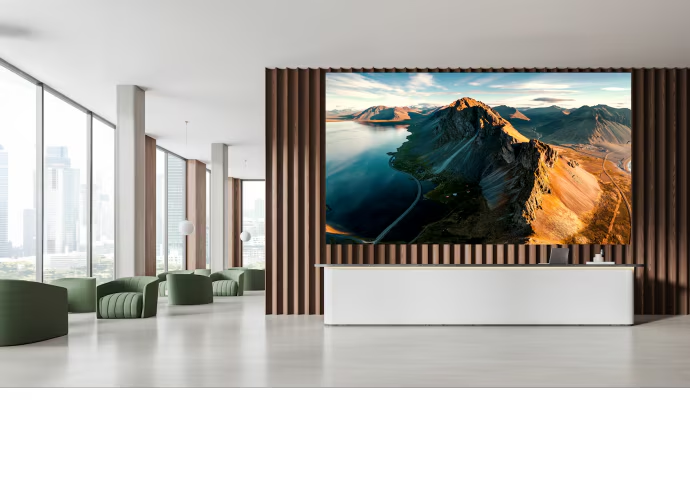
Sony’s existing CH and BH Series sit toward the premium end of the company’s LED portfolio. The S Series takes a different approach, targeting organizations that want Crystal LED across more spaces but may not need, or have the budget for, the flagship models.

“This is our enterprise solution for Crystal LED,” Jason Metcalfe of Sony said at InfoComm 2026. “We’re bringing that quality and that performance into a range that’s scalable across a whole institution, complex, whole organization.”
That scalability is tied directly to cost. Metcalfe said the S Series represents roughly a 50 percent price reduction compared with Sony’s CH and BH Series. That potentially changes the conversation for enterprise buyers considering dvLED not simply for one statement installation, but across multiple spaces.
The tradeoff is largely around performance requirements. Sony positions the CH Series for precise image control and higher brightness, while the S Series is designed around more typical enterprise environments. It offers 800-nit brightness along with an anti-reflective coating intended to help in spaces with significant ambient light, including corporate lobbies. Sony says the display still maintains strong contrast and black levels under those conditions.
“We want to make CLED more achievable for a number of organizations,” Metcalfe said.
Watch the full interview coverage.
That’s an important distinction. For enterprise AV teams, dvLED adoption increasingly isn’t about whether the technology can produce an impressive image. The practical questions are whether the budget works, whether the display fits the environment, and whether deployment can be repeated across an organization.
Sony takes an all-in-one approach
Sony is also addressing another barrier to LED adoption: complexity.
At InfoComm, the company showed its first all-in-one LED product, UNIFY. The 135-inch, 1.5mm-pixel-pitch display packages Sony’s image processing and engineering into a format intended to simplify installation and deployment.
“We have an all-in-one product. It’s called UNIFY,” Metcalfe said. “It’s got our own engineering behind it, our image processing, but in a much easier-to-install, easier-to-apply package.”
All-in-one LED displays address a different buying requirement than fully customized LED walls. Instead of approaching the display as a collection of cabinets, processing, mounting, and supporting components, organizations get a more packaged experience.
That could make the format particularly relevant for meeting rooms, collaboration environments, executive spaces, and other applications where buyers want the scale of LED without treating every deployment as a highly customized project.
Virtual production moves into the office
Sony’s InfoComm story didn’t stop at displays.
The company also demonstrated a corporate virtual production environment developed with partners including Forte, Vu Studios, Original Syndicate, Megapixel, and Aputure Lighting. Rather than reproducing the scale of a Hollywood virtual production stage, the demonstration was designed around what a large enterprise could realistically accommodate.
“This is built for 10-foot ceilings. It’s built for a space that would be in an office building. And it’s built for ease of operation,” Metcalfe said.
That’s significant because corporate video production is becoming a more substantial part of enterprise AV. Organizations are producing executive communications, training, internal broadcasts, customer presentations, and livestreamed events at a pace that increasingly demands dedicated production infrastructure.
Sony’s demonstration paired its Capri LED wall with an Alpha-series camera rather than the company’s higher-end VENICE 2 cinema platform. The idea is to show that virtual production doesn’t necessarily require an entirely separate tier of equipment or staffing.
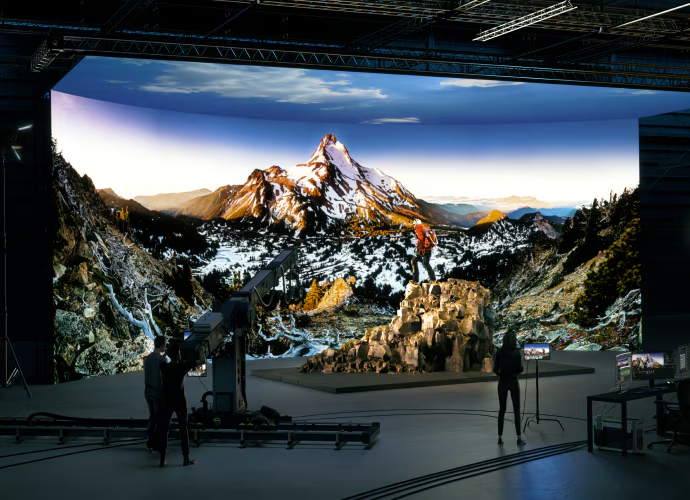
Metcalfe said the environment can be operated by one person or a small team, with lighting responding dynamically to content and access to a cloud content library.
A broader enterprise play for dvLED
Sony’s InfoComm 2026 display strategy reflects where dvLED appears to be heading next.
Premium LED walls aren’t disappearing, and demanding applications will continue to justify flagship systems. But growth in corporate AV depends on making the technology practical in more ordinary spaces.
The S Series tackles price and scalability. UNIFY tackles installation complexity. The corporate virtual production demonstration tackles accessibility at the workflow level.
For enterprise AV and IT teams, that’s ultimately the more interesting development. The next phase of dvLED isn’t simply about building a bigger or brighter wall. It’s about making LED practical enough that organizations can start considering it as part of their broader AV standard rather than reserving it for the one room designed to impress everyone who walks through the door.
- AVNation Staff
- AVNation Staff
- AVNation Staff

- AVNation Staff