At ISE 2026, Netspeek delivered one of the most practical and forward-looking demonstrations on the show floor. In an industry where “AI-powered” is often more promise than reality, Netspeek showed what applied artificial intelligence looks like when it is designed specifically for AV operations.
The result was a showcase that made a strong case for how room support, troubleshooting, and system reliability could be fundamentally reshaped in the coming years.
From Reactive Support to Intelligent Room Management
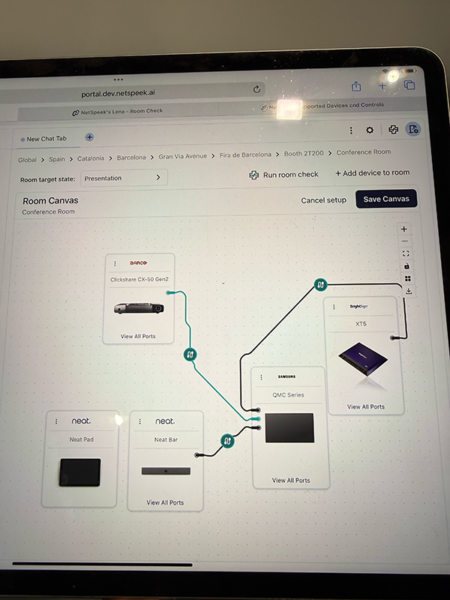
For most AV operations teams, support still revolves around reacting to problems after users report them. A room fails, a ticket is submitted, and technicians begin diagnosing the issue remotely or on site.
Netspeek’s ISE 2026 demonstrations suggested a different model: one where rooms are continuously evaluated, problems are identified automatically, and users are guided through solutions in real time.
At the center of this approach is Lena, Netspeek’s AI-powered troubleshooting and operations assistant.
Room Check and Personas
One of the most compelling features on display was Netspeek’s “Room Check” capability, supported by configurable room personas.
Instead of treating every space the same, Netspeek enables organizations to define how different room types should behave. A boardroom, training space, huddle room, and broadcast studio each have distinct technical and operational requirements. Room personas allow Lena to understand those differences.
When a Room Check is triggered, the system evaluates:
- Device connectivity
- Signal paths
- Peripheral status
- Network conditions
- Configuration alignment
If an issue is detected, Lena can automatically attempt corrective actions or guide the user through the fix. For operations managers, this represents a major shift from static monitoring toward adaptive, context-aware diagnostics.
Natural Language Troubleshooting in Practice
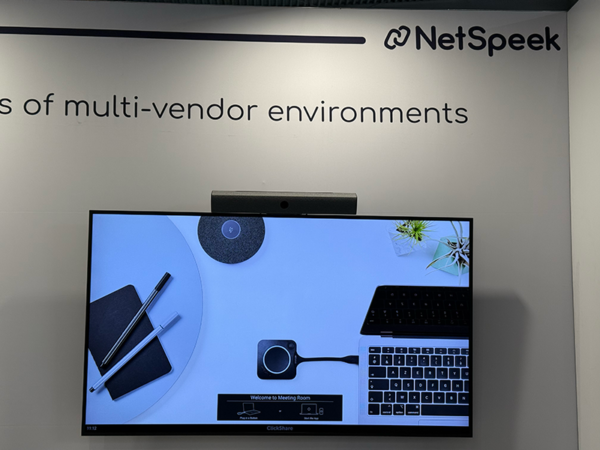
Lena’s natural language interface was another highlight of the Netspeek booth. Rather than navigating complex dashboards or documentation, users can interact with the system conversationally.
During demonstrations, operators and end users asked direct questions about room performance and received actionable responses. This is not limited to generic troubleshooting. Lena is trained to understand AV-specific workflows and terminology, allowing it to function as a specialized support agent.
In one example, a faulty HDMI connection was introduced into the system. Lena identified the issue and presented clear remediation options to the person in the room, without requiring escalation to technical staff.
For AV operations teams, this has direct implications for reducing first-level support volume and empowering users to resolve basic issues independently.
Knowledge Access and Embedded Documentation
Another practical capability demonstrated at ISE was Lena’s access to system documentation and configuration data. The platform can surface information typically buried in manuals, setup guides, and internal knowledge bases.
Instead of searching PDFs or internal wikis, technicians and users can ask Lena for relevant instructions or specifications. This shortens resolution times and reduces reliance on institutional knowledge that often resides with a few senior staff members.
By centralizing operational knowledge inside the AI layer, Netspeek addresses one of the most persistent challenges in enterprise AV: knowledge continuity.
Moving Toward Persistent Intelligence
Netspeek also previewed upcoming enhancements that will give Lena persistent memory capabilities, scheduled for release later in 2026.
With memory enabled, Lena will be able to:
- Retain historical context about rooms and systems
- Learn from past incidents and resolutions
- Adapt recommendations over time
- Build profiles of recurring issues
For operations managers, this means troubleshooting becomes progressively more accurate and less repetitive. Instead of treating each incident as isolated, the platform develops institutional memory.
This evolution positions Lena as more than a chatbot. It becomes an operational intelligence layer embedded within the AV environment.
Log Analysis and Service Integration
Looking ahead, Netspeek outlined plans to enable automated download and interpretation of system logs from connected devices. This capability is expected to integrate with enterprise service platforms such as ServiceNow.
Once implemented, this will allow Lena to:
- Collect diagnostic logs automatically
- Analyze fault patterns
- Attach structured data to service tickets
- Recommend remediation steps before escalation
For large organizations, this integration is significant. It connects AV operations directly into broader IT service management workflows, supporting unified reporting, compliance, and incident tracking.
Rather than operating as a siloed support function, AV becomes part of the enterprise service ecosystem.
Why This Matters for AV Operations Managers
Netspeek’s ISE 2026 showcase stood out because it focused on day-to-day operational realities rather than abstract innovation.
For AV operations leaders, the platform addresses several persistent pain points:
- High ticket volumes driven by simple issues
- Limited visibility into room health
- Dependence on senior technicians
- Inconsistent documentation access
- Slow escalation workflows
By combining room personas, AI diagnostics, conversational interfaces, and service integration, Netspeek is building a system designed to reduce operational friction.
The emphasis is not on replacing technicians, but on amplifying their effectiveness. Routine issues are handled automatically or with guided assistance, allowing staff to focus on higher-value work.
From Monitoring Tool to Operations Platform
Traditionally, AV monitoring platforms have focused on alerting: something breaks, and the system notifies support. Netspeek’s approach extends far beyond that model.
At ISE 2026, the company demonstrated how AI can move AV management toward:
- Preventive maintenance
- Self-healing environments
- User-assisted remediation
- Knowledge-driven support
- Integrated service workflows
This represents a shift from passive monitoring to active operations management.
Looking Ahead
Netspeek’s ISE 2026 presentation offered a glimpse into how AI-driven AV support may function in mature enterprise environments. With memory, log analysis, and service platform integration on the roadmap, the company is building toward a comprehensive operational intelligence system.
For organizations managing large room portfolios, hybrid work environments, and distributed campuses, this approach aligns with growing expectations for reliability and responsiveness.
More importantly, it reflects a practical application of AI focused on measurable outcomes: fewer disruptions, faster fixes, and more efficient support teams.
At ISE 2026, Netspeek did more than talk about artificial intelligence. It showed how AI can be embedded into everyday AV operations in ways that directly improve performance. That is what made this showcase stand out. And why it truly deserved the “wow” reaction.
To see all of AVNation’s ISE 2026 coverage, visit our dedicated page.

Tim Albright is the founder of AVNation and is the driving force behind the AVNation network. He carries the InfoComm CTS, a B.S. from Greenville College and is pursuing an M.S. in Mass Communications from Southern Illinois University at Edwardsville. When not steering the AVNation ship, Tim has spent his career designing systems for churches both large and small, Fortune 500 companies, and education facilities.
- Tim Albright
- Tim Albright

- Tim Albright
- Tim Albright