Category: Perspectives

  • My AVFitness Journey

    My AVFitness Journey

    From Big Dumb American to 75Hard acolyte  

    I don’t want to write this. I really don’t. But, if one person out there that needs a push can benefit, here you go.  

     My heaviest weight was 307 pounds. That’s a big boy right there. Obese doesn’t even begin to describe it. The BMI (body mass index) of 40 or greater is classified as “morbidly obese”. That was me. BMI of 44. Yup. 44. I was unhappy. No, I was miserable but not motivated to change. I had dress shirts with a 20 inch neck and jackets of 52 regular that fit me just fine. And, I didn’t look horrible in those dress clothes. But I felt horrible. 

     I like food; bad food and good drink. Or maybe it’s the other way. I’m not going to get into the why’s of how I got that big. In reality, they are slightly relevant, just not right now. I was a fat guy and didn’t want to be. So how did I finally decide to get off my backside and head down a different road?  

    There was no light switch moment. I know some who’ve had that, it just isn’t my story. This change was at least two years in the making. Most likely, it needed to be that way. I was flying to the UK and was in one of those “I’m too big to fly” moods. It happens when you have to ask for the seatbelt extension. Flying is generally enjoyable for me, even that big. It gives me time to think, read, and catch up on movies. This particular flight I had bookmarked for a Penn Jillette book called Presto. It was Jillette’s story of his own weight loss.  

     Presto is not a diet book. Nor is it a guide to “how you too can lose weight.” In fact, the magician goes to great pains to explain how his lawyers want you to know that Mr. Jillette is NOT a dietician. Well, duh. However, the one comment that Penn made that has still stuck with me involved a very personal choice. Penn Jillette was fat, pushing 60, and was sick. So sick, in fact, that his doctor recommended gastric bypass surgery as a way to get his weight to a healthy level. (side note: this is not a commentary on this surgery, if it works for you that’s great) Jillette writes that he wanted to give losing weight on his own a swing. If his doctors were willing to do something as crazy as cutting him open and performing surgery to lose weight, he could try something equally as crazy 

    Off I set to try my own crazy. At first I did follow Jillette’s program which is basically vegan/vegetarian. I couldn’t follow it but did cut back on the carbs and most meats. And then the world came to a screeching halt. March and April of 2020 were some of the most difficult for all of us; emotionally and financially. Back on came the weight I had worked to take off and then some.  

    Around the end of June my doctor says I’m borderline high blood pressure and am pushing some other health issues. Between my weight, my age (46) and other factors I was a prime candidate to not only catch COVID but not make it through. It was the final push I needed.   

    At first I focused on sweating. I walked every day for 45 minutes. When my local gym opened back up I switched to elliptical for an hour. My heart rate was my main goal, trying to keep it within the fat burning zone for my age. After doing this for two months I was down about 15 pounds. It was respectable, consistent, and safe. But then Chris Neto does what he regularly does to me; turns it up to 11. 

     Chris had also been quietly working out as well and for many of the same reasons. During these workouts he’d listen to podcasts and one he hit on was by Andy FrisellaFrisella is the CEO of 1st Phorm supplements and Supplement Superstore. Come to find out, he’s in my backyard of St. Louis. During one of Andy’s podcasts he lays out a new challenge, a program, for mental toughness called 75 Hard. Here are the basic pieces 

    Tim Albright 75 Hard
    Tim Albright 75 Hard

    Two 45 workouts per day (one has to be outdoors) 

    1. Drink a gallon of water daily 
    1. Pick a diet and stick to it (no cheat meals/cheat days) 
    1. No alcohol 
    1. Read 10 pages of a non-fiction book, preferably self-improvement 
    1. Take a progressive pic – this not only keeps you honest with yourself you will also be glad you did as you’re able to watch the transformation 

     These daily tasks for 75 consecutive days. No days off, no rest days, no nothing. This for 75 days. If you miss something on a day you start over. And I did it. Now, if you work out twice daily and eat cleanly for 75 days you’re going to lose weight but that wasn’t the point. It was about building mental toughness. To sit down and say “ok, what HAS to be done today to be successful”. And it got done.  

     For those who ask about extremeness or excessiveness I go back to Penn’s quote. Doctors were willing to do something as crazy as cut him open to help him lose weight, I can work out two-a-days for a couple of months.  

     As I write this I’ve gone back into the 75 Hard world. Frisella has three additional phases. Each one is 30 days and includes various other tasks. I did not make it all the way through Phase 1 but I am going back to it. These last six months has taught me more about myself, my weakness, and my strengths.  

     The final tally of the tape is 70 pounds lost to date. My waist went from 52 to 42 and neck from 20 to 16. What’s most important is the mindset I’ve gained. I’ve developed both mental and physical habits. You do anything for two and a half months and you’ll miss it once you don’t. Whether it’s the workouts or even the eating, they have become part of my daily routine. The other is the personal accountability. When you’re in this for your own betterment you don’t lie to yourself, there’s no point, nothing to gain. Learning that health is a journey that is never over is huge. It’s a mind shift for me. If you can grab onto that idea, it can be a life changer for you as well.  

     I’ve had people tell me I’m inspirational or brave. Those are very kind words and I appreciate them. We all get inspiration from others and if my story can help someone else out, take what you need and move forward. 

    Albright family beach
    Albright family beach

    So, here I am and here I go. At 46 years old, my mid-life crisis was weight loss, mental toughness, and a transformation that I’ve just begun to uncover.  It’s certainly cheaper than a Corvette. My advice to anyone looking to make a life change is to truly take it one day at a time. Set your goal, your dream, and figure out what must happen daily for you to achieve that goal. It’s what we consistently do that adds up to the ultimate transformation for which we are reaching.  

  • To Build or To Buy? Deciding on Your Signage Network’s Operating Software

    To Build or To Buy? Deciding on Your Signage Network’s Operating Software

    Digital Signage software solutions as a service or purchase

    Author: Eric Lamb

    Eric Lamb Vistar
    Eric Lamb Vistar

    To build or to buy? When it comes to business-critical software, this is a decision that many companies face and we see this consideration come up frequently with digital signage networks.

    Imagine that you’re in need of a new home. You have two options:

    1. You can buy a house that is already built, choosing the one that best matches your list of requirements.
    2. You can build a house from the ground up, designing every aspect from scratch to exactly fit your needs.

    While the benefits of building a completely customized home may sound enticing, the strain on time, money and resources makes that impossible for most and impractical for many. The concept is similar when thinking about your digital signage.

    When evaluating the decision of whether to invest in developing in-house software or partnering with an outside provider, there are a few key factors to consider – cost, control, maintenance and innovation.

    Cost

    Robust infrastructure comes at a price, whether it’s from hiring a team of engineers to build your software or licensing it from a provider. Just like building a house, developing software from the ground up it typically comes with many unforeseen or hidden costs.

    When buying, you have more say over the price. However, it’s important to do your research as many providers have hidden costs such as onboarding fees. Prices vary based on network size and the sophistication of the software. It’s worth investing in a software that can grow with your network and support things like advertising that you might not need today but will be beneficial to your business in the future.

    Control

    It’s important to ensure that any partner you may be evaluating will still provide you full control over your network operations and content management. If your signage network plans to monetize through advertising, you’ll need to select inventory for sale, manage direct and programmatic sales, and reserve dedicated spots all from one simplified platform. Custom alerts and user restrictions can provide confidence that your network is running efficiently.

    Maintenance

    As your network grows, changes will need to be made to your infrastructure as well. If you’re considering in-house building, make sure to dedicate budget and resources for maintenance as well as continuity. Too many networks suffer from poorly maintained code-bases that were developed years ago by an employee that has since left the company!

    When considering partners, you’ll want to validate that they have a dedicated team of engineers working on updates and improvements to ensure your software is up to date with the latest technology. One of the biggest reasons to work with a vendor is that you benefit from the improvements they make the platform, even if you didn’t ask for them.

    When it comes to maintenance, you’ll need to be able to seamlessly roll out changes across your network. You’ll want to look for a partner that offers web-based diagnostics, meaning you can register, configure, monitor and upgrade players remotely.

    Innovation

    As an operator, you shouldn’t have to dedicate significant time to maintaining your basic infrastructure. Too many operators spend their time managing servers, building basic ad serving functionality and generally re-inventing the wheel. Instead, your focus should be on what makes your network special, draws the attention of consumers and is appealing to buyers.

    Your technology should empower you to customize and control the on-screen experience – build custom apps for anything ranging from transit updates to weather notifications, all based on web-standard technology (HTML, JavaScript, CSS).

    If your company’s core competency isn’t building software then buying software that is designed to handle your network of the future is the best solution for you. Work with a provider who has a team in place to update and maintain your infrastructure and give you the flexibility to manage and customize your network to meet your needs.

    Vistar Media’s solutions will be showcased at The Digital Signage Event on March 4, 2021.  

    Click here to register.

  • A Heartfelt Thank You to the AV Community

    A Heartfelt Thank You to the AV Community

    An Open Letter to the AV Industry

    by: Joe Way, PhD, CTS

    Growing up with very little, I found that as the years went on, I began to value the physical
    blessings, job titles, and recognitions I earned more than just about anything. I became
    someone who believed my worth lied in my accomplishments. I mean, that is how you prove
    you have “made it,” right? I didn’t seek to keep up with the Joneses, I wanted the Joneses to try
    to keep up with me. Plainly and simply, I have always loved the rush that comes with starting
    something new—whether it be a business, job, or organization—and then becoming one of the
    single best at it. I hate failure; and to me, the more “things” I could collect meant the less times
    I had failed.

    On December 15, 2020, one of the most devastating things happened to me and my family. We
    lost our home, three cars, and nearly all our earthly possessions to an electrical house fire. One
    minute I’m returning business emails and recording a podcast episode, the next I’m watching
    my garage all but disappear in flames within the span of a three-minute call to 911. Adding to
    the pain, the fire spread to our neighbor’s home; they too were deemed a total loss. Yet, we
    thank God we all got out safely… including the pets. Even still, over a month and a half later, I
    feel pain when I think about the “things” that are no more, just as if the fire had happened
    yesterday.

    C.S. Lewis wrote that “when we lose one blessing, another is often most unexpectedly given in
    its place” (1967). That which I lost was not replaced (at least not yet), and while my life and
    comfort were both heavily displaced, I discovered a fresh new feeling of security and hope from
    a very unanticipated place. You.

    Yes, you.

    While it may not be apparent to many people because of my very public persona, I am actually
    quite the loner. I’d much rather be passively observing. I am a conflict avoider. My safe space is
    by myself. And therefore, when I lost it all, I had nowhere to hide. I was exposed, lost, scared. I
    felt something I hadn’t in a long time… vulnerable. But, I did what I was supposed to as the
    leader of the household; I put on the fake smile and took many deep breathes behind the
    scenes in order to appear strong for my family. Deep inside, well, that was a different story… I
    was—and honestly still am—weak. My faith in the Lord propelled me, it guided me, it became
    my rock, but something very unforeseen inspired me. You.

    Yes, you.

    Just hours after checking into a hotel for the night, a call came in from the front desk. “You have
    a delivery.” “Thanks, I’ll be right down.” No sooner than returning to my hotel room with the
    beautifully wrapped package of wine and gift card for dinner, the phone rang once again. “Dr.
    Way, you have another package here at the front de… actually you have two more.” Somehow,
    someway, people were finding out where we were staying and sprang into action. The texts,
    emails, calls, and Tweets began to flood in. At the time, I was in no shape—physically, mentally,
    or emotionally—to answer the calls or respond to each notification. However, with each new
    ding on my phone, I knew more and more, things are going to be ok. Somehow, someday,
    things are going to be ok. The next morning, we woke up to meet the insurance adjuster at our
    house; by the time we returned to the hotel after lunch, there was that familiar red flashing
    light on the late 90’s corded phone. “Good afternoon, we have some deliveries here for you.”
    “Ok, I’ll be right down.” “You’re going to need a few trips. We can just let you borrow a valet
    cart if you want.” I return to the room with box after box, envelope after envelope. And then in
    one moment of rush, I cried. Amy cried. We cried. And I knew everything would be ok because
    of selfless acts of love and compassion from the most unexpected of places. You.

    Yes, you.

    As we sat down to start going through all the deliveries Amy asks, “who are all these from?”
    These are from my colleagues at this university, and that university. These are from some of my
    vendors. These are from people I know from my Sunday morning Twitter conversations. And
    then, there’s this one: “Hi Joe. I am praying for you and your family. You don’t know me, but I
    listen to your podcast every week. I heard what happened to you, and felt I needed to do
    something. You have changed my life and helped me in my career. I want you to know we are
    all here for you and are praying for you. God bless you and your family; I hope you come out
    stronger in the end.” Enter… tears. Enter… silence. Indeed, we are stronger, and getting
    stronger every day. And that is only because of the answered prayers for strength that have
    come from the most humbling of places. You.

    Yes, you.

    And then it happened. The GoFundMe. The moment I would forever believe in the hope of
    humanity and know the “community” of AV people we often talk about is more than just a
    community, it is a refuge. It was not the act so much of setting it up (which I am indeed
    extremely thankful but would be way too shy and probably too proud to have done myself), but
    of all the selfless acts of over 250 people wanting to make a difference for me and my family.
    And another hundred who wanted to do something privately. Many I knew well; some I have
    never met. Articles were written throughout our various industry publications, podcast
    episodes were dedicated, and shoutouts came from everywhere. My family was flooded with
    messages of hope, prayers for peace and safety, gracious warmth, and… love. Throughout my
    entire life, I can honestly say, I have never felt so cared for. At a time when I didn’t know what I
    needed, you took the initiative to act… That should tell us all we ever need to know about you.

    Yes, you.

    The phrase, “I can’t thank you enough,” just doesn’t sound like, well, enough. What do I do
    now? How do I say thank you to an entire industry? How do I begin to repay you even in the
    slightest? Where do I begin? In his second book of poetry, John Bunyan wrote: “You have not
    lived today until you have done something for someone who can never repay you” (1684). The
    sentiment in that quote never felt so true, so impactful, so profound, until I was on the
    receiving end it. When we perform even the smallest deeds out of selfless compassion for
    others, life change happens. When we turn toward others in their time of need, life change
    happens. When we say through our actions, “everything is going to be ok, we’re here for you,”
    life change happens. Lives are restored, renewed, and revived. Lives get back on track, dig
    themselves out of the rubble, and stand strong in faith-filled confidence. My life was changed
    because of you.

    Yes, you.

    If there’s a lesson to learn, it’s more than you are all awesome. That’s a given. If there’s a lesson
    to learn, it’s more than a testament to the fact that our people are here to help when the need
    arises and tragedy strikes. That’s a given. If there’s a lesson to learn, it is this… We are as strong
    as we stay united and as weak as we allow others to fall apart. When we come together as an
    industry, we can accomplish great things. I know that. I… felt… that. I pray that the response to
    my tragedy was just the tip of the iceberg to the power of what can be realized when we
    recognize we are all in this together. My life was changed. Now it is time to change everyone
    else’s, especially those who do not share the same spotlight I have been blessed to fill.

    I pray we seek those in our industry who are suffering in the shadows due to any number of
    reasons from natural disasters and personal tragedies of their own, to mental and physical
    health, to financial difficulty caused by the pandemic slowing in our industry. I pray that 2021
    be the year we turn misfortune into blessing and pain into faith. I vow that moving forward my
    platform will be used as a place of community, support, learning, and comfort for everyone in
    the AV industry. It will start with me, and all because of you.

    Yes, me. Yes, you.

    Joe Way, PhD, CTS, is the Director of Learning Environments at the University of Southern California, in Los Angeles, CA and AV Nation 2019 AV Professional of the Year. He is the host and editor-in-chief of the Higher Ed AV podcast and digital magazine, and serves as the co-founder and acting chair of the Higher Education Technology Managers Alliance (HETMA.org), aimed at connecting the higher ed tech manager community and advocating for their common audiovisual needs. He is the author of the bestselling book, Producing Worship: A Theology of Church Technical Arts, is a regular contributor to leading AV-industry media outlets and podcasts, and serves on the AVIXA Tech Managers and Diversity Councils. Joe is an Orange County, CA, native with over 25 years’ experience in education, technical production and the arts, and organizational leadership and management. Over his career, Dr. Way has received diverse awards in the areas of education, the arts, and business, and is a regular keynote speaker and writer for AV-industry and higher ed conferences and media outlets.

  • Shure pro audio roundtable: Continued creativity and innovation will drive 2021 music business

    Shure pro audio roundtable: Continued creativity and innovation will drive 2021 music business

    CHICAGO – The professional audio industry spent much of last year pivoting and adapting to the current state of live events. From live-stream concerts to pre-taped performances in artists’ bedrooms, the entire industry was forced to adjust to a new way of working.

    To bring the industry together, Shure gathered an all-star panel of guests to offer their own perspective on how the current situation has impacted their professional lives and day-to-day reality. The 90-minute roundtable chat offered unique viewpoints from bands, venues, music labels, and more, including Julie Weir (Sony Records UK, Music for Nations), Adam Thurston (Audiotree, Lincoln Hall, Schubas in Chicago), Glen Rowe (KYOTO Music, Muse), Taylor Goldsmith and Griffin Goldsmith (Dawes), Greg Morrow (Session Drummer), and John Harris (Mixing Engineer).

    Moderated by Peter James, Vice President of Global Professional Audio Sales at Shure, the discussion touched upon the positives of 2020 and the steps the industry needs to take to re-open again.

     A Pro Audio Renaissance

    Regardless of profession, all panelists agreed that there’s been a rebirth of creativity. From writing sessions over Zoom to recording new music to developing platforms to consume the content, the industry has never been more creative.

    “People are really desperate for new music,” said Julie Weir of Sony Records. “We had a top ten record in the UK with a heavy metal band because we did an interesting campaign that was all digital and people engaged with. It has taken longer to do smaller things, but I’ve never been more creative because you talk to more people now and there is more collaboration coming through because artists are open to thinking outside the box.”

     While live events with large audiences may have slowed down, the creativity hasn’t stopped.

    “Around May and June, studio work picked up a bit,” noted Griffin Goldsmith of Dawes. “Then it was really busy. Everyone is making records because we can’t tour right now, and people are finding ways to be creative. It’s definitely inspired some pretty awesome music.”

    The shutdown of live events gave many industry professionals a much-needed break from constant touring or moving from job to job. It gave people time to take a moment to breathe and re-evaluate their goals.

    “You don’t want to be complacent and you don’t want to be lazy,” commented Greg Morrow, a session drummer. “I’ve reestablished relationships that I had with people many years ago who I haven’t connected with in a long time. These relationships have come around again because people understand you can work from home.”

    One thing is for certain: technology enabled everyone to get creative. In the beginning, manufacturers couldn’t keep audio products in stock long enough for people to outfit their home studios. Technology enabled anyone to collaborate musically from remote locations.

    “Artists don’t want to come to the studio in-person,” said John Harris, a mixing engineer. “In some cases, studio engineers have sent remote facilities to the artists so when they put on headphones, they can speak with the studio engineers as if they are right there and are able to carry on their craft. If we can establish a good way to do live TV and music performances remotely, are companies going to want to pay to fly out 25 people for one performance?”

    Hybrid Shows May Be Part Of The Near Future

    Live events will not look the same when venues are cleared to open. The crew responsible for helping concerts run smoothly might have already found new jobs in different industries, which is a concern to many.

    “The big worry is not just live events in general but the live ecosystem and the people who work in the live events: the tour managers and tour bus companies,” noted Weir. “There is maybe 20 percent of people left in the industry because people had to get other jobs. There is not going to be enough people to go around. When we get back into it, a minimum crew is what our issue is going to be.”

    There will likely be an audience capacity limit at live shows. Coupled with people out of work, industry professionals need to come together and create an economy around a new way of working. A hybrid of live shows also streamed online could be an interim solution.

    “Nothing is ever going to replace being at a show,” remarked Adam Thurston of Audio Tree. “Live streaming will not replace that, but it will introduce more music to people. Most people don’t live within a hundred or two hundred miles of a music venue, so having a way to present good-quality content for people to watch in the comfort of their own home will have a lot of people interested now and in the future.”

    In some countries this has already happened. Major concerts have been broadcast to people in cinema where they can still experience high-quality audio. This interim period enables record labels, management companies, and bands an opportunity to think of new ways to offer exclusive content to loyal fans.

    “The music business will come back better than ever,” noted Thurston. “Everyone will want to get back. There will be new ways of innovation, other ways to consume music, and additional revenue streams. The traditional touring business will evolve and there will be more music out to more people.”

    As we embark on 2021, there will be a continuous demand for unique music content across different platforms as the industry begins to transition back to live events. Together, the pro audio community will prevail. For more insightful and uplifting anecdotes from the panel discussion, click here to watch a recorded version of Sounding Board.

  • Diversification of Disciplines Among Convergence

    Diversification of Disciplines Among Convergence

    AV and IT combine for more options, opinions

    By: USAV Group

    The idea of convergence between commercial A/V and IT industries is in the past; It is now a reality here to stay. Around the corner is the adoption of physical security which we see nudging its way further into the Venn diagram overlap. With A/V and security moving to a network-based infrastructure, both industries need to be quick to adopt foundational levels of IT solutions and technologies to accommodate the digital transformation age. However, the differences between the security and A/V disciplines are far enough apart that the growth of convergence in these two areas has been slower.

    Historically, A/V and security have not had much crossover in their businesses due to several factors. Both industries have had robust economies for many years and there simply wasn’t the need for one to explore the other. In the commercial space, the security integrator typically works with the property management company or building owner while the A/V integrator focuses on the individual tenants.

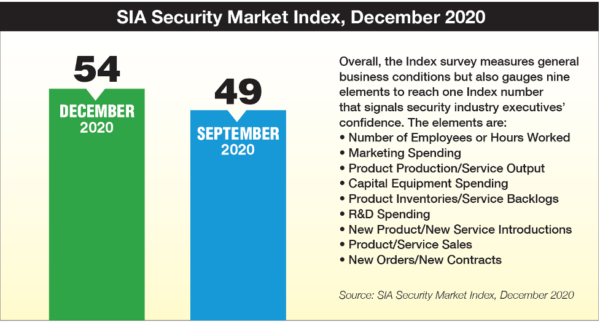
    2020 catapulted physical security to the front of the line for all technology solutions providers and industries. Deemed “essential,” the security industry had a brighter spotlight, but the industry experienced its own set of headwinds resulting from the 2020 COVID-19 economic hit. According to the Security Industry Association (SIA), the security industry outlook is turning favorably based on the Security Market Index. An index above 50 indicates that conditions within the industry are largely positive and that security professionals are predominantly confident in their business outlooks.


    USAV diversified chart
    USAV diversified chart

    The 2020 COVID-19 experience encouraged end-users to re-think their needs resulting in technology integrators having to diversify solutions. The reality of business as usual was turned upside down and businesses witnessed projects canceled and new work put on hold or delayed. The need for universal safety protocols in both public and private spaces of buildings created a unique environment where technology integrators were trying to solve the same problems.

    The demand shift from end-users came in the forms of thermal scanning, command and control centers, crowd intelligence and remote monitoring. These different offerings were easy to adapt for some but left others trying to wrap their heads around how to pivot and change, or wondering if this trend will fizzle and fade.

    Peeling back the layers of A/V and physical security, what are the commonalities? This may be oversimplified, but the top three operational similarities boil down to:

    • Solutions are installed systems that live on customer premises throughout the world
    • For the most part, technologies are low voltage cabling with a head-end and some endpoints
    • The sales, engineering and operations processes are largely the same (with a few differences) and the result is a system that works 24 hours a day, seven days a week, 52 weeks a year

    Thermal Scanning

    At times, the customer contact in an organization is different for security and A/V professionals. Many tenants within professional buildings are requiring temperature scanning. Regardless of who the customer contact is, the tenant or building owner, this crossover opportunity brings the technologies of temperature scanning devices, digital signage, professional furniture and other A/V related products together. The demand for these solutions may increase as corporations around the world begin their “return to office” plans.

    Command and Control Centers

    Command and control centers historically had a clear delineation between A/V and security. A/V would cover the panels, controls, furniture, lighting, etc., while security would provide content from their servers. The delineation is blurring as both “ends” bend toward the middle and security is no longer providing most of the content. New systems are being displayed in centers that are not necessarily related to either security or A/V, such as mapping, social media news feeds, custom applications specific to the client or broadcast news feeds.

    The demand for these centers increases as the number of video feed sources increases. What used to be state and local government requirements are now branching out into various corporate and other campus verticals.

    Crowd intelligence

    Crowd intelligence has been an emerging technology for several years.  As new artificial intelligence (AI) protocols and algorithms are developed (many specifically related to COVID-19) the pace of development has increased dramatically. Most states in the US have specific rules in place for capacity in hotels, restaurants, gyms, houses of worship, etc. As health and safety levels change, so do the capacity limitations within workspaces, restaurants, bars and other venues. New crowd intelligence platforms are able to adjust and adapt to these changes and provide real-time alerts to both occupants and system managers.

    Remote Monitoring

    Often, crowd intelligence systems may need to be monitored in real-time. Remote video monitoring centers or on-premises command centers have the ability to monitor and interact with locations around the world. Two-way audio is utilized to communicate directly with the remote locations, providing critical and time-sensitive instructions.

    These are just a few examples of the diversification of disciplines occurring within the A/V, IT and physical security industries. This is important as today’s customers are used to increasingly sophisticated, yet simple interactions with technology. They are demanding a unified and simplified user experience that gives them more control yet remains easy to use. Technology solutions providers are uniquely positioned to provide these solutions.

  • HDMI Cabling and the Veil of Fog

    HDMI Cabling and the Veil of Fog

    Drilling down to the HDMI cable’s physical layer will bring quick resolution to AV performance testing

    Ariel Marcus,  CTO MSolutions

    The transition to HDMI 2.0 was overwhelmingly driven by the urge to support higher resolution signals up to Ultra HD HDR. Even with popular consumer systems like Apple TV passing Ultra HD HDR (4K HDR 4:4:4, 600 Megapixels flow rate over 18Gbps bandwidth), many cables on the market today are still limited to 1080p and 4K 4:2:0. On short transmissions, the viewer might still receive and see an Ultra HD HDR using these connections, but this will fail on longer runs.

    In any scenario, a quick 10-to-20 second test will generally help determine the capabilities to carry HDMI 2.0/1.4/1.2 signals over each connection. The kind of tests you run will make a big difference as to how quickly the problems are solved, if at all.

    Which Path To Take

     There are a number of testing options on the market today, though many fall short when it comes to HDMI testing. Most HDMI testers focus on pattern testing versus physical layer testing. These pattern-oriented devices understand how to read a video stream, and run through a loop with the HDMI cable from transmission to receipt. These provide an appropriate comparison of the pixel levels through the loop, and confirm that the cables can carry HDMI 2.0.

    This provides value to a degree, but these are any additional physical layers in the mix that can adversely affect signal integrity. The wiring inside the HDMI cable have a remarkable influence. In the short term, the video activated and transmitted through the cable will work fine, and the image will appear exact, even if there is damage on or underneath the shielding.

    Testing the cable itself will identify these more advanced issues. HDMI cables have 19 standard conductors for video, audio, Ethernet and data moving over twisted pairs of wiring inside the cable. Each of these cables should be shielded to maximize performance, which represents a 20th conductor. Most installers today use an HDMI pattern generator, which will provide return information that often suggests all 19 conductors are functioning properly.

    For temporary short-duration runs, the signals may pass just fine even if there are issues with some of the conductors. The problems visibly surface on permanent runs, and/or if there is a continuous signal moving through shorter cables for hours. For example, a 24/7-hour system with internal conductor shortcomings will gradually leak outside the wiring. This will inevitably cause signal degradation and ultimately affect performance.

    DC resistance is another common issue related to HDMI performance. This represents the actual resistance of the wire, and how it affects the ability of the twisted pair to correctly pass video signals. Higher resistance can support lower resolutions, such as Full HD (1080p, 148 Megapixels at 3Gbps) or Ultra HD (4K 4:2:0, 297 Megapixels at 9Gpbs of bandwidth).

    The higher the resistance, the greater likelihood of interference between the twisted pairs underneath the shielding. That interference will lead to unbalanced signals during the transmission process. This is where the ability to access information from the TMDS clock, which synchronizes these signals over the HDMI twisted pair connections, becomes invaluable.

    The TMDS Clock that can provide these physical readings is not accessible through a standard HDMI pattern generator, which can only transmit and receive the pattern and demonstrate if the data passed correctly. There is no way to determine the level of resistance in the twisted pair connection, and how that relates to HDMI performance and whether the cable can transmit the video signal according to the required bandwidth.

    Instead, it requires a testing device that can perform more granular physical layer test functions. This begins with sending a low or high current through the wires. This will create heating and draw power over the wire that will change its characteristics. Over a 15-second span, the internal artifacts and effects of this test function will draw the performance readings from the TMDS clock, including the DC resistance levels.

    There is no question that testing with an HDMI pattern generator will affect the overall depth and integrity of test. HDMI transmitters and receivers use equalization for error correction to improve the HDMI transmission. Not all the HDMI transmitters/receivers use the same equalization, which means that testing high-bandwidth HDMI signals with a pattern generator will often hide issues caused by the cable’s physical layer and associated wiring quality.

    Cable Design Characteristics

     The HDMI cable’s architecture is defined by pin-to-pin connectivity. As referenced above, this architecture includes 19 contacts on each side of the connectivity (20 if adding the shield). Depending on the manufacturer, there will often be differences to the underlying twisted pair design. Some manufacturers that are seeking to reduce costs are reducing some of the less pertinent copper conductors, such as the CEC wires or the TMDS shields.

    Other manufacturers are working hard to improve the cables by connecting the TMDS shield to the cable GND pin17, without connecting to the cable shield. The thinking behind it is that it will increase the immunity.

    Another approach some manufacturers take is to connect twisted pairs shield to the cable GND, pin 17, and the cable shield, in an effort to increase the immunity from interference. This actually increases the problem, as interference from outside the cable – such as from a nearby electrical wire – is more likely to be injected into the HDM video stream. This will result in an immediate video drop.

    It is important to remember that according to the HDMI standard, each TMDS twisted pair should include the dedicated shield contact – pins 2, 5, 8 and 11 in the HDMI cable – to optimize immunity. Each twisted pair therefore has three lines: data plus, data minus, and shield.

    Only point-to-point, pin-to-pin connectivity designs for each conductor will minimize interference. Yet these differences in HDMI cable design characteristics (as well as category network cables for AV over IP systems) mean that installers will come across varied performance results based on which cables are used in the AV system. This requires a test device that can determine the connectivity approach under the shield, detect the presence or absence of each conductor, and understand how the architecture affects the performance – again, something that simply does not exist in a standard HDMI pattern generator.

    Modular Connections

    All of the above can create a complicated situation for end users that have no way to reliably troubleshoot the connections. Perhaps the systems integrator installed the system and verified integrity through a pattern generator, and everything checked out.

    Perhaps the system remained dormant over a holiday week, between school semesters, or sadly over long periods of office closure due to the pandemic. The moment the system was turned with the goal of passing 18Gpbs, the video drops surfaced. There is no HDBaseT extension – just a 3-foot cable connecting the source and sync devices. The HDMI cable simply cannot carry the high-bandwidth content between the two points.

    There is also the issue of overuse. Consider a meeting space where user after user is connecting to an HDMI cable. Most HDMI cables with accommodate up to 500 connections and disconnections, but the possibility of earlier damage certainly exists to do a more consistent flow of different users. Today’s more diverse, portable test devices will help installers verify signal presence and integrity through a variety of key parameters, including:

    • Activation of links to transmit through the cable, even without a source or sink to receive the signal
    • The quality of transmission on the uplink (much higher bandwidth) and downlink
    • Improper terminations or crimps that cause faults through the twisted pair wires

    These and other problems can be identified and fixed on the spot, without the need to bring in a 4K display or projectors to confirm and evaluate the link. Special HDMI test modules are emerging to connect the tester directly to the wire, and return detailed physical layer readings to the handheld or a connected laptop. This allows the tech manager to immediately confirm whether the HDMI cable can reliably carry high-bandwidth signals over the long term by performing tests that transmit the video, verify terminations, and verify cable quality.

    Attaching a professional HDMI and/or DC Resistance module to both ends of the cable will provide instant access to crucial cable-quality data, including:

    • The presence of each of the 19 HDMI-standard conductors, with instant feedback on missing or defective wiring (called an HDMI Swipe Test)
    • HDMI bandwidth requirements for signal carriage (called an HDMI compatibility test)
    • Confirmation if any of the cable’s conductors are shorted or missing
    • Gauge (AWG) measurements for each of the conductors.

    Show Your Work

    A final important consideration is certification. This is something that installers cannot achieve with a common network analyzer, for example. Devices that can immediately offer a report that display the minimum and maximum parameters, provide details on signal degradation and improvement, and what artifacts influenced the transmission provide major benefits to everyone involved.

    Manufacturers’ warranties are further protected through a certification report that verifies the performance of their equipment. Furthermore, if problems arise several months down the road, comparisons of the initial certification can be made with the current measurements to isolate problems and failures. For example, if someone ran electrical wiring for an air conditioner next to the AV system, that can be isolated as an outside interference problem.

    The ability to accurately and thoroughly test each cable’s quality and performance is paramount to long-term viability of a new AV system. Using a modern HDMI test device will better assure the end user that their system can move high-quality, high-resolution signals – including 4K/UHD and HDR – with maximum integrity, while having better insight into a broader array of testing parameters. They can now also more effectively diagnose a greater range of performance issues, and quickly leverage the readings and results to optimize HDMI performance.

  • AI and Digital Signage Brings Business Back Safely

    AI and Digital Signage Brings Business Back Safely

    Utilizing AI for a safe return post-COVID

    Florent Hediard, Director of Marketing at Navori Labs

     The Covid-19 pandemic has had a dramatic impact on retail and QSR operations. There have been countless new sanitary measures put in place, and regulations can vary wildly between countries and regions. Not surprisingly, these regulations are impacting both management and employees, as staff members are reassigned to perform tasks that fall outside their normal duties.

    This might explain why we see so many digital signage screens repurposed and moved near storefronts or at points of entry. In most cases, these screens are meant to inform visitors and promote the use of face masks as people enter the premises.

    As the Covid-19 situation continues, stores and restaurants are investing in new digital signage screens specifically for this purpose. Screens are popping up everywhere to help businesses as they deal with changing health and safety protocols, reminding people to socially distance, and wear masks during their visits.

    Automating visitor access

    The pandemic is forcing businesses to assign more resources to access control duties. Employees are being asked to regulate store traffic by greeting visitors and counting people as they enter and exit the premises. Many employees can end up reassigned depending on the number of entrances to monitor and the level of foot-traffic. This has let businesses to hire additional staff or increase work shifts, leading to higher operating costs and affects profit margins.

    AI-based computer vision technologies and digital signage have become hot commodities during the pandemic. Combined, they provide an efficient and cost-effective way to manage site occupancy and enforce local sanitary rules.

    Computer vision uses hardware (PCs, cameras) and software to scan and count visitors, while digital signage screens deliver live information as people line-up and wait. Screens show the number of people who are currently in the store, and they display the number of people who can enter when occupancy levels permit. Warnings and notices can also be shown when someone approaches an entrance without a face mask or when the maximum number of occupants has been achieved.

    To make each shopper’s wait more pleasant and useful, screens can be programmed to display topical content such as local news or ads featuring on sale items. With computer vision and digital signage handling all visitor access and control duties, staff can resume their normal duties, like assisting shoppers or ringing-in sales.

    Screen Messaging for AV Verticals

    The pandemic has affected everyone both mentally and physically. In many cases, people have been confined for many weeks and are longing for social interaction. These social interactions are welcomed whether in a shopping on the weekend or moving about a corporate or higher ed campus. Just the same, the proper approach to messaging will bring benefits to digital signage across any AV vertical.

    In the Retail and QSR vertical, many consumers have turned to e-commerce for their daily shopping and restaurant take-out/delivery needs, but not everyone is willing to sit and wait for their purchase to be delivered. It’s why people are still driven to go out and shop, as long as they aren’t under a full lock-down or curfew.

    Retailers can leverage digital signage and related technologies to help shoppers complete their errands faster and safer by following these guidelines:

    • Screens clearly indicate product locations on screens near the front of the store.
    • Screens include safety policies and sanitary rules in their content programming.
    • Content uses clean designs that are easy to read with fewer words for clarity.
    • Touch-screens with interactive maps of their stores help shoppers find what they need.

    In corporate or education environments, digital signage and modern communication techniques help staff, visitors and students manage added stress levels. during the pandemic. Integrators and tech managers have increasingly installed screens in common areas and cafeterias to display safety updates and deliver motivational/uplifting content. Some trends we have seemed emerge thematically include:

    • Keeping associates and students informed about the latest sanitary standards and requirements.
    • Promotion of mandated safety protocols and describe proper disinfection techniques.
    • Highlighting best practices within corporate environments.
    • Recognizing employee, faculty or student milestones.
    • Improved engagement with success stories and positive messaging.

    As we look toward a hopeful decline in Covid-19 as we move toward the middle of 2021, we all can benefit from better and more meaningful communication. Digital signage is quickly proving to be more than a simple informational source over the past several months – it has evolved into a platform that has helped businesses safely return from lockdowns, and with a human touch.

    Sidebar: QL Access Control

    Navori Labs released its AI-powered computer vision software, QL Access Control, at the onset of the pandemic. Available as a module within Navori’s latest QL DSS release, the application integrates with security cameras and other technologies for occupancy monitoring. QL Access Control counts visitors and deliver important safety information to visitors, with four integral features that also free staff to perform their traditionally duties:

    • Monitor and count the number of visitors entering and exiting a building from multiple access points.
    • Determine if a visitor is wearing a face mask regardless of its material or pattern.
    • Display visual information in real-time, such as the number of occupants, number of people who can enter
    • Display customized warning if someone isn’t wearing a face mask when interfaced with Navori’s QL powered digital signage screen network.
  • Sharp/NEC looks ahead to Digital Signage in 2021

    Sharp/NEC looks ahead to Digital Signage in 2021

    Digital signage market in 2021

    By Michael Ferrer, Sharp NEC Display Solutions

    The main goal for digital signage has always been to effectively share a message. This will be even more true in 2021 as we continue to deal with the challenges of the pandemic and living in a post-COVID world.

    What we found in 2020 was that businesses needed a way to effectively communicate with customers. They had to pivot – and fast. From big box retailers displaying which cleaning supplies and household products were sold out for the day to restaurants alerting customers when their to-go order was ready, the ability to communicate in real-time became even more critical. But many businesses just weren’t equipped with the technology to implement digital messaging – many resorted to dry erase boards pulled out of the breakroom to communicate with customers. And while it worked in the middle of chaos, a low-tech option is not ideal for an effective customer experience.

    CX has always been central to business success, but the COVID-19 pandemic and ever-evolving safety regulations have drastically changed what “customer experience” means. Digital signage provides businesses with the opportunity to capitalize on the customer experience, pandemic or not.

    For example, rather than having frustrated customers standing in a queue outside a retail establishment or waiting in the lobby for their turn to see the doctor, digital signage helps decrease perceived wait time. Using digital displays, businesses can loop video content, such as promotions, brand assets or even alerts, keeping customers engaged and don’t feel like they are waiting forever.

    In 2021, we will begin to see digital signage act as a virtual concierge of sorts. Businesses will be able to use digital signage to communicate with a customer in lieu of unnecessary face-to-face interaction with an associate. Digital signage will also continue to be a way to educate and inform. As guidance from agencies like the CDC continues to change, the ability for businesses to educate their customers in real-time with important alerts will continue to be crucial in creating a good experience. For example, by integrating technologies with digital displays in an airport or other public transportation setting, monitors or video walls can display COVID-related messaging but switch to flight information as a traveler approaches. In a corporate environment, presentation systems can be programmed to turn on and prioritize the presenter’s laptop when someone enters a conference room.

    Ideally, businesses should look for cost-effective digital displays that are dynamic and flexible to handle a multitude of functions. As customers are able to enter establishments again, displaying scheduled product promotions for specific items, providing wayfinding and entertaining customers with interactive music and video are just a few of the ways digital signage solutions are an investment that pivots with your business.

    Michael Ferrer is National Manager, Solutions Sales and Operations for Sharp NEC Display Solutions. Sharp NEC Display Solutions of America, Inc. is the leading global provider of professional and commercial visual technology and digital signage solutions, owned jointly by Sharp Electronics Corporation and NEC Corporation. Serving a wide variety of markets, the organization’s expertise spans education, digital signage, graphics, healthcare, restaurants, retail, enterprise, entertainment, transportation, and more. For additional information, visit https://www.sharpnecdisplays.us/.


  • Reviewing Kramer Control

    Reviewing Kramer Control

    A simple congratulating approach to AV control

    As someone who used to live in control programming spaces all day, getting into a new system always took a minute. We need to come up with a universal “you are here” point in control systems. Even for configurating systems. The same was true when I entered the Kramer control interface. Once I got into the system and started in the main area, called Manager, I was off to the races.

    Find out more about Kramer Control at AV Network Nation

    I’ve programmed systems with logic flow, writing code, and configurating. Kramer control falls into the configurating column. That doesn’t make it automatically good or bad. Just understanding the requirements before starting is helpful.

    For the purposes of this review and demo I deployed three Kramer SL-240C units into various offices here at AVNation. In those offices we had an Epson PLE20 as well as Sony BluRay players. That way I could test both RS-232 as well as IR control. One of the Epson projectors we also controlled via IP.

    Building Project

    Putting together the control project was simple and straightforward; once you figured out where everything was. In order to start putting the parts and pieces you have to launch “Builder” from the Manager interface. For me, it wasn’t an intuitive experience. Now, one caveat. I did NOT read the manual. At all. The only time I referenced the manual was when I really could not figure out a particular part. Had I RTFM first, it may have gone a bit easier. And, if you don’t know what RTFM means, call your favorite tech support and ask.

    Once inside Builder, the going was easy. Both the projector and player drivers were available. According to Kramer, had they not been available it would take anywhere from 2 days to possibly a week to get one built. An aspect I appreciate in configurator systems is the option to build your own drivers. Kramer control has this. When you add a device you can choose to add your own. This will take you to a Device Driver builder. It’s a nice addition. The Device Driver builder puts Kramer on a professional standing as opposed to other configurators who don’t give you that option.

    Once the “room” was outfitted with devices I went to create the user interface. Creating the user interface is the one area that drove me to the manual. Developing pages inside Kramer control was not intuitive for me personally. In addition, there are limitations in the overall look and feel. I did use the stock graphics. I would recommend creating your own backgrounds, graphics, and buttons and importing them. Making your own will give you a bit more control and creativity.

    An aspect of Kramer control that I’ve only experienced one other time is the copying of completed rooms. You can select an entire “Space” and copy the entire project to a new Space. Once my original room was done I copied it to the other two rooms, adjusting the code for one of the projectors to be controlled over IP. In addition to copying a room you can also make a reference system. The reference system is more than a copy. It’s a copy that continually references the master. In that way, you only have to make one change then all the, classrooms for example, are updated with the new code.

    Rollout Kramer Control

    Kramer control is an IP-based system. The brains were connected to the network and then their individual devices. We did not have a touch panel to control the systems so I launched the computer/web interface. The systems worked consistently well over the course of three days. We powered on and off both projectors and players and created global shutdowns at the end of the day. The ability to control the other rooms from one location was a nice benefit for this test. However, it’s something I would be careful of for large deployments. It’s unwise to give the professor in one lecture hall control over someone else’s room technology.

    Another part of the cloud-based system of Kramer control was the configurator. I hesitate to call it the software because at no time did I download a program. All of the work was done on the Kramer website. Kramer says they prefer Chrome browsers but will also support Firefox. This means a few things. The first is that I can use a Mac (my preference), PC, Chromebook, or Linux machine. It doesn’t matter the hardware as the service lives in the cloud. The second part is the continual backing up of the program. Backing up to the cloud ensures you don’t lose any work. Finally, someone can come up behind you and finish the job without needing your computer. If the files live in the cloud then your co-workers can get access.

    The cloud based approach is a new one for me. There are half dozen other control systems I’ve used and programmed or configured. Leveraging the cloud to not only store but also program within is an advantage. There is no software to keep updated, and a team of programmers can work remotely on the same project. In addition, you don’t have to send a team of techs to a job site. During COVID especially, this is important for keeping your clients and employees safe.

    Overall review of control platform

    As a programmer, the configuration space was straightforward and relatively simple to get comfortable. What wasn’t intuitive I could look up in the manual. As an integrator, the cost is competitive for the hardware and you will certainly save on the costs of programming time. Kramer has several deployments you can talk with to get a sense of how the system holds up over months of use. Kramer control should certainly be in your toolbox of control options.

    Programming/Configurating     – 4 out of 5 stars

    User Interface                         – 3 out of 5 stars

    Control Operations                  – 4 out of 5 stars

  • Thankful for the challenges of 2020

    Thankful for the challenges of 2020

    Tim Albright reflects on the benefits of a challenging year

    Each year we sit back and reflect on what we are thankful for. Megan Dutta from SCN gathers audiovisual industry members to give what they are thankful for as well. I figured I’d expand on my entry. This might come as a bit of a surprise, but I am genuinely thankful for the year 2020. No, I don’t wish the hundreds of thousands who have perished from the COVID-19 virus. The challenges, though, has forced me to rethink, re-invent, and get creative. It’s also forced some interesting mental and physical changes.

    AVNation is blessed to have several media partners, including SCN and Future. In fact, if you haven’t signed up for AV Network Nation December 10, you totally should. With those partnerships, it’s a bit like fren-amies. We do compete for advertising dollars. My general attitude is there is enough for all of us. So, I enjoy co-creating content for the industry and leaving it a better community than I found. In 2020, those advertising dollars did indeed become scarce and there genuinely wasn’t enough for us all. Do make up those losses I had to get creative.

    The need to get creative and re-think your business model and offerings is a great gift. Some people could spend decades just going through the motions with no real challenge or change. This year has given us plenty of those, with triumphs and failures. In mid-April AVNation produced our very first virtual conference. In fact, it was our first two as week one was residential and week two was commercial. Learn From Home was an exercise in our great community coming together. We had some great speakers, instructors, and interactions.

    The summer came and went with some good experiences, including helping AtlasIED launch Atmosphere. I became a meme. Not something I thought I’d ever type. SMH. As the year wore on it became increasingly clear that 2020 was just a warm-up act for 2021. With the pandemic continuing to cause havoc financially and a vaccine not coming soon, we must be prepared for the next 12 to 18 months. That’s where I am most thankful.

    Writing this here in the Fall of 2020, in my office, we’re still here. From a business standpoint it was a challenging year, but we’re still here. There was no DSE, InfoComm, NYDSW, or CEDIA, but we’re still here. We, I, have learned, grown, and evolved. I have generally held that we are not the same people we were five years ago as we grow, adapt, and change. This year has accelerated that to where I can say with confidence, I am not the person I was 12 months ago.

    So, yeah, I’m thankful for the challenges, risks, failures, and wins of 2020. This has taught me valuable lessons about myself, my business, media, and the AV industry. Sitting here on the precipice of 2021 I can confidently say I can’t wait to see what next year has in store. ‘Cause we’re going to handle it.