Category: Perspectives

  • Four Verticals that Need AV Now

    Four Verticals that Need AV Now

    The markets that could use some audiovisual magic

    By Murphy Daley

    The COVID 19 pandemic has people working from home and relying on distance communication.  Remote AV conferencing and collaboration is not new, but the pandemic has brought nearly everyone to use it. 2020 is the year of worldwide disruption.

    It is unsettling. The world is waiting to find out what the new normal is. Who knows what’s next? I hear again and again that it is not possible to know what will come.

    I reject that. There is always a way to move forward. What experiences have we had to help see a way forward? What other technology disruptions have come before? What comparisons can be drawn?

    Where I live in Southern California, the Aerospace industry shaped society. The old folks at the end of my block tell me how they worked at General Dynamics in the 60s making airplanes. Commercial jetliners began service in 1951 and quickly changed just about everything. People could safely travel further and faster than ever before.  Soon packages with necessary goods and legal documents could travel across the world in less than a day. Businesses could transact commerce, sell and seal deals faster than ever before.

    Comparing with that previous disruption, I can see what industries are ready to be changed by the adoption of AV conferencing and begin preparations to serve them with our services and expertise. I see four verticals ready for change.

    Legal

    America’s legal system has adapted to distance communication.

    On April 18, 2020, the governor of New York signed an executive order that allows marriage to legally happen over a video conference. This fall,  Texas and Florida have held jury trials over video conferencing.

    I assisted the Los Angeles county courthouses in California install a digital evidence presentation system in 2019 and these systems were leveraged immediately to accommodate remote conferencing. Each system of courts in every locality in America is re-evaluating their AV infrastructure with an eye toward expansion. There are new demands for using this technology starting this spring. The ease of use, improved scheduling and cost benefits are compelling reasons to adopt this technology.

    Education

    Every level of education is utilizing distance communication. Elementary school classes are sending tablets and laptops home for students to use. Teachers are learning new skills and trying out different methods of teaching. Webcams and ring lights are expected.

    Universities have even more sophisticated setups, partly in an urgent response to keep students. Many students are taking a gap year, and universities must respond to what their customers need.

    Cameras for classrooms and home offices, learning software systems and remote study groups must be incorporated into the university with greater attention than before.

    Healthcare                 

    The pandemic is a healthcare crisis and there is a big healthcare response.

    The years I spent supporting videoconferencing services at America’s largest HMO, I had endless conversations with doctors and administrators despairing how this technology had regulatory restrictions that denied payment for telemedicine services. CMS (the Centers for Medicare& Medicaid) would not reimburse healthcare provided through distance communication. And CMS is the largest single payer of health care. Naturally, this dampened exploration and use of conferencing tools.

    But this is the year things changed: “In response to the COVID-19 pandemic CMS moved swiftly to significantly expand payment for telehealth services” (CMS.gov Aug 3)

    Many kinds of health care are perfect for Telemedicine. Pandemic aside, America’s aging population is growing and the need for medical care—particularly access to specialists—is going to increase. They will use AV collaboration and communication. Physicians are highly motivated to stretch any available technology to provide care for their patients. Extraordinary advances in telemedicine using AV technology are on the way.

    Business

    About 60% of American workers are working from home since the pandemic. Notably Twitter’s San Francisco headquarters and REI near Seattle have both shut down, abandoning plans to occupy the specially designed office space.

    There has long been advantages to a workforce that works from home–advantages for both employers and employees. No commute, family time when the kids are awake, working flexible hours to accommodate different demands. Employers don’t have to pay for expensive real estate and utilities.

    Unified conferencing and collaboration allows this to work. Mobility, security, communication from the click of a mouse are available to corporations for a fee.

    It does take some adjusting. The kids and the pets come in and out of the camera frame. That’s being accepted.

    Some managers may not know how to manage he remote direct reports. Nervous managers of the knowledge workers (so named by Peter Drucker) could micromanage remotely with the use of software and burdensome reports. Clumsy management databases have been around a long time.

    But the opportunity to serve businesses with AV technology and with infrastructure solutions is compelling.  Understanding the needs, fears and constraints of business is the first step to presenting the right solution. All the parts are here. The solution can be developed with a conversation.

    These four verticals need AV answers. They are faced with new requirements and many people working in them are anxious and need reassurance. Our industry can give them hope. It is on us to recognize that we can know enough of what the future holds by seeing what is happening right now. We have the solutions that so many are asking for.

    Even though there is a lot that is still uncertain, this is a time of opportunity and a time to reach out. We know this technology very well, and can make the disruption easier for others who don’t.

  • Audiovisual and IT Technology Convergence

    Audiovisual and IT Technology Convergence

    Coming together under one network

    By: USAV Group

    We have talked for years about the AV and IT fields merging. Let’s take a deeper dive into what that means. In today’s technology, world everything has an IP address. Physical security integrators are increasingly involved with AV (Audio Visual) over IP (Internet Protocol) and touchless technology solutions. How about Dante and what explains their strong position in the industry? Also, We can’t forget about cybersecurity as we integrate devices on the network either. As we move toward a convergence model it is important to understand the critical need for device and network security.

    AV over IP

    AV over IP is a rapidly growing category targeting large enterprise deployments. This is not typically for the small to mid-size conference room installations, unless it’s part of a much larger campus eco system. The AV over IP boom began a few years ago when major manufacturers sold specific products designed for the enterprise market. As a larger “big picture” network strategy developed, it became important for manufacturers to consider all functional aspects of their offerings, including keeping a sharp eye on cost and return of investment (ROI) calculations. AV over IP is a great solution for enterprise deployments and with the proper security measures in place, they can be a win for all parties involved.

    Touchless Technology

    Covid-19 represents unprecedented challenges for our industry and has resulted in touchless solutions becoming a top priority for end users. The ability to walk up to a screen and wirelessly present is paramount and several products introduced into the market allow for solution requirement.  They each have their own bells and whistles, but the integration remains the same. It requires an appliance on the network to be attached to a display. This function merges the AV and IT worlds, and technical details must be coordinated with the IT department when deploying the solution. For example, which network will it reside on? Most large organizations have multiple communication options with varying levels of access. The coordination of network access needs to be the initial focus of an ongoing joint venture between the AV and IT teams to assure success.

    Networked Audio

    Clearly the majority of technologies are now using the network to transmit their signal. Audio is no different. Over the last few years our industry has seen the battle between Dante and AVB. Each solution offers valuable features, with Dante having been more widely adopted. To date the AV industry is experiencing a big boost in manufactured products using Dante equipment and providing one ecosystem of networked audio products. This is a huge time saver to system integrators from both an installation and programming perspective. In today’s world networked audio is a proven solution that provides measurable value by reducing cost and delivering a ROI.

    Cybersecurity

    Network convergence in the form of IoT (Internet of Things) is becoming the new normal today. In years past, the general attitude of the IT department regarding additional device support was “not on my network” as many companies were already overworked and understaffed. That attitude has changed as IT managers and system administrators now require more control over networked devices as data security and corporate liability issues have become priorities. Today, IT departments are active participants with their physical security and AV integrators partners providing products that utilize their networks and storage architectures. As networks expand, so does the actual “threat surface” from a cyber breach perspective. A continuous focus on cybersecurity solutions is the new normal for any integrator that connects their product and service offerings to a network. “You sold it, you secure it” is the new mantra for integrators moving forward. Integrators that discount the critical importance of cybersecurity expertise in their own organizations will quickly find themselves at the mercy of competitors. Currently, the trend is toward RFP and Statement of Work documents requiring cyber resources to be included on job bids. Eventually, cybersecurity protections will be regulated for all devices on public and private networks. This trend is already occurring overseas in the European Union with the GDPR (General Data Protection Requirement) which also impacts American companies doing business in Europe: https://www.csoonline.com/article/3202771/general-data-protection-regulation-gdpr-requirements-deadlines-and-facts.html. Cybersecurity is an emerging solution “requirement” for integrators deploying devices on networks, period. Today integrators need to partner and hire to implement cybersecurity best practices if they plan to be relevant in the future – which is here today.

    Clearly everything is becoming network based and includes the AV endpoint, security cameras, or any number of current and future sensors for emerging applications. They all have IP addresses connected to a network – and they all need to be “managed and secured”. This combination of managing and securing networked devices is a common requirement across all markets. The explosion of traditional network attached devices and the emerging need for more functional sensors has simply outpaced the ability of manual IT and security staffs to scale with the demand. The IoT opportunity is upon us! The integrator can now evolve from point product sales and support to consolidating devices into platforms managed by dashboards that provide real time status and alerts, predictive maintenance capabilities and continuously update security patches. This solution capability can be tailored to specific market requirements from commercial buildings to higher education or health care facilities. Platforms that manage and secure networked devices in real time is the future. The beauty of this opportunity is that the continuous nature of managing and securing network devices lend itself perfectly to recurring monthly revenues and account control over the long term. Integrators become strategic partners to their customers and evolve far beyond product sales and service maintenance vendors.

    USAV recovery
    USAV recovery

    We will see innovative low voltage integrators start to diversify their offerings to include AV, IT and security. They will embrace partners where they can leverage 3rd party expertise as they develop their own internal skill sets. Covid-19 has pushed system integrators to look at different markets and offerings, this pivot was inevitable, Covid- 19 simply accelerated the pace by five years. When we look back, this will be the silver lining in the Covid – 19 Cloud – for those integrators astute enough to ADAPT.


  • Creating genuine equity through equity intelligence

    Creating genuine equity through equity intelligence

    The Loop Lab’s Founder and Executive Director Chris Hope outlines his vision to create an intersection between communities of color, the tech economy, and workforce development

    Over the next few months, I will be sharing my experience and thoughts regarding equity with you, but first would like to share a little about my background. I am originally from Atlanta, Georgia, and moved to the greater Boston area for school. My career focuses have largely been in the sciences and in advancing equity. I received my Masters from Harvard Divinity School, and I currently hold a CTS in the pro AV industry. I am the Founder and Executive Director of The Loop Lab.

    While at Harvard Divinity School I interned as a minister at my church, Pentecostal Tabernacle in Cambridge, Massachusetts. Part of my ministry and internship there included helping with AV and organizing community events. The church is located in the center of the most impoverished neighborhood in the city. In my role, I mentored several young adults from the neighborhood and would invite them to the studio to record their music and to learn more about AV. I identified an opportunity to help these youths by helping them connect their passion in AV and music to meaningful and prosperous careers. Soon, I began to talk with city officials about funding a formal program where students could receive free workforce development and training into the industry.

    My vision was to create an intersection between communities of color, the tech economy, and workforce development. This vision is being realized through The Loop Lab. The Loop Lab was created to create more viable workforce pipelines into the Pro AV industry, and to stimulate more diversity in the industry by empowering womxn and people of color to enter careers in the AV industry through job training and job placement. Implicit bias and discrimination exists in almost every aspect of American society, and in every industry, but is especially obvious in the AV industry.

    A glance at a companywide photo at a typical AV company, would yield images of mostly white men over the age of 40. People of color are grossly underrepresented in the tech industry and often left out of work opportunities. For example, the immigrant labor workforce makes up 39.8% of the MA workforce, but are overwhelmingly underemployed in building and maintenance jobs.  

    Beyond lack of diversity in the workforce, underrepresented people who do work in the industry face additional challenges, such as lower promotion rates, lower pay rates, higher instances of building security following them around during installation or work visits, dealing with higher levels of scrutiny on field job due to a perception of stereotypical laziness.

    In the past year, AV organizations such as AVIXA, have expressed a genuine desire to address disparity and biases in the industry. AV companies are starting to learn that increasing diversity in their industry will enrich the AV experience, allow for diverse perspectives, and serve a broader population. In addition to The Loop Lab, I have created a company called Equity Intelligence, formed to help companies and organizations like AVIXA recognize, control, and handle systemic, structural and interpersonal unfairness judiciously and empathetically, identify specific growth areas, form action steps, implement trainings and initiatives aimed at advancing equity and inclusion.

    In 2020 it is clear that we have a long road ahead of us. But I believe that through our collective will power, we can usher in a new horizon of equity and progress through the dark and stormy clouds of ignorance.

    For more information on The Loop Lab, visit www.TheLoopLab.org.

    “Equality is treating everyone the same. But equity is taking differences into account, so everyone has a chance to succeed.Jodi Picoult, Small Great Things

  • The Reid Report: How to safely distance while returning to work

    The Reid Report: How to safely distance while returning to work

    Sean Reid offers practical ways to apply rules of AV integration to establish safer work environments for the many who will inevitably return to offices

    Many of us have been caught in the upheaval of now — told to stay home then to come back to work; to pull our kids from school and then send them back, only to be told to take them out once more; to balance work, home life, education and a tumult of other pressures while bracing for a return to the way things were. Many AV companies have faced similar upheaval, fielding questions and concerns on how to transition some of their client’s workforce back into the office, safely and securely. Apps like Envoy and Robin provide scheduling and remote access for employees, allowing the staggering of entry into the building or facility, planned seating and social distancing and other related health-safety procedures. While these new apps are great steps forward, affordable for a company to try for a while, longer term solutions must be found.

    Display Sizing
    There is no reason to reinvent the wheel. Human vision hasn’t changed, so the common conventions on display size still apply. What we have seen change is room layout to accommodate six-foot social distancing guidelines, which comes with new challenges of its own. The rooms we must use now are longer or wider and the room capacity may change to adhere to these guidelines. If a room’s dimension is longer to accommodate a viewer further from the display, we will require a larger display in the room. This may impact the cost to outfit the room by using a larger display, or if the room is large enough switching to a projection system.

    Thinking long term on new technology expenditures is always a wise thing, particularly in these uncertain times. (See my post about this here https://www.astromanav.com/implement/be-like-joseph-not-like-pharaoh) Using a projector will require creative placements for cameras instead of mounting directly above or below the TV on the wall. And a projector and screen, motorized or not, may require a specialized lens as well. However, these equipment choices do have a longer use-case and product life, so your ROI is much more certain.

    A well-placed camera will avoid the light from the projector and capture the room’s occupants nicely. As a room gets wider and/or longer to accommodate the distancing guidelines, the viewing angles of the display are pushed further off axis. Typically, a 45-degree from the edge of the display is within a good viewing angle. However, pushing beyond the 45-degree arc weakens the view of the display. Choosing a display larger than what is required for the furthest on axis viewer may help mitigate this.

    You can also choose to install two displays side by side. The content should ideally be mirrored on each display. The new width of the room should support multiple displays on the same wall. Alternatively installing wider displays may help, this can be done with ultra-wide aspect monitors, or direct view LED display technology. For a more immersive experience displays could be installed around the room mirroring the content on each display. Simply measure the distance from each display to its respective farthest viewer to size them appropriately. In this scenario it is advisable to use multiple cameras to best capture the users in their relative points of view. If you must have unique content on each display consider using an integrated control system, create auto-switchable default video routings and either provide a small control panel for each viewer or delegate a single person to command control of all displays from a single control panel.

    Audio Coverage & Assisted Listening
    We can, for the most part, stick to industry standard best practices when determining speaker layouts for a room. The same math applies, but now we may need to consider small changes to the placement of speakers based on new room layouts. Rooms may get wider or longer to accommodate more distance between occupants. If a room gets longer, you may find that speakers in the front of the room are adequate for the users in the rear. You can solve this by supplementing the audio reinforcement system with ceiling speakers or leveraging long throw speaker arrays in the front of the room. In wider rooms you can essentially do the same with ceiling speakers or wide-angle speaker systems. Ceiling speakers will cover the room evenly, uniformly and sometimes with less power, thus providing more options and allowing for some often-needed value-engineering.

    Using ceiling speakers with a wide dispersion pattern can help reduce the total number of speakers in the ceiling improving aesthetics and staying on budget. Aimable Beam-Forming microphones like the Shure MXA910 and MXA710 or Biamp’s Parle beam-tracking mics can be used in the right space to cover vast amounts of seating from a single position. Having to limit the amount of direct contact with the microphone, whether that be by eliminating handhelds or not forcing people to yell over a crowd and spread germs, finding smart and efficient technology solutions keeps people safe. Speakers in the front of the room tend to draw the listener to face them but sometimes require more power, making them appear louder the closer the listener is. Taking into consideration the spacing required for social distancing, this could be problematic in some rooms. Having to now add acoustic treatments or retrofitting is yet another expense which may be cost preventative for some clients.

    Per the rules set forth by the ADA, many of these spaces will require an assistive listening system (ALS). The terms dictate how many listening devices must be available based on a percentage of the maximum room occupancy. This means that you must provide and manage the ALS receivers and batteries, ensuring you have adequate available and secondary channels for the maximum room capacity. These items would be handled by multiple users and aren’t likely to be cleaned with increased frequency. To minimize touch points on shared devices, you can leverage new wireless-based ALS systems. The user in question simply installs an app on their smart phone to connect to the in-room ALS wireless transmitter and their own headset. If you standardize this across your whole enterprise the user only ever needs one app installed once and then can help themselves. No parts to lose or replacing batteries. Again, not as efficient or as touchless as an induction loop ALS, but much more cost effective and easier to deploy in these volatile times.

    Social Distancing – Voice Lift Applications

    The Reid Report: How to Safely Distance While Returning to Work

    The Reid Report: How to Safely Distance While Returning to Work

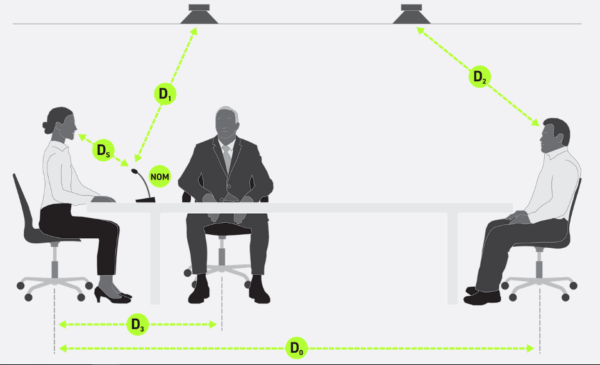
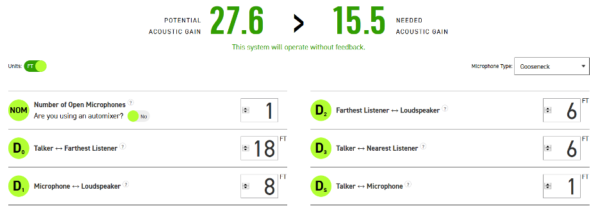
    The graphic above shows a room where each person is six feet away from each other. This table would support six people seated around it while maintaining typical social distancing guidelines of six feet.  We are assuming a 10ft. ceiling height, 30in. table height, average seated person 4ft. from the floor to the center of their heads. This leaves approximately 18in. between the tabletop and person’s face. If we place a minimum 6in. gooseneck microphone we’re left with approximately 1ft. of space between the person’s mount and microphone. This is a good distance to minimize plosives while still being close the voice for adequate gain. In this system design we’re intending to keep only one microphone open at a time to best manage the system and background noise. The calculations above show how much gain to apply to the microphone to enable the furthest listener to hear well compared to how much acoustic gain is at the nearest listener. This shows a stable system that will be able to mitigate feedback issues.

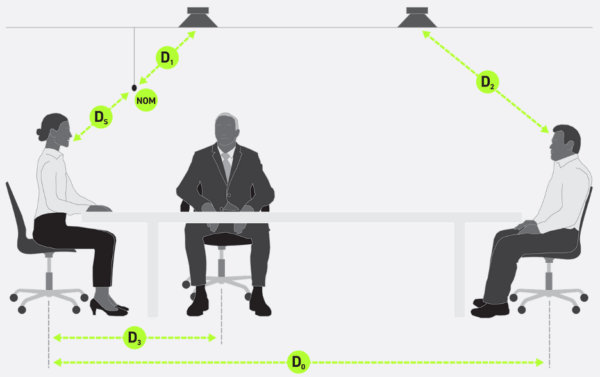
    The following graphic illustrates the minimum dimensions for voice lift applications within social distancing guidelines for ceiling microphones where a table microphone may not be an option. This could be because the room is a flexible workspace or the furniture and construction of the room do not allow for table microphones. This solution minimizes touch points in the room allowing a cleaner environment for meetings.

    The Reid Report: How to Safely Distance While Returning to Work

    The Reid Report: How to Safely Distance While Returning to Work

    If voice lift is not required for the scope of your project, then your microphone choice and placement is less encumbered by dimensions and design of the physical space and feedback stability is not a mitigating factor in the design of your AV system.

    The truth is we do not know what is coming next, what we can do is plan here and now for the future. Looking to next week, next month or even next quarter is not being proactive. You will end up burning more good money after all the bad, and who can afford that right now? What we can do is look at simple, cost effect and efficient ways to protect ourselves and co-workers and provide all industries a way of moving forward. Lest we never get back to working in our ‘outside clothes’ and are forever taking meetings in bed or at the dinner table, not showering for days on end and crushing our personal bests in Minecraft. While seemingly fun and functional for some, for the greater good we need to find ways to get back in touch with our work and each other. We too in the AV field are essential, let’s show them what we can do and how we can contribute to making this pandemic livable and functional.

    Sean Reid is a consultant and owner of Astroman AV.  Reid’s friend, colleague and peer Kresimir Tokic at VERSA Integrated Solution and formerly of Electrosonic, contributed to this column.


  • The other side of the AtlasIED launch

    The other side of the AtlasIED launch

    AVNation’s Tim Albright highlights the AtlasIED story, which is one of innovation, growth, and taking care of our community

    When the team at AtlasIED began talking with me about their new Atmosphere product launch, I was quite humbled to be asked to help. AVNation was able to create a unique experience for both the AtlasIED team, their dealers, the press watching, and curious AV professionals. As we began digging into the details of this project, there was an underlying story that had nothing to do with technology. This is a story of innovation, growth, and taking care of our community.

    Samsung bought Harman in November of 2016. In the fall of 2017, Harman Professional let go 650 employees; roughly half of their workforce. These layoffs impacted product managers, salespeople, technical support, and even our own Bradford Benn. The job elimination also cost a number of engineers their livelihood.

    At the time, the engineers at Harman created BSS audio DSP (digital signal processors), Crown amplifiers, JBL speakers, and AMX control and video processors. These were a smart group of brains who suddenly had nowhere to go.

    John Ivey has been in the process of evolving AtlasIED in recent years. The company has been known for creating airport and transportation communication system. If you have flown within the United States, there’s a 90-percent chance you have heard an AtlasIED system. Throughout the world, the company has a 50-percent market share. Now Ivey has set his sights on creating solutions for the commercial audiovisual market.

    These two stories cross with a gentleman I met through my friend Bradford Benn. Tom Lureman was an engineer with Harman when I met him at ISE 2016. Bradford can be rather loud so anyone else is quiet, comparatively speaking. Tom was even more so. But his quietness disguises his intellect. Lureman is a creative and smart engineer. Bradford had begun having talks with Ivey about joining AtlasIED. Within those talks, Benn introduced Ivey to the Harman family — or, former Harman family. Tom Lureman was one of the first ex-Harman engineers that John Ivey hired. Lureman was out of the Elkhart, Indiana office. There were others there as well who had created an impressive team atmosphere and none had a desire to move. So, Ivey hired the entire team and bought offices in Elkhart to house this brain trust.

    The next step is what puts this story above and worthy of writing. Internally, the newly appointed engineer team, and executive management were in conversations about what areas of audio technology to focus on. The Elkhart team mentioned that there was a cache of talented engineers on the market in Salt Lake City, Utah. Salt Lake was the site of Harman’s BSS Audio team. John Ivey hired almost the lot of them. Shortly afterward, AtlasIED’s Salt Lake City office was opened.

    In all, John Ivey and the AtlasIED team hired dozens of former Harman employees that had been let go. It was this team that set out with “a blank sheet of paper”, according to Ivey, and crafted Project Apollo. Apollo would eventually be introduced to the world as Atmosphere, a brand new digital audio ecosystem.

    Ivey says: “AtlasIED is one of the best places in the AV space to work, we just need to let people know that.” Not only did Ivey put his proverbial money where his mouth is, in doing so, he was able to evolve AtlasIED into a solutions provider and create a new ecosystem for dealers and their clients.

  • Live Labor: Shape to be Determined

    Live Labor: Shape to be Determined

    Columnist George Tucker meditates on the state of live staging’s past, present and future

    “We become what we behold. We shape our tools, and thereafter our tools shape us.” —Marshall McLuhan

    Live event work has its share of ebb and flow; overabundant at times or leaving you wondering just who shot the albatross to cause such doldrums at others. Regardless, the essential skills needed vary from technicians to riggers and general hands — a variety of crew were needed. Will the current crisis put an end to it?

    The shape of the past
    “What if they just put barcodes on the back of our necks? At least we would know where we are and what we were sent for.” A colleague of mine mused over this while the event staging company we worked for was firing on all cylinders. Growing from a small mom-and-pop to a preeminent name in the NYC area was in part due to the dedicated and talented crew. This was a golden era for the company (the first of many) where jobs were often scheduled back to back to back.

    Companies like the one I made the move to from recording studios presented a multitude of career paths. Starting out as a shop technician or audio school intern did not limit the direction you could go, all it took was the fortitude to listen and the stamina to keep going. The ability (or the desire to learn how) to perform competently often led to being kept close at hand.

    It is a constant quandary for project-based companies whether to invest in keeping a core staff or to rely on freelance talent. There are natural cycles in the industry where companies flow between being in-house labor heavy and outsourcing the lion’s share. The pattern generally follows periods of great growth or entry into a specific market and times of quiet.

    During the good times it makes sense locking in talent to consistently complete jobs. While this comes with added weight of salaries and benefits, it does provide an assured pool of talent. When the economics are lean or times when there is steady but flat work, companies tend to wean staff off, often putting the former staff into first-priority freelance roles, with a more nimble cashflow, hopefully,  enabling the balance sheets to keep in the black. There may be less work but the work was there.

    The shape of the present
    The recent crisis has completely turned things around. As of this writing, the prospect of in-person shows is some time in the new year. Audience or no, there is still a need for high production value live entertainment, companywide meetings and product releases. The question is, just what skill sets are needed, and what happens to folks who do not possess them, are their roles gone forever?

    Normal shows, from multistage extravaganzas to ballroom corporate events all require several trades working in harmony to bring the experience to life. Lighting operators, riggers, the squad of video village, directors, production, and the FOH bringing all elements together. These crews are needed to run the flotilla of equipment required to produce high quality productions.

    LIve Labor George Tucker column
    The pandemic has shown that a fair majority of people can work productively from home. Likewise, the events world is grudgingly acknowledging the same.

    As an industry we have been experimenting with edging closer to fully virtual events. More than webinar or Goggle-centric viewing, these events combine live action and immersive elements. The so called XR (Extended Reality) systems translate exceedingly well into remote and network distributed shows. What they do not require are ancillary crew, especially when the event is to be viewed remotely. ‘Virtual’ type shows require highly technical people who understand the nuances of data networks, image mapping, and graphic design.

    The pandemic has shown that a fair majority of people can work productively from home. Likewise, the events world is grudgingly acknowledging the same. The ‘shows’ that are continuing use crew who work from home on specialized software via a laptop. The yeoman’s work of multiple trades are needed to a lesser and lesser degree.

    The shape of things as they are
    Staging and theatrical people value education and training as an essential core component of the culture. We are always learning a new skill, diving deeper into technology or craft with an eye at advancing our capabilities or into more responsibility and new roles. The industry is technology driven, even as we dragged our feet embracing Ethernet and fiber topologies in lieu of reliable stalwarts such as copper. Such an ingrained drive should act as a pathway for displaced hands to move into these new roles, the question is whether they will find their sea legs again.

    One only has to take a look at the information technology industry for a clue as to what may be inevitable for event work. If you were accustomed to watching late night cable television in the early aughts the IT training ads were ubiquitous. The promise was that high paying jobs in the world of network computing were in demand and needed trained technicians asap! While the industry was in dire need of able bodies, the true tale is that most wound up being company help desk staff.  The jobs were promised as an exciting cutting edge profession where one would help shape the future. In reality the work consisted of helping people recover their passwords (for the twentieth time) or rebooting a computer the user swore they did (they did not).

    The current platform for live events just does not support the same number of skilled people to bring it about. Yeah, more technicians will be needed, just not nearly enough to move the majority of idle hands over.  We are being shaped by the tools thrust upon the moment.  Auxiliary or supporting platforms have now become the de facto method.

    The shape of anxiety  
    Is a great purge upon the industry?  Perhaps, at least for now. The best advice is to hold on, keep your skills sharp and look at gaining a better understanding of core technology and niche aspects.  From networking and Wi-Fi to audience support services (captioning, assistive listening), being able to jump in when needed can only help.

    There is positive movement just over the pond. EU and UK events are slowly starting up using limited audiences, drive-in style attendance and reserved platform viewing pods. It is a hopeful sign that live events focused on a communal gathering will thrive once again, the same, but oh so different, in shape.

  • Back Stage: The Corleone Syndrome

    Back Stage: The Corleone Syndrome

    Columnist George Tucker takes us into the studio and back stage to reveal some of the darker moments in his tech engineering career

    The livelihood of supporting live events quickly becomes an addiction; a religion almost, a life itself. There is an almost sinful pleasure in designing a system that helps make that moment, in getting the unrehearsed-one-chance-only  cue to sync for an audience of thousands, or seeing the client brimming with the knowledge that the attendees will not forget this one. Seriously, what high can match all of that?

    Corleone Syndrome
    The work can be gruelingly hard; disaster can lurk just around the corner and requires an acceptance that sleep and good nutrition are often optional for survival. Lord knows there are far easier ways to make a living, yet why would we do anything else? Many of us intimately know the feelings of  Michael Corleone when he states, “Just when I thought I was out, they pull me back in.” Even when we do manage to move to another profession the allure never leaves you — the sirens calling you, as muse, to the rocks at every event you attend.

    My career in AV has weaved in and out of Broadway tours, ballroom events, trade show support, recording studios, and integration. In many ways my professional life has been like that of the thrill-seeking freight train hoppers. As such, my permanently temporary insider status has prevented me from getting any serious scars.

    And yet there are moments that make you step back, scratch your head with an existential awe at just how f’d up people can be. These tales are the fodder for the late afternoon therapy sessions or are to be told only at the end of  day-drinking whiskey — lubricant for those in the know and a hazy anesthetic for the uninitiated.

    Rock Stars, Well, Being Rock Stars
    I worked in recording studios from 1990 to 1995. They were exciting times and helped me develop listening skills, interpersonal relationships (read: how to deal with insane creative types under the influence and not get yourself canned), and a life skill of eschewing sleep.  The main studio to employ me was built for a legendary guitar hero, its name often mistaken for an album by the same.

    Studio sessions are odd affairs, and when the Flaxen Fighter and her solo band took up residency in Studio C, it was assured to get strange. Long days in the studio are not action packed.  As a result, folks take on all manner of oddball activities, often imposed on the entire group as a communal connection and inside joke.

    Flaxen is a well-known breakout artist from the early days of New York Punk. Her original band, which many call her by instead of her name, were more pop oriented than their CBGB compatriots. Her ‘90’s solo sessions required many things, but most importantly the Flaxen provided ThighMaster, the Suzanne Sommers hyped exercise product , was to be on hand at all times

    After a few weeks of working and reworking songs the band took a few needed days off to recharge and reset. As it happened my (then) wife and I had a rare free Saturday and decided to see if the 20th street flea market had any cool mid-century furniture.

    It is here that the trouble started. The producer of the record, who also played on the album, was someone I worked with every day and it was him I noticed first. As we finished our hellos, I introduced my wife to him and his companion. My wife was in Flaxen’s infamous rap video when just a teenager (look for the purple beret wearing ‘street walker’).

    It was then that it hit me, quite literally. Before the introductions could be properly made, I took a sharp right cross to the shoulder and then a jab to my chest, effectively driving me sideways and backward a few steps. A 5-foot-5 blur rushed past me and across the avenue, obviously in a huff. Once I regained my bearings the producer explained that I had not recognized Flaxen, hidden behind the others covered by a shaggy faux jacket and hoodie. The Producer just shrugged, saying, “She’s mad you did not introduce her first.”

    When the sessions resumed, I found Flaxen’s umbrage unsubdued. I was banned from the control room except for urgent work. The most damning indication of my transgression was that my ThighMaster was taken away and now hung on the wall, my name tag covered in white camera tape. While I was eventually allowed back in the studio and could talk with her present, I never did get the exercise unit back.

    No Sleep ‘Til Brooklyn
    Anyone who has worked at least one live event knows that the primary skill appreciated is the ability to work with limited or no sleep for days on end.  It is not an ability one lists on their resumes, but the most talented of crew can have a career sidetracked by an inability to fight off the effect of sleep deprivation.

    Before there was CES there was COMDEX (Computer Dealers’ Exhibition). The show, at its height, premiered the latest technologies from 2,500 exhibitors to over 200,000 attendees. The show was so influential that the annual adult entertainment expo moved their event to overlap with it.

    We were hired to help automate a booth for a major processor manufacturer.  The booth production had trouble from the start. As a result, a number of us were pressed into the work of mounting items, running cable, focusing lights, etc.  This pushed back our final programming and run through. As the clock hit 30 hours, we had all the effects working except the final curtain opening. Our initial programming had all the rails running smoothly, but now they would not budge.

    The production manager raged; the client huffed. There was no time left to fix it. When you have not slept in nearly a day and a half,  you have the option of controlling two things: your emotions or your bowels. I commenced to have fits of bawling until my hotel room shower.

    The show that day went off just fine, excluding the fact that the curtains had to now be manually opened. As we finished our final packing, I overheard the producer ringing out his shop on the phone for sending  the wrong rails.  Bastard was throwing us under the bus to avoid blame! The anger welled in me but after so many hours -the rest was a blur.

    I was awoken by the hotel security attempting to enter my room. Apparently, I had returned to my room and slept for two days straight. Security was making sure I had not died/been murdered.

    On my way to the airport the producer and I had a run-in. I told him what I knew and replied with a few choice expletives back.  Let’s just say the quiet conversation ended with me telling him that if we ever did meet again it would not be pretty.

    It’s getting dark out, the bar is picking up with the first shift night owls and the whiskey bottles are now empty. I also have a 6 a.m. crew call.  What are ya’ doin’ Saturday? Bring your stories or post some below.

  • The Reid Report: Do requirements for minority inclusion actually work?

    The Reid Report: Do requirements for minority inclusion actually work?

    Sean Reid tackles the racial and gender disparities in AV business ownership and funding as the industry reckons with the lack of minority representation throughout its ranks

    Never before, in the shadow of a pandemic and in light of the rash of media attention paid to the senseless murders of Black and African-American people across the country, has the ethos of the racial divides within America been so pronounced. We can no longer afford, nor can we willfully deny the existence of systematic racism in our society. Nor can we deny that it penetrates, violently and punitively, into our justice system and places of work. We can blame poor leadership, elections, politicians, pandemics and everything in-between; yet none of these faux boogiemen are the true culprits. The fact is we live and work in a racist and sexist society. And the shriveled diseased hand of that bigotry touches each and every one of us, whether we wish it to or not.

    In our industry alone, women and minorities are severely underrepresented, while white males are, not surprisingly, over represented. The monochromatic nature of this industry makes for a number of misconceptions, internal and external, about skill, competence and trustworthiness for those professional persons when dealing with clients, peers and even coworkers. Often, I find women in sales or management, but rarely as technicians and engineers and programmers. With minorities, regardless of gender, not fairing much better. I know three amazing women engineers and have met countless others, and they are far too few and in-between, underrepresented and far too often marginalized.

    Can we any longer pretend we live in a great society, obfuscating the fact that our society is anything if not divided? Gripped by division and utterly false in its claims of being equal and/or color blind? Grappling with discussions of race, gender, faith and the like are never easy. Even more so in the current hyper-partisan climate, juxtaposed against the controversies related to hiring and advancement within the AV and IT industries. 

    The disparaging gap of misrepresentation does not stop sadly with hiring and advancement, however. Company ownership is also a place where we who are so often marginalized are also underrepresented and under rewarded. Most certainly that is true in context to the awarding of bids and contract work. Despite the number of MBE, WBE and SDVOSB businesses and the legal requirements on almost every bid to contract a percentage of these businesses, it does not happen. The ‘good ol’ boy’ networks of the construction business work against those advancements in federal, state and local compliance and allow waivers for white male-owned businesses, to the detriment of the minority and women-owned ones. Even when they are legal mandated to solicit and award sometimes upwards of 40 percent of a bid to MBE and WBE and the like, we time and again see that these waivers are just handed out along with checks to the same companies. Recently, a study was released showing the depth of this thievery and it is shocking.

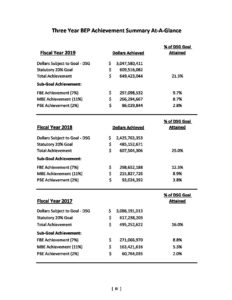
    In an insightful and incendiary report, issued by the State of Illinois Department of Central Management Services for fiscal year 2019; recording in detail the awarding of all BEP (Business Enterprise Program) contracts for that year, it becomes abundantly clear that the awarding of state contracts is anything but fair. What the report shows unequivocally is that minority-owned male and female businesses and veteran-owned businesses are receiving the least of the awards possible. In comparison, the state of Illinois awards on average more than 50 percent to Caucasian-owned women businesses, thus ‘satisfying’ the BEP requirement, while still under valuing and keeping contracts from reaching minorities and veterans in large numbers. In just an overview, the numbers are more than telling:

    The Reid Report

    Clearly the number speaks for themselves as it pertains to the lackluster awarding of contracts. For 2019 alone only $649,423,044 were awarded to BEP,  21.3 percent  of over three billion dollars allocated. Granted the mandatory goal was 20 percent and they exceeded that by 1.3 percent. Nonetheless, we can all agree that spending less than half of the monies allocated to minorities, disabled persons and women with those vendors and companies is abysmally poor management. This is even more impactful when you consider the State of Illinois is as diverse as it is and cannot or will not seek out and award more lucrative contracts to minorities and veteran-owned businesses. The waiver system, which allows large, mostly white-owned and managed firms, to be exempted from partnering with or even seeking to meet the BEP utilization quotas is at the heart of the problem as well. Besides what is sure to be an inherent and systematic racial preference for these companies; if after the hard work of seeking some degree of equal treatment through reforms and legislation these white-owned companies can just get a waiver, then the BEP requirements are toothless and meaningless.

    Without enforcement and a guarantee that the majority of monies earmarked are spent with qualified vendors, alongside ending the waiver program, things will never change. The engrained and systematic redlining of contract awards is in fact a reality and needs to change.

    The numbers are staggering and disturbing, as to the disparagement of contract awards, across the known spectrum, as it relates to white versus minority contractors, vendors and businesses. This depreciates and undervalues these businesses while simultaneously extending to veteran-owned businesses as well an implicit connotation of unworthiness, which in turn keeps these disadvantaged businesses in that position. The effect is one of making them in need of hand outs, rather than equal in their right and need to participate. With this in mind, it is equally puzzling and upsetting the preferences for even white women-owned businesses over their minority and veteran counterparts, in spite of utilization requirements for these businesses, in that 10 to 30 percent range on average. 

    We stand on the precipice of one of the greatest watershed moments in modern American history. A time when respect for the acknowledgement of racism, including women’s suffrage, are at an all-time low, brought about by media attention to the conflict and not the solution. We can, however, come together and overcome with our best intentions and combined efforts to rebuild, reorganize and redirect that negativity into something palpable and pragmatic. I pray we find that new path to that new normal and once there we find a better world and better future than we previously thought possible. Wherein all people are given the chance to excel and work at their craft in a fair and equitable environment of peers from every background. Let us construct that future and let us bring it into fruition here and now, not later when it seems more convenient or less painful. True change, the best change, comes when it is most difficult and least convenient and the betterment of the few and downtrodden always inevitably leads to the betterment of all others.

    Sean Reid is a consultant and owner of Astroman AV.

  • The Tech Life: The COVID-19 Culture Shift

    The Tech Life: The COVID-19 Culture Shift

    The pandemic has given rise to new ways of working from home and with each other

    Once upon a time, before computers, the only way to be at work was to, well, physically be at work. If your boss couldn’t see you, you were not working. Then one day, after computers became commonplace and smartphones became cemented to us, and cell coverage covered all the nooks and crannies of the world, we found we could no longer leave work.

    Yet, the workday didn’t change. Most people are still expected to show up at work on time with overheard whispers if you walked in “late.” No one saw you working late last night, finishing a proposal or curing a gremlin in a system, so, therefore, to the company, you were not at work.

    Then one day, a pandemic happened, and we were all told by the powers that be that we could not come into the office and click into our chains. Work would now happen from home. Installs, notwithstanding, we did a pretty good damn job. We logged in remotely from software on our laptops, we brought home our VoIP phones, and we finally figured out how to use that video conferencing software we’ve been selling.

    Now that the worst is over (we hope) and the nation has begun to reopen, we are at a precipice: return to the office and put your shackles back on or find a hybrid of work and home.

    According to Forbes, Twitter CEO Jack Dorsey recently announced that, with the exception of those required to be physically present in the office, Twitter employees will be allowed to work from home permanently even post pandemic. Microsoft and Amazon are remote through October. Google, Twitter, and Facebook employees that don’t need to be in the building will work from home until the end of the year.

    As an owner of a smaller AV firm, I’ve learned a few things (mostly by doing it the wrong way first) over the last few months on both working remotely myself and not seeing my team every day.

    Tasks versus Time
    Let’s say the assignment is to run five miles. Line up five members of your team and say go. Do you think it will take each member the same amount of time to run the distance? Now perhaps we give them eight hours to complete the task, how long will it take them? My point is that we have different superpowers. Maybe, we start thinking how much we would employ a person for and stop worrying about how much they’re getting done in 15-minute increments? Are they getting the job done?

    Transparency and Expectations
    “Treat a man as he is, and he will remain as he is. Treat a man as he can and should be, and he will become as he can and should be.” —Stephen R. Covey

    These have been fluid times, and there is no script for this. However, does your team know what you expect of them? Is it clear? Have you had honest conversations with them about the company’s state and what is needed to survive? Now, more than ever before is a time for radical candor.

    Connecting While Apart
    Whatever your infrastructure is, make sure you are connecting with your team while apart. We use the Microsoft 365 suite, and during the NY Pause, we enlisted additional Teams meeting to connect and see each other’s faces. We use Planner to assign and keep track of tasks for ourselves and others working on a project. There was a time if one wasn’t at the office you did not want to disturb them. That time is over. My VoIP phone is mirrored and at my desk and in my home. We are breaking the mold and one does not to have to sit behind a desk to get the job done.

    So far, quality of life is better. My team is working through the kinks and happier. Happier that can still live and get their job done. We have the chance to change, let’s do it.

  • Challenging the adversity to diversity within AV

    Challenging the adversity to diversity within AV

    On the latest episode of AVWeek, the staff of AVNation and several notable voices in AV took a break from industry news to discuss race in AV and what measures can be taken to support greater diversity across the channel

    As groups across the United States and the world continue to protest and call for systemic changes to governance and policing in the wake of the murder of George Floyd in Minneapolis, Minnesota, at the hands of police, we at AVNation felt that, as a media platform, it was important to address not only the question of diversity in our own industry, but how the growing call for systemic reform can be carried out within our ranks.

    On the latest episode of the weekly podcast, AVWeek, Tim and I are joined by AVIXA’s Dave Labuskes, Verrex’s Charmaine Tourella, LoopLab’s Chris Hope, Giovanni Agramonte of ArtMedia Group, and Iffat Chaudry from the UK’s CDEC, to discuss our own personal experiences of race in the AV industry as well as how as individuals and within working groups, such as AVIXA’s Diversity Council, we can effect sustainable change that reflects equality and genuine diversity in our channel.

    What can AV organizations do to address the issue of racism and race relations within their industry, but also within their communities?

    “I try to reflect on the fact that it’s a difficult week for me, but not a difficult life for me,” Labuskes says during the opening question of the episode. “And that this is a conversation this week, or these last couple weeks, that we need to have more. I spent a lot of time over the years actually to try to figure out, what can an industry association or more specifically, what can the industry association that I’m the CEO of do to confront these issues? I also have a background, as you mentioned, of technology and coding and stuff. I tend to try, in my head, to break complicated problems down into small pieces.”

    Labuskes acknowledges that this approach might be impossible with the scale of systemic racism and on a microlevel, the implicit bias that dog so many interactions with people of color when engaging on all aspects of society.

    “I think putting those types of gathering places, whether they’re online or in place, in reality, allows a conversation to start,” Labuskes adds. “Then that conversation can inform further conversations, and people can get… We can’t solve implicit bias, but when can contribute to people connecting with each other, learning from each other, as you talked about at the outset here. And recognizing their faults, learning where they’ve made assumptions that are wrong, and moving forward from that point.”

    Tourella, underscoring her 20 years in the industry, observes that the adversity to diversity within AV is really about how comfortable and holistic the channel is, having been founded and rooted in the mom-and-pop approach to business development, which means hiring the people they know and are most familiar with.

    “For a long time, holistically, they hired people they worked with, they’re on the road with. It was a family affair, so the family got involved,” Tourella notes. “They siloed themselves and never looked out. In not looking out, they missed out on a lot of the diverse talent that actually had the ability to propel their businesses much further. Because fast forward to today, a lot of the diverse AV workers are on the client side because they couldn’t get satisfaction on the AV side. A lot of those people went to, “Okay, I’m going to go to the client side because they appreciate me there and my diversity. They have a diversity plan and initiative, and I get paid more, and I get stock options. Screw AV, bye. I’m going there, or I’m going to the manufacturer’s side where it’s the same.

    “What we have to do is we have to start outreaching. The outreach in the AV industry with a dominant group, which typically usually is older white men are the dominant group in our industry, have to now take the mantle of looking up ways to implement strategies. Sometimes it’s a plan, but really what we have to do is have a cultural shift in the AV industry to make diversity a thing that’s positive. Because you can do it a couple of ways.”

    Tourella suggests that the AV industry focuses on a cultural shift through positive actions — events, programs, training, education and outreach — to bring greater diversity to channel and stop the brain drain of talent that has decamp for IT or client-facing organizations.

    To Tourella’s point, Chris Hope adds representation in simple, straightforward ways such as adding people of color in the industry to corporate and company AV integration tutorials can have a great impact. But he poignantly adds that diversity is not the same as racial justice.

    “I would say though, when we’re talking about the situation that’s happening nationally and locally with the protests, diversity isn’t really… it’s just one part of it,” Hope says. “Racial justice is not diversity, right? Diversity means variety. Racial justice is not equality, equality is just sameness. Really, at the root of what we’re dealing with here is equity, fairness, justice. For us at The Loop Lab, we are really centered in the principle that all people are deserving of liberty, justice, and dignified labor. That they have the ability and should have the access to dignified labor if they work hard and they really want to pursue pro AV as a career choice, they should have access to do so.”

    As this moment in history continues to shed a glaring light on the inequalities in the U.S. and moves many organizations and outlets in power to amplify the voices and labor of people of color, Hope like many of us, is hopeful that conversations about reform stay alive once the protests end.

    “We have to really talk to key level executives in why it’s important to be proactive,” Hope says. “And making sure that their corporate environments are promoting and coming at it from a racial justice framework. That can be done as simple as having people that get paid to do that kind of consultancy, to do trainings.

    “It has to be constant, it has to be an investment. It has to be something that the company says, “We see the benefit in this and what it does to our employees.” The data has to demonstrate that, right? Numbers don’t lie. If you see over a period of time the number of people of color that are employed not going up, and in fact maybe decreasing in some places, then you can’t say that you’re really invested in racial injustice and equity. I think there’s a lot of work to be done, as already been shared, but there are many ways that folks can get engaged and involved, particularly in the pro-AV space.”

    Later in the discussion the panel returns to actionable changes that can bring greater diversity to our industry.

    “David and I actually had a meeting a few weeks ago about this as it pertains to the missed opportunity in not opening up the doors to diversity for the AV industry,” Tourella says. “And how we have to better work, it’s a work in progress, and it’s got to continue. But we have to be more diligent about application. It’s all about application. It’s collaboration and application.

    “That’s also on us and our community as well,” Tourella continues. “We are tired of talking, like I said before. However, there’s a crack in the window and a crack. There’s a crack that we have to start opening up a little bit wider. We see the crack. We’re here on this show, we see the crack. We have to take the opportunity more to step through and talk to you, and let you know what we need to see, what we need to have. How, and also not just tell you, but help you on how it can be done and show you. And kind of help to collaborate together, to pull that strategy and application along so we can actually make applications that we can apply to see results, because that’s what it’s going to take.”

    Listen and watch the full discussion on AVWeek 459: Race & the AV Industry here.