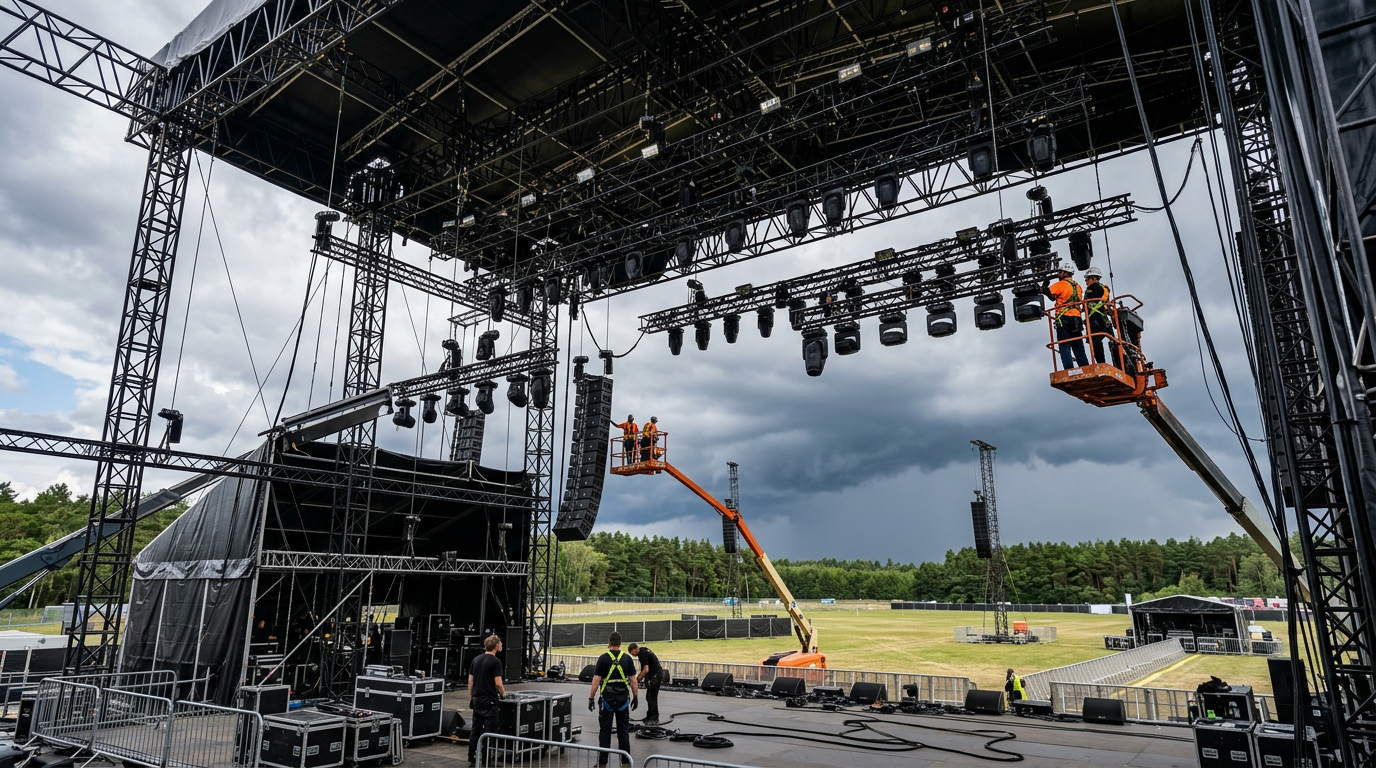
The main stage at Italy’s Alien Sound Festival came down two days before the show. High winds hit the former NATO base in Bagnoli, near Naples. The gusts knocked over the main structure and several lighting towers. Nobody was on site, so nobody got hurt. Local authorities revoked the event’s permit anyway, and organizers pushed the festival back to July 23.
The footage circulated widely, and it landed on a recent episode of AVWeek. Host Patrick Norton opened with the obvious question. Was this bad luck, or was it a warning sign the industry should heed? Norton asked George Tucker and BC Hatchett for their reactions. Tucker is an event staging technical specialist at Corporate Audiovisual Services. Hatchett is director of classroom technology at Vanderbilt University.
Listen to the full episode of AVWeek 778 – Click Here
Weather is the wildcard
“It’s your worst fear that people get hurt, equipment gets hurt, and the event doesn’t go on,” Tucker said. He builds temporary structures for a living, and he said crews follow every rule the permits require. Straight-line winds and sudden high-velocity gusts are different. No one can engineer around every version of that.
Tucker noted the show hadn’t started yet in Naples. Crews were likely still finishing rigging when the wind hit. That timing may explain why crews hadn’t finished tying down some fabric panels, Tucker said. It didn’t change how fast the wind took the stage down.
Tethering isn’t optional
Norton described riding out a minor earthquake inside a San Francisco TV studio. Three overhead lights swung loose from their angled mounts. Their safety tethers held. “There’s a reason they put safety tethers on everything,” Norton said.
Tucker described a similar close call from earlier in his career, at a convention center he declined to name. He looked up and saw large speakers hanging by their safety cables alone, with the mounting hardware already failed. He flagged it to venue staff, who said they’d get a lift up the next day. State troopers eventually got involved before crews fixed it.
Tucker said crews sometimes rush rigging when time is short. That’s when accidents happen. “Safety first, or someone will get hurt,” Tucker said.
Fixed installs carry the same risk
Hatchett doesn’t rig temporary stages, but he sees the same risk in Vanderbilt’s classrooms. Ceiling-mounted speakers and projectors sit above dozens of students every day. “That’s a big spread of folks something could fall on,” Hatchett said.
Norton shared a story of his own. He once helped strip AV gear out of a room nobody on his team had built. A crew member pulled a speaker cable and discovered it ran to a subwoofer hidden above the ceiling tiles. Nobody got hurt when it fell. Norton said he now knows exactly what a 45-pound subwoofer sounds like after a 15-foot drop.
Hatchett’s team had a closer call of their own. A campus department installed a classroom projector without looping in Hatchett’s group first. Two months later, someone reported a flickering image and asked for a look. Installers had set the projector and its mount into the ceiling grid instead of anchoring it to the deck. The mount weighed about 45 pounds, and the grid was already starting to give way.
Hatchett’s team pulled the projector down immediately and brought in a contractor to fix the mount properly. The contractor arrived within 30 minutes and rehung it with aircraft cable. “The last thing I want is a call saying a projector fell on a kid’s head,” Hatchett said.
What safety first actually means
The Naples collapse and the near misses Tucker and Hatchett described sit in different categories. Nobody could have stopped that wind. However, both panelists agreed a loose speaker or an unanchored projector is a different kind of failure. Those come from skipped steps, not weather.
The fix isn’t complicated. Tether everything overhead. Inspect old installs on a schedule, not just when something looks wrong. Treat a flickering image or a shaking fixture as a warning, not a nuisance.
“Safety first, or someone will get hurt,” Tucker said.