At IBC 2025 in Amsterdam, Sony made it clear that live production is entering a new era, with AI-powered tools doing heavy lifting in camera tracking, workflow automation, and spatial content creation. For organisations such as houses of worship, universities and colleges, or any team operating with tight staffing, Sony’s announcements promise both relief and new creative potential. Sony at IBC 2025 made clear statements about automated production and sustainability.

One of the standouts is Sony’s OCELLUS camera tracking system, which was demonstrated alongside the Virtual Production Tool Set version 3.0. The company showed how OCELLUS integrates with Sony’s LED display technologies (Crystal LED CAPRI, VERONA) and spatial content production hardware and software to enable automated tracking of talent in studio, virtual or hybrid settings. Sony describes the evolution of this architecture as “connected media ecosystem” where camera, cloud, AI, and IP tools are tightly integrated to reduce setup complexity and operator load.
Sony at IBC 2025 Higher ED
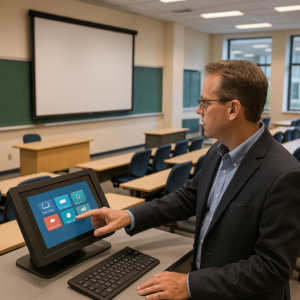
In higher education, for example, the ability to rely on AI tracking means professors can move freely around lecture halls without concern for camera operators. Sony claims that its AI-powered tools can adjust camera framing in real time, responding to both motion and spatial context. This kind of automation reduces the burden on technical staff, who often must juggle camera, audio, lighting and streaming tasks simultaneously. One university AV manager quoted by Sony said: “We need tools that anticipate movement, that can track speakers without us having to constantly adjust. Sony’s tracking minimizes our technical overhead so we can focus on content, not camera operation.”
In houses of worship, many congregations face similar constraints: volunteer staff, limited budgets, and varying levels of technical expertise. Sony’s AI tracking and integrated virtual production hardware allows worship services to look much more professional without hiring a full crew. The precision of systems like OCELLUS, combined with Sony’s LED display solutions, means that churches can project engaging visuals, follow speakers or performers across the stage, or mix live and pre-produced content with less manual intervention. The benefit is two-fold enhanced attendee experience and reduced staffing/operational cost.
Sony Sustainability
Sony also emphasised its sustainable and cloud-native tools as part of its exhibit. One of the goals is to enable remote monitoring or control, so that fewer people need to be physically on site. This is especially useful for campus environments or houses of worship with multiple locations one technician can oversee several spaces, schedule automated tracking profiles, and ensure consistent visual quality. Sony’s press materials highlight that its Virtual Production Tool Set 3.0, due later in the year, will enhance remote operation and AI-augmented scene control.
But there are trade-offs to consider. The initial investment in LED walls, tracking hardware, and higher bandwidth for IP/ cloud workflows may be substantial for smaller institutions. Training is still required, even if operation is easier. Yet for organizations willing to make that leap, the return often shows up in reduced personnel costs, more consistent output, and greater flexibility in programming (whether worship service, lecture, or live event).
In sum, Sony’s presence at IBC 2025 made a strong case that AI tracking is more than a feature it’s becoming a foundation for live production in sectors where staffing and resources limit what is possible visually. For houses of worship, educational institutions, and lean content teams, the promise is that better visuals, more freedom, and lower operating stress are now reachable.
Check out all of AVNation’s IBC 2025 coverage here.

Tim Albright is the founder of AVNation and is the driving force behind the AVNation network. He carries the InfoComm CTS, a B.S. from Greenville College and is pursuing an M.S. in Mass Communications from Southern Illinois University at Edwardsville. When not steering the AVNation ship, Tim has spent his career designing systems for churches both large and small, Fortune 500 companies, and education facilities.
- Tim Albright

- Tim Albright

- Tim Albright
- Tim Albright