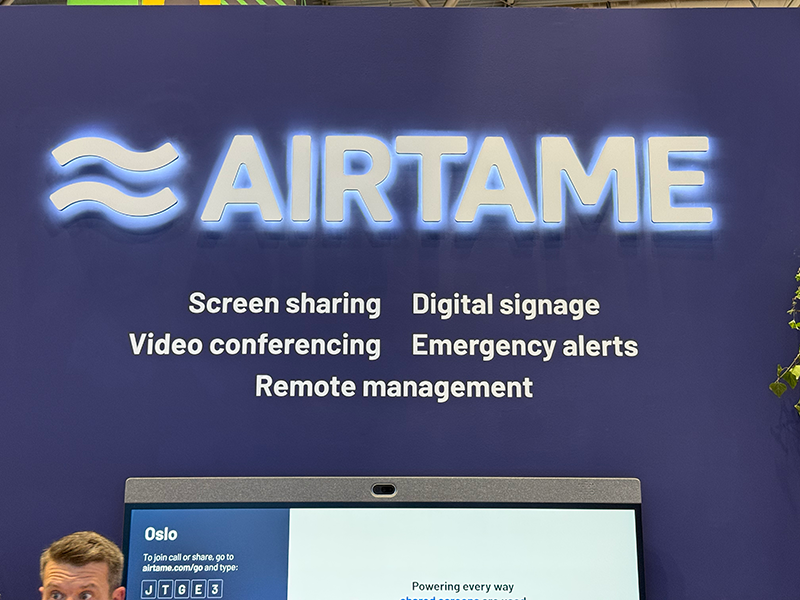
At Integrated Systems Europe 2026, Airtame reinforced a growing reality across enterprise collaboration environments: the meeting room is increasingly defined by software, not hardware.
While many manufacturers continue to compete on devices, Airtame’s message centered on platform flexibility. With updates across its Airtame 3 hardware lineup and expanded software availability running on third-party collaboration and signage devices, the company demonstrated how wireless collaboration and digital signage can operate as adaptable services rather than fixed room systems.
For enterprise IT and AV managers tasked with supporting diverse room types across multiple locations, that flexibility is becoming essential.
Decoupling Collaboration From Dedicated Hardware
Traditional meeting room deployments have long relied on purpose-built hardware tied to specific collaboration platforms. While effective initially, those environments can become difficult to scale or adapt as organizational needs evolve.
At ISE 2026, Airtame positioned its platform as an alternative approach.
Airtame software now runs not only on its own Airtame 3 devices but also across Windows and Android environments, enabling deployment directly on existing hardware infrastructure. Demonstrations showed Airtame operating on platforms including Neat collaboration devices, SMART displays, and Amazon Signage hardware.
This shift allows organizations to extend wireless presentation and signage capabilities without introducing additional standalone devices into every space.
For enterprise environments managing lifecycle refresh cycles, reducing hardware dependency translates directly into lower long-term operational complexity.
Platform Flexibility for Enterprise Deployment
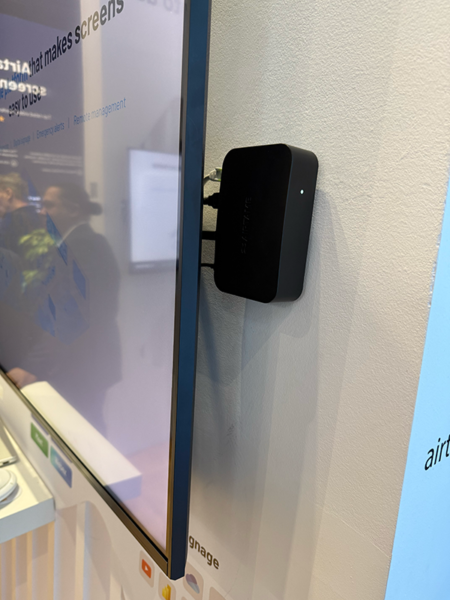
One of Airtame’s strongest differentiators at ISE was its hardware-agnostic strategy.
Rather than requiring organizations to standardize around a single manufacturer ecosystem, Airtame enables collaboration functionality to move with the organization’s broader technology decisions. Displays, collaboration bars, or signage endpoints can become Airtame-enabled through software deployment rather than infrastructure replacement.
This approach aligns closely with enterprise IT expectations, where flexibility and interoperability increasingly outweigh proprietary feature sets.
As collaboration platforms continue evolving, software-defined room capabilities provide insurance against rapid technology change. Rooms can adapt through updates rather than redesign.
Subscription-Based Management and Predictability
Supporting this model is Airtame’s subscription structure, which shifts collaboration technology toward a service-oriented operational model.
Organizations can select deployment tiers based on usage needs, including Core plans beginning at approximately $120 per screen annually and Hybrid configurations designed for more advanced collaboration and signage workflows. Multi-year subscription options further support predictable budgeting and lifecycle planning, with education-focused pricing also available.
While subscription licensing is now common across enterprise software, its growing adoption within meeting room infrastructure reflects a broader convergence between AV and IT operational models.
Technology is no longer purchased once and left unchanged. It is continuously updated, managed, and optimized.
Supporting Hybrid Work Without Added Complexity
Hybrid work environments continue to challenge enterprise technology teams. Rooms must support in-person collaboration, remote participation, and shared content workflows without increasing user friction.
Airtame’s demonstrations emphasized simplicity at the user level while maintaining centralized administrative control. Wireless content sharing, digital signage, and room communication tools operate within a unified management framework accessible remotely by IT teams.
The result is a collaboration experience that remains consistent regardless of room size or hardware configuration.
For organizations scaling collaboration across regional offices or global campuses, consistency often proves more valuable than advanced feature depth.
The Enterprise Takeaway
Airtame’s presence at ISE 2026 reflected one of the clearest industry trends emerging across the show floor: meeting rooms are transitioning from hardware-defined environments to software-managed platforms.
By expanding Airtame beyond dedicated devices and enabling deployment across existing collaboration hardware, the company is positioning wireless collaboration as infrastructure rather than an accessory.
For enterprise AV and IT leaders, the appeal lies in adaptability. Systems can evolve alongside organizational needs without requiring wholesale hardware replacement.
In an industry increasingly focused on operational efficiency, Airtame’s strategy suggests that the future meeting room may not be built around a specific device at all, but around the software layer that connects everything together.
To catch all of AVNation’s ISE 2026 coverage, visit our dedicated page.

Tim Albright is the founder of AVNation and is the driving force behind the AVNation network. He carries the InfoComm CTS, a B.S. from Greenville College and is pursuing an M.S. in Mass Communications from Southern Illinois University at Edwardsville. When not steering the AVNation ship, Tim has spent his career designing systems for churches both large and small, Fortune 500 companies, and education facilities.
- Tim Albright

- Tim Albright

- Tim Albright

- Tim Albright