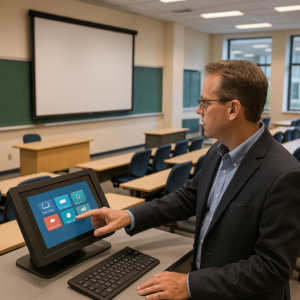
At events like ISE 2026, it becomes clear that the audiovisual industry rarely moves in small steps. Instead, the market tends to cross thresholds. One year a display is simply a screen. A few years later it becomes something much more.
Commercial displays are approaching one of those thresholds now.
For most of the past two decades, enterprise displays were evaluated primarily on visual performance and price. Resolution, brightness, and panel size dominated specification sheets. If the image looked good and the budget allowed for it, the conversation was largely complete.
That approach is rapidly becoming outdated.
Today’s commercial displays sit on enterprise networks, consume measurable amounts of power across thousands of rooms, generate heat that affects facility infrastructure, and require lifecycle management just like any other connected device in an IT environment. In other words, the display is no longer just an output device. It has become infrastructure.
The vendors that succeed in the next phase of enterprise AV will be the ones that design displays accordingly.
Displays Are Now Network Endpoints
Perhaps the most significant shift in commercial display design is the recognition that these devices now live squarely inside the IT ecosystem.
A decade ago, a display was often treated as a passive endpoint. Today, that assumption no longer holds. Displays are connected devices with operating systems, network interfaces, and in many cases direct access to collaboration platforms and content delivery systems.
That reality changes the requirements dramatically.
Security becomes a fundamental consideration. Enterprises now expect displays to include mechanisms for restricting inputs, controlling device behavior, and maintaining secure operating environments. Administrators increasingly want the ability to manage displays in ways like other IT endpoints. That includes firmware updates, network authentication, and configurable device policies.
The rise of operating system–driven displays has also created a new dynamic in the industry. Many commercial displays now run platforms based on widely supported operating systems such as Android, allowing vendors to leverage ongoing security updates and ecosystem support rather than relying solely on proprietary software stacks.
For IT leaders, this shift means displays must be evaluated not just as hardware, but as managed network devices.
The Total Cost of Ownership Conversation Has Changed
Another major shift taking place in the commercial display market is the growing emphasis on total cost of ownership.
Historically, display purchasing decisions often revolved around upfront cost. While price still matters, organizations are increasingly looking at the operational implications of large-scale deployments.
Consider the reality of a corporate environment deploying hundreds or thousands of displays across conference rooms, huddle spaces, digital signage networks, and training environments. In these scenarios, the long-term operational impact becomes significant.
Energy consumption becomes a measurable factor. Power usage multiplied across hundreds of displays can meaningfully affect energy budgets. Reliability becomes equally important. Every service call represents lost productivity and operational disruption.
Even heat generation can become a facilities consideration. Displays contribute to thermal loads in conference rooms and command centers, which can influence HVAC requirements over time.
Because of this, enterprise buyers are increasingly asking different questions than they did ten years ago:
- How reliable is the display over a five-year lifecycle?
- How much energy does it consume compared to previous generations?
- How easily can it be serviced or replaced if something fails?
- What operational costs will this device create over time?
Manufacturers are responding by designing displays with longer expected lifecycles, improved power efficiency, and warranty structures that support enterprise deployments.
The result is a market where reliability and operational efficiency are becoming as important as image quality.
Sustainability Is Moving From Marketing to Engineering
Environmental considerations are also beginning to shape commercial display design in meaningful ways.
Corporate sustainability initiatives are increasingly influencing procurement decisions. Organizations are looking beyond marketing claims to measurable improvements in efficiency and lifecycle impact.
Display manufacturers are responding by rethinking core design elements, including panel architecture, power consumption, and materials sourcing.
Energy efficiency has become one of the most visible indicators of this shift. Reducing display power consumption not only aligns with sustainability goals but also directly reduces operational costs for enterprises deploying large fleets of screens.
Longer product lifecycles also contribute to sustainability objectives. Displays that last longer reduce electronic waste and minimize replacement cycles, which are particularly important for organizations operating at scale.
In many ways, sustainability has become another dimension of the total cost of ownership discussion. Energy efficiency and durability now represent both environmental benefits and financial advantages.
The Integrator Experience Still Matters
While enterprise IT leaders increasingly influence AV decisions, integrators remain a critical part of the ecosystem.
That reality means manufacturers must design displays not only for end users but also for the professionals responsible for deploying them.
Installation efficiency is one area where vendors are investing significant attention. Lighter displays, standardized mounting patterns, and slimmer chassis designs can dramatically reduce installation complexity and labor requirements.
These details may seem minor at first glance, but they matter when large-scale rollouts are involved. When hundreds of displays need to be installed across an enterprise campus, small improvements in installation workflow can translate into meaningful time and cost savings.
For integrators, this shift toward usability represents an important evolution in product design. Displays are increasingly being engineered with the installation process itself in mind.
Why Anti-Glare and Environmental Performance Still Matter
Even as infrastructure considerations dominate the conversation, traditional display performance metrics remain relevant.
In fact, environmental viewing conditions are becoming more important as displays replace projectors in many enterprise environments.
Conference rooms today often feature large windows, open office layouts, and bright collaborative spaces. In these environments, glare and reflection can quickly undermine display visibility.
Manufacturers are addressing this challenge through improved anti-glare technologies designed to reduce reflections while preserving image quality. The goal is to ensure that displays remain usable in real-world environments without requiring rooms to be darkened or reconfigured.
For enterprise customers, this means displays must perform consistently regardless of room design or ambient lighting conditions.
The Higher Education Factor
Higher education institutions offer a useful preview of how these trends are playing out at scale.
Universities operate hundreds of classrooms and lecture halls, often with tight technology budgets and limited support staff. In these environments, reliability, energy efficiency, and ease of deployment become critical factors.
Classroom technology also operates in high-visibility environments where downtime directly affects teaching and learning. As a result, universities tend to prioritize displays that offer long lifecycles and predictable performance.
Many of the features now appearing in commercial displays—power efficiency, centralized management, and improved durability—reflect lessons learned from deployments in education.
As enterprise organizations continue expanding their own AV infrastructures, they are beginning to adopt similar priorities.
Scalable Deployment
Another factor shaping the future of enterprise displays is scalability. It is one thing to deploy a single screen in a conference room. It is something else entirely to manage dozens, hundreds, or even thousands of displays across a corporate campus, regional offices, or a global real estate footprint. That is where centralized oversight becomes critical. Tools like Sony’s Device Management Platform (DMP) reflect how the category is evolving beyond hardware and into lifecycle management. For IT and AV teams, the value is not just in the display itself, but in the ability to monitor status, manage fleets remotely, streamline updates, and maintain consistency across an entire deployment. In a modern enterprise environment, that level of visibility and control is quickly becoming part of the baseline expectation.
The same is true of ecosystem strategy. No display manufacturer can meet every enterprise workflow or vertical requirement alone, which is why open integration is becoming more important across the market. Sony’s emphasis on an open partner ecosystem, including more than 100 technology and solution partners, speaks directly to that reality. Enterprise customers are not buying displays in isolation. They are buying into a broader environment that includes collaboration platforms, control systems, signage applications, workplace experience tools, and management software. The manufacturers that will stand out are the ones that understand the display is only one part of a much larger technology stack, and that interoperability is now just as important as panel performance.
Sony’s Pro BRAVIA Line Reflects the Industry’s Direction
This broader shift in commercial display design was visible throughout ISE 2026, where multiple manufacturers highlighted improvements in efficiency, usability, and lifecycle performance.
Sony’s recently announced Pro BRAVIA updates are one example of how vendors are responding to these evolving expectations.
The new generation focuses on three areas that align closely with current enterprise priorities: improved image quality, enhanced usability for installers and end users, and greater environmental responsibility. Features such as reduced power consumption, improved anti-glare performance, and updated processing capabilities reflect the industry’s broader push toward displays that function as long-term infrastructure rather than short-term hardware purchases.
Security considerations are also becoming part of the design conversation. Configurable operating modes and ongoing operating system updates illustrate how display vendors are increasingly addressing the needs of IT-managed environments.
While Sony is not alone in this approach, its latest Pro BRAVIA lineup highlights the direction the commercial display market is heading.
The Future of the Enterprise Display
The commercial display is no longer just a screen on the wall. It is a network endpoint. A power consumer. A facilities consideration. A managed device within the IT environment.
For enterprise decision makers, this means display selection must now be approached with the same level of strategic thinking applied to servers, collaboration platforms, and network infrastructure.
As organizations continue building connected workplaces and collaboration environments, displays will remain one of the most visible pieces of the technology stack.
The difference is that behind the screen, the technology is becoming far more sophisticated than it once was.
And increasingly, that sophistication is exactly what enterprise environments require.

Tim Albright is the founder of AVNation and is the driving force behind the AVNation network. He carries the InfoComm CTS, a B.S. from Greenville College and is pursuing an M.S. in Mass Communications from Southern Illinois University at Edwardsville. When not steering the AVNation ship, Tim has spent his career designing systems for churches both large and small, Fortune 500 companies, and education facilities.
- Tim Albright

- Tim Albright

- Tim Albright

- Tim Albright