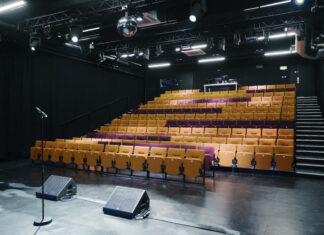
Two lower-cost, sphere-inspired venues in China raise questions about scale, novelty and what large-format LED can now do elsewhere.
Las Vegas is not the only place building spherical, immersive LED venues anymore. Two China-based projects now offer a smaller, cheaper version of the idea.
Two venues in China have built sphere-style LED architecture. According to figures discussed on a recent AVWeek episode, the projects cost roughly a tenth of the Sphere’s price tag. Host Tim Albright called the specific number in initial coverage clickbait. He said the figures still need independent confirmation.
Still, the panel agreed the underlying trend is real. Large-format curved LED and acoustically transparent displays are now within reach of smaller developers. AVNation panelists Jennifer Weaver of AVIXA, Heather Sidorowitz of Southtown AV and Lex Evans of Epiphan discussed what that access means for the wider industry. Titles for all three are pending confirmation.
What the two venues actually are
Details on the two venues are still emerging. One is described as located in China’s Hubei region; the exact venue name requires confirmation. The other is a Shanghai project called “Starry Sky” near the city’s West Bund district, according to the panel.
Both venues are smaller than the Las Vegas Sphere and purpose-built for regional cultural programming rather than mass-market entertainment.
That distinction matters. The panel’s discussion centered on what cheaper, smaller sphere-style venues mean for the wider industry. It did not focus on direct competition with the flagship Las Vegas venue.
Cheaper spheres, cautious optimism
Jennifer Weaver offered a mixed reaction. She had not yet seen a show inside the original Sphere. She planned to attend that week.
Weaver doubted the world needs identical spheres everywhere.
“Massive replicas of the Vegas sphere all over the place? Probably not,” Weaver said.
She compared the idea to the giant guitar-shaped hotel at Florida’s Hard Rock in Fort Lauderdale. Once a similar structure exists closer to home, she said, some of that landmark’s draw fades.
Weaver saw a possible upside for smaller cities without major tourism draws. A scaled-down sphere, she said, could bring new cultural programming and tourism revenue to places that would otherwise be overlooked.
“It’s a baby sphere to me,” she said.
A competitive market could push innovation
Lex Evans, Account Executive at Epiphan, welcomed the competition. She compared the sphere market to the smartphone industry. In her view, limited U.S. competition has left buyers with fewer, pricier choices than shoppers overseas get.
“I’m excited because this feels like the phone market, where a few companies have monopolized America,” Evans said. “Everyone else is leagues ahead with cheaper, cooler phones. I’m hoping for some competition so we’re not fully monopolized by the world of spheres.”
Evans also referenced additional venues in the works. These include one in Abu Dhabi and a possible Washington, D.C.-area site, raised separately by other panelists.
Heather’s closing take: proof of concept, not a verdict
Heather Sidorowitz, President at Southtown AV, had the panel’s final word. She sees value in both the original Sphere and its cheaper imitators, for different reasons.
“I think one proves it’s possible and the other proves it can scale,” Sidorowitz said.
She likened the pattern to Top Golf venues or Disney World locations, which multiply once a concept proves itself. Not everyone will travel to the original; smaller regional versions can still capture real demand.
The bottom line
None of the panelists expect the cheaper Chinese venues to hurt attendance at the original Sphere. Instead, the discussion pointed to a familiar industry pattern. A flagship technology proves what’s possible. Lower-cost versions determine how far it eventually spreads.

Tim Albright is the founder of AVNation and is the driving force behind the AVNation network. He carries the InfoComm CTS, a B.S. from Greenville College and is pursuing an M.S. in Mass Communications from Southern Illinois University at Edwardsville. When not steering the AVNation ship, Tim has spent his career designing systems for churches both large and small, Fortune 500 companies, and education facilities.
- Tim Albright

- Tim Albright
- Tim Albright

- Tim Albright