Category: Article

  • Securing the AV Network

    Securing the AV Network

    Protecting Informational Currency

    Steve Greenblatt and A State of Control guests took a left turn recently. Instead of discussing control and automation, the group found themselves talking about the security of AV systems. We wanted to hear opinions on what kind of impact this has on the AV programming space, designers, and those who are in our audience wondering what to do.

    Rich Fregosa said, “We are quickly reaching critical mass…It is now a requirement for us to be aware of how information can get out and prevent the unauthorized release of that information…” Noting that if we are involved in these systems, part of our responsibility as programmers is to help protect that informational currency. We can be liable for it if we don’t, and there also lies some element of AV trust across the board.

    Rich uses a check engine light metaphor, referenced many times throughout the podcast. We highly recommend taking a listen to get a picture painted for you.

    Greenblatt asks our guests how important it is going to be that there is not only comprehension but a dedication to security?

    Brian Magrogran from Verrex speaks on the importance of keeping up with the changing requirements for security. He notes that following this alone will provide a stronger sense of security. Referencing the Windows theory and the fact that users are now forced to update their projects in order to enforce this dedication to security.

    “We have to protect ourselves, and our clients”, the panel noted. If your company gets hacked, there is a call to evaluating equipment. There must be a prior decision regarding which devices you deem secure. “No matter what,” James King says, “you have to face that you’re going to have difficulty no matter what equipment you’re using.”

    Need tips as you dive into security?

    Magrogran says that one of the most important factors is to be paying attention to what manufacturers are doing. “Security is never once then done,” followed King. We have to embrace security. Fregosa rounds it out , saying, “you gotta educate the people you’re selling it to,” which means we must all educate ourselves before doing so.


     

    Listen for a deeper look into the security of AV control.

  • What 500 Episodes Mean to Me

    What 500 Episodes Mean to Me

    Leaning into your legacy

    A number is just a number. Most of the time. Whether it’s age, weight, or IQ. Even episode numbers haven’t ever really impacted me. We hit 100 at year 2; 200 at 4, and so on. This year AVWeek celebrated episode 500, which means 10 years of me saying “This is AVWeek”. Ten years of some of the greatest and brightest audiovisual professionals sitting down and giving the industry their wisdom and insights.

    I won’t go into the backstory of how AVNation came to be. Short version, I had a life change and said why not. If you’d like the full story, catch me at InfoComm some time. I’ve been blessed to connect with and interview over 300 different guests. Each one brought a unique perspective and insight.

    Hosting AVWeek has been one of the greatest joys of my life. This podcast married my love of broadcasting with an incredible industry I fell in to. It’s allowed me to travel beyond the borders of the US, learn from AV pros in Nigeria, India, Brazil, and China. The world has been brought into the little AVNation studio in St. Louis. And from there, the world has been able to watch me grow and evolve.

    Sunday AV Chat with #AVintheAM

    Then on #AVintheAM, Chris Neto asks what will your legacy be. Hmm. My legacy? That seems pretty simple to me. I was a part of the group that started AVNation and AVWeek. I’ve been the host for nearly all 500 episodes. So, my legacy is this vehicle that allows others to speak into the AV community. But that isn’t quite right.

    An overarching belief that I’ve evolved into is the idea that we are not the same people from year to year. At least we shouldn’t be. I’ve changed physically, spiritually, and mentally the last ten years. So have you. I’ve learned and grown. Some of that growth has been at the expense of others, I’m afraid. By that I mean, I’ve made mistakes, hurt others, and tried to learn from that.

    While the vast majority of these offenses have been unintentional, some haven’t. I can only attribute that to immaturity and ignorance. While at the time I most likely saw myself as in the right, I wasn’t and my actions uncalled for. See, we’re all humans. We make mistakes. Even other people. I know that’s hard to believe. That person who cut you off may be rushing to see a dying loved one. Or they’re just a jerk. The thing is you don’t really know which. If we’re able to allow for the best in others, maybe they will see the best in our actions. Doing so would go a long way in lowering the overall rancor in our world, and our industry at times.

    I’m just this guy

    Maybe this is my legacy. Being wrong and being open about being wrong. In my 20’s and into my 30’s I thought I knew everything, or at least quite a bit. My personality was tied to how much and what I knew. It was a keystone. The older, and more experience, I got the more I realized how wrong that was. People ask me for a bio or to introduce myself. Most of the time my first response now is “I’m just this guy, you know.” Now, this has two purposes. One, it’s an inside joke pointing to Hitchhiker’s Guide to the Galaxy. The other point is to recognize that I’m just a human. A fallible human who has more to learn and is willing to do so.

    Episode 500 has come and gone. It’s taken me a few months to really process this and put into words the milestone of ten years. From presidents and CEO’s to some of the best techs in the audiovisual business, you have given me one of the greatest joys. If I could stand in a booth at InfoComm and thank each of the thousands of you who listen on a weekly basis I would.  As we at AVNation continue on with episode 500 and something at this point, take a look at what your legacy is now, or will be. No, there’s no way to go back but you can absolutely begin today and build a story to be proud. Thank you for your time.

  • Chip Shortages Challenges the Audiovisual Industry: Solutions and Possible Actions

    Chip Shortages Challenges the Audiovisual Industry: Solutions and Possible Actions

    As the world emerges from the COVID-19 pandemic, one lingering issue is still impacting the economy; chip shortages. Cars, washing machines, and audiovisual technology all rely on chips to do their technological magic. With factories shut down and ports at a standstill because of COVID, product lead times are beginning to impact university and corporate audiovisual installs.

    The shortage of certain types of integrated circuit (IC) chips is impacting the audiovisual industry. We have seen a significant increase in lead times for these ICs, which has led to an increased demand for our spare inventory levels that are difficult to replenish due to other customers’ demands on the same supply chain. This has created challenges and possible actions for your company as well as our team members who serve you.

    What is a chip shortage

    Computer chip shortages happen when there are not enough chips to meet demand.

    Factory shutdowns and port closures due to COVID can lead to supply chain delays for the audiovisual industry, which has a cascading impact on customers.

    The shortage of certain types of integrated circuit (IC) chips is impacting the audiovisual industry. We have seen a significant increase in lead times for these ICs; this leads to an increased demand for spare inventory levels that are difficult to replenish because other customers’ demands on the same supply chain create challenges with availability.

    This creates risks within your company as well as integrators when it comes time to serve you or when we need special support from one another during peak installation periods such as university orientation week.

    Listen to AVWeek 506 talking about Chip Shortages

    Why are AV chips in short supply

    The current chip shortage is a result of both COVID-19 shutting down factories and ports. When factories and ports shut down , they can no longer produce chips.

    We have seen an increase in demand for audiovisual equipment with integrated circuits (IC) such as smart TVs, digital signage players, A/V receivers or switches – all of which require ICs. With ports closed due to COVID-19 increasing demand for audiovisual products also exceeds supply availability on the market at this time creating shortages in inventory levels.

    It’s important now more than ever before that your company prepares for these challenges.

    What to do if your product is on back order

    Consider your audiovisual partner and their ability to provide you with a spare or replacement inventory for certain ICs. Using B stock or slightly used equipment is one tactic. Remembering the final outcome, the AV experience, is what faculty, staff, and co-workers are after.

    Plan ahead: If you know that there is going to be increased demand on an audiovisual component, it may be wise to order in advance and plan accordingly. This raises the question of whether we should have a “just-in-time” delivery model as this would help meet customer demands without overstocking our own warehouse facilities which could lead us both into unplanned RCA situations down the line. It also means having more flexibility when dealing with constituent needs such as installation time frames during peak periods like orientation week at universities across North America.

    The chip shortages aren’t going to be solved anytime soon. Preparing yourself, your team, and your company or university will provide some much needed protection. Planning ahead and having an understanding for integrators and manufacturers will go a long way in getting all of us out of this current supply chain crisis.

  • LEA Cloud Platform Helps A/V Integrators Transition to Post-COVID Business, Develop Recurring Revenue Strategies  

    LEA Cloud Platform Helps A/V Integrators Transition to Post-COVID Business, Develop Recurring Revenue Strategies  

    SOUTH BEND, Ind. — The past 12 months challenged the AV industry in new ways, particularly when it came to sustaining and supporting partners and customers. LEA Professional, manufacturer of innovative, high-quality, pro-audio amplifiers with cloud- and IoT-based technologies, saw the difficulties faced by system integrators and worked to connect with them and support their business through the use of cloud technology. Now, with the benefits of the cloud firmly embedded in the minds of industry stakeholders, LEA Professional expects there is no going back.

    “Integrators have been able to navigate the ever-changing environment by capitalizing on proven, robust cloud technology from global leaders, such as Amazon Web Services, to provide continued support for customers and partners. It’s made it easy for integrators to help customers through various work-from-home situations and to navigate social distancing and other health protocols,” said Blake Augsburger, Founder and CEO LEA Professional. “The advantages of cloud technology have been reinforced in the minds of system integrators over the course of the last few months, and now we’re at this critical moment where cloud technology has gone from a ‘nice-to-have’ to a ‘must-have’ for the future of the industry — the next generation of system integrators won’t know life without the cloud.”

    LEA Professional is one of the first in the industry to create a Cloud Platform that allows complete control and monitoring functionality. This provides systems integrators with powerful, reliable and secure remote monitoring and control capabilities across their entire lineup of IoT-enabled amplifiers. The cloud platform has supported integrators not only by allowing them to work remotely, but also helping ensure they are provided a steady, stable income in the form of recurring revenue.

    Remote Monitoring: Over the past 12 months, with stay-at-home orders in effect, system integrators could not easily travel to adjust systems or troubleshoot issues, so they relied heavily on the LEA Professional Cloud Platform. This platform has made it possible for integrators to remotely access critical operational data points that are integral to maintaining system health. While travel intentions and activity are beginning to rise, consumers are still somewhat cautious and travel plans may not fully return to pre-pandemic levels, according to a survey from Deloitte. Post-pandemic, 37% of consumers said they will fly less often than before the onset of the pandemic. Consumers also indicated that they expect to continue to work from home at a level six times higher than pre-pandemic levels (30% versus 5% in 2019). Cloud technology allows global teams to respond to the needs of their customers from home without missing a beat. No longer will integrators need to roll a truck to fix a minor issue, ensuring customers are given immediate, around-the-clock support.

    Recurring Revenue: The LEA Professional Cloud Platform allows individual amplifiers or entire systems to be accessed and controlled securely from anywhere in the world without the need to VPN into a Local Area Network. The capability delivers greater visibility and response time which enhances preventative maintenance, simplifies troubleshooting, and cuts down or even eliminates on-site maintenance requirements. Integrators can create an LEA Cloud account for free by visiting leaprofessional.cloud. All of this together provides a unique opportunity for new recurring revenue streams for integrators to add to their service contracts, a major benefit to those who may have lost income in 2020. To learn more about developing recurring business models by leveraging the Cloud, download the LEA Professional whitepaper here.

  • The History Of AVNation… According To Bradford

    The History Of AVNation… According To Bradford

    [bc_video video_id=”6243630548001″ account_id=”6090301008001″ player_id=”default” embed=”in-page” padding_top=”56%” autoplay=”” min_width=”0px” playsinline=”” picture_in_picture=”” max_width=”640px” mute=”” width=”100%” height=”100%” ]

    Last week we recorded and hit the milestone of the 500th episode of AVWeek. Things took a turn for the strange when Bradford Benn, Matt Scott and Josh Srago invaded the Zoom call and aided in our celebration. We had a discussion of AVNation’s humble beginnings from an impromptu Google Hangouts recording to where we are now. Then Bradford took over, and the rest is in his own words.

    [SubscribeAVWeek]

  • RGB Spectrum’s award-winning XtendPoint™ KVM-over-IP system provides distributed workflow for remote systems

    RGB Spectrum’s award-winning XtendPoint™ KVM-over-IP system provides distributed workflow for remote systems

    XtendPoint offers the versatility to view and control systems in windows on a single display or an array of display devices. It consolidates controllable sources into a multiwindow image, providing operators with a correlated view of up to signal sources. It supports multi-image display in both single and dual monitor configurations, the former able to display four and the latter up to eight remote systems with a single monitor and keyboard.

    Operators can sift through mountains of data, inspect multiple signal sources, and  share any source viewed on their local displays.  Critical information can be curated by operators at their various control stations.  The result is improved situational awareness, better decision-making and faster response.


    RGB Spectrum’s XtendPoint KVM-over-IP provides operators centralized control
    for interacting with local or remote systems

    XtendPoint’s KlickSimple navigation allows for seamless control of multiple sources simultaneously. Operators can take control of a remote system simply by moving the mouse to select a system to control.

    A single mouse is used to select which system to control. Ergonomic efficiency is critical to the functioning of an operator station.  It was once standard practice to have multiple display and control devices on the operator station, each addressing separate systems. But having multiple keyboards and mice creates confusion and reduces work efficiency. XtendPoint KVM offers single keyboard and mouse, providing uncluttered, more efficient operator stations.

    The system delivers low latency responsiveness and exceptional 4:4:4 UHD visual performance. It encodes signal sources up to 4Kp60 resolution into low-bandwidth streams that can be efficiently distributed to multiple operator stations simultaneously.

    XtendPoint KVM-over-IP supports one-to-one, one-to-many, many-to-one, or many-to-many configurations. Secure communication and control is provided for both point-to-point extension or networked operation over standard Gigabit Ethernet. Additional security can be made available through fiber optic connection. From the simple to the complex, the system addresses all of your KVM needs.

    XtendPoint KVM-over-IP extenders offer benefits to operators, decision makers and IT managers.

    In summary, RGB Spectrum’s XtendPoint KVM-over-IP extenders provide a comprehensive audio-visual solution to meet the most demanding control room requirements, integrating operator stations and control of remote systems. They are an ideal solution for control rooms, dispatch centers, government, healthcare, education, airports and more. RGB Spectrum is a leading designer and manufacturer of enterprise-class audio-visual products for mission critical applications. Best-of-breed systems combine both hardware and software elements to satisfy the unique needs of our client base. For more information, visit www.rgb.com


  • Crestron 70 Series Scheduling Panels integrated with Microsoft Teams

    Crestron 70 Series Scheduling Panels integrated with Microsoft Teams

    As companies strive to bring simplicity and confidence to on-site employees, room scheduling has emerged as a key tool in the modern workplace. Crestron’s new 70 Series Scheduling Panels with native Microsoft Teams panels software will provide cross-enterprise Teams experience for in-office employees. With a comprehensive overview of each corporate rooms’ status in real-time, the Crestron devices display occupancy, availability, cleanliness, and more via the Teams panel functionality coupled with Crestron hardware for any bookable space. The ability to gather, share, and act on room scheduling data in real time helps keep employees and management efficient and compliant with reconfigured safety protocols.

    Employees use Teams panels to view meeting room details, reserve a space, view upcoming reservations, and easily identify the current availability of a room. Designed to be mounted outside the meeting room, the Crestron Scheduling Panel displays data from inside the room to the people approaching the room, avoiding issues before they arise. Network-based occupancy sensors provide data to notify employees when a room is at capacity or automatically release the space if no one shows up. Employees can even locate an available room close by with the “Nearby Rooms” feature in the event their desired room is occupied.

    A Microsoft Teams firmware upgrade is now available for the Crestron 70 Series Scheduling Panels. For more information and pricing options, please visit: www.crestron.com/roomscheduling


  • Reinventing and reinvigorating Outdoor Signage in the world of COVID

    Reinventing and reinvigorating Outdoor Signage in the world of COVID

    By: Megan Zeller Business Development Director, Peerless-AV

    It’s no secret that outdoor digital signage has always been an important tool for businesses, but the current state of the world has made that fact increasingly true. With many health recommendations providing insight that anything outdoor is for the best of the general public’s health and wellbeing, businesses are trying to adapt as quick as they can to attract customers and help streamline processes.

    Megan Zeller

    Two facets of business that have been quick to embrace new tactics for outdoor signage are restaurants and retail/grocery establishments. With many of these businesses being deemed essential, or at least allowed to stay open if certain guidelines are followed, there are ways outdoor signage, whether it be for wayfinding, menus, and beyond, can help these corporations thrive in a COVID world.

    The ongoing pandemic has placed an increased importance on distance, which has led to more takeout dining via drive-thrus or curbside pick-up areas. With many wanting to stay at home while still enjoying their favorite meal, this has been a quick way to gain more normalcy in dining. With this switch in our habits, many QSRs and Fast Casual restaurants are investing in innovative, digital menu board and signage solutions.

    Digital menus can be changed in real-time as specials become unavailable or available, they can adapt to the time of day and the items being served at the hour, and can even be installed both inside and outside, whether behind a counter or in a drive-thru lane. Many of the latest solutions are not only all-weather rated but are truly universal solutions that are able to easily accommodate the leading 55″ outdoor displays.

    Who would have thought the grocery store or shopping would become a place of respite to get out of our homes?! To meet the demand of ever-changing health protocols, digital signage in grocery and retail settings need to have the capability to be updated easily with the latest news and even technologically advanced enough to provide occupancy control. COVID-19 alerts can be easily displayed on kiosks in malls or grocery stores and, these kiosk solutions can even help with wayfinding so that customers can find new routes to avoid crowds and properly social distance.

    In addition to in-store shopping, many customers prefer to order online and pick up their orders curbside to avoid coming in contact with too many crowds or people. Digital signage has become advanced enough to where software can now be incorporated into store-side kiosks and pick-up zones to ensure that a quick phone scan alerts employee of arrivals for those looking to pick up orders.

    As the pandemic changes and health solutions like vaccinations and more are introduced, digital signage, especially in outdoor settings, will continue to be prevalent. Who knows – perhaps soon we will see kiosks that track more than just a temperature reading, such as health progress and stats of individuals as they pass through! But, for now, companies can look to digital signage to help adapt and grow their various QSR, food service, and retail businesses.

    Megan Zeller Business Development Director, Peerless-AV

    As Business Development Director, Megan Zeller leads Peerless-AV’s dvLED video wall systems, integrated kiosks, and outdoor AV sales initiatives in the hospitality and gaming verticals. In this role, she is responsible for helping her clients develop brand standards that are representative of the specific style and quality of the company.

  • Painting Outside the Lines with Non-Conformist LED

    Painting Outside the Lines with Non-Conformist LED

    Customizing LED Display Designs

    Peter Lawrence headshot
    Peter Lawrence headshot

     LED is a dominating force in the display industry and 16:9 remains one of the most popular form factors used, but what happens when your environment won’t accommodate a traditional rectangular display? Bendable LED display technology is maturing, producing more concave and convex curved video walls that stop traffic, make jaws drop and leave passersby wondering how did they do this? From sports arenas and education facilities to broadcast studios and tourist attractions, organizations across a wide range of markets dream of achieving this ‘wow factor.’

    Must-Have Ingredients for Non-Conformist LED Video Walls

     Before you start painting outside the lines with non-conformist LED video wall displays, you have a few factors to consider to ensure you’re on the right path to create a video wall unlike any other.

    First and foremost, make sure your LED displays aren’t an afterthought, but instead seamlessly designed into the fabric of the space or the building it’s being added to. LED displays are now an architectural wall cladding and the digital experience is best when it is planned during the interior design process.

    Next, thin, bright, seamless, colorful and eye-popping LED displays are ideal for creating unconventional video walls and ‘wow factors’ for audiences. You want the technology to be elegant from both a physical and image-quality standpoint. Today’s customers prefer direct view LED technology over printed and backlit signs, rear projection cubes or other forms of traditional digital signage.

    Finally, do you have a creative blend of live video, still images, intriguing messages and motion graphics for your audience? Gone are the days of static images and presentation-style slides. In addition to communicating your message, you’ll want to educate, entertain and create emotion in a way that will have audiences glued to the video wall. The longer you have viewers lingering, the more effective your impact will be.

    Planar Matthew Knight Arena OHub
    Planar Matthew Knight Arena OHub

    Modern-Day Display Innovations in the Spotlight

     Once you have the basics in place for a one-of-a-kind video wall, it’s worth exploring popular display innovations and trends that can help elevate your organization’s ‘wow factor.’ Here are a few of the most common being used today:

    • Custom display sizes and shapes: These include formats that don’t conform to the normal 16:9 rectangle such as the concave and convex displays previously mentioned, as well as skinny ribbons, tall columns, triangles and trapezoids and compound curving displays like domes and spheres.


    • Anamorphic three-dimensional video: More organizations are experimenting with ways to make content appear to physically escape the confines of giant outdoor digital displays. Imagine, for example, a hand reaching out at you or an animal jumping out of its cage.


    • Transparent displays: Rigid LED curtain and flexible LED mesh can be used to wrap entire buildings while still allowing viewers to see out from within and natural light to enter.


    • Mosaic-style and sculptural displays: Organizations are increasingly gravitating toward mosaic-style and sculptural LED video displays that can make a statement with their unique, artistic shapes alone. Further, more displays are emerging with sections that physically move on actuators, allowing the technology to move up and down, fold up accordion-style and even split apart and come back together.


    • Video floors and ceilings: Today, any surface is a candidate for digital signage and purpose-built LED displays are available for face-up and face-down applications. Combining a three-dimensional space with 360-degree content can facilitate a virtual environment creating stronger impact for viewers compared to a traditional, flat display.


    • Gesture-based control: In light of COVID-19, many organizations and end users are adapting to a touch free society. However, they still want an engaging experience and this is fueling a strong demand for gesture-based control and bring your own device (BYOD) technology, which allows users to download an app and control content via personal touch devices.


    Of course, creating a jaw-dropping video wall requires more than a single innovation or content hook. Consulting with a qualified AV consultant can help set you up to gather the key components for creating a truly unforgettable viewing experience.

    Hear more from Peter and Planar at The Digital Signage Event March 4 and get yourself 4.75 CTS RUs. Register Here.

    ###

     Peter Lawrence is director of custom design team at Planar, working with architects, AV consultants and systems integrators to develop custom LED display solutions. Peter has 30-plus years of business development experience and an extensive background in writing and public speaking, including teaching AIA® and CTS® continuing education classes.


  • Fine Pitch LED Heads Outdoors

    Fine Pitch LED Heads Outdoors

    Planar aims to change the game of DOOH

    David Thibeau, director of fine pitch outdoor and general manager of transportation division at Planar

    David Thibeau Planar
    David Thibeau Planar

    During a time of social distancing and gathering in open, outdoor spaces, outdoor fine pitch LED technology is quickly gaining popularity as businesses small and large need ways to engage audiences and relay information. This is true for cities providing residents and visitors with updates ranging from traffic and weather reports to emergency situations, as well as airports, shopping malls and stadiums deploying display technology for wayfinding.

    Until recently, outdoor LED display technology was limited in terms of the visual performance it could deliver for both organizations and end users. Outdoor venues have often had to sacrifice either details or brightness in their on-screen content. Today, both are possible because of ongoing advancements in areas like pixel pitch and seamless, high brightness imagery. Companies can finally present the clear, captivating visuals they’ve been longing to share.

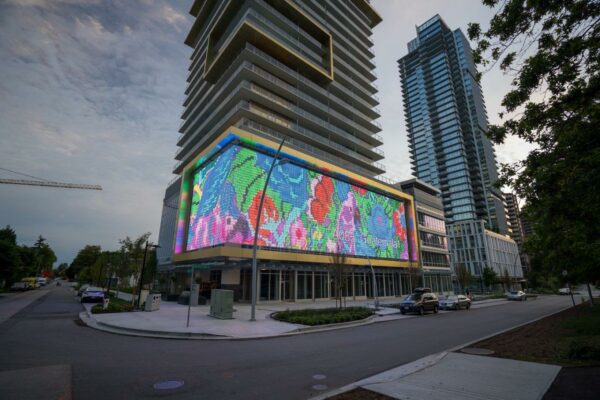
    A mixed-use development in the City of Burnaby, British Columbia, for example, incorporated an innovative and compelling LED canvas on the exterior of the building as part of an initiative to promote pedestrian and transit-friendly spaces in the fast-growing Metrotown area. Showcasing digital artwork from local artists, the installation measured 144-feet-long by 33-feet high and featured a high transparency LED mesh that allowed the building to preserve the availability of natural light.

    Planar outdoor fine pitch LED
    Planar outdoor fine pitch LED

    Are you wondering whether deploying outdoor fine pitch LED display technology is the right move for your company? Let’s address some of the most significant ways the technology is changing the game for the display industry today:

    • Withstanding weather conditions: Design elements ranging from UV protective treatments and dust-tight enclosures to waterproofing, wear-proof masking and mesh for low wind resistance are crucial for protecting your outdoor display technology’s image quality and all-around system operation. Fortunately, these are available today and better yet, manufacturers are increasingly mindful about designing features that will preserve the viewing experience. This not only maximizes your use of the display, but more importantly, your investment.
    • Enhancing viewing distances: Outdoor LED display technology has come a long way in recent years, especially in the case of pixel pitches. Manufacturers are offering pixel pitches as low as 1.5 millimeters and already, we’re seeing demand for even finer pitches. Considering 10 to 16 millimeters used to be the industry standard for outdoor LED displays, we can expect to see even more incredible innovations in the future.
    • Unlocking applications previously unimagined: While outdoor LED displays were previously selective to key markets, today we’re seeing options for nearly any application environment. The technology is adaptable to nearly any size or shape and as a result, industry demand and advancements are fueling a strong rise in custom, breathtaking LED video wall installations. From immersive video art installations at tourist destinations and vibrant scoreboards electrifying crowds in sports venues to durable video wall flooring that offers a platform strong enough to hold people, vehicles and much more, modern-day outdoor LED display technology allows customers to bring visual creativity to life.
    • Extending lifespans and demonstrating ROI: Traditionally, the industry turned to LCD technology to deliver precise visual messages, especially in situations requiring very close viewing distances, but few outdoor solutions were available, came at a high price and lacked the long-lasting brightness that was needed. By comparison, today’s outdoor LED displays demonstrate an ability to stay bright for nearly 10 years. This, combined with the fact that more manufacturers are introducing display solutions with front serviceability and simplified maintenance for reduced downtime and costly repairs, now makes it easier for companies to justify the expense of purchasing an outdoor LED video wall solution.

    Hear more from David at The Digital Signage Event, March 4 and get 4.75 CTS RUs in the process. Register here.

     ###

     David Thibeau is director of fine pitch outdoor and general manager of transportation division at Planar. He leads his staff in designing and integrating the best digital signage solutions for each client’s needs.