Category: Article

  • Are We Ready for the AI Revolution in Audiovisual?

    Are We Ready for the AI Revolution in Audiovisual?

    Really, really ready for AI in AV

    in episode 600 of AVWeek, Tim Albright, our host, invited Bren Walker from Kirkegaard Design & Consulting, Brittany DiCesare of Control Concepts Inc., and Tom LeBlanc from the NSCA to talk about the hottest topic of the decade: AI in the AV industry! They dive deep into Microsoft’s groundbreaking developments and what it means for the future.

    GPT: The Genius Behind the Text

    Ever heard of Generative Pre-Trained Transformer (GPT)? It’s this crazy AI technology that takes a simple sentence and turns it into a well-researched paragraph. Perfect for transcribing meetings, conferences, and speeches – kiss manual transcription goodbye!

    Subscribe for AV News Updates

    Microsoft’s OpenAI: Revolutionizing Online Meetings

    Microsoft’s Teams Premium now has GPT technology built-in, thanks to OpenAI. You’ll get automatically generated meeting notes, recaps, and personalized highlights, making it easier than ever to review meetings. Microsoft plans to add even more features, like speaker-based timeline markers and AI-recommended tasks based on meeting discussions.

    AV + AI = Match Made in Heaven?

    Microsoft and Bing are making AI more useful than ever for all industries, but it’s a game-changer for the highly technical AV world. AI can help save time in presentations, spare the work of transcribers, and learn your preferences over time. But is it all good news?

    AI Concerns in AV: Too Good to Be True?

    AI might reduce human error, but it brings the risk of computer error. Brittany DiCesare reminds us to keep the human touch, as AI can’t always pick up on nuances as we can.

    “As someone who used to have to take meeting minutes… [paper and pen] can be a great tool,” shared DiCesare, who is Client Success Manager at Control Concepts Inc. “I think we have to be careful that we don’t lose that connection and the human side of all of this. I think there are things and nuances that can be picked up and perceived by a human that AI can’t necessarily do right now.”

    The secret? Knowing which tasks to automate and which need that personal connection.

    The Ultimate Question: Is AV Ready for AI?

    Find out the answer in AVWeek’s special 600th episode, “Is AV Ready for AI?” Don’t miss Tim Albright and his guests talking about AI, the Philadelphia Eagles’ stadium audiovisual upgrades, and the latest in educational tech. Check out the podcast from our website, or watch the video on YouTube to learn more.  🎧📺

  • Strategic Alliances

    Strategic Alliances

    How Netgear and Origin Acoustics bring streaming audio

    Recently partnered Netgear, Inc., and Origin Acoustics are two AV giants on rather opposite sides of the tech world that both work heavily with the audiovisual (AV) industry. In the 367th podcast episode of ResiWeek, titled “The Origin Story,” host Matt Scott speaks with Origin Acoustics’ Joe Whitaker and Netgear’s John Henkel about what this strategic partnership means for their companies’ futures.

    What Is Netgear AV?

    Netgear is a networking hardware company best known for its networking services, security solutions, and online storage. For years, Netgear has stood out for being more affordable and less complicated than other network hardware options — which is part of its goal of making networking easier for everyone.

    Recently, the tech giant rolled out Netgear AV, which integrates systems within residential and commercial buildings to improve the network’s strength and security. Netgear AV connects to laptops, phones, speaker systems, digital photo frames, surveillance cameras, and more.

    With the fully integrated network, Netgear AV ensures that the internet connection is stable throughout the entire property, both indoors and outdoors, and that every piece of data within the network is protected. All of this is done through Netgear’s advanced switchboards, such as the M4500 Managed Switches.

    Additionally, Netgear AV provides unlimited resources, such as product images, education, assets, white papers, and online AV courses, for businesses to use. These vast capabilities and resources are a result of Netgear’s ever-expanding list of partners, with Origin Acoustics being among the most recent.

    Subscribe for AV News Updates

    The Birth of an AV Partnership

    As part of their new partnership, Netgear AV’s switches and Pro WiFi Access Points are now available from Origin Acoustics. The partnership was announced at Integrated Systems Europe (ISE) 2023. The team-up allows Netgear to be further integrated within networks’ audio systems and also allows easier access to Origin Acoustics speakers.

    “Netgear’s been fostering relationships for years with all kinds of partners,” says Henkel, Director of SMB Product Marketing for Netgear AV. “[We are] making it easier for integrators, for the end users, for everybody to start getting into networking because it’s not easy.”

    Based in Nevada, Origin Acoustics manufactures speakers “for every space.” Its products include cinema speakers, amplifiers, subwoofers, outdoor speakers, in-wall loudspeakers, and other audio options that can be integrated into almost any building, exterior, or vehicle.

    Whitaker, Vice President of Business Development for Origins Acoustics, recognizes that most music today is streamed or cast wirelessly, stressing the need to expand the company’s network capabilities further. As part of its partnership with Netgear, Origin Acoustics aims to provide residential and commercial customers with end-to-end solutions that improve their entire ecosystems rather than just their audio systems.

    Benefits of AV Partnerships

    AV partnerships make the advancement of AV technology a collaborative effort. In the cases of Netgear and Origin Acoustics, communication, integration, and customer service have noticeably improved for both companies.

    Reducing Complications

    The Netgear AV and Origin Acoustics partnership makes their products more accessible for customers and clients. According to Henkel, AV networking is new and, therefore, complicated, especially for residential AV. Because of this, Netgear has tech support teams worldwide who respond to emails within only a couple of hours. Additionally, Origin Acoustics now provides a direct phone line for professional engineering support.

    Having two tech companies like these work together generally makes solving technical problems much easier. Since Origin Acoustics’ and Netgear’s products are integrated, troubleshooting can usually be resolved via one email thread. When systems aren’t integrated at the corporate level, customers may be left contacting multiple tech companies to try to identify which company’s product might be causing the problem.

    Faster Turnaround

    According to Whitaker, Origin Acoustics’ partnership with Netgear AV has already improved its efficiency. In the past, Origin Acoustics’ most complicated speaker setups could’ve taken up to a week to install. Now, thanks to Netgear’s help, Origin Acoustics is significantly better at identifying and communicating access points, heat maps, channels, bills of materials, and everything else necessary for a high-quality AV setup. According to Whitaker, its longest setup since the partnership has only taken three hours.

    ResiWeek 367

    This strategic alliance between Origin Acoustics and Netgear is still in its early days. In “The Origin Story,” ResiWeek host Matt Scott asks the companies’ leaders what we can expect from the future of their partnership. They also speak about the impacts electric vehicle chargers and Sony’s new receiver models may have on the greater AV industry. Watch the podcast on YouTube or listen on our website to learn what these tech experts have to say.


  • 7 Ways to Rock Return to Work

    7 Ways to Rock Return to Work

    The last few years have been filled with stress and uncertainty. It’s hard to imagine that things will ever go back to normal. Regardless, at some point, we’re going to be making a return to office spaces.

    It’s unclear what exactly this will look like as more employees look to continue working remotely in one way or another. Hybrid work may very well be the future, but that will still require employees to be in the office at least part-time.

    Even though we don’t know exactly when offices will be up and running again, it’s a good idea to start planning your office return strategy. Here are seven great ways to rock your return to work.

    Return to Work group
    Return to Work group

    Implement Health and Safety Measures

    Many employees, especially those with compromised immune systems or other preexisting conditions, may be particularly nervous about returning to work.

    To address these safety concerns, it’s important to put measures in place to reduce the spread of infection. OSHA’s return-to-work manual can help employers plan for a safe reopening. The guidelines suggest that employers:

    • Be willing to adjust plans based on current local outbreak levels
    • Provide hand-washing supplies to all employees and guests and encourage frequent and proper hand-washing
    • Provide hand sanitizer for employees and guests
    • Enhance the office’s cleaning and disinfecting policies for high-traffic spaces
    • Monitor business occupancy to accommodate proper social distancing
    • Require employees to monitor themselves for COVID-19 symptoms and provide equipment like thermometers when necessary
    • Establish a protocol for managing and tracking sick employees, including notifying employees who may have been exposed as soon as possible

    Follow CDC guidelines when an exposed or formerly ill employee returns to work.

    Reconsider Sick Policies

    Before bringing employees back into the office, companies should consider adjusting their sick leave policies to allow employees to regain their health faster and avoid situations in which employees can get sick at work in the first place.

    The average employee in the US gets 7 sick days a year. A COVID-positive employee could use those 7 days up fast. Businesses should consider offering employees more sick days or even offering sick days specifically for use in case of a COVID infection.

    Hybrid employees could also be given flexibility in their telework schedules. This would be an excellent option for employees who have been exposed but aren’t yet showing symptoms. Allowing them to work from home in such events will reduce the spread of COVID in the office.

    Hoteling Spaces

    Office hoteling is the concept of having unassigned workspaces that employees can reserve when they’re in the office, rather than each employee having their own desk or cubicle.

    This concept has benefits for both the company and the employee. Businesses can choose locations with a smaller footprint by reducing the number of workspaces. This also gives them flexibility on location. On the other hand, employees can choose whichever workstation is best for them when they’re in the office.

    Office hoteling creates flexibility in the office space. Just be sure to implement appropriate sanitization protocols for the workspaces between uses.

    Return to Work sound masking
    Return to Work sound masking

    Offer Noise Reduction

    For many remote employees, returning to the office may be overwhelming. The home office doesn’t usually have constantly-ringing desk phones or colleagues’ voices contributing to a rather distracting ambiance. One study from 2013 showed that a lack of sound privacy was the number one frustration for office employees.

    To help quiet the office and promote focus, companies can try options like:

    • Having dedicated quiet and loud workspaces
    • Feeding in white or brown noise
    • Using soundproofing materials for sound masking

    Bring the Outside Inside

    Adding greenery to the office space is a fantastic way to boost employee morale. One 2014 study found that adding plants to the work environment increased productivity by 15%. Adding indoor plants may also help lower stress.

    Methods for adding greenery into an office space may be as simple as adding more plants here and there. But it can also include setting up a vibrant outdoor space. As a bonus, plants help reduce noise pollution indoors.

    Return to Work standing desk
    Return to Work standing desk

    Update Seating and Offer Standing Options

    Doctors have long claimed that sitting for long periods is bad for our health. Jobs that require an employee to sit at their desk for most of the day can lead to health issues such as increased blood pressure, high blood sugar, and unhealthy cholesterol levels.

    Remote employees can customize their desk chairs or even avoid sitting altogether. Many may take short walking breaks to relieve stiffness during the day. Businesses should consider incorporating some of these options into their return-to-work strategies for in-office employees.

    Ensure Effective Communication

    Regardless of the changes or preparations made for a return to the office, communicating openly and effectively with employees is the most important factor. This will ensure that everyone is on the same page.

    A few tips for communicating with employees include:

    • Talking the plan through with your employees before telling the public
    • Ensuring customers and clients are aware of the new changes
    • Explaining how the changes will make the office a safe and healthy space for employees
    • Asking for employee feedback on the back-to-work plans
    • Being flexible with the new changes

    A Safe and Smooth Transition for All

    Some of your employees will be happy to go back to the office. Others may be reluctant. By incorporating the strategies above, you can help make the transition smooth for everyone.

    AVNation will be heading to the Modern Work Summit this September. Click here for more information. We might see you there.

  • InfoComm 2022 and the Verified Attendee

    InfoComm 2022 and the Verified Attendee

    Trade show attendance numbers and ROI

    In 2019 ISE (Integrated Systems Europe) touted 81,000 attendees. CES had about 110,000. NAB weighed in at 107,000. InfoComm 2019 was 42,000 in the Orlando summer. But what were the “real” numbers of those shows? Not certain any of us will ever know.

    One thing that the pandemic gave us was the idea, the metric, of verified attendees. I, for one, applaud AVIXA for pushing this as the new reality. In 2021, during a COVID variant, AVIXA still put on the annual North American commercial AV show. The number they posted after the October event was 7,500 “verified attendees”. For this years’ trek to Las Vegas those numbers came in at just under 20,000 (19, 681) verified attendees. Verified attendees? Now, what does it take to be verified?

    For both CES and NAB in 2022 the listed audience number was made up of integrators, press, consultants, customers, and exhibition staff. This type of accounting lends itself to inflated overall numbers. Those numbers look great in a press release and when you are trying to sell next year’s show. Where it doesn’t work is with exhibitors.

    Why Verified Attendees Matter

    As a reminder, my day job is head of marketing for CTI in St. Louis. For the second InfoComm in a row we have exhibited on the show floor. I have had some incredible learning, and humbling, experiences the last two shows. One of those is figuring out how many attendees you managed to get to your booth. If you’re a large manufacturer with a ginormous booth, no sweat. You simply put out your sign and, BOOM, you have people magically show up. For the rest of us, our booth visits help with the ROI (return on investment) of the cost of showing.

    Even for those large manufacturers, ROI is a concern. Exhibiting at any tradeshow has a couple of considerations. For InfoComm, it’s a combination of connecting with the AV users, in-house integrators, and decisions makers. We are also supporting the overall AV community by supporting AVIXA. Even still, accounting will ask me how much we spent and whether it was worth the money. Giving exhibitors, large and small, the ability to confidently gauge how well they attracted people to the booth is one-way AVIXA and InfoComm help, at least this exhibitor, make the decision on whether to return next year.

    On AVWeek Episode 566, our guests weighed in on the Verified Attendee metric. Dawn Meade, now an end-user but an integrator in years past, said “The fact that they’re giving you verified numbers, that’s a hard metric. That’s an actual number that you can rely on.” Meade went on to say that not only was the metric substantial but the quality of the audience was greater than in 2019.

    Joel Norris from Shure added, “(the verified number) has given us some granular detail that allows for better demand planning.

    Listen to AVWeek

    AVIXA is just one organization in a sea of other trade shows. Having them lead the way in this area is a positive first step as we move beyond COVID and into a version of live events that is both positive and safe. Events aren’t going anywhere. At least not in the tech field. There are too many new and emerging technologies that require the user to see, hear, and experience Giving those of us that exhibit a more transparent attendance number to base our future plans on is a welcome change from other shows. Thanks. Keep it up, AVIXA.

  • Wrapping up ISE 2022

    Wrapping up ISE 2022

    ISE swings back

    From 10 until the 13 of May, Integrated Systems Europe (ISE) returns to a full-strength show. The first show to be hosted in earnest at Barcelona’s Fira Gran Via conference center brings the European AV world back together. Not since February of 2020 has this many EMEA audiovisual professionals been gathered together. Much has happened since then. Based on the excitement, energy of the show, and numbers, the AV world is coming out of the pandemic and is ready to come together.

    Watch all of AVNation’s video interviews from ISE 2022

    ISE 2022 Fira Gran Via

    First up, the Fira Gran Via is huge and is easy to navigate. The second floor allows attendees to quickly jump above the crowd and pop in and out of Halls 2 through 7. For some reason Hall 1 was not in use. Not certain why and it wasn’t overly important for the show. Hall 4 is where the IoT Solutions World Congress held their event in conjunction with ISE. On the second floor as well were four outdoor patios. These were sponsored by various organizations and featured food and beverage as well as comfortable seating. It was a nice respite for a hectic show.

    The layout of most of the halls was straightforward. There were spaces for live events, digital signage, and video processing. Two of the halls were labeled “multi-technology” as those spaces featured a diverse set of manufacturers. Typically they were the biggest booths on the show floor. A couple of highlights from around the show.


    ISE 2022 Holoplot
    ISE 2022 Holoplot

    Holoplot is touting themselves as the first “matrix array”. This speaker system allows dealers to pinpoint different audio throughout a venue. Designers can send different audio to different parts of the audience. This can include language translation, dynamic processing, and distributing.

    Hall 7 also housed at least four local integrators highlighting their abilities. I found it refreshing to see AV experts showing off their skills.


    ISE Digital Signage

    Hall 6 is the new Hall 8 for those used to ISE’s past. Digital signage lives here, but not to the extent of years past; at least not yet. A large percentage of the Chinese manufacturers were not allowed to travel from their home country. We’ll see more LED and other signage manufacturers as that country’s COVID wanes. The hall also featured a Retail Showcase that gave attendees ideas for the future of signage and retail.

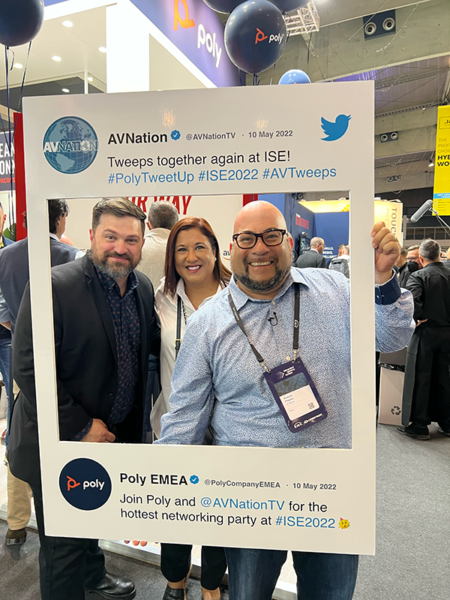
    ISE 2022 Tweetup
    ISE 2022 Tweetup

    Coming Together

    According to ISE, the attendance logged in at 43,000 “qualified attendees”. The reporting structure is different than years past. There was a time when we just received number of attendees. This new qualified attendees are just those who signed up and were scanned coming in. The number does not include manufacturer attendees which makes the number a bit more reliable. Based on the feeling of the show floor and I would absolutely agree with this assessment based on the business of the crowd. The AVNation PolyTweetup was a huge success thanks to our team and the Poly team.


    Improving on ISE 2022

    As great as it was getting back together with our EMEA counterparts, there were some areas that could use improvement. The ISE team provided attendees with a free public transit pass. That was a nice touch. Those of us who had never been to Barcelona may have been better served with buses similar to what we’ve experienced at InfoComm. The lack of coordinated transportation and the absence of Uber or Lyft, put an undue stress on the taxi system.

    Then there is the issue of the badges. Had you not paid attention to social media, the bottom line is there were no badges. At least not officially needed. Should you choose to print your badge you couldn’t use it to get scanned in to get in. You had to use the app to get access to the show. It was inconvenient to some vendors and attendees to lean on the phone/mobile app to scan someone’s information. In addition, exhibitors can quickly assess someone’s geographic location and connect them with the right person. I’m certain there are areas others can point to, and this is the first show at the Fira for ISE, so they’ll have plenty to discuss before January of 2023.

    ISE 2022 Sagrada Familia
    ISE 2022 Sagrada Familia

    It felt incredible to be back in person with so many AV professionals. The stands exhibitors put up were creative and highlighted their core strengths. Barcelona as a city was outstanding and I loved the opportunity to explore it’s unique beauty. As an industry we are getting back. As live events and conferences, that segment is getting back as well. Put ISE 2023 on your calendar of events to consider. From 31 January through 3 February, 2023 back in Barcelona. I’ll see you there.

  • What is NEXT for Crestron

    What is NEXT for Crestron

    On the road again with Crestron

    When the pandemic was beginning to wane, Crestron made the commitment to exhibit at InfoComm 2021. But then the various variants that violated the vestiges of society reared their ugly heads. Crestron still showed up to Orlando, though in a much-muted way. As COVID began to calm down, the New Jersey AV manufacturer hit the road. With a new CEO in place, Crestron NEXT is aiming to bring their vision of the future of AV, UC, and work to a city near you.

    My stop took me to the Minneapolis version of Crestron NEXT. Housed just 20 minutes from the MSP airport, the space was large and diverse. With Crestron you have the benefit of seeing innovations in both the commercial and residential spaces.

    [bc_video video_id=”6303951125001″ account_id=”6090301008001″ player_id=”LHZ0TGeaR” embed=”in-page” padding_top=”56%” autoplay=”” min_width=”0px” playsinline=”” picture_in_picture=”” max_width=”640px” mute=”” width=”100%” height=”100%” aspect_ratio=”16:9″ sizing=”responsive” ]

    The same “Teams”

    The integration of soft codecs within the AV space is crucial to a company like Crestron. Their newest versions of their Crestron Flex Phones for Microsoft Teams allow for full Microsoft Teams functionality. It isn’t like having an extra appliance, it is exactly having an extra Teams-specific device on your desk. In that way you can still be on your call and access your computer as well.

    I may be of a certain age, and that’s fine. I’m too old to care anymore. Having an actual physical handset to pick up, talk into, and “hang up” is very gratifying. It’s almost comforting. A technical version of a warm blanket or the smell of my grandmother’s biscuits.

    Supply Chain

    Supply chain disruptions impact us all. Crestron is no stranger to that either. One solution the company has come upon is to streamline some of their most popular products with chips and parts they can still access. DM Lite is one of those innovations. Take the popular DM product line, remove some of the features that aren’t always used, and you have DM Lite.

    These products have a much shorter lead time than traditional DM devices, and most of the functionality. With the introduction of DM Lite, Crestron has also been able to develop DMPS Lite. The “room in a box” solution that Crestron popularized over a decade ago also have shorter lead times than the legacy versions of DMPS.

    Crestron’s AirMedia technology has also had an evolution. The AirMedia Connect adaptor brings detethered wireless presentation to the AirMedia lineup, providing a simple and intuitive way to make any space a meeting and collaboration space. With AirMedia Connect, you can add wireless presentation capabilities to any space without the need for additional wiring or infrastructure. AirMedia Connect also provides a way to simplify guest presentation, without the need for presenters to connect to the internal network. Native support for Microsoft Teams or Zoom video conferencing ensures that meetings happen within seconds, either through a wireless connection on the AirMedia network or by plugging any USB-C device into the AirMedia Connect, without the need to download additional software. If you weren’t aware, AirMedia can also be used as a digital signage solution throughout the network.

    As the world comes out of its two-year hibernation, companies like Crestron will continue to reach out locally. Certainly there are members of the AV community who either don’t feel comfortable in large spaces and gatherings or aren’t allowed to get together because of employer restrictions. Localized events like Crestron NEXT give us in the AV community the chance to reconnect with colleagues, customers, and friendly competitors.

    See a full list of upcoming Crestron NEXT dates.

  • First Timers Enterprise Connect

    First Timers Enterprise Connect

    Entering further into Unified Communication

    For someone who likes to attend trade shows, you would think I’d have already experienced the UCC (unified communication and collaboration) spaces premier gathering. Alas, such is not the case. Since COVID hit and the world turned on its head, I figured there would be no time like 2022 to experience all the things I had been putting off; including Enterprise Connect.

    Enterprise Connect is a bit different than other shows I’ve attended. The three-day format is similar but education is handled on the front end. The show floor doesn’t open until noon. The later start is nice but so is having the opportunity to go to keynotes and education sessions. At some shows attendees have had to choose between the show floor or education.

    Hybrid

    The overarching word of the week was Hybrid. This should come as no shock to anyone in the UCC or audiovisual (AV) space. Employees were sent home en masse in the Spring of 2020 and sort of just figured out how to get work done. The team members who had been the outcasts working remotely suddenly were the wisened old uncle with all the answers.

    Fast forward two years and every person who took the keynote stage was talking about Hybrid work. Zoom, Ring Central, Google, and Poly all had presentations surrounding work from anywhere.

    Show Floor

    Highlights of the show floor was the realization that I knew most of these companies. It may not be the same exact people that I’m familiar with but Biamp, Shure, DTEN, Poly, AtlasIED, Sennheiser, and GoTo were all there. Certainly there were companies we’ve had very little interaction with in the AV space exhibiting. The nice part was the familiarity and how those AV companies fit into the UC space.

    Neat was a particular bright spot. The brain power behind Neat has a long history in the AV and UC space. That legacy know-how shines through. The Neat Frame is a personal device positioned like a portrait mobile device. Neat has had the Frame for Zoom for a while. During Enterprise Connect they announced Teams certification and integration. Though that won’t be available until third quarter this year.

    Call Centers

    Zoom and others released either new or updated products in the call center space. These solutions allow for companies, integrators included, to bring together CRM, ticketing, and call mangagement into one interface. In that way you and your service team can see logs and data on speed and efficiency of service teams.

    Though it was my first time at Enterprise Connect it won’t be my last. This show has demonstrated a unique view of the “AV/IT” convergence that those of us on this side of that divide have talked about for twenty years. As it becomes ever more clear these two industries are more related than not, you’ll see more AV companies at Enterprise Connect.

  • Heading out to Enterprise Connect 2022

    Heading out to Enterprise Connect 2022

    Back together for UCC

    This is a year of firsts for me professionally. I’ll attend more trade shows and conferences in 2022 than I have in any year prior. While I’m looking forward to the new technology, new connections, and new places on the map it’s the new shows that really get me.

    One of those is Enterprise Connect. The show has been billed as the unified communications show. In talking with past attendees, it’s more than that.

    First, this is the chance to see the biggest names and companies speak about collaboration, conferencing, and the future of work. As someone who serves the corporate community, this is huge. Google, Microsoft, Zoom, and others will send their brightest minds to give attendees a glimpse into what they are working on and what to expect next.

    There will certainly be gear there. Poly, DTEN, Shure, Barco, Jabra, AtlasIED, and a number of other typical AV companies. In addition to the regular cast of characters, I’m getting ready for software codecs, headphone manufacturers, and camera companies.

    As the world is getting back to normal, and getting back together, it’s important to realize there are some that want to stay remote. Whether that is due to medical issues, travel concerns, or supporting family in various ways, some in our workplaces have no need, or ability, to travel the globe. Enterprise Connect will allow us to continue to connect those team members.

    As an industry AV will also have to keep pushing forward with various remote production capabilities. The pandemic has blown wide open the notion that you need $100,000 worth of gear to connect various participants in a “Around the Horn” style production. I could almost write “all you need…” but it’s more than just a cam and mic. You do need a good camera. Visuals are still important. Not nearly as important as the microphone, though. Your audio is crucial. Poly, Jabra, and Shure showing at Enterprise Connect is a testament to that fact.

    I expect to meet new people. I expect to discover new hardware and software solutions. Most of all, I expect to learn something at Enterprise Connect. If you’re headed to Orlando for EC 2022, send me a note, tim at avnation.tv and let’s connect. If not, watch AVNation’s website for videos, interviews, and more.

  • How 4K Projection Technology Revolutionizes the Visual Experience

    How 4K Projection Technology Revolutionizes the Visual Experience

    Projectors have come a long way since their inception over 100 years ago. Instead of just being used for classroom and movie theaters, projectors can now provide an immersive experience like never before. 

    “The great thing about projection is you can turn on any show at any given time. It can be a van Gogh show during the day or an after-hours party at night,” said Joe Conover, Strategic Manager for Panasonic Themed Entertainment Solutions.

    Panasonic has provided projection solutions for decades. Projection mapping technology has transformed what would normally be an exciting live event into an immersive and captivating experience as well. An example of the excellence of the Panasonic projection technology is the projection mapping used for both the opening and closing ceremonies of the Olympics. The company has partnered with innovative entertainment experience companies, such as Area 15 in Las Vegas and Illuminarium in Atlanta to bring their visions to life.

    “When we say immersive technology, we are talking about projecting on all walls and floors in particular to give you that full eye-catching visual experience,” Conover said.

    What makes these immersive projects possible also includes their high-speed projection mapping and tracking solution. This software allows projectors to track objects at high speeds while also projecting onto them. For instance, Panasonic’s new PT-RQ35KU 3-Chip DLP® projector can track a ping pong ball at fast speeds while projecting engaging graphics on the move. High-speed projection mapping and tracking works well on camera and in live events to provide an all-around, fast past experience.

    “I love when we put our emerging technologies in the hands of creatives,” Conover explains. Panasonic leads the charge, working hand in hand with their partners to take advantage of these new solutions and emerging technologies. 

    To learn more about the new and innovative ways Panasonic is using 4K projection technology, REGISTER HERE to check out the live webinar and Q&A on November 16th at 2:00pm ET (1:00pm CT / 10:00am PT). 

  • Working Remote after COVID-19

    Working Remote after COVID-19

    Back from the Pandemic

    There is no hiding that within the last year and a half, remote working has become almost everyone’s favorite change the COVID-19 pandemic forced us into. Now that the world is returning to some semblance of normalcy, it is time to consider how to proceed in the AV community.

    Despite the obvious and sometimes overbearing qualities that come with remote work, organizations have spent over a year trying to adopt this new method of getting things done. As operations resume, there are several obstacles that companies will face moving forward. HR will have many decisions to make, employees to please, opinions to sift through, and perhaps the most important, how should to balance the inevitable, partial, perhaps hybrid, return to work sites.

    After extensive research, Gartner provides us with “current data on remote work in practice,” as well as a three-part series “to help guide HR.” It is clear that waging employee preferences and needs will be critical in this new era of reestablishing in-person, hybrid, and remote work for everyone.

    Best practices leveraging UCC

    The research found on Gartner discusses the three imperative components of navigating this decision. The first, “benchmarking current remote adoption rates and outlining future remote patterns.” This means, your company must reflect on how effective and efficient the work over the past year has been. Data should be analyzed and compiled in order to create tangible evidence necessary for creating a reasonable plan of attack. Second to this, it is vital that companies address “perceived barriers to continued remote work.” The data completed in the first step will inevitably reveal negative consequences of working remotely. Once these flaws are acknowledged, they must be examined. It is also imperative that these flaws are met with predictions regarding potential obstacles that did not arise throughout COVID-19. Lastly, Gartner suggests, “providing a framework for making decisions about which parts of the workforce can or should stay remote.” Arguably, this last point is not easily resolved and in fact, it is quite moot. Companies should consider leaning into this last point, reaching out to employees, and understanding what the individual needs of each employer are. COVID-19 was, as everyone loves to say, unprecedented. As a result, returning to normalcy will look vastly different for some people. Respecting and assessing these opinions should set the foundation for a general sense of contentment once the return plan is finalized.

    For more information, we encourage you to do research on this topic. The article referenced in this blog post can be found here. It is no secret that what works for one company may not work for another. AV Nation encourages individual research and assessment of the company’s current climate.