Category: Loudspeakers

  • Pro Audio Technology’s Top Selling Loudspeakers Receive Performance Upgrades

    Pro Audio Technology’s Top Selling Loudspeakers Receive Performance Upgrades

    Pro Audio Technology (PRO) has announced performance upgrades to five of its top-selling loudspeakers, focusing on improving sound quality rather than launching new products. These enhancements include upgraded components and advanced DSP processing, delivering higher clarity, lower noise, and more accurate sound, especially for high-end private screening rooms. All products continue to be built-to-order in the USA and are engineered using industry-leading measurement and testing tools.

    A key highlight is the updated SR-28212ai v2 loudspeaker, which sets a new benchmark for depth, detail, and accuracy in a slim design. PRO also emphasized its commitment to continuous improvement, offering free firmware updates that enhance system performance over time. For customers, this means their audio systems can keep getting better without additional hardware investments.

    Pro Audio Technology (PRO), the leading supplier of loudspeakers and amplified loudspeaker controllers for elite private screening rooms, is proud to announce noteworthy improvements to five of its high-performing loudspeakers including: LFC-24sm 24-inch subwoofer, SR-28212ai dual 12” full range surround speaker with internal subwoofer, S-12sm 12” multi-use loudspeaker and its SR-12ai shallow version brother, and the compact-but-powerful, SR-8ai 8” shallow multi-use loudspeaker.

    PRO loudspeakers are built-to-order in the USA and unite lively dynamics, high maximum output level, and refined acoustic performance. For the past 21 years, PRO has focused on designing and manufacturing a complete range of loudspeakers and DSP amplified loudspeaker controllers that address the needs of high-end residential installations, bringing cinematic sound into the home – most commonly into upscale private screening rooms.

    “In 2025 we took a good look at our line-up of high-performing loudspeakers and instead of asking ‘what else should we make?’ we challenged our engineering team to take our best-selling models to the next level,” said CSO for PRO, Marc Bertrand. “Tweaking and improving PRO’s already highly respected line of loudspeakers and subwoofers was no easy feat but our engineers did not disappoint. By leveraging upgraded transducers combined with the highest-resolution loudspeaker processing in the company’s 20+ year history, 2025 brought substantial, tangible performance enhancements to these models.”

    Part of what makes PRO products so accurate, detailed, and refined is in the engineering practices and investment in the best laboratory equipment and modeling software available, from brands like Klippel, Bruel & Kjaer, Audio Precision, Loudsoft, and more. PRO headquarters in Orange County, California has a unique installation of the break-through Klippel Near Field Scanner (NFS) acoustic scanning robot – the most advanced, and most accurate way to measure loudspeakers extant. Every PRO loudspeaker is developed and optimized on the NFS, ensuring the most accurate sound reproduction possible.

    “The SR-28212ai v2 full-range loudspeaker is the most refined speaker PRO has produced to date,” said PRO CEO, Paul Hales. “We’ve now incorporated the Theory Audio Design 1.7″ 16-ohm compression driver. Not only will this update improve on the SR-28212’s remarkable performance, but it also aids in lowering audible system noise floor within large systems where many very high efficiency tweeters may be deployed.

    “We are particularly proud of the full-range SR-28212ai model, which sets a new standard for bandwidth (22Hz-23kHz), resolution and timbral accuracy from loudspeakers of any category. The SR-28212ai resolves more musical detail than my $4,500 reference beryllium headphones, which is crazy if you think about it. That such a capable loudspeaker is only 6” deep is icing on the cake. The fact is, real-world loudspeaker acoustic response doesn’t get much better than this!” (See the latest PRO SR-28212ai v2 measurements).

    Continuous improvement is one of the many benefits to purchasing PRO systems. PRO products employ the most advanced DSP techniques within a closed system, which means they can ensure the highest performance and highest reliability on the market. In addition, since the PRO engineers are crazy perfectionists, they are constantly improving the voicing of their loudspeakers and subwoofers.

    The speaker voicing for all PRO loudspeakers resides in the Theory loudspeaker controllers, and whenever there is an improved voicing made available for a PRO loudspeaker model, a simple firmware update brings that improvement to any project with a few simple mouse clicks (provided there are no component changes). And best of all, the performance improvements are FREE. Just like an electric vehicle, you may wake up one day and learn that ‘Ludicrous Mode’ has just been made available in your PRO speaker system.

  • L-Acoustics L Series Concert Sound System Brings New Life to Venerable Warfield Theatre

    L-Acoustics L Series Concert Sound System Brings New Life to Venerable Warfield Theatre

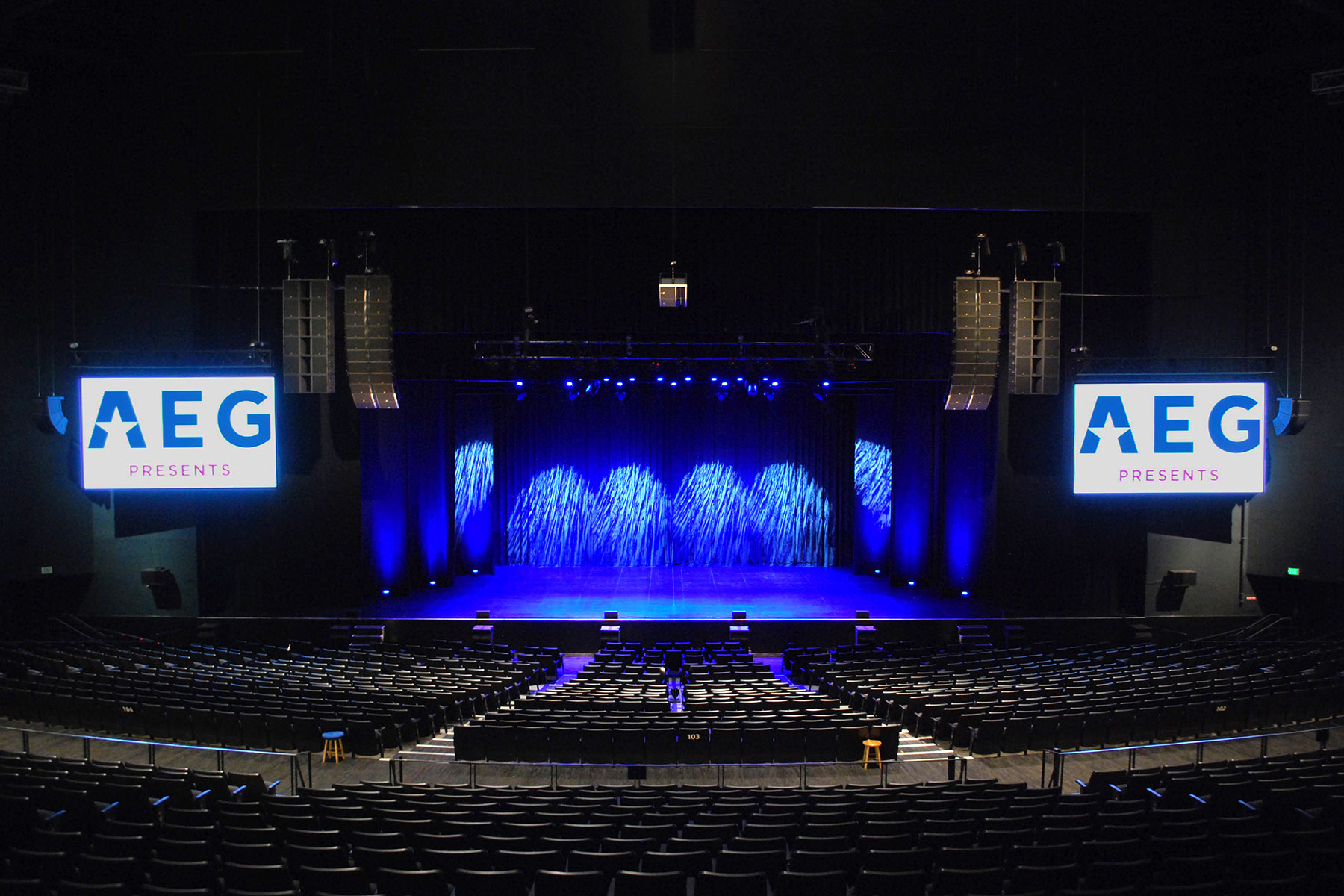
    “The Warfield.” That’s all you need to say in touring circles. Like “The Garden” in New York, these venerable venues are known by their nicknames, like old friends. And just like the artists that grace its stage, the Warfield Theatre, which opened in San Francisco in 1922, has worked at staying at the top of its game. That ethos was reinforced yet again this past July when the AEG Presents-affiliated venue installed its new sound system, L-Acoustics L Series, designed and integrated by Petaluma-based UltraSound, in conjunction with Certified Partner distributor Rat Sound Systems.

    This is the first time in 17 years that the 2,300-seat theater has refreshed its live sound. UltraSound Director of Operations Josh Osmond says the L2/L2D and other L-Acoustics components were chosen based on sonic quality as well as their thorough coverage capabilities, assuring great sound in every part of the venue. “We’ve been putting sound systems into the Warfield since the 1980s, so we know the room very, very well,” he says. “And I can say that this is the best this space has ever sounded.”

    What patrons experience there now is a system comprising three L-Acoustics L2 over one L2D per side, with a single A15i Wide flown as a central front-fill. The L Series arrays are supported by six KS28 subs per side, flown in a cardioid configuration and hung behind each main array, plus four more KS28 per side, configured in two stacks of two directly below. Between them, dotting the lip of the stage, are four low-profile Kiva II deployed as front-fills.

    Underbalcony seating is addressed via five A15i Wide loudspeakers spread out and individually mounted to the ceiling. And anyone in the lobbies during shows won’t miss a note, thanks to a pair of coaxial X12 on the lower level and a pair of X8i on the upper floor. The entire setup is powered by LA7.16i amplified controllers driving the L2/L2D arrays, LA12X that drive the subs and underbalcony fills, and LA4X that power the front-fills and lobby reinforcement systems.

    “Every seat in the house is now completely covered,” says Osmond, who, in addition to his role at UltraSound, serves as front-of-house engineer for both the Lumineers and John Legend.

    “Sonically, it’s a traditional theater, with the typical challenges a steep balcony presents. You need to cover up to the top of the balcony with consistent coverage all the way to the back, while also making sure you’re covering underneath, so you don’t have any ‘shadows’ under there.”

    One of the bigger challenges, he explains, is achieving uniform low-frequency control from the floor to the back of the balcony. “L Series gave us just that. It’s very directional, so it’s not bouncing off the walls; it’s really focused specifically on where it needs to cover. In conjunction with the flown subs behind the main arrays as well as the ground subs, it delivers a consistent target curve from the back of the room to the front of the house. There is simply no bad seat anywhere.”

    Although the main L2/L2D arrays are the obvious stars of the show, Osmond also praises the A15i Wide enclosures for their specific roles. “When you’re under the balcony, you’re essentially trying to extend the coverage of those main arrays,” Osmond explains. “You want to keep the tonal qualities and characteristics consistent, which definitely came into play in deciding the right product for the under-balcony areas. As you get into the front-fill locations, you’re bringing more vocal intelligibility to the very first few rows—the seating area where the main arrays don’t quite wrap down.”

    The five A15i units provide everything the under-balcony needs, while the center A15i Wide plus four Kiva II front-fills add coverage to that critical barricade line the main arrays can’t quite reach. “Every speaker has a specific job to do here,” Osmond notes, “and each one performs it perfectly.”

    Not surprisingly, artists passing through the Warfield since the new L-Acoustics system was installed have noticed the change, starting with Nigerian-American Afrobeat artist Davido and Americana darlings the Red Clay Strays, the first two touring artists to experience it. “Both of them were very impressed with the sound of the system and the room, and commented on it,” says Matt Albrecht, General Manager at the Warfield Theatre. “That kind of diversity was a great kick-start for the new system and reflects how it can handle any kind of music. Everyone who’s heard it now comments on the clarity of the sound, and how it stays clear even as the volume increases. ‘Loud and clear’ is a great way to describe it—the sound, even for the loudest shows, feels clean and controlled.

    “L-Acoustics L2 is a great amenity for the artists who play here, and it helps further set us apart when it comes to attracting those artists.”

  • Unified Soundscape: How Petrone Technology Group Deployed Coastal Source to Deliver Seamless Audio at the National Polo Center

    Unified Soundscape: How Petrone Technology Group Deployed Coastal Source to Deliver Seamless Audio at the National Polo Center

    Set in the heart of Wellington, renowned as the winter equestrian capital of the world, the National Polo Center (NPC) is a destination where elite sport, luxury hospitality, and South Florida’s vibrant social season converge. Home to the United States Polo Association, the 248-acre property is known for championship-level play, elegant member spaces, and an atmosphere defined by sophistication and tradition.

    For NPC, excellence is not just found on the field. It extends to the moments in between — the gatherings by the pool, conversations in shaded cabanas, pre-match energy at the indoor bar, and evenings spent around the fire pit. NPC wanted these spaces to feel as polished and intentional as the rest of the venue, and audio played a central role in achieving that vision.

    Therefore, NPC partnered with Petrone Technology Group, one of South Florida’s premier integrators of luxury residential and commercial AV systems, and Coastal Source, the industry-leading manufacturer and designer of high-performance outdoor audio and lighting solutions engineered to Defy the Elements™. Together, they created a cohesive, property-wide sound experience that elevates NPC’s social spaces, aligns with its architectural refinement, and delivers a seamless sonic environment worthy of America’s home of polo.

    “For a venue like the National Polo Center, every detail matters,” said Anthony Petrone, President of Petrone Technology Group. “Coastal Source gives us audio that enhances the guest experience without ever calling attention to itself along with the durability and performance we rely on outdoors. Using one ecosystem lets us create a continuous soundscape from bar to pool, cabana to fire pit where everything feels intentional and perfectly matched.”

    The previous audio system struggled with uneven coverage, volume fluctuations, and durability issues caused by Florida’s intense UV exposure, humidity, rain, and year-round operation. Consistency and reliability were essential, which is why Petrone turned to Coastal Source. Unlike conventional outdoor products, Coastal Source systems are engineered specifically for harsh climates, offering weatherproof construction, wide, even dispersion, and long-term performance the venue could trust.

    “NPC members recognize quality instantly,” Petrone noted. “When audio is uneven or equipment struggles in the heat and humidity, it breaks the mood. Coastal Source lets us design a system that simply melts into the environment. Guests shouldn’t be aware of speakers or settings, they should just feel the space working in harmony around them.”

    Petrone Technology Group approached the project with both acoustic precision and hospitality-driven intent. Each zone was carefully studied to ensure the audio complemented how people naturally gather, converse, and move throughout the space.

    Around the pool and fire pit, Coastal Source 12.0 Line Source Bollard speakers were selected for their wide dispersion, detail, and ability to maintain clarity at any listening level. Their discreet, sculptural forms blend into the landscape while creating a balanced soundfield that feels immersive but never overwhelming. The system is anchored by a Coastal Source 18.0 Bollard Subwoofer, providing controlled, musical bass that enhances ambience without dominating conversation.

    The cabanas required a more architectural approach. Coastal Source Razor RZ310 speakers offered the perfect combination of clean lines, weatherproof engineering, and true-to-life clarity — all while integrating seamlessly into the cabana structures. The result is a natural, unobtrusive audio presence across shaded seating areas.

    Inside the bar, speech intelligibility and ambience were key. Razor RZ220 speakers were chosen for their warm, articulate sound and their ability to match the voicing of the outdoor zones, ensuring a consistent audio experience as guests move seamlessly between the bar, pool, cabanas, and fire pit.

    Every loudspeaker is powered by Coastal Source Dante-enabled amplifiers, enabling synchronized audio across all zones and seamless integration with NPC’s existing Sonos platform. This unified ecosystem allows staff to manage the indoor and outdoor spaces as one continuous sound environment — adjusting levels, selecting sources, and shaping the atmosphere with complete consistency from inside to outside. All wiring is protected in underground conduit using Coastal Source’s weatherproof cabling system, ensuring long-term durability and preserving the venue’s refined aesthetic.

    “The installation was executed easily and quickly,” said Shaun Ramasawmi, Director of Facilities Management at the National Polo Center. “The recommended materials and equipment were all high quality, and the sound is truly impressive. I hear compliments all the time around the pool about the audio quality. The system is also very user friendly and easy to manage with the Sonos integration.”

    The completed system reflects NPC’s long-term commitment to hospitality excellence. Designed to endure Florida’s climate, tuned precisely for the property’s architecture, and integrated for easy day-to-day management, it brings a new level of refinement to NPC’s outdoor and indoor experiences.

    “We love the sound system by the pool,” added Patrick Marinelli, Director of Services and Special Projects at the National Polo Center. “The speakers are barely noticeable even if you’re looking for them, but the volume and sound quality is consistent across the entire space. The sound really improves the ambiance and completes this unique environment.”

    From morning gatherings in the cabanas to twilight conversations by the fire pit, the National Polo Center now offers an environment that reflects its reputation — immersive, welcoming, and unmistakably elevated.

  • Heart’s Ann and Nancy Wilson Rock U.S. Tour with JBL VTX System and Crown Amplifiers

    Heart’s Ann and Nancy Wilson Rock U.S. Tour with JBL VTX System and Crown Amplifiers

    The unmistakable energy of legendary rock group Heart’s live performances demands a sound system that delivers both power and musicality. The first person who knows that is veteran front-of-house engineer Gary Hartung, who’s helped deliver the band’s signature sound across arenas, sheds and theaters for several tours. After first specifying JBL Professional’s VTX V25 loudspeaker system for Heart’s 2019 tour, Hartung continues to rely on it today for the band’s 2024-2026 tour, citing years of consistent results and audience acclaim.

    Hartung, who has worked with Heart and vocalist Ann Wilson for more than a decade, first mixed on the JBL VTX system during a run of outdoor venues in 2019. “We had phenomenal success with that PA,” said Hartung. “With the VTX system, we were having great shows one after another so I knew I had made the right choice.”

    When Heart reunited for their latest tour in 2024, Hartung returned to the same JBL Professional system that helped define his live mix. The rig, provided by Sound Image, features VTX V25-II-CS mains, B28 subwoofers and VTX A8 front fills, powered by Crown I-Tech amplifiers. Hartung’s preference for JBL Professional stems from what he calls its musical smoothness and dynamic balance. “The VTX has a warm, natural character,” he said. “It’s not overly aggressive, it’s musical. That matters when you’re mixing a show that goes from hard rock to ballads. The system stays even and consistent no matter the dynamics.”

    Heart’s current production is a full-scale rock show built around a dense wall of guitars and powerful vocals from Ann and Nancy Wilson. Hartung emphasized that the JBL VTX system handles that range without harshness. This proved especially important during high-pressure shows such as Heart’s recent stop at Pechanga Arena in San Diego, a notoriously challenging acoustic environment. “It was one of those nights where everything came together – the band, the mix, the room,” Hartung recalled. “The feedback from industry friends and venue staff were unanimously positive.”

    With Nancy and Ann Wilson still performing at full power, the Heart tour continues to draw thousands of fans across North America. By pairing rock’s enduring energy with the precision and musicality of JBL’s VTX system, the production delivers the clarity, coverage and impact needed to make each night on the tour unforgettable.

  • Texas Trust CU Theatre Continues to Trust in L-Acoustics with New K2 System

    Texas Trust CU Theatre Continues to Trust in L-Acoustics with New K2 System

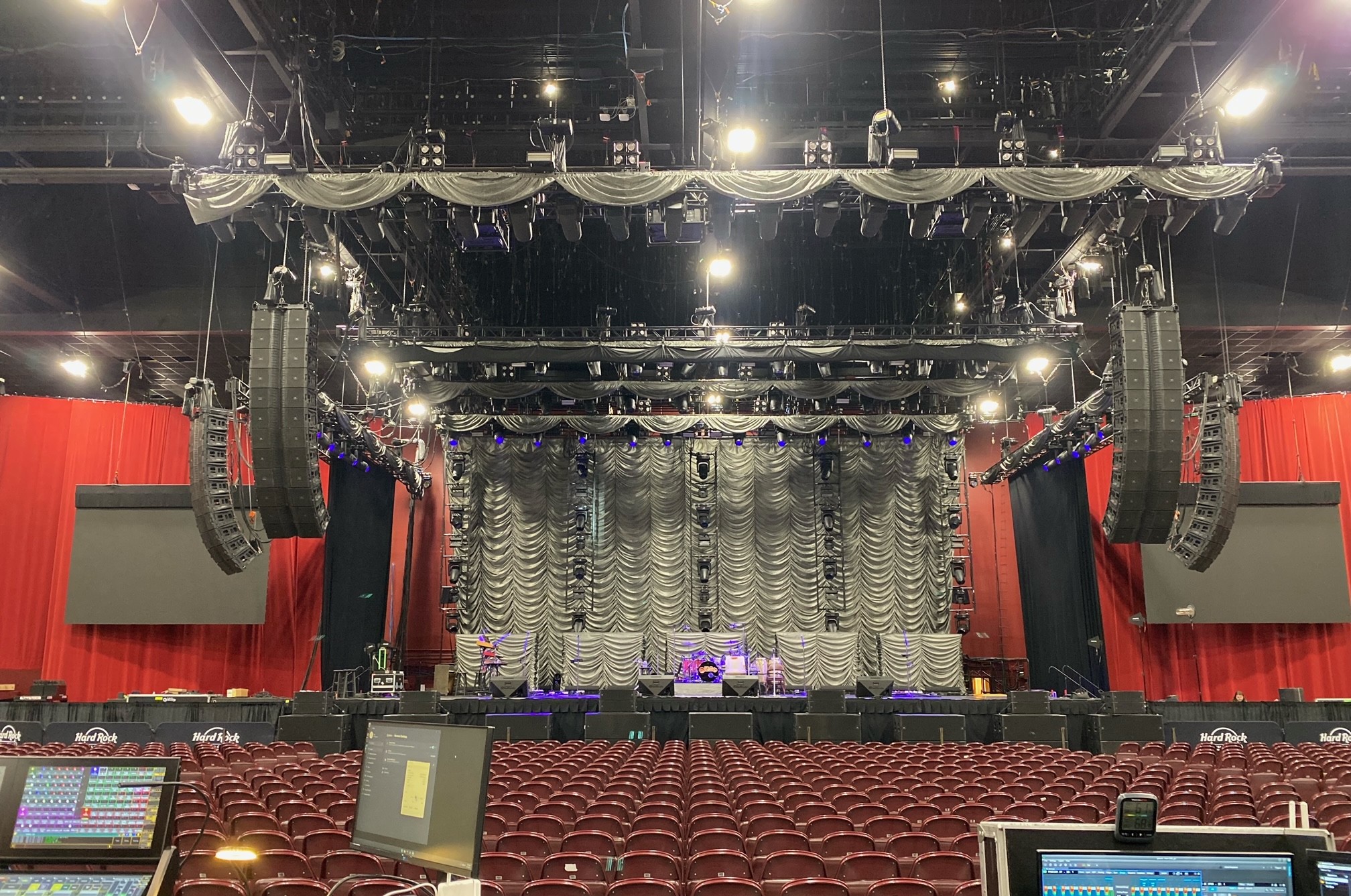
    Since first opening in 2002, Texas Trust CU Theatre at Grand Prairie has seen a variety of name changes: Texas ShowPlace, NextStage Performance Theater, Nokia Live, Verizon Theatre, and its current moniker, after Texas Trust Credit Union acquired the venue’s naming rights in 2021. However, one thing that has remained constant is the 6,350-capacity live performance hall’s commitment to delivering amazing-sounding concerts and shows, thanks in large part to an L-Acoustics V-DOSC loudspeaker system installed there by Onstage Systems more than a decade ago. Now, to best maintain that same commitment for the next ten-plus years, the city-owned and AEG-operated indoor theatre has upgraded its audio facilities with a modern L-Acoustics K2 concert sound system.

    “When looking for a new PA, L-Acoustics was the first contender on a very short list, and it was a very brief deliberation before deciding to stick with the ‘sure thing’ and a proven track record that is accepted on every rider,” says Tyler Johnston, Dallas Operations Manager for LD Systems, a Clair Global brand, which acquired Onstage’s equipment inventories earlier this year. “The venue’s V-DOSC system continued to deliver solid performance after more than a decade of service. However, as touring acts increasingly arrived with K2 systems, upgrading to match current industry standards became the logical next step—allowing the venue to offer seamless integration while maintaining the L-Acoustics reliability they’d come to trust.”

    Working with L-Acoustics Soundvision and the manufacturer’s Application team, Johnston designed the new system, which now features main arrays of 12 K2 per side, each backed by a hang of six KS28 subwoofers in a cardioid configuration. These are augmented by four KS21 subs on each side of the stage, located below the mains, while coaxial X8i are spread out across the stage lip as front-fills.

    L-Acoustics A15 enclosures are deployed for a center vocal array, as well as wide/out-fill arrays, with eight more A15 clusters flown from a delay ring addressing the upper balcony seating area. The entire PA is powered by LA7.16i amplified controllers, aside from the subs, which are LA12X-driven. The system also features a P1 processor and LS10 Milan-AVB front end that is fully redundant. For stage monitoring, the venue now offers a collection of X15 HiQ wedges and A15/KS21 side-fills, while a pair of DiGiCo Quantum338 FOH and monitor consoles round out the new gear complement.

    The Soundvision design’s final result is a system that offers across-the-board improvements in power, fidelity, dispersion, and physical size. “We went from 15 boxes in the previous system to 12 per side, because of the vertical and horizontal coverage pattern of K2, and still got better coverage,” Johnston notes. “Single-box resolution on the LA7.16i amplified controllers allowed for optimal filtering from the top to the bottom of the arrays, providing very even coverage and tonal response throughout the venue. The delay ring is quite robust and those ‘cheap seats’ actually sound great now with overlapping A15 clusters hitting every inch of the balcony, while still getting some of the power and ‘feel’ from the big K2 and KS28 arrays at the stage.”

    Johnston proudly reports that he’s already heard numerous positive comments about the “consistency of coverage and how there are no longer any bad-sounding seats,” he says. “And, of course, the rider acceptance is great. When your tech pack reads ‘K2 PA, X15 wedges, and Quantum338 desks’, there’s no pushback from any touring artist. The cost and hassle savings of not having to constantly negotiate removing house gear has been a huge boost to their operations, and their new K2 setup was absolutely the right choice for them moving forward.”

    For Amanda West, AEG Presents’ Director of Production, the new system’s enhancements in fidelity and coverage were immediately noticeable. “The sound quality in the balcony and far reaches of the theater is striking—every patron is truly hearing the same concert,” she says. “Another big plus is that touring engineers are all really pleased with what we have to offer and enjoy mixing their shows in our space.”

    Roger Gates, the venue’s Operations Manager for AEG Presents, also appreciates K2’s sonic performance. “Alan Parsons played a concert here, and it sounded absolutely amazing!” he enthuses. “Alan is known for his studio magic and attention to detail when it comes to sound and the listening audience’s experience, and he did not disappoint when he performed on our new system. It was probably as close to his studio sound as you can possibly get, and both our guests and staff were floored by the quality of the audio.”

    “And there are many other similar examples,” he continues. “Dwight Yoakam played a great show, and his acoustic guitar was bright and up front in the mix. More recently, we hosted tribute act Brit Floyd, and the room sounded incredible with everything you’d expect from listening to Pink Floyd’s music. All of the details were clear and bright, with no muddiness or loss of fidelity. One could have easily confused the sound for a high-quality, well-mixed live recording. That’s a huge compliment, not only to the band and their engineer, but also our new K2 system, which delivers excellent sound quality throughout the entire theatre with no dead spots or gaps, even in the highest corners of the space.”

  • Houston’s Hobby Center Installs L-Acoustics K3 Concert Sound System for Broadway Tours and Resident Productions

    Houston’s Hobby Center Installs L-Acoustics K3 Concert Sound System for Broadway Tours and Resident Productions

    Since its curtain first went up in 2002, the Hobby Center for the Performing Arts in Houston, Texas has hosted some of Broadway’s biggest hit shows, including Wicked, Hamilton, Les Misérables, The Lion King, and Moulin Rouge! The Musical. And now, productions staged at the center’s 2,650-seat Sarofim Hall are sounding better than ever thanks to a new L-Acoustics loudspeaker system that pairs K3 main left and right hangs and a Kara II center array with A Series delays and X Series fill enclosures for comprehensive coverage to every seat in the three-tiered venue.

    “This new system supports the Hobby Center’s goals of expanding artistic programming and developing and sustaining infrastructure,” says Michael Metzdorf, Operations & Production Director, the Hobby Center for the Performing Arts. “This is one of many projects we have undertaken to modernize technology in Sarofim Hall over the past year that are possible with a grant from the Sarofim Foundation, and I am absolutely thrilled with the result. Our guests are now experiencing smooth, even coverage from the orchestra section’s front row all the way to the back of the upper gallery, including a palpable amount of low end.”

    Right-Sizing for Broadway and Touring Productions
    The Hobby Center had long since replaced its original horn-loaded speakers with a modest L-Acoustics setup but wanted a system that would better satisfy the sonic demands of current Broadway shows and other touring productions. To design a suitable replacement system, the Hobby Center worked with Charcoalblue, the global theatre, acoustics, and experience design consultancy. “Their familiarity with L-Acoustics products helped their decision to move forward with this design,” says Texas-based Nick Correa, Associate Director with Charcoalblue, who led the design. When considering which models of L-Acoustics speakers to incorporate into the new system, he says, “We modeled a lot of options and ultimately felt that K3 was the right product with the right size for the space, and it fit their budget.”

    He continues, “It’s easy to attempt to cover as much as we can with the main arrays. But it’s also important to acknowledge that this is a touring house, and often Broadway shows bring in their own PA systems while relying on the house fill system.” The new rider-friendly K3/Kara II main system should more than meet the needs of most productions, he says; but for any show that has an alternative main speaker preference, “We wanted a robust fill system that would also stand on its own,” he states. “And we made sure that they have carts and chariots to haul the main system away into storage if needed.”

    Strategic Subwoofer Placement and Comprehensive Coverage
    The new system incorporates 12 flown K3 enclosures per side with a center hang of 14 Kara II. Six KS21 subwoofers are flown to either side of the center array in a 2:1 cardioid configuration. Suspending the KS21 subs behind the K3 would have meant moving the two main hangs forward, blocking sightlines from the box seats, Correa notes. Flanking the center hang was the most effective way to provide uniform coverage throughout the room, he says, and mimics many L-ISA designs. “We also gave them some KS28 subs that they can roll out on the deck when they need additional low end.” There is also a sizable complement of speakers for onstage monitoring, including X12 and SB15 subs with Kara II enclosures for side-fills.

    Filling Every Seat Across Three Tiers
    Sarofim Hall’s seating is arranged in three tiers—orchestra, mezzanine, and gallery—and additionally includes several private boxes. The farthest seat in the gallery is just 128 feet from the stage. To provide coverage to every seat in the house, Correa designed a fill system that expanded the venue’s previous speaker layout. “There were some quiet areas in the hall where we added new fills, and we also relocated some existing positions,” he says.

    Eight compact 5XT systems are mounted across the stage face for the audience in the front orchestra seats. Eight 8Xi two-way coaxial speakers are distributed under the gallery to cover the mezzanine seating with another eight 8Xi installed below the mezzanine level for the rear orchestra seats. Three flown arrays of two A15i Focus over one A15i Wide cover the upper gallery. One 8Xi per side provides additional coverage on the orchestra level with one A10i Wide per side covering the mezzanine. Three 8Xi enclosures per side direct coverage to the private box seats.

    Fast Installation with LA7.16i Amplification and Individual Control
    The venue was dark for a relatively short time to accommodate the installation, reports AJ McGlynn, Project Engineer, LD Systems, a Clair Global company. “We pulled off the project in a very condensed time frame; we had five weeks to get the PA portion of the project done, including pulling cable. It’s easy to put the main boxes up, because they’re touring boxes and they’re meant to go up fast. But all the install positions changed from the original under-balcony speakers, so we had to get creative.”

    The entire system is powered and processed by LA7.16i amplified controllers, apart from the floor subs and balcony delays, which are driven via LA12X amplified controllers. The amplifiers are addressed from front-of-house via a Milan-AVB network. “The LA7.16i is a great amplifier,” Correa comments, and using 16-channel amplifiers and individually wiring as many speakers in the fill system as possible provides greater control. Broadway shows could treat the gallery delays as a single channel, he says, “But they may still want to individually adjust those, and that’s a requirement for the resident theatrical productions. So we made sure all the fills could be individually amplified and matrixed appropriately.”

    Tour-Ready System Serves Resident and Visiting Productions
    “Now touring acts can use this awesome system because the Hobby Center has a superb quality system that can handle anything from a rock band to a hip-hop artist,” McGlynn says. Visiting artists, seeing the L-Acoustics rig on the tech rider, will know that they can leave their PA in the truck. The front-of-house system accepts analog, AES, and Dante inputs and feeds the L-Acoustics rig over AVB, stereo, or LCR, and Danny Nordby, Jr., the Hobby Center’s House Audio Engineer, is able to switch to the desired configuration via snapshots in the system processor, he adds.

    The new L-Acoustics system design also accommodates the Hobby Center’s principal resident company, Theatre Under the Stars (TUTS), which produces and presents its own shows at the venue. “They bring in designers from all over the country, but have a resident sound designer, Andrew Harper, with whom we engaged during the design process. Andrew provided some valuable feedback regarding equipment selection and the overall design, and our consensus is that with the new L-Acoustics system now in place, the Hobby Center will be delighting artists and audiences alike for many years to come,” Correa reports.

  • How to Choose the Right Speaker for Your Space

    How to Choose the Right Speaker for Your Space

    When organizations plan a new classroom, lecture hall, or meeting space, the focus often starts with displays, cameras, and control systems. Yet one of the most critical elements for effective communication is frequently treated as an afterthought: intelligibility. As AtlasIED’s Graham Hendry, Vice President of Loudspeaker Strategy, and Ivan Schwartz, Director of Consultant Relations, explain, choosing the right loudspeaker is less about power or brand and more about intelligibility, how clearly people can understand what’s being said.

    Start with the Space

    The first step in any loudspeaker decision is understanding the room itself. “Everything matters,” Schwartz says. “The aesthetics, the acoustics, and the physical limitations of how and where you can mount a loudspeaker.” Hard reflective surfaces like glass, concrete, and metal can scatter sound and create echoes that make speech harder to understand. In contrast, rooms with carpet, acoustic panels, and furnishings tend to absorb reflections, improving clarity.

    Schwartz emphasizes that the purpose of the space dictates the acoustic approach. “A cathedral that sounds great for a pipe organ sounds awful for speech,” he notes. “If you’re designing for intelligibility, you need to know whether the goal is clear spoken word, background music, or immersive sound.”

    The Intelligibility Factor

    According to Hendry, one of the biggest misconceptions in AV design is that “good sound”

    What is STI
    What is STI

    equals “good music.” In classrooms, lecture halls, and conference rooms, it’s all about the spoken word. “It can sound good and not be intelligible,” he says. “And vice versa.”

    The industry has a measurable way to define that clarity: the Speech Transmission Index (STI). The STI measures intelligibility on a scale from 0 (poor) to 1 (excellent). In Europe, it’s often written into code for public spaces, and while it’s not yet mandated in the U.S., it’s increasingly part of consultant specifications. “Intelligibility can be specified in advance, designed through simulation tools, and objectively measured with an accuracy as good as that achieved using a panel of “live” listeners”, Hendry explains. “And that makes it something that can be guaranteed in a design if it’s planned from the start.”

    Overhead vs. Surface-Mounted Systems

    For many IT and facilities teams, overhead speakers are the default. They’re easy to install, cost-effective, and familiar. But that convenience comes with tradeoffs.

    “In a classroom, an overhead distributed system might cover the room evenly, but it can introduce timing and phase issues if multiple loudspeakers overlap,” Schwartz explains. “It can also make gain-before-feedback harder if there are open microphones.” A surface-mounted loudspeaker, on the other hand, can be aimed toward the audience, keeping sound energy away from microphones and reflective surfaces.

    In larger rooms such as lecture halls, column arrays either passive or digitally steered offer another option. These allow designers to direct sound precisely toward listeners’ ears and away from walls and ceilings, improving clarity without excessive volume. “The goal is not just to make it loud,” Schwartz says. “It’s to make every seat in the room hear the same message clearly.”

    Designing for Human Hearing

    Beyond hardware, there’s a human side to loudspeaker selection. “Sound is psychological and physiological and affects our cognitive abilities,” Hendry notes. “If you can draw the listener’s attention to the presenter, you reduce fatigue and increase engagement.”

    Acoustic fatigue is the strain people feel when trying to decipher unclear speech. That fatigue can have real consequences in learning environments. Students in the back of a reverberant classroom may understand far less than those in the front. Hendry puts it bluntly: “At the end of the day, it’s about learning outcomes. The system can be designed to overcome those challenges.”

    That human-centered approach extends to sound consistency. A mix of ceiling- and wall-mounted loudspeakers with different drivers or dispersion patterns can create uneven audio experiences. “Wouldn’t it be good to design something that sounds the same throughout all frequencies and across all rooms?” Hendry asks. Consistency, he argues, helps maintain listener comfort across multiple spaces on a campus or enterprise deployment.

    Collaboration Is Key

    Both experts agree that great sound doesn’t happen in isolation. “Engage the manufacturer, engage a consultant,” Hendry advises. “Sound system design and acoustics have been refined over decades. There’s no reason to reinvent the wheel.”

    Schwartz adds that collaboration should start early in the project. “I’ve walked into rooms where my first thought was, ‘I don’t need to be here; they need an acoustician first,’” he says. “You can’t fix a bad room with a good loudspeaker. It’s far more cost-effective to address acoustics during design than to retrofit later.”

    Architects also play a role. Overemphasis on visual aesthetics with glass walls, high ceilings, and open atriums can inadvertently make spaces sonically unusable. “If I had one wish,” Schwartz says, “it would be for architects and consultants to work closer together early on to understand the client’s goals.”

    Balancing Budget and Performance

    Every IT or facilities manager eventually faces the reality of value engineering, scaling back to meet a budget. Hendry doesn’t see it as inherently bad, but he urges honesty about expectations. “The design aspect may cost more upfront,” he says, “but it saves money in the long run. It costs far more to pull out and replace a poor system than to specify it correctly from the start.”

    Schwartz echoes that sentiment: “It’s about setting expectations. If you ask for every feature imaginable, you’ll get sticker shock. Having an open discussion early about budget versus outcome is key.”

    The Next Frontier: Networked Speakers

    The conversation around loudspeakers is evolving alongside AV over IP. Power over Ethernet (PoE) and network-addressable speakers are beginning to redefine distributed audio. While the technology isn’t yet widespread, Hendry sees huge potential. “We’re finally at a point where PoE++ can deliver enough power and quality to realize the full potential of a loudspeaker on an IT network,” he says. “It’s ideal for applications where each speaker is a discrete channel like black box theaters or flexible classrooms.”

    As AV and IT continue to converge, these systems will make it easier to control, monitor, and tune loudspeakers individually across a network—blurring the line between the audio system and the enterprise infrastructure.

    The Takeaway

    Choosing the right loudspeaker isn’t about wattage or brand—it’s about clarity, consistency, and collaboration. For classrooms, boardrooms, and worship spaces alike, intelligibility is the true measure of success. “Most people can deploy a system that sounds good with music,” Hendry says. “But it takes a professional to make it intelligible.”

    In other words, start with the room, design for the voice, and measure what matters.

  • New Bose Professional DesignMax Luna Redefines Pendant Loudspeaker Performance

    New Bose Professional DesignMax Luna Redefines Pendant Loudspeaker Performance

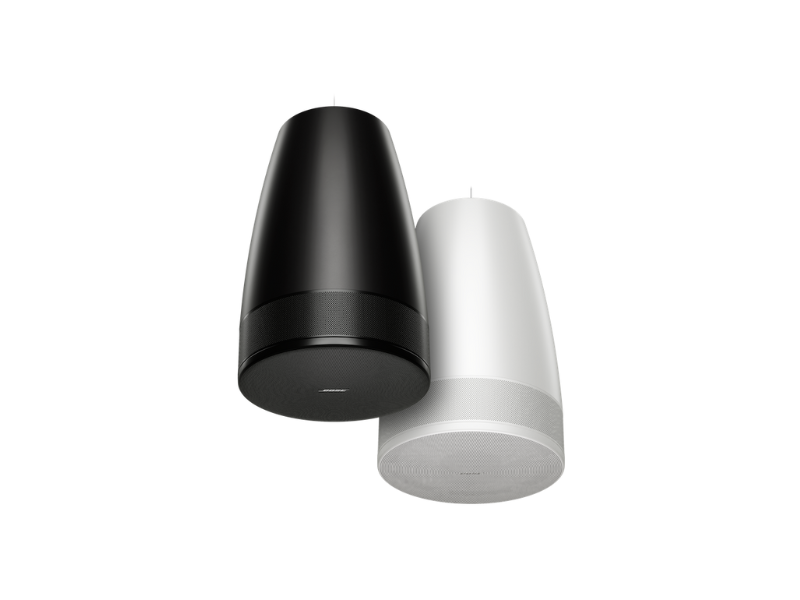
    Bose Professional has introduced the new DesignMax Luna DML88P, a high-performance pendant loudspeaker designed for modern open-ceiling spaces such as retail stores, restaurants, gyms, and cafes. Featuring the brand’s proprietary Ring Array™ technology, Luna combines eight 2-inch drivers and an 8-inch woofer to deliver powerful, evenly distributed sound without the need for additional subwoofers. The result is clear, immersive audio that fills large areas while maintaining visual elegance.

    Engineered for easy installation and clean aesthetics, Luna supports flexible suspension options and conceals wiring for a sleek look. With impressive coverage, deep bass, and a minimalist design, Luna redefines what pendant loudspeakers can achieve, blending technical excellence with architectural style to meet the demands of today’s design-focused commercial environments.

    Bose Professional, independent developer of world-class audio experiences designed to transform any space, today announced the global availability of the DesignMax Luna DML88P pendant loudspeaker system. Luna delivers room-filling, high-fidelity audio from a sleek, modern design, and is perfectly suited for open-ceiling environments such as retail stores, restaurants, breweries, fitness studios, and similar design-conscious spaces.

    At the heart of Luna is Bose Professional’s proprietary Ring Array™ configuration, which combines eight precisely positioned 2-inch mid-high drivers and an integrated 8-inch woofer to create a smooth, articulate listening experience that fills the coverage area without hot spots or dead zones. This innovative design achieves exceptional clarity and balance down to 40 Hz, which eliminates the need for external subwoofers even in open-ceiling spaces. With a maximum SPL of 111 dB and consistent 140° coverage, Luna delivers powerful, immersive sound that requires fewer speakers to cover large areas—preserving both aesthetics and budget.

    “DesignMax Luna represents a bold leap forward in pendant loudspeaker technology,” said John Maier, CEO of Bose Professional. “We’ve reimagined what’s possible in architectural audio, delivering a product that meets the highest standards of sonic performance and visual elegance. Luna is a testament to our commitment to technical leadership and addressing our customers’ evolving needs.”

    Luna was specifically engineered to address installation issues commonly found in challenging open-ceiling spaces and adapt to constraints while remaining perfectly balanced. Luna supports both single- and two-point suspension, with a streamlined profile and concealed wiring that provides a clean look from every angle.

    “Luna is more than another pendant loudspeaker—it sets a new standard for performance in a unique, self-contained solution,” added Shawn Watts, Vice President of Product at Bose Professional. “Luna delivers space-filling, crystal-clear sound and deep bass from a single pendant form factor. Designed to replace the traditional pendant-and-subwoofer setup, Luna is easy to spec, easy to hang, and made to blend in visually—letting the sound take center stage. We’re proud to bring this groundbreaking product to our global customers.”

  • Crossroads Church Creates 360-Degree Immersive Worship Experience with L-Acoustics L Series and L-ISA Technology

    Crossroads Church Creates 360-Degree Immersive Worship Experience with L-Acoustics L Series and L-ISA Technology

    Cincinnati-based Crossroads Church has built its reputation on creating immersive worship experiences that draw people deeper into the message of the Gospel. So when the tech-forward congregation opened its eighth location this Easter—transforming a 90,000-square-foot former Sears department store at Dayton Mall into a vibrant community space—they knew conventional audio wouldn’t suffice. The result: the first house of worship to combine an L-Acoustics L Series concert sound system with L-ISA Immersive Hyperreal technology, creating a true 360-degree spatial audio environment in the 1,560-seat auditorium.

    HouseRight, a national house of worship integrator, designed and installed the groundbreaking system, which pairs L Series loudspeakers with A Series out-fills and X Series surrounds. The configuration creates a fully immersive sound space for worship services, concerts, and theatrical productions—a strategic choice for a church that has always valued technology as a tool for engagement.

    Full 360-Degree Immersive Surround with L Series and L-ISA
    The system features five L-Acoustics L2D enclosures as the Scene arrays, with far left and right Extension arrays of A10i. Six KS28 subwoofers are flown in two cardioid hangs of three boxes behind the center L2D, bolstered by groundstacked SB15 subs. Thirteen coaxial X8i spread across the stage lip provide spatial front-fill, while A15i systems handle out-fill duties.

    The immersive experience extends throughout the house with X8i and X12 enclosures serving as surrounds and fills, creating a true 360-degree sound field. An L-ISA Processor II and Controller at FOH drive the room’s object-based mix, giving engineers unprecedented creative control.

    X8i Speakers Create Dynamic Immersive Plane
    Luke Hesher, HouseRight General Manager, Church Relations, says the Crossroads installation was unique in deploying 28 X8i speakers as a comprehensive immersive surround system. “The speakers positioned beside and behind the audience spread sounds and effects throughout the whole space, creating a very dynamic environment and stretching the sound stage much wider than a traditional house system,” he says. “It’s very impressive.” The room’s geometry—not too wide—brings the full immersive effect to every seat. But equally important, Hesher notes, is how immersive sound aligns with Crossroads’ engagement strategy.

    Technology Strategy Aligns with Engagement Mission
    “Crossroads is always looking to push the boundaries technologically, asking, ‘how can we create an experience that really draws people in?’” Hesher explains. “Knowing their desire to leverage technology to create excellent, amazing experiences, immersive is the next big thing for churches, which is why we originally recommended L-ISA to them.”

    But technology alone wasn’t the deciding factor. L-Acoustics’ sonic performance proved equally crucial. “We love the clarity and the SPL we’re able to get from this system,” Hesher says, “while also not having too long of a line-array length that would impede sight lines to the LED screens. L-ISA delivers an amazing immersive experience.”

    Long-Standing Commitment to Immersive Worship
    Patrick Buescher, AVL Leader of the church’s Experience Team Operations, says immersive audio has been part of Crossroads’ DNA from the start. “Since the beginning of Crossroads, we’ve valued immersive experiences,” he says. “At all of our sites, we deploy surround speakers that we’re able to matrix off the mixer to create a more engaging environment. We’ve always been a firm believer in the value of creating amazing environments where people can experience a sense of wonder in the message of the Gospel. So it just made sense as we continue to evaluate how we can do that well, and L-Acoustics L-ISA fit that goal here.”

    Consistency Across All Campus Locations
    L-Acoustics and L-ISA are also part of a long-range technical strategy that will eventually see the church install similar systems throughout its other locations. That will offer worshipers a consistent experience no matter where they choose to attend and bring the church’s technical staff a familiar workspace on every campus.

    “We are driving towards a world where every room is consistent, and we can have the exact same experience across every site,” states Dave Kendall, Crossroads Church Director of Site Audio. “When you walk into a Crossroads site, the audio experience is going to be uniformly excellent. It’s going to be impactful, and you’re going to be able to feel it in your chest. First hearing the L-ISA technology was an amazing experience, and it’s going to be part of that effort going forward.”

    L-ISA as a Creative Instrument for Worship
    Luke Stickford, Site Audio Engineer for Crossroads Dayton, is finding that L-ISA technology functions as an instrument itself in the church’s music. Placement of vocals and instruments imparts a new dimension to the worship experience, with vocals now positioned within the congregation to bring unprecedented audience engagement to services.

    “I’ll take a vocal mix with reverb from the console into L-ISA and place the left and right channel as far back and as wide as it can go in the spatial field, as to engage a portion of the surround system,” he explains. “During larger parts of a song, I’ll ride that fader, and what it gives you is this really cool, massive vocal feel. You have the huge frontline vocal coming across the frontal system, followed by the reflections of the room engine mixed with that rear vocal mix. It just envelops you.”

    Another technique involves subtly panning key elements—a tambourine or organ pad, for example—slowly across the front scene system, subtly encouraging worshipers to follow along and drawing them deeper into the music. “It’s been a lot of experimentation so far, but the possibilities are really tremendous,” he says.

    Stickford has discovered he can rely far less on conventional processing thanks to L-ISA’s spatial capabilities. By placing vocals at 15% distance from the front of the spatial field and engaging the room engine through surrounds, he creates natural reflections without console reverb. “The room engine itself is incredibly powerful,” he says. “For intimate moments with just vocals and piano, or when the congregation is singing together, I can create this full, enveloping sound that brings everyone into the moment.”

    Intuitive Technology Enables Weekly Creative Innovation
    L-ISA fits another unique aspect of Crossroads’ vision: keeping service content fresh and its delivery impactful each week. Instead of simply delivering new content through a conventional PA system, the L-ISA system itself becomes part of both the music and the message thanks to its ability to position objects in a sound field.

    “For instance, one of our creative team members will have a vision for a production, and they’ll say, ‘I want this script element coming from the left rear,’” Kendall explains. “The process before L-ISA was cumbersome and difficult to execute. What we’ve found now is that it’s just so much easier to achieve almost anything like that.”

    “In a sense,” he concludes, “we’re perpetually a creative startup looking for fresh experiences every week, and L-ISA makes that a much more intuitive process.”

  • Combeuil Audio and Funktion-One Power Landmark La Bringue Event

    Combeuil Audio and Funktion-One Power Landmark La Bringue Event

    When Collectif La Bringue and Minuits took over Nantes’ 9,000-capacity Zenith Arena for Calling For Rave, they made history. This was the first time the venue, a cornerstone of France’s touring circuit, had hosted an all-night techno event. To achieve the sonic engagement they aspired to, the team turned to long-time collaborator Combeuil Audio and its sizeable inventory of Funktion-One sound systems.

    “Zenith Nantes is a major institution for entertainment production,” said Esteban Haie of Collectif La Bringue and 99dB. “Our goal was to deconstruct the venue’s image and create a true rave experience in a concert hall environment. Funktion-One has been with us since the beginning, so it was the obvious choice.”

    Working with La Bringue’s production team, Combeuil Audio designed a system to deliver powerful, coherent coverage across the vast arena. Suspended Evo 7T arrays with F124 subwoofers formed the main system, while Evo 6SH, Res 2 and F121 cabinets handled front fill. Evo 7TH, Evo 7TL, Evo 2, and Evo 2L delays extended coverage to the seating tiers, maintaining consistent coverage across the audience areas.

    The system’s visual form also played a key role in the design, with delay stacks and lighting integrated for a striking, architectural look. On stage, the DJ booth featured the iconic Dance Stack setup (DS210, DS15 and F215), while the backstage area was powered by Evolution XSH and F215 Mk2.

    Combeuil Audio’s Guillaume Combeuil explained: “We deployed a large Evo 7 system with delays and fills to perfectly cover the arena-shaped room. La Bringue requested the mighty Dance Stack as booth monitors for their striking look and the DJs were thrilled with how powerful it was. It was our first time rolling out a system of this scale and everything went flawlessly thanks to the easy rigging.”

    Haie added: “The power and clarity of the system allowed us to achieve precise coverage across every point in the venue. The diversity of Funktion-One loudspeakers perfectly matched our configuration, both acoustically and visually.”

    Combeuil Audio and La Bringue’s partnership began in 2022 with a series of warehouse takeovers. “They were the first company to trust us,” Haie recalled. “Now, we’re tackling the largest concert halls together.”

    The result was a defining moment for both teams. “We’ve never received so much praise for an event,” said Haie. “The speaker presence and lighting design cemented our concept. People loved the sound and they’re already waiting for the next one.”