Category: Mixing

  • Oasis Live ’25 Tour Brings The Biggest Band of the ’90s Back with DiGiCo on Monitors

    Oasis Live ’25 Tour Brings The Biggest Band of the ’90s Back with DiGiCo on Monitors

    Announced two days before the 30th anniversary of Oasis’ debut album, Definitely Maybe, the Oasis Live ’25 tour marks the band’s first live appearances since they acrimoniously split in 2009. The trek, which has crossed the UK, North and South America, Australia, and Asia, was so highly anticipated that it had the serendipitous and unexpected outcome of prompting six of Oasis’ previous LP releases to re-enter the UK charts, one of which even made it back into the top ten.

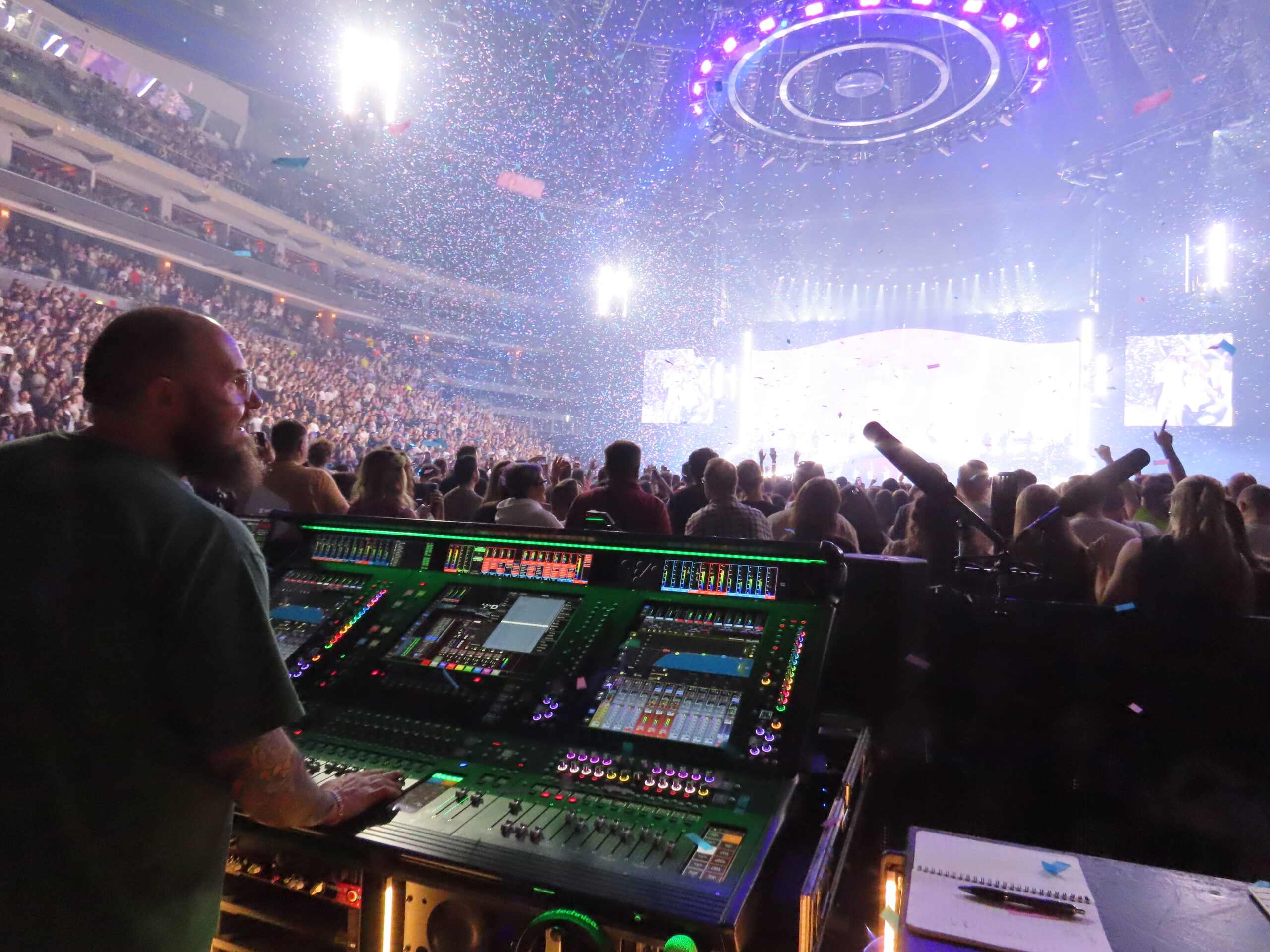
    Steve Weall mixes monitors for Noel and half of the band while his colleague, Bertie Hunter, mixes monitors for Liam and the rest of the band, but the split monitor desks are not the result of any brotherly animus. “That’s not unusual at the very pinnacle level of stadium touring,” says Weall, who also does monitors for Noel’s solo project, ‘Noel Gallagher’s High Flying Birds’. “When you’ve got the wherewithal to do it, it’s quite nice to have someone who’s just there for you.”

    It’s also quite nice to have the absolute pinnacle of monitor-mixing technology on hand, as well. The tour’s pair of DiGiCo Quantum852 consoles and other gear, including Quantum338 and Quantum326 desks used by some of the support acts on the tour, were supplied by Midlands, UK-based Urban Audio Productions Ltd, whose technical director, Dan Lewis, is also one of Oasis’ front-of-house engineers. Urban Audio also supplied a Fourier Audio transform.engine that is being used by Weall.

    “We have a separate console each, and they are side-by-side next to each other, very close, very sociable,” Weall laughs. “And despite obviously having a significant budget, the floor space is not infinite, so we also have a shared SD-Rack setup: two main SD-Racks that take all the inputs and the majority of the outputs that we share between two consoles, and we additionally share a master Shure RF rig for the in-ear monitors. I also have another local SD-Rack, and Bertie has a local SD-MiNi Rack, and then we have another SD11 mixer running some shouts, talkbacks, matrixing and other elements, all on a large Optocore network.” He puts the channel count at approximately 140 inputs and 100 outputs between the two desks, including outboard processing.

    However, both monitor operations are very independent of each other, Hunter emphasizes, intended to give each Gallagher their own monitor universe. At the same time, he adds, “We both have to kind of work together. We both have to decide on the gain structure of every channel. It’s been a lot easier because we’ve been working quite closely together physically, as opposed to being in our own little worlds, which we could have been if we had separate SD-Racks. We can also take input from elsewhere. For instance, I take some effects stems and things like delays, slap delays on Liam’s voice, and sort of one-off catching words from Sam Parker, who is mixing Liam’s vocal and effects out front, just to kind of keep it all locked in. The DiGiCo infrastructure gives us the options and we chose what works best for this situation.”

    Both Weall and Hunter are DiGiCo fans, but Weall points out that the Quantum852 consoles were newly purchased by Urban Audio for the tour. The presence of a third LED screen and a redundant engine made all the difference, he says. “In case of an emergency – one that has yet to happen,” he quips.

    The flexibility of the Quantum852 comes into play in a big way with Oasis. Hunter points out that, unlike his brother, Noel, who uses IEMs every night, Liam prefers floor wedges but will also use IEMs on occasion. “So I kind of split the desk up; I have Liam on one end and I have the band in-ears on the other, with a central bank with my graphic EQs and outputs,” he explains. “There really isn’t another desk that could be laid out that easily and where I can pretty much grab anything, anywhere I need to be, whether it’s an in-ear mix or Liam’s wedge, and get it into the right balance and tone. And the amount of faders is definitely useful. If I was to have to start flipping through layers, that’s not where you want to be on a show of this size. And with the 852, I don’t even have to think about it.”

    When it comes to processing, Hunter says he uses the Spice Rack’s Chilli 6 six-band dynamic multiband compressor/expander module often, especially on vocals. “It’s really handy,” he says. “I used to have to have that as a plugin, so now it’s nice to have it on the desk. I’m also running a couple of Midas XL42 preamps for Liam’s vocal, to give it that sound of ‘old’ Oasis that he likes, so his vocal will go straight into a Midas preamp. Then I’ve got some Distressors in my rack and I’ve got a couple of Kush Audio EQs and a couple of Bricasti M7 reverbs.”

    Weall estimates he’s working with 24 stereo channels of effects returns, “So it does start to fill up the console quite easily. But the thing is that the central screen can be fully usable as a home screen, with inputs, outputs and overview, which is very handy.” Much of his processing is outboard, including Neve 5045 primary source enhancers on the vocal chain, Summit DCL-200 compressor/limiters, a Bricasti M7 reverb, and Neve master bus processors. These he’s able to manage easily through the console’s aux sends and inserts, applying them directly to the IEM outputs. “We have the flexibility to send anything we want pretty much anywhere,” he says. “For a big, complex show like this, you need flexibility and management, and the Quantum852 desks have tons of that.”

    While not being a heavy plugin user when mixing monitors, Weall adds that “there are a few metering and measurement tools I find extremely useful to have at my disposal to help me deliver the best and most consistent IEM mixes,” he says. “The demo and support I received from the team at Fourier Audio’s HQ in London to get familiar with the setup and integration to my DiGiCo console was invaluable, having never previously used the Fourier transform.engine. I’ve really enjoyed having the extra tools available and am looking forward to bringing the Fourier engine further into my workflow on future projects.”

    Urban Audio has been a DiGiCo stockist for some time, having a rental fleet of Quantum Range consoles at its disposal, so the company was more than familiar with the DiGiCo lineup prior to the tour. “We have the philosophy of giving people what they want to do the gig, so naturally have invested heavily in DiGiCo over the years as they are a very popular product for our clients,” says Urban Audio Managing Director Warren Fisher.

    “In the early planning phases of the Oasis tour, it became apparent that both Bertie and Steve were seasoned DiGiCo users, so it made sense for them to stay in the familiar DiGiCo ecosystem,” Fisher continues. “For a show of this scale, though, the spec naturally gravitated towards consoles with redundancy built in, for which the Quantum852 fit the bill perfectly with its dual-engine setup and plenty of available I/O. This, alongside the ability to put both consoles and associated racks on an Optocore loop and share all the routing alongside some very neat custom packaging from Urban Audio, meant we managed to streamline a complex infrastructure project into an easily tour-able and freight-able package. DiGiCo’s flagship consoles have been performing brilliantly on this tour, and we here at Urban Audio look forward to using them on more projects soon!”

  • Palace Theatre Fit for a King with New DiGiCo Quantum225 Desks

    Palace Theatre Fit for a King with New DiGiCo Quantum225 Desks

    The Palace Theatre has hosted everything America has celebrated in the last 100 or so years: marquee-level entertainment, Roaring ‘20s gangsters, and one of the city’s and the country’s finest movie palaces of its day. After its inevitable decline in the urbanization of the 1970s, it was rescued by the city a century after its founding in 1916 and renovated as a live music destination.

    Within a few months of the revived Palace’s first show in March of 2017, the 2,500-capacity venue was once again a leading national music venue, now co-managed and co-operated by hometown First Avenue Productions and Chicago-based Jam Productions. After being fitted that year with a new L-Acoustics K2 PA system, the Palace Theatre has just capped off a nearly decade-long revival with a new pair of DiGiCo Quantum225 consoles, one each at front of house and monitors. Both were sold through and installed by local integrator and rental vendor Allied Productions & Sales.

    After nursing the venue’s nearly decade-old consoles along for years, Randy Hawkins, head audio engineer/A1 at the Palace, says the arrival of the new DiGiCo desks has been “a game-changer here. I’ve been touring with a 225 with the band Atmosphere for over three years now and I love it, and it’s the perfect choice for this venue. The thinking had originally been to go with no consoles at all, since so many artists tour with their own. But more and more of them tour with DiGiCo, or are at least very familiar with the DiGiCo worksurface. So by having that here, ready for them to plug their files into, we’re really building the model for the future of touring,” at a time when costs and logistics are paramount, he believes.

    Hawkins says choosing the same console for both FOH and monitors further supports that approach, with engineers able to move positions as needed without changing their worksurfaces. “The DiGiCo worksurface is instantly familiar to the majority of touring engineers out there,” he says confidently. “Very few need any tutorial on them, and most visiting engineers will just plug in their files and go.”

    Like other engineers, Hawkins, who says he’ll mix the occasional opening act at the venue each week, is a fan of the Quantum’s processing. “I enjoy the Spice Rack the most, though Mustard is cool, too,” he says. “When you factor those in, you realize that this was a massive upgrade for the room’s sound, and the consoles bring huge new firepower with them. Plus, First Avenue, our sister venue, also has Quantum225 consoles, so what we’ve done is built a Quantum ecosystem between them, one that also has L-Acoustics sound systems in both — L2 at First Avenue and K2 here. Mix engineers can seamlessly move between the venues and find the same great interfaces in both. It’s a good place to be.”

  • Engineers Choose DiGiCo Quantum852 for Dua Lipa’s Radical Optimism Tour

    Engineers Choose DiGiCo Quantum852 for Dua Lipa’s Radical Optimism Tour

    Global pop superstar Dua Lipa kicked off her 80+ date Radical Optimism Tour in November 2024 in Asia. The tour visited Australia, New Zealand, Europe, and the UK, including two shows at Wembley Stadium that saw over 160,000 tickets selling-out in a matter of minutes. The tour is currently making its way across North America and will conclude in December 2025 in South America. Between her wide-reaching appeal and epic touring schedule, a rock-solid console is essential. Front-of-house engineer Will Nicholson and monitor engineer Alex Cerutti are both utilizing DiGiCo Quantum852 desks, supplied by Britannia Row, a Clair Global brand.

    At front of house, Nicholson has four SD-Racks loaded with 32-bit cards, plus an Orange Box with Dante and HMA cards. He relies on the Fourier Audio transform.engine for his plugin needs, appreciating the latest integration with his console.

    “DiGiCo has always stood out for me because of the consoles’ functionality, robustness, and honest approach to sonics,” he says. “I’ve made use of the transform.suite to access some of my favorite plugins, including the UAD Distressor, 1176, and Shadow Hills Mastering Compressor. The transform.engine is very solid, and the automation makes it incredibly versatile. It’s now my only plugin engine, which has made time alignment so much quicker. Having access to a massive variety of plugins has been of real benefit to my mix and I can test and deploy techniques that were limited before.”

    For Cerutti, the large surface layout of the Quantum852 has allowed him to customize his view and keep his workflow as efficient as possible.

    “The Quantum852 is a huge step forward. I’ve been using DiGiCo consoles on and off since the D1 and D5 days and really appreciate not having to create socket files!” he explains. “I’ve used SD7s and SD8s, and keep coming back to DiGiCo consoles because I don’t have to change my setup or mix for the console. They are as configurable as I need them to be.”

    The Quantum852 is highly versatile and the engineers are both making use of the expanded touchscreen capabilities. For Cerutti, moving the layer select buttons to a touchscreen makes navigation of multiple channels much easier. He appreciates the improved access to channel meters and the added diagnostic visibility, too.

    For Nicholson, the spacious layout of the Quantum852 and increased options for scale and resolution of the metering has helped him refine his display. It is features like these, as well as the spacious layout, that also keep him coming back to DiGiCo.

    “I really like the big screens and loads of Macro options, and responsive faders mean the tactile experience is a bit more natural,” he expands. “Having multiple metering options is extremely valuable making lots of information available to me. The diagnostic meter on the bridge is a small but excellent tool. I really like Mustard processing and I’m also using the MSE expander on a handful of channels, which has been handy.  It’s a quality addition and, thanks to the V20 upgrades, Macros have got even more capable.”

    Communication between engineers is key, especially during the performance, and Cerutti has created a channel Macro that he is using as a talk button, allowing him to be more efficient with his rotary controls. For wider communication, the integration with their Riedel comms system has improved workflow and management of the whole comms system.

    Nicholson is using a similar system, enabling fast desk state changes that quickly flip between pre-show and show states for fail-safe communication. This also comes in handy for spare microphone channels, so EQ and processing can be quickly applied if a spare is required. When a large amount of information requires processing at speed, having a smooth and reliable workflow is invaluable. Snapshots and Macros are all part of making the console work for the engineers, and DiGiCo’s flexible FPGA-powered processing ensures it can always keep up. As the pair conclude, it is a system that is working well for them and delivering the best results for their artist.

    “There are two significant benefits to using two Quantum852,” Nicholson notes. “One is harmonic; we have a shared sonic space. Secondly, it’s a big help for problem solving. If you’re scratching your head trying to solve an issue, having that shared language and setup doubles your chances of success. I make extensive use of the group functionality on the Quantum852 for my mix setup. We have quite a few inputs, returns, and groups, and I really appreciate how I can quickly flip between banks to see the relevant input processing and associated routing.”

    “The amount of information I have to hand and the speed at which I can access it makes everything easier,” Cerutti concludes. “We both agree that the support is excellent, too. Whether you’re mixing a support band or a stadium artist, both Brit Row and DiGiCo are exemplary.”

  • Coldplay Circles the Globe with DiGiCo Desks on Music of the Spheres World Tour

    Coldplay Circles the Globe with DiGiCo Desks on Music of the Spheres World Tour

    Coldplay’s Music of the Spheres World Tour is a global concert trek without peer. Kicking off in San José, Costa Rica on March 18, 2022 and taking a hiatus following a ten-date residency at London’s Wembley Stadium that concluded on September 12, 2025, the 225-show-to-date tour has performed in 80 cities across 43 countries.

    Supporting 2021’s Music of the Spheres and 2024’s Moon Music albums, the stadium run has been equally significant for its remarkable sustainability initiatives, reducing CO2 emissions by nearly 60 percent compared to the band’s previous outing. But the trek is far from over; it’s expected to pick back up in 2027 with another massive leg in what the band have teased as “138 more shows to go.”

    If the tour’s longevity is impressive, it pales in comparison to the tenures of some of its key crew, including Dan Green, Coldplay’s FOH engineer and audio producer since 1998, and Tony Smith, head of audio system design and FOH tech, who has worked with Green for 23 of those years. Almost as remarkable, the lion’s share of that timespan has found the duo working with DiGiCo worksurfaces.

    “I’ve been using DiGiCo since 2011, starting on the SD7, and have carried on ever since,” says Green, who eventually bumped up his worksurface to a Quantum7 with a new Quantum engine. “DiGiCo is just so versatile – it has so many ins and outs, and its matrixing is amazing. It’s just very versatile.”

    In November 2024, when the tour headed to Australia, Green and Smith had the opportunity to switch the FOH mix over to a brand new Solotech-supplied DiGiCo Quantum852, and they jumped at the chance. “The Q8 has been amazing – it just offers so much more workflow flexibility,” Green enthuses. “It’s taken everything that was great about the Quantum7 and expanded upon that. The screens are amazing, obviously, and it enables me to have more layers and a lot more workspace on the desk. The Q8 is clearly the best of the DiGiCo bunch, so far.”

    Green notes that he particularly appreciates the Quantum852’s onboard processing. “The expanded Spice Rack has allowed me to free up some of my plugin chains, which I was using on outboard processors, and be more integrated into the console, which is really useful to have everything under my fingertips. The onboard filters are always the first thing that I go to for any channel that’s coming into the desk. I use them to do the immediate cleanup of the low end if it’s needed – or if the top end is needed to be cleaned up – and the Q8’s filters work really well. I really like their sound. They’ve got a nice analog feel to them.”

    With the band performing on no less than three stages at each tour stop, a huge number of inputs are coming into the FOH console. “I think it’s around about 200 or so, plus another 32 channels of ambient microphones as we’re recording every show. The Q8 is amazing because, as far as I know, it’s the only desk on the market that would be able to handle that amount of inputs.”

    Speaking of I/O, the Quantum852 has been invaluable for its ability to provide exceptional feeds for broadcasters. “Our recordings have far too many channels to be able to send out to a broadcast engineer; there’s no way they’d be able to accept those channels, let alone mix them in a live situation,” Green describes. “The Quantum8 has so many auxes that I’m able to create submixes of all of my individual elements and send out 48 channels of stems to the broadcasters so that they’ve got a head start. In fact, they can line up their faders at zero, and that’s a good starting point. They can recreate my mix and then adjust it to be tailored for whatever they’re mixing for.”

    “We’re really proud of what we’ve achieved with the sonics of the Coldplay shows, and we always get nice comments back about the shows. Wherever you are in the venue, it’s a great experience. And it’s also great because the social feeds and broadcasts sound brilliant because of our stem system. We’ve had an incredible response to our Glastonbury performance from the BBC, so we are really pleased with how everything is sounding.”

    The tour’s commitment to “going green” is embraced by all departments, including audio. “Sustainability has been a big part of what we’re trying to achieve for the tour,” Green shares. “In the audio department, we’ve tried to downscale our racks, whereas before I had a lot of analog hardware, lots of analog preamps, lots of outboard effects. And I’m really happy that now we’ve managed to reduce our setup down to the Quantum8 and basically one rack by the use of Fourier plugins and onboard effects and processing on the desk. It’s made a big difference.”

    Green and Smith actually started out with the beta version of Fourier Audio’s transform.engine two and a half years ago, before it was officially launched, and were able to road test it by slowly integrating it into their setup. “Fourier was really interesting to me as I was able to host the VST3 plugins that I use a lot in the studio, and I wanted to have the opportunity to bring these into a live context,” says Green. “I was really excited to beta test it. And as soon as we got the full working version – the official release – we put it into our system and it’s been fantastic. I’ve uploaded all of my effects onto the Fourier and have really enjoyed exploring VST3 plugins in a way that I wasn’t able to do before.”

    “With mixing live audio, I’ve always enjoyed using plugins because it enables me to switch things out and try different things on an almost nightly basis, if I want,” he continues. “Hardware is amazing and I love it, but it’s quite restricting in the fact that once you’ve built a rack, you’re normally stuck with that rack for the duration of the tour or the whole campaign – in our case, that’s four years! So it’s quite hard to change things in and out on an ad hoc basis when it’s all still working. With the transform.engine, having access to all of these VST3 plugins enables me to experiment with any idea that I may have. Anything that pops to mind, I can basically just give it a try – let alone also being able to stack processes, which in hardware is much harder. For instance, I may have a reverb that I want to follow by a compressor. If I want to try that, I’ve got the option to be able to do that.”

    “The Fourier has been really rock-solid – no complaints there at all – and it’s been a joy to test it on DiGiCo products. I’m really excited about what they’ve got to offer in the future.”

    For Smith, one of his main appreciations of the Quantum852 stems from a very practical standpoint when it comes to the potentially punishing environments of outdoor shows. “Everywhere seems to be hotter these days, and in some places on the tour the temperature at front of house has reached 43 degrees [110°F], so that presents its share of challenges for the consoles, racks, and everything else,” he says. “But clearly a lot of thought has been given to how air and heat flow through the Quantum8. It runs so much cooler, which is amazing, because there’s more processing power under the hood. Knowing that shows will stay up-and-running even in the hottest conditions, for me, that’s a huge relief.”

    Under the stage, in monitor world, Chris “Woodsy” Wood continues to ride the faders of his tried-and-trusted Quantum7, says Smith. “Though he was tempted to move over to the Q8 when we did, Chris is more than happy with the Q7, so why change if it’s not broken?” he notes. “And aside from a Bricasti M7, there’s no outboard being used on monitors. The Q7’s Nodals get utilized, as well as all the Spice Rack and onboard effects – it’s all onboard.”

    Great gear is only as good as its support, and the support from DiGiCo has reportedly been sterling. “DiGiCo have just been amazing to us,” says Green. “They’ve been so supportive and the team are always there to answer a text or help us with any emergency situation. And if we have any ideas on how to do things, or any strange requests, Dave and the team are always there to help us and answer our messages whenever we send them.”

    Smith agrees: “From my point of view, not being the mixer, one of my favorite things about DiGiCo is their amazing support, which you always need,” he says. “When you’re halfway around the world, things do go wrong. But if you’ve got the right support, you know you can get through it. And in the past, DiGiCo have done that. They’ve pulled rabbits out of hats, which has been amazing.”

  • Ed Sheeran Takes DiGiCo’s New Quantum112 Flypack Mixer on its Maiden Flight

    Ed Sheeran Takes DiGiCo’s New Quantum112 Flypack Mixer on its Maiden Flight

    Although DiGiCo has only just revealed the true identity and specifications of its Quantum112 – previously codenamed “Pufferfish” – the new ultra-compact flypack mixer is already being put through its paces by Ed Sheeran’s FOH engineer, Simon Kemp, and production manager, Chris Marsh. Appropriately, the tiny desk had its first official deployment on National Public Radio’s Tiny Desk Concerts video series, recorded live on Friday, September 12 at NPR Music’s office in Washington, DC. The very next day, the still-secret digital mixer was whisked off in its Peli case to Williamsburg’s Domino Park in Brooklyn, New York for an exclusive TikTok LIVE performance promoting Sheeran’s eighth and latest album, Play.

    DiGiCo has enjoyed a long history with Sheeran, tracing back to 2011, when Chris Marsh began mixing the artist’s early solo tours on a compact SD11. In 2017, to accommodate an ever-increasing need for more busses, Marsh stepped up to an SD7 and subsequent Quantum7, which he toured with until passing the FOH mix baton on to Simon Kemp in 2023.

    “I enjoyed six years on the SD11, going from pubs and clubs to stadiums – we even did Wembley and Croke Park with it in 2015,” Marsh recalls. “But it was finally time to say goodbye to the convenience of the small console and increase my front-of-house footprint to match Ed’s ambitions for shows moving forward. This was a big change as I could no longer walk in with a mixer under my arm, it cost more on freighting, and it was a logistical consideration at festivals and venues alike. I chose the SD7 and Q7 for many reasons, but mainly that it gave me an almost unlimited opportunity to expand and handle the demands of the artist. It was the right move at the time.”

    “When we launched the Mathematics tour in 2022, I attempted to return to the SD11 for our launch shows in pubs and small venues but simply could not make it work. The console would not stretch to our requirements. I truly wish that I had a Quantum112 at that time, but I am so pleased that we have this option now. As production manager, it is a game-changer for being able to make Ed’s show translate into smaller venues, offering quicker turnarounds and cost-effective freight movements. It almost makes me want to be back at the faders again!”

    Those FOH duties, of course, are now in the very capable hands of Simon Kemp, who has mixed Sheeran for the past two years, after working with everyone from Mariah Carey, Usher, and Lionel Richie to Robbie Williams and Passenger.

    “The exciting thing about Ed’s show is that we do it all – from tiny popups to stadiums and everything in between,” Kemp describes. “He creates loops via his guitar and vocal mic, which feed into Ableton and come to me via MADI as individual loop inputs. Years ago, the routing was likely fairly simple, but that has evolved into a much bigger setup. Today, we have the availability to have 16 channels of looper inputs, and the source can be his guitar or his looper vocal mic. We also now have a keyboard where he can loop samples, and for the bigger shows, there are three main vocal mics, three loop vocal mics, and five separate guitar inputs. It all adds up.”

    DiGiCo’s smallest and newest addition to the Quantum Range – the Quantum112 – is a single-screen, 12-fader desk that is the company’s first true flypack mixer. Designed to fit within a rugged and robust Pelican™ Air 1637 case, the ultra-compact console, when packed, weighs only 23 kilograms – a perfect 50 pounds – qualifying it as a standard checked bag option on most flights.

    When Kemp was first briefed on the top-secret Pufferfish, two thoughts immediately came to his mind: “My first reaction was: I love the idea of getting this show back onto a small console that I can check at the airport and do a gig anywhere in the world. That thought was quickly followed by: how in the world am I supposed to fit this show onto 12 faders?!” he laughs. “But as it turns out, it’s been great, and the desk is so easy to get around, which is essential seeing that monitors for the looper setup are also run from FOH. I’m not sure how DiGiCo fit so much into such a small footprint, but it really covers everything I need, and with the help of macros and a huge touchscreen, I can be anywhere almost as quickly as if I had 36 faders.”

    Aside from applauding the Quantum112’s compact size and remarkably light weight, Kemp already has a list of other features and functions that he particularly appreciates. “I’m really impressed with the big screen and its brightness in the daytime,” he says. “In terms of mixing, the Mustard Source Expander has been great. Spice Rack has also been a must for us, and we use it for both Ed’s vocal and guitar. It’s a really powerful setup, and quite a robust little console in general. We’ve given it a good test throughout our US promo shows and it seems very hardy; the faders are great as well.”

    A proper tour in support of Play is set to kick off closer to the end of the year, dramatically scaling up the production requirements, but the mix will steadfastly remain on DiGiCo’s Quantum platform. “We’ll be carrying a much-larger Quantum852 for that, but seeing that they’re both Quantum surfaces, transitioning the show between the two extremes in surface size is surprisingly painless. Even in the early stages of the Quantum112, before its file converter function existed, it didn’t take me long to shrink the show onto the little flypack mixer.”

    “To my knowledge, I don’t think there’s any other console out there that can do what the Quantum112 does,” he sums. “It has all the I/O that I need as standard on the back – and still has space for two DMI cards! Honestly, I can’t see any other mixer even getting close to its versatility. We’ve really been impressed with it.”

  • Grace for the World Relies on Graceful DiGiCo Consoles to Deliver Global Message of Human Fraternity

    Grace for the World Relies on Graceful DiGiCo Consoles to Deliver Global Message of Human Fraternity

    On September 13, Rome’s Vatican City hosted Grace for the World, the first-ever music concert held in St. Peter’s Square, reportedly drawing more than a quarter of a million people to the venerable plaza. The event, which was accompanied by a spectacular drone show above the Sistine Chapel, concluded the “World Meeting on Human Fraternity 2025,” a two-day gathering that brought together people from around the globe to reflect on humanity in an age defined by social and environmental challenges, as well as rapid technological progress.

    Also streamed live on Disney+, Hulu, and ABC, a massive worldwide audience tuned in to witness uplifting musical messages delivered by a star-studded lineup, including co-directors Andrea Bocelli and Pharrell Williams, along with John Legend, Jennifer Hudson, Jelly Roll, Karol G, and others. And making sure that all of the music performed at this historic event came through crystal clear was a pair of DiGiCo Quantum852 consoles, at front of house and monitors, provided by the Berlin, Germany office of Clair Global.

    “This was more than a concert, it was a true event, and the broadcast put it on a level with a world-class awards show,” observes Jeremy Peters, who works from Clair Global subsidiary Sound Image’s Escondido, California office, and who served as the production’s audio co-designer with audio supervisor Michael Abbott. “This was literally the equivalent of a Grammy broadcast, but in St. Peter’s Square, as if it was in Las Vegas! It was very much a team effort to pull this off in such a short amount of time, but it really came together incredibly well.”

    Peters, who mixed monitors for the artists performing for the show, as he has for years for Pharrell Williams on tours, says the project initially seemed fairly routine. “At first, I was just thinking, It’s a normal Pharrell show with some guests, and we’d put an audio package together with some extra mics and ears and then call it a day. But that wasn’t what this was at all,” he laughs.

    For that reason, Peters says he turned to the DiGiCo Quantum852, the desk he says that he and FOH engineer Kyle Hamilton have been using religiously since it was introduced. “I’ve used it with Doja Cat at Coachella, with Usher, and with Stevie Wonder, so it’s my go-to console when I have to go to work,” he says. He likes its analog feel, but also how it puts so much information at his fingertips. “For the monitor person on a show like this, that’s critical,” he says, noting that the monitor input count was nearly maxed out. And that was with the full range of what monitors can be: IEMs, d&b and L-Acoustics wedges, butt-kicker subs, and coverage for a 350-voice choir. “I had well over 90 auxes, hundreds and hundreds of channels, six SD-Racks, and an Orange Box interface for digital playback I/O. Kyle and I normally share racks, so we went through multiple Prodigy MX multiformat audio matrixes to get out of the stage racks, sending all those streams to the truck via MADI,” he explains.

    And while he’s a fan of the Quantum processing, especially Mustard, Peters says it was the console’s flexibility that made it work. “This show was by far more ins and outs than I have ever had to manage. Normally, on an event like this, you’d likely have two monitor engineers, two house engineers, a dialog mixer, and so on. But, here, it was one front of house guy and everything else was coming through me on stage. But there’s no other console I would want to work on to do this show. The flexibility of the Quantum852, the worksurface — there is nothing else like it.”

    Grace for the World’s FOH engineer, Kyle Hamilton, is also a fan of the Mustard processing, particularly its gate, compressor and EQ capabilities. But, like his colleague in monitor world, his first order of business was how to manage nearly 300 inputs for a wide variety of artists onstage. “I mean, between the 90-piece orchestra and the choir alone, they said the total input count would be close to 500,” he recalls. “I just know that there was an ocean of people on stage, plus the core band itself.”

    The Quantum852 offered him the processing he needed to manage all of the individually mic’ed instruments on stage, which particularly helped control the impact of the percussion instruments in the reverberant space. In fact, he says, it all came down to management. “The Quantum852 was on it, one hundred percent,” he says. “The multiple worksurface layers, the routing flexibility — it let us what we had to do to corral that massive infrastructure. The workflow let us do multiple things at the same time, because everybody needed something different — often at the same time! So that flexibility was huge. Any other desk just wouldn’t have been able to handle it.”

    One thing Hamilton didn’t need from the Quantum852’s onboard trove of processing was reverb. “We were in St. Peter’s Square, man,” he says, in awe of that sonic memory. “All of that stone and glass. We had reverb that you would pay thousands of dollars for in a recording studio. You could say it was heavenly.”

  • DiGiCo Announces V3.1 Update for S-Series

    DiGiCo Announces V3.1 Update for S-Series

    DiGiCo has rolled out version 3.1 of its S-Series software, bringing new power and flexibility to its popular S21 and S31 digital mixing consoles. The update, available for free download, introduces features like User Layouts and Separate Layer Control that make live sound mixing more customizable and efficient. It also adds full compatibility with the new MQ-Rack, which offers 48 mic inputs and 24 outputs for high-quality audio performance.

    Additional improvements include advanced aux control options, enhanced macro functions, and streamlined interface updates to make workflow smoother for users in venues such as schools, theaters, and houses of worship. With this update, DiGiCo continues to prove its commitment to longevity and innovation, ensuring even decade-old consoles gain fresh capabilities and a modern mixing experience.

    Ten years ago, when DiGiCo introduced its first S-Series mixing console, the S21, that product was quickly applauded for capturing the manufacturer’s renowned sound quality in a compact design featuring a surprisingly affordable price point. Since then, the dual-screen S21 and its larger three-screen sibling, the S31, have resoundingly proven themselves to be consoles worthy of the DiGiCo name, ideal for many applications, from nightclubs and theaters to churches, schools, and performing arts centers. Today, both desks have become even more powerful and versatile with the launch of the new S-Series version 3.1 software update, which is immediately available and free of charge from the DiGiCo website.

    “Many of our Quantum and SD-Range customers are well-familiar with the incredible longevity that they can get out of their consoles thanks to our R&D team’s downloadable updates,” says DiGiCo Managing Director Austin Freshwater. “But that same level of ROI is just as accessible to our S-Series user base, some of whom are now crossing a decade with their desks, and still getting new features and functionalities with our very latest software enhancements.”

    Chief among v3.1’s new amenities is that it allows the S21 and S31 to each fully support DiGiCo’s latest MADI-based stage rack, the MQ-Rack. This unit features 48 high-quality microphone inputs and 24 line outputs, with four of these outputs switchable to AES/EBU digital outputs, at 48 or 96 kHz sampling rates via MADI over BNC connection.

    S-Series consoles have always provided a simple, intuitive layout. With version 3.1, DiGiCo now offers User Layouts, allowing multiple operators to have their own favorite way of laying out the console easily accessible – or the ability to change layouts for different bands as a show progresses, containing only the channels needed for that band. Users can easily change between layouts with a single press of the touchscreen, and the user menu can also be opened from a macro. Loading a new user will not interrupt audio, unlike loading a session, and can be done mid-show.

    Alongside the User Layouts, DiGiCo has added another option, Separate Layer Control, which allows for the left screen of an S21 – or the left and center screens of an S31 – to view and control a different layer to the one displayed on the right-hand screen. The layer up and down buttons are added to the top menu bar, meaning they are always accessible. Separate Layer Control is ideal for leaving a set of output controls on the right-hand side while scrolling up and down the inputs on the left-hand side.

    Additional new features can be found on the auxiliary section of the S-Series desks. First, DiGiCo has implemented Link and Reverse Link pans for stereo auxiliaries. Link pans are helpful for keeping FX sends lined up with the master panning layout. And with Reverse Link pans, mixing monitors from front of house is greatly simplified, with no need to manually pan each send inverted to the main mix.

    With the latest software update, the auxes on the S-Series consoles are able to take a signal from three positions: pre-mute, pre-fade, or post-fade. The aux master can assign a global pick position to all of its sends, and each individual pick point can be changed from on the channel itself. With the latest software update, the number of sends in each position can be seen from the aux master, allowing the user to quickly see the position of all sends at once.

    Other new features and performance improvements include:

    • The position of the aux sends is now always displayed on the channel strip; previously, it would display nothing if the aux send was in post-fade position
    • Macro menu rework: mute CG and spill CG macros have been condensed down from 10 individual

    macros in the menu to just one, which lets users select which macro to spill or mute

    • New Macros: User Layouts and Separate Layer Control get a new macro, and Fire Snapshot X is also a new macro
    • Skip Prev/Next Snapshots: individual snapshots can now be skipped from the list
    • Hide Clock: the clock on the top menu bar can now be hidden
    • Shift Key Behavior: shift key now has two modes – shift and caps lock
    • • Various bug fixes
  • First Baptist Jonesboro First Church to Install DiGiCo Quantum852 Console

    First Baptist Jonesboro First Church to Install DiGiCo Quantum852 Console

    First Baptist Church of Jonesboro was founded around the same time as its namesake city, now a suburb of Atlanta. You don’t last that long without understanding that things change, and that’s reflected in the recent installation at the church of a pair of DiGiCo Quantum consoles. A Quantum852 has replaced the previous DiGiCo SD10 at front of house, while a Quantum338 is now at monitors. Both were purchased through Atlanta-based integrator Clark.

    Like it did for many churches, Covid changed everything. First Baptist Jonesboro Media & IT Director Tom Gobebo points out that the church’s traditional orchestral/organ and choir worship style was expanded in the wake of the pandemic to include electrified instruments, as well as backing and click tracks. Along with more outside concerts and increasingly complex holiday event productions, the channel count and processing needed to follow suit. The Quantum852 console was the right choice for this moment in the church’s media evolution. It’s also notable that First Baptist Jonesboro is the world’s first house of worship to install a Quantum852, which came along at the perfect time.

    “The 144 channels on our SD10 were no longer enough,” says Gobebo, whose arrival there coincided with the pandemic, a pivot point for the church’s media infrastructure. “We already had a 30- to 40-piece orchestra and an 80- to 100-voice choir, and that was just for regular Sunday services. We added more wireless microphones as well as a six-piece band with electric guitars and drums,” which currently share worship music duties with Jonesboro’s 3,000-pipe organ.

    Further, the church at that time also changed how it handled its online streaming of services, making them fully live and thus requiring additional channels. That’s where the Quantum852 was the game-changer. “We have literally more than doubled our inputs now, and that leaves us lots of extra channels for special events when needed,” says Gobebo.

    The Waves processing that was integrated into the SD10 consoles is still there, but now split between the new desk’s A and B engines, adding a layer of failover protection. And the processing load has shifted to the console, itself. “Before, the SD10 was doing about 40 percent of the processing onboard; today, the Quantum852 is doing about 80 percent of it,” he estimates, pointing to the desk’s Mustard Processing channel strips, Spice Rack plugin-style native FPGA processing options, and Nodal Processing. “There’s just so much more there now.” The church also doubled the number of stage boxes, as well, adding two more SD-Racks, allowing up to 220 inputs at the stage. And they are currently operating the church’s audio at full 96k resolution, up from 48k before.

    “The audio staff at First Baptist Jonesboro has certainly loved the DiGiCo platform they’ve been using for years, but the arrival of the Quantum852 gave them the chance to also have the channel count they needed while still standardizing around the console they’ve come to know and use,” observes Clark Business Development Manager Noah Hawley. “More I/O, more horsepower — those were all the things they were looking for as their worship style evolved. They get exactly that with the Quantum852.”

    The addition of the Quantum338 at monitors has wrought equally tectonic changes for the church’s media workflow, says Gobebo. “Having three screens on the console makes it so much easier to work on,” he says, adding that it also greatly aids in training the church’s mostly volunteer audio crew. “It makes a huge difference now that we have the band and so many more microphone inputs and the tracks,” he says, noting that as many as 21 of the vocalists can now be on stereo IEMs, with wedges for the choir. “With the Quantum338, all the patching can be done internally in the console. In terms of workflow, monitors are much easier to manage these days.”

    And of course, then there’s the sound. “People have noticed, especially the musicians,” he says. “There’s more space and depth to the sound. So the sound quality is improved and the workflow is really enhanced. The Quantums have been a real step up for everyone.”

  • All In The Family – The Brothers Return To MSG With DiGiCo’s Quantum Siblings

    All In The Family – The Brothers Return To MSG With DiGiCo’s Quantum Siblings

    To honor the legacy of the Allman Brothers Band, godfathers of Southern Rock, the musical supergroup known as The Brothers recently returned to New York City’s storied Madison Square Garden for a pair of shows in April. Led by former ABB guitarist and Gov’t Mule founder Warren Haynes and featuring drummer Jaimoe, the last surviving original member of the Allman Brothers Band, the ensemble also included former ABB guitarist Derek Trucks (nephew of ABB drummer the late Butch Trucks), bassist Oteil Burbridge, and percussionist Marc Quiñones, plus Joe Russo, Reese Wynans, and Isaac Eady, as well as special guest Chuck Leavell on piano.

    It was an emotional reunion. The Brothers last played MSG in March 2020 to celebrate 50 years since the founding of the Allman Brothers Band. Fortunately, some very 21st century technology was on hand for the two shows, in the form of three DiGiCo Quantum consoles, as well as a DiGiCo SD12-96 desk, all provided by Southold, New York-based SK Systems (with an L-Acoustics sound system supplied by PRG). At front of house were both a Quantum338 and a Quantum225; the broadcast mix had another Quantum338; and monitors used an SD12-96. So on those nights at MSG, The Brothers relied on another set of siblings – DiGiCo Quantum, all of which were connected on an Optocore network along with an SD-Rack and SD-Nano Rack – to assure a flawless performance.

    The workflow began with front of house. Engineer Brian Speiser, who also regularly mixes FOH and acts as PM for Tedeschi Trucks Band, was at the Quantum338 for the main house mix. In addition, systems engineer Chris Bedry, who also performs that role for TTB, manned a Quantum225 next to Speiser, taking stems from Speiser’s house mix and putting them together, over headphones, for a backup broadcast mix. The primary broadcast mix was being handled by Bobby Tis – usually TTB’s monitor and studio engineer – on another Quantum338, with Chris Bailey mixing monitors on a DiGiCo SD12-96.

    “Chris Bedry was multi-tracking the whole show, but also sending a backup stems mix from me to the broadcast people so that they had an emergency backup that was coming directly from us if something went wrong in the broadcast room,” explains Speiser, who started laying out this workflow months ahead of time, adding, “the Quantum225 was also submixing all of Marc Quiñones’ percussion channels and sending them back to me on the 338.”

    This was only the second performance for The Brothers, the first being 2020’s ABB 50th Anniversary show. “I didn’t mix their 2020 show, so going into what’s essentially a throw-and-go at Madison Square Garden, I felt like it would be best if I had Chris specifically zero in focus on what Marc, the percussionist, was doing so that I can mostly focus on everything else that was happening on stage with two drummers, an organ player, a piano player, two guitar players, bass, and vocals. Marc had a lot of mics that sometimes needed to be live, but sometimes didn’t, and two different vocal mics for his two positions.”

    What could have potentially complicated matters was the fact that Speiser had never piloted a Quantum console before this. “I have always been on SD consoles, so I went to a local vendor in Cleveland where I live now who happened to have a Quantum and a Waves server in the shop,” he recalls. “And they were nice enough to let me come over there one day and build my session, and I spent one afternoon just going through it. At first, I was worried that it might feel like a desk that I didn’t know my way around because I had just never been on a Quantum. But I started building my session in the offline editor, and then when I went over to their shop and got my hands on the desk, it was super intuitive – everything was exactly where I would’ve expected it to be based on having so much experience with the SD. It just felt like the exact same experience.”

    “Once I had the time in rehearsals, I wound up using a good amount of the Mustard and Spice Rack dynamics,” he continues. “For instance, the functionality of the Mustard version of the Primary Source Expander is the most functional I’ve ever used. I had more success with that than I had with the hardware version or the Waves plugin version. And the other thing that was super helpful was the Mustard compressors having the hardware mix knob – being able to mix the clean input with the compressed signal like that was a game changer. Altogether, these kinds of features made this workflow much easier to manage.”

    Broadcast mixer Bobby Tis is also a longtime DiGiCo user – he tours with TTB on a Quantum338 – and felt at home in what he described as a “DiGiCo universe” at the Garden. “It was pretty cool to really network four consoles together and be sharing lines and making it all work together,” he says of the MSG shows. “We were all gain-sharing, which kept things orderly for a one-off type of show like this. It was nice that we had four engineers’ eyes on the gains of every channel, especially with that many inputs. Good gain structures, good shows! Everything worked out the way we had hoped and expected it would.”

    Tis says the Quantum338 has become a foundation for his work as TTB’s monitor engineer. “It’s really, really useful, especially for the monitor gig, but using it on The Brothers broadcast made it even more fun because I got to use more of the Quantum features in new and different ways,” he says. “For instance, I used the FET limiter within Mustard quite a bit on inputs and I love the fact that I can use it parallel with all the other Mustard processing, which has saved me inputs. And the Mustard Source Expander is super useful and it’s really better than the hardware versions. I find things like that, really make mixing live music a lot easier.”

    A new Fourier Audio transform.engine that Tis used with his console at Madison Square Garden also helped make the broadcast mix a better experience. “I had messed around with other scenarios of running plugins with the DiGiCo, but not with the actual Fourier Audio transform.engine before, and I’ve got to say I was super impressed with how very easy it was to use,” he says. “There’s always a bit of nerves when you’re using something new like that on a show, but I put it through its paces and found it to be a really solid device and I had a lot of fun playing with it.”

    One application was applying the oeksound Soothe2 dynamic resonance suppressor to the three pairs of stereo microphones in the arena, used as ambience mics. “I was mixing those into a group on the DiGiCo, and then across that group I was using the Soothe2 plugin aimed at the high midrange to look for resonance and take it out of the room ambience. And then I also am sending one of those pairs of audience mics out to a Bricasti M7 reverb. I’ve come to learn that putting the audience into a great space of its own and extending the room a bit helps the whole thing smear together. I also brought a lot of what I generally use in my studio right to the stage. That combination of the DiGiCo console and the transform.engine had me in my own sweet spot those nights, and that’s a great place to mix anything from.”

  • Benson Boone’s Engineers Positively Flip Over DiGiCo Quantum Consoles

    Benson Boone’s Engineers Positively Flip Over DiGiCo Quantum Consoles

    In just a few short years, Benson Boone has gone from a brief stint on American Idol and his first chart-topping single to opening for Taylor Swift at London’s Wembley Stadium and performing on the main stage at Coachella 2025. With his highly anticipated second album, American Heart, dropping on June 20, Boone is currently playing the summer festival circuit, followed by arena shows across the US and Europe, including Madison Square Garden, with DiGiCo Quantum338 consoles supplied by Clair Global at front-of-house and monitors.

    Joey Diehl, Boone’s FOH mixer since early 2024, is a longtime DiGiCo fan, and has been using the Quantum338 since it was released, during the pandemic. “At the time, I was with Special Event Services, doing a lot of streaming shows. It’s one of my favorite consoles I’ve ever used,” he says. “It feels very modern and up-to-date with current requirements, with the things that people are looking for and what sounds good now – and it keeps getting better.”

    Carter Luckett, who has mixed monitors with Boone since August 2024, is another DiGiCo aficionado, using them at both monitors and FOH over recent years. “I toured heavily on the Quantum225, then upgraded to the Quantum338 a couple years ago,” he reports. “For monitors, it’s hard to use anything else because of the functionality and the speed with which you’re able to get around the desk and get mixes pulled up quickly and accurately. Quantum desks have really changed the way I work, and with the new Quantum processing, I’ve got a lot more ‘flavor’ to work with, building on the already robust, consistent DiGiCo infrastructure. It’s my preferred workflow.”

    Coachella was a highlight of this year’s tour dates so far, not least because Queen guitarist Brian May joined Boone for his rendition of “Bohemian Rhapsody.” Luckett had to stay alert as the high level of movement on stage by Boone didn’t favor the use of wedges, put out exclusively for May. With both artists operating in the same space, Luckett expertly merged the two environments together. “Obviously, we didn’t want any squeals or squawks, so I would ride his mic in and out based on where he was on stage to keep his vocal from feeding back,” he says. “But it worked out.”

    While Diehl uses some outboard gear, he’s equally happy relying on DiGiCo’s onboard Mustard and Spice Rack processing when there’s not enough real estate for racks at FOH. “Give me 30 minutes and a pair of headphones and I’ll be set because I love everything on the DiGiCo. Even with outboard, I still use the EQ on the desk. The way that you can send things and build out files is very close to what I would do at home in a studio, so it’s given me the ability to have that studio process on the road.”

    Diehl continues, “The best thing for me are the macros and how the snapshots work. I don’t think any other console has yet gotten close to how powerful the snapshots on the DiGiCo can be. It can do anything, and it can do it really well. I do some crazy stuff; there are songs where I have 20-something snapshots. I am doing such minutiae in these snapshots, but it makes a massive difference.”

    It took a lot of programming, he says, but his efforts are matched by the musicians, who have worked hard to replicate Boone’s recordings. “Our MD is amazingly critical and famously very detailed oriented. Lately, we’ve been landing the actual record in playback; I’ll go back and forth between my mix and the record. By the end of the song, I can press play and say, ‘OK, this sounds like the record.’ And it’s all saved to the snapshots,” and driven by the show’s timecode.

    “I have a couple of outboard analog pieces,” Luckett reveals, together with a hardware reverb, “just to polish Benson’s vocal and give it a little saturation to set it apart. It’s an extra sauce to add to Benson’s mix to make him feel comfortable in his own space. He’s the star of the show, so we’ve got a solid band mix, then his vocal just floats right on top of it. That chain, paired up with what’s inside the DiGiCo for the rest of the band, really complement each other.”

    Elaborating on the musicians’ in-ear mixes, he says, “The keys player is our band leader, so he wants to hear each musician equally to keep tabs on everything that’s being played. He wants to hear an honest representation of what each player is creating. That’s where the DiGiCo helps – it’s really easy to get good, clean sounds that replicate what each player is actually playing, not coloring the sound, and without having to scoop ‘mud.’ But when you want to add some flavor, you have Mustard and Spice Rack, which give me a nice, almost front-of-house mix for my artist, while maintaining these clean, honest mixes for the players – or even give a fun little mix to somebody who wants to hear the record, or some version of it.”

    As for the rest of the band, he continues, “I’ve got one player who wants a really dry mix that’s mostly her on guitar, no reverb on anything. The bass player wants more of a record feel, where he gets Benson’s reverb and a little more treatment and compression to round things out and help glue everything together. The drummer is similar to the guitar player, where he wants a fairly dry mix – but he mostly wants click and drums, like most drummers.”

    This next leg of the tour passes through North America and Europe, before ending up in the Middle East in December, and offers few breaks, the pair say. “If it wasn’t a DiGiCo console and it wasn’t Clair Global, I swear it would be impossible, logistically. As much as I love other production companies and other consoles, this is how it has to be to get it done,” Diehl comments. Luckett agrees: “You can get a DiGiCo anywhere in the world, and even if it’s not the exact same console, you can convert the file. It’s the only way for us to get through some of these shows.”

    That said, Diehl and Luckett recently spent some time at Clair Global’s HQ in Lititz, Pennsylvania, getting familiar with the new DiGiCo Quantum852. They are looking forward to adopting the new console when they have the opportunity, likely this fall, during production rehearsals for the arena tour. “It feels very familiar, but it also has loads of new features. It’ll be fun to figure out exactly what new implementations you can do with it,” Luckett says. Diehl adds, “I sat down and made a file, and it only took me a few hours, so I could do a show on the Quantum852 right now!”