Category: ISE 2026

This category is used for ISE 2026 News, PR and Case studies.

  • ISE 2026 – The Ohm’s Law of Change in AV

    ISE 2026 – The Ohm’s Law of Change in AV

    When I was in school, science class had a bad habit of making certainty sound permanent. We memorized neat little rules like Ohm’s law and what it said about resistance, even as the science we were learning kept changing around us.

    For example, in grade school we were taught that the noble gases on the periodic table would never bond with anything. Ever. Full stop. By junior high, the story softened – under very rare conditions, they might react. By the time we got to high school and college, the same teachers who once swore those elements were loners for life were now telling us they were pairing up like rabbits.

    That whiplash is a good reminder that “settled” science and technology often turn out to be more flexible than the people teaching it. The world changes, our understanding improves, and things that were supposedly etched in stone start to look a lot more like chalk on a sidewalk. Walking the halls at ISE this year, that same pattern was hard to miss.

    In collaboration and AV right now – and especially at ISE this year – the tools are getting smarter and simpler, all while some parts of our industry increase their resistance, digging in their heels and insisting that the new ways are wrong…because they are not the old ways.

    The Self-Configuring Room

    For most of my career, there were only a handful of “proper” ways to build AV systems. You mounted displays or screens on walls, wired up a rack, added a control system, programmed a custom interface, and integrated DSPs, amps, and microphones from best-of-breed manufacturers. It was an art form and a craft.

    It still can be. But best practices change.

    Take room audio. At ISE, we saw systems that, frankly, program themselves. A great example was Nureva’s new HDX room speaker system. You surface mount it on a wall and/or ceiling, connect it, push a button, and it auto-configures into a voice-lift-capable, no-feedback room system. No manual zoning. No painstaking DSP block diagrams. No “call us back after commissioning” dance.

    And here is the kicker – Nureva is doing all of that without leaning on AI. Add modern AI-driven sound cleaning algorithms into the equation, and you get cleaner audio from far simpler pickup systems than many still insist must be embedded in ceiling tiles to be effective.

    Every time I describe this kind of thing in an article or a video, at least one seasoned AV pro will respond with some version of:

    “You can’t do it that way.”

    or

    “Sure, maybe – but it will only ever be ‘good enough’ audio.”

    That is not technical criticism. That is muscle memory. It is what happens when the tools evolve faster than the people using them are comfortable with.

    MDEP, ODMs, and the Myth of the Lone Genius Vendor

    At ISE we saw a similar shift on the video side. For decades, if you wanted to be a “real” videoconferencing manufacturer, you had to build a platform from the ground up – your own embedded OS, your own call control, your own video stack, your own everything.

    Today, if you want to ship a Microsoft Teams Rooms-style device, you can make a deal with Microsoft and adopt the Microsoft Device Ecosystem Platform, MDEP. That instantly gives you a hardened, Teams-centric Android variant, a certification path, and a seat in the ecosystem.

    Then you pick up the phone to a capable ODM – one of the manufacturers that has been quietly building hardware for multiple brands for years – and say, “Here is what we want the product to look like, here are the features, and here is the price point.”

    A year or two later, you are a “video hardware company.”

    This modular approach is not theoretical – it is how a lot of the industry already works and has for years. MDEP handles the platform. The ODM handles the industrial design, optics, and electronics. The brand on the label handles the channel and the relationship with the customer.

    What has not evolved is our willingness to talk about it. Many vendors still act like admitting they work with ODMs is some kind of shameful secret, even though the exact same model has been perfectly acceptable in our world for decades. Odds are better than 50–50 that the ‘manufacturer’ on the label is not the company that really built your AV device, whatever it is.

    So we now have a world where:

    · It is easier than ever to build a solid room device

    · It is harder than ever for buyers to know who is actually doing the engineering and if they have any real qualifications to build a good device.

    Changing the way we view this not-so-secret secret would be a great first step.

    Everything Over IP, Eventually

    Another area where the tools are getting ahead of attitudes is infrastructure.

    Look at what Cisco is doing with its collaboration portfolio: cameras, microphones, and other peripherals in its systems are connected over IP and powered via PoE. Control, AV, and power are increasingly riding on structured cabling and network switches instead of proprietary boxes and point-to-point runs.

    No one seriously argues that AV-over-IP, control-over-IP, and PoE-powered endpoints will make systems more complex in the long run. The opposite is true. Fewer home-run cables, fewer weird interfaces, fewer “don’t touch that” boxes in ceiling spaces. It is a cleaner, more scalable architecture that aligns with how IT teams already think about infrastructure.

    But again, every step toward that future runs into familiar resistance:

    “We have always done it another way.” “Our techs do not know networking.” “What happens to our existing hardware lines?”

    Those are real concerns. They deserve real answers. But they are also the same kind of rigid thinking that said noble gases would never bond and that automatic camera tracking would never be as good as “a human director with a joystick.” Each generation of tools erodes the certainty of the generation before it.

    The Only Constant

    At the end of the final episode of The Big Bang Theory, Sheldon Cooper quotes a well-worn idea: the only constant in life is change.

    In AV, we seem determined to add a second constant – resisting that change for as long as humanly possible.

    ISE this year made it very clear that life is getting easier for users and, in many cases, for integrators too. Rooms are increasingly self-tuning. Platforms like MDEP are standardizing the messy middle. Devices are moving to IP and PoE. Behind the scenes, some of the most interesting innovation is about removing friction and complexity, not adding knobs and switches.

    The question is not whether those trends are real. They are here. The question is how long parts of our industry will keep treating them as temporary fads instead of the new normal.

    We can keep insisting that noble gases never bond and that rooms never self-configure, or we can admit that the science – and the technology – moved on while we were busy defending the past.

    Personally, I know I’m a “Digital Immigrant.” I have to consciously work to be open to ideas that were not good, or not even possible, just a short while ago. It’s hard work, but it’s worth it. If you miss the boat due to resistance, you may remain stuck on an island.
  • Harman Pro at ISE 2026: Platform Expansion and Precision

    Harman Pro at ISE 2026: Platform Expansion and Precision

    ISE 2026 reinforced a trend we saw across the show floor: manufacturers are thinking less in terms of standalone products and more in terms of complete, scalable platforms. At the Harman Pro at ISE 2026 that philosophy was front and center.

    Under its JBL Professional banner, Harman introduced two major developments that matter directly to AV and IT decision makers: a significant expansion of its system processing and loudspeaker ecosystem, and a full refresh of its Intellivox beam-shaping column loudspeakers.

    Together, the announcements signal a continued push toward tightly integrated, networked audio systems designed for real-world architectural and enterprise environments.

    Expanded System Architecture from JBL Synthesis

    While JBL Synthesis has long been known for performance-driven loudspeaker systems, the expansion announced at ISE 2026 positions the platform more clearly as a complete, scalable architecture.

    The update includes nine new custom loudspeaker models along with three new processing and amplification platforms. For integrators, the bigger story is not the individual SKUs. It is the consolidation of loudspeaker, DSP, and amplification under a unified system approach.

    Key integration takeaways:

    • Timbre-matched loudspeaker families allow for consistent voicing across zones and room types.
    • Updated processing platforms support immersive formats and network-centric system design.
    • Rack-ready amplification and processing simplifies deployment in commercial and institutional environments.

    For enterprise and higher education environments, this matters because system consistency reduces commissioning friction. When loudspeaker voicing, DSP tuning, and amplifier control live inside a defined ecosystem, design time decreases and performance becomes more predictable.

    In a year where software and control integration dominated ISE, Harman’s expansion reinforces the importance of tightly coupled hardware and processing layers. For AV teams supporting multi-room deployments, repeatability and centralized management are becoming as important as raw acoustic performance.

    Intellivox: Precision for Intelligibility

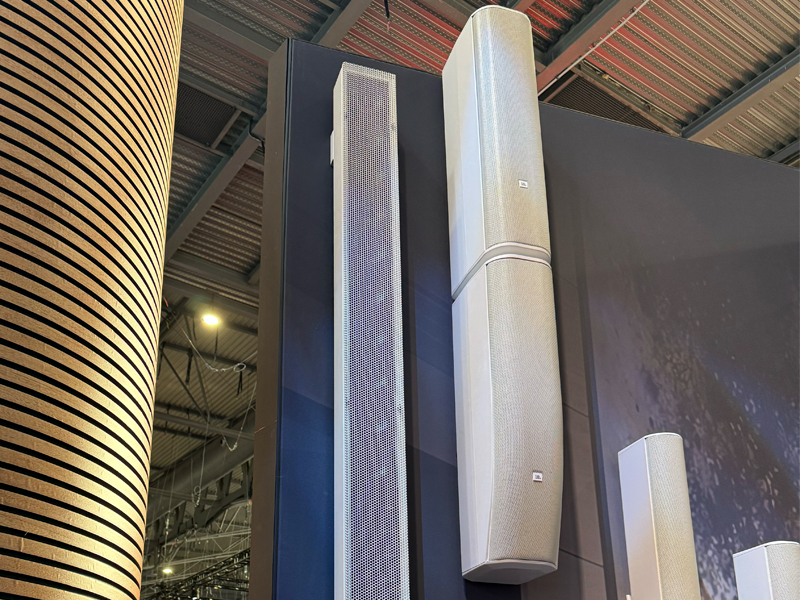
    On the professional side, Harman refreshed its JBL Intellivox line with 13 new active digital beam-shaping column loudspeakers.

    For integrators working in reverberant or architecturally challenging spaces, Intellivox has always been about control. The updated models continue that focus while modernizing connectivity and system flexibility.

    Highlights include:

    • Integrated Dante networking, aligning with IT-centric AV infrastructure strategies.
    • Digital beam shaping control, allowing precise vertical directivity and improved speech intelligibility.
    • Architecturally friendly form factors, including custom color and recessed installation options.

    For corporate, higher education, houses of worship, and public sector spaces, speech intelligibility remains a primary driver of user satisfaction. Beam shaping reduces reliance on heavy acoustic treatment and minimizes spill into reflective surfaces, which directly impacts clarity.

    The integration of Dante is particularly important. AV and IT managers increasingly expect audio endpoints to behave like networked devices, not isolated analog components. With Dante onboard, Intellivox becomes part of the broader AV-over-IP conversation rather than a standalone specialty solution.

    What It Means for You

    ISE 2026 made one thing clear: the future of professional AV is defined by ecosystem thinking.

    Harman’s announcements show a dual-track strategy:

    1. Platform consolidation in processing and amplification, creating more predictable system architectures.
    2. Precision control at the edge, particularly in acoustically difficult spaces.

    For decision makers, the ROI conversation centers on three factors:

    • Design efficiency – Pre-aligned system components reduce engineering time.
    • Deployment consistency – Scalable ecosystems make multi-site rollouts more manageable.
    • Operational alignment with IT – Dante and network-ready platforms ensure audio systems fit modern infrastructure standards.

    In an era where AV increasingly lives inside the IT stack, Harman’s ISE 2026 presence was less about incremental product refreshes and more about reinforcing an integrated systems strategy.

    For AVNation’s audience of IT and AV leaders, the takeaway is straightforward: when evaluating audio solutions in 2026 and beyond, the question is no longer just “How does it sound?” It is “How does it integrate?”

    Harman clearly intends to answer both.

    To see all our ISE 2026 coverage, visit our dedicated site. 


  • VIZRT at ISE 2026: Broadcast-Grade Production Into Zoom

    VIZRT at ISE 2026: Broadcast-Grade Production Into Zoom

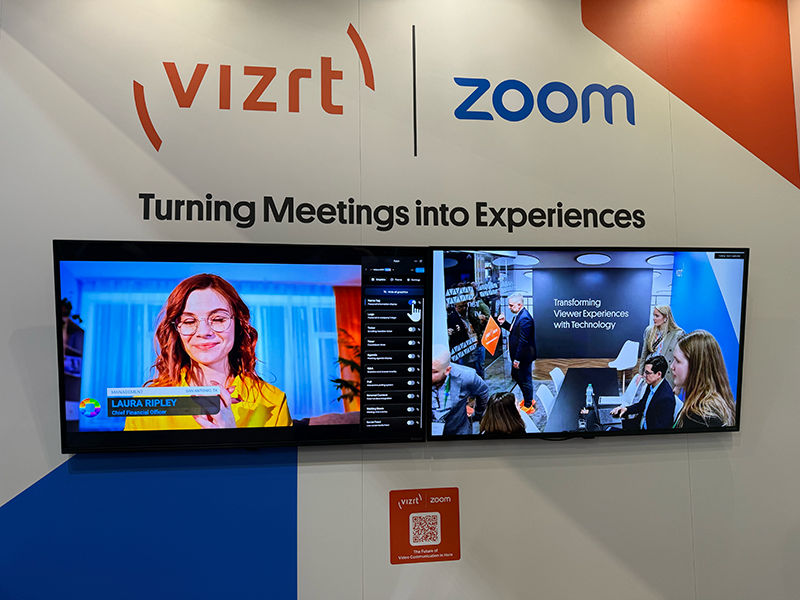
    At Integrated Systems Europe 2026, Vizrt made a clear statement: professional live production is no longer confined to control rooms. It is moving directly into collaboration platforms, and specifically into Zoom.

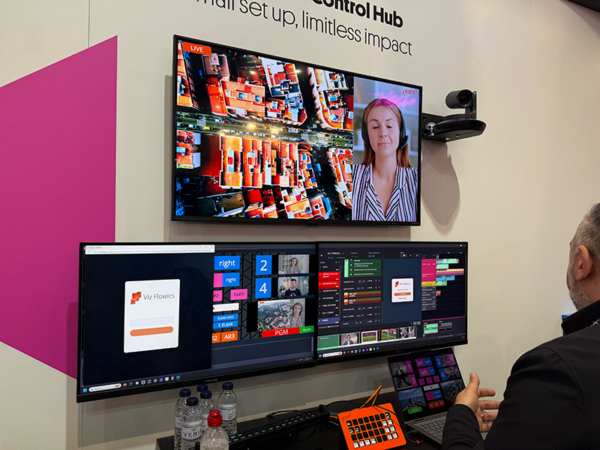
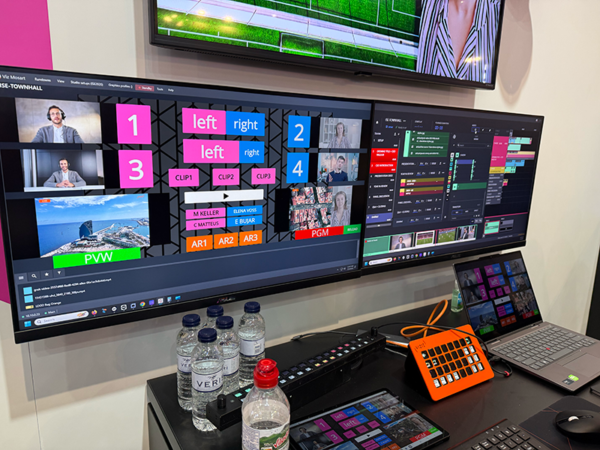
    The company showcased new tools designed to interactive-fy the Zoom experience by layering professional-grade graphics, augmented reality, and live production control into environments that IT teams already manage and support. For enterprise buyers, one of the most significant details is that this solution becomes available on February 20 and is sold directly through Zoom.

    Turning Zoom Into a Production Platform

    ISE 2026 Vizrt Zoom production
    ISE 2026 Vizrt Zoom production

    The headline development from Vizrt at ISE was the deeper integration between its production tools and Zoom environments, including Zoom Rooms. Instead of positioning Zoom as a simple conferencing layer, Vizrt presented it as the foundation for broadcast-level experiences.

    Demonstrations focused on web-native HTML5 graphics, triggered lower thirds and transitions, AI-powered keying, multi-input switching, instant replay, and AR tools layered directly into Zoom-based workflows. For higher education, corporate communications, and live events teams, this signals a shift away from static hybrid meetings toward dynamic, branded, interactive productions.

    This approach is particularly relevant for organizations producing live sports, esports, campus programming, or executive town halls. Vizrt illustrated how a single operator can manage switching, graphics, replays, and distribution through Zoom, creating professional results without traditional production crews.

    Simplifying Live Production Workflows

    One of the strongest themes in Vizrt’s presentation was operational efficiency. The company emphasized that a single person can now manage multi-input live switching, instant replay, graphics insertion using HTML5 templates, augmented reality enhancements, and transitions powered by its AI keyer.

    For IT managers and AV directors, this represents a meaningful shift in how live production is resourced and supported. Reduced staffing requirements, lower operational complexity, fewer specialized systems, and tighter integration with existing collaboration infrastructure all translate into lower barriers to adoption.

    In higher education environments, particularly in athletics and media departments, this model opens the door to student-led productions that still meet professional standards. In corporate environments, it enables communications teams to produce high-quality internal and external broadcasts without relying on external vendors.

    Professional Graphics Inside Collaboration Environments

    ISE 2026 Vizrt virtual production
    ISE 2026 Vizrt virtual production

    Historically, broadcast-quality graphics required dedicated hardware and separate production chains. Vizrt’s message at ISE was that professional graphics should now exist natively inside collaboration workflows.

    By leveraging HTML5-based graphics, organizations gain greater flexibility in template management, cloud deployment, and branding consistency across distributed teams. Lower thirds, triggered graphics, and branded transitions can now be embedded directly into Zoom-powered environments rather than added downstream.

    For enterprise communications teams, this elevates the visual quality of investor briefings, leadership updates, and product announcements while minimizing the need for additional infrastructure.

    AR, AI Keying, and Virtual Participation

    Vizrt also highlighted its augmented reality capabilities and AI-powered keying as core components of this new workflow. These technologies enable clean background removal, seamless AR overlays, and more immersive presentation environments.

    The company also demonstrated scenarios in which remote participants appear as virtual or VR-based guests within production scenes. Rather than presenting audiences with grids of video windows, producers can place participants into cohesive, visually unified environments.

    For IT leaders, this raises important strategic questions about how far collaboration platforms can be extended beyond traditional meeting use cases and into immersive communication experiences.

    Commercial Alignment Through Zoom

    The decision to sell this solution directly through Zoom is strategically significant. Procurement and licensing structures often determine whether new technologies gain traction, and Vizrt’s alignment with Zoom simplifies adoption for organizations already standardized on the platform.

    For enterprise buyers, this model reduces vendor complexity, streamlines purchasing processes, and aligns live production investments with broader collaboration strategies. Rather than introducing a standalone production system, Vizrt is positioning its tools as an extension of existing enterprise infrastructure.

    Implications for AV and IT Decision Makers

    The broader takeaway from Vizrt at ISE 2026 presence is that collaboration platforms are rapidly evolving into full-scale production environments.

    In higher education, this enables athletics departments, campus media teams, and hybrid learning programs to deliver broadcast-style experiences without building traditional studios. In corporate IT environments, it allows executive communications, global town halls, and product launches to incorporate dynamic, branded, interactive elements inside familiar platforms. For enterprise AV teams, it represents a move from simply enabling connectivity to creating compelling, content-driven spaces.

    While technical considerations remain around network capacity, processing requirements, system integration, and security governance, Vizrt’s approach aligns with one of the dominant trends from ISE 2026: software-driven, platform-centric workflows replacing hardware-heavy production stacks.

    VIZRT at ISE 2026

    Vizrt is no longer positioning itself solely as a provider of broadcast graphics engines. At ISE 2026, the company presented a vision in which professional production tools are embedded directly into enterprise collaboration platforms.

    By integrating multi-input switching, instant replay, HTML5 graphics, augmented reality, and AI-powered keying into Zoom workflows, Vizrt is betting that the future of live production lives inside systems organizations already trust and manage.

    For AV and IT decision makers, the central question is no longer whether collaboration platforms can support professional production. It is whether their organizations are ready to treat collaboration as content.

    To see all of our ISE 2026 coverage, visit our dedicated page.

  • Panasonic Connect at ISE 2026: Display and Projection Innovation

    Panasonic Connect at ISE 2026: Display and Projection Innovation

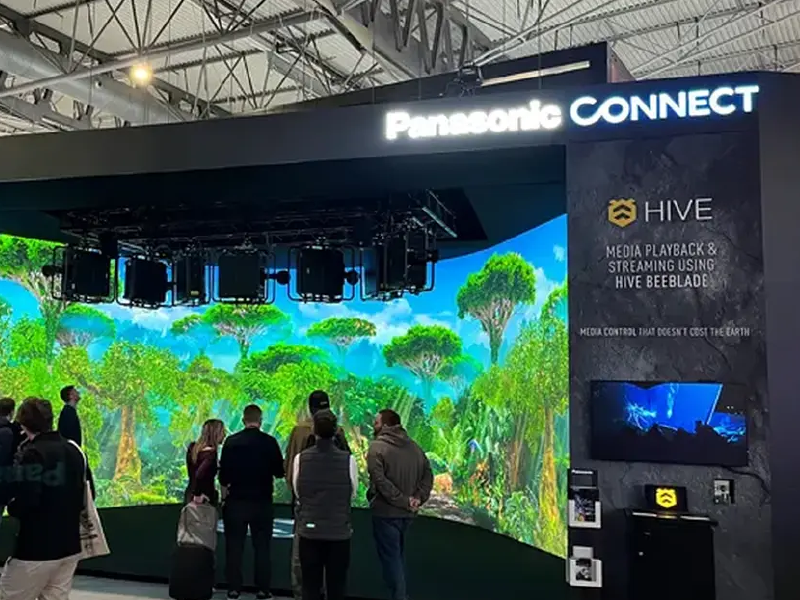
    Panasonic Connect at ISE 2026 delivered a message that resonated strongly with higher education and enterprise decision-makers: innovation does not always mean disruption. Sometimes, it means refinement, modularity, and long-term reliability.

    For universities and large institutional buyers navigating shrinking budgets, expanding hybrid learning models, and growing expectations for immersive learning spaces, that approach matters.

    Rather than chasing short-term trends, Panasonic Connect used ISE 2026 to reinforce its position as a long-term partner in display and projection infrastructure.

    Engineering Continuity in a Changing Market

    Much of the industry conversation around Panasonic in recent years has centered on structural changes following its acquisition by ORIX Corporation. At ISE 2026, however, the company’s ProAV presence suggested operational stability and technical continuity.

    The focus was not on reinventing the brand. It was on strengthening core competencies in projection, LED, and large-format visualization.

    For higher education institutions, this consistency reduces risk. Procurement cycles often span multiple fiscal years. Facilities teams need confidence that platforms adopted today will remain supported, serviceable, and upgradeable tomorrow.

    Panasonic’s booth and product lineup reflected that reality.

    Single-Chip RGB: Precision Without Complexity

    Panasonic projector
    Panasonic projector

    One of the most notable technical highlights was Panasonic’s continued development of single-chip RGB laser projection.

    While traditional high-end visualization has often relied on three-chip architectures, Panasonic is leveraging single-chip designs combined with three-chip-class lenses to balance image quality, cost efficiency, and operational simplicity.

    For lecture halls, auditoriums, and visualization labs, this approach offers several advantages:

    • High color accuracy and brightness
    • Reduced system complexity
    • Lower long-term maintenance overhead

    In higher education environments, where AV systems must serve multiple departments and user skill levels, simplified architectures translate into fewer service calls and greater uptime.

    The emphasis here is not on headline-grabbing specifications. It is on dependable performance in real-world academic settings.

    RQ45K: Modularity as a Strategic Advantage

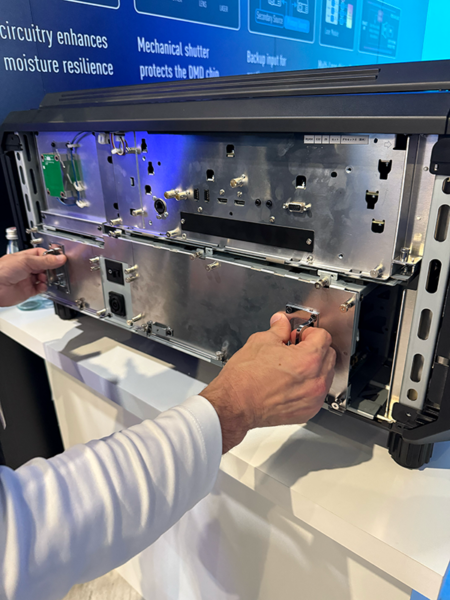
    Another centerpiece of Panasonic’s ISE 2026 presence was the RQ45K projector platform and its modular design philosophy.

    Unlike fixed-configuration projectors, the RQ45K allows users to customize and upgrade key components by swapping modules. This enables institutions to tailor projection systems to specific applications, whether for immersive simulation, large-format visualization, or advanced research environments.

    From a strategic perspective, modularity delivers three major benefits:

    1. Lifecycle Extension
      Institutions can upgrade components without replacing entire systems.
    2. Application Flexibility
      One platform can support multiple use cases across campus.
    3. Budget Optimization
      Capital expenditures can be spread across upgrade cycles.

    For higher education buyers managing long-term infrastructure plans, this approach aligns closely with multi-year capital planning and sustainability goals.

    Mevix LED: All-in-One DVLED for Learning Spaces

    Panasonic wall
    Panasonic wall

    Panasonic’s expansion into direct-view LED continued at ISE 2026 with the Mevix 165-inch all-in-one DVLED wall.

    With a 1.2 mm pixel pitch, 800-nit brightness, and modular 55-inch panels, the system targets institutions looking to deploy large-format displays without the complexity of traditional LED installations. Shipping beginning in April further reinforced Panasonic’s intent to move from showcase to deployment.

    For universities, these systems open new possibilities:

    • Active learning classrooms
    • Collaborative research environments
    • Simulation and visualization labs
    • Digital signage and campus communications

    The all-in-one approach lowers installation and commissioning barriers, making LED more accessible beyond flagship facilities.

    This reflects a broader industry shift. As LED becomes more turnkey, it is increasingly viewed as a viable alternative to projection and tiled LCD walls in academic environments.

    Designing for Long-Term Ownership

    Across projection and LED platforms, a consistent theme emerged: design for long-term ownership.

    Panasonic’s product strategy emphasized serviceability, upgrade paths, and ecosystem compatibility. Rather than positioning individual products as isolated solutions, the company framed them as components within a broader visualization infrastructure.

    For higher education buyers, this matters more than feature lists.

    Institutions must consider:

    • Service contracts
    • Parts availability
    • Staff training
    • Integration with existing systems
    • Long-term vendor relationships

    Panasonic’s ISE 2026 portfolio addressed these concerns directly by prioritizing standardization and maintainability.

    Strategic Alignment with Higher Education Needs

    What made Panasonic’s presence particularly relevant for higher education was how closely it aligned with evolving campus requirements.

    Modern learning environments demand:

    • Hybrid teaching support
    • High-visibility content delivery
    • Reliable lecture capture and presentation systems
    • Flexible space utilization

    Large-format displays, modular projection, and scalable LED walls all support these objectives.

    More importantly, they do so without forcing institutions into experimental or unproven platforms.

    Panasonic’s approach reflects an understanding that higher education values innovation, but only when it is accompanied by predictability.

    Innovation Through Refinement

    At ISE 2026, Panasonic Connect did not attempt to redefine ProAV. Instead, it refined it.

    Single-chip RGB projection improves efficiency without sacrificing quality. Modular projectors extend system lifecycles. All-in-one LED lowers adoption barriers. And platform consistency supports institutional planning.

    For enterprise and higher education decision-makers, this represents a pragmatic vision of innovation.

    It is not about chasing every new technology wave. It is about delivering dependable, upgradeable, and scalable visualization systems that support teaching, research, and collaboration over the long term.

    That strategy positions Panasonic Connect not just as a technology provider, but as an infrastructure partner for the next generation of learning environments.

    To see all of AVNation’s ISE 2026 coverage, visit our dedicated page.

  • Utelogy Expands Cloud Innovation and Data Intelligence for AV at ISE 2026

    Utelogy Expands Cloud Innovation and Data Intelligence for AV at ISE 2026

    As organizations scale meeting technology across thousands of spaces worldwide, visibility and control have become mission-critical. At ISE 2026, AVNation’s Tim Albright chatted with Jonathan Mangnall, Managing Director, Utelogy Corporation to discuss how the company is advancing AV/UC management through expanded cloud capabilities and deeper data integration.

    Utelogy’s latest innovation moves system configuration and management further into the cloud, allowing global enterprises to onboard, configure, and maintain thousands of rooms remotely. For organizations operating international help desks and NOCs, the ability to manage rooms without being physically onsite significantly reduces operational complexity and accelerates deployment.

    Central to this evolution is Utelogy’s powerful data platform. While the company provides standardized dashboards for monitoring system health, its integration with Microsoft Power BI unlocks advanced reporting and analytics. Enterprises can now analyze historical performance, room utilization, product reliability, and occupancy trends, transforming raw AV data into strategic insights. This allows IT, facilities, and executive teams to make informed decisions about future room design, technology investments, and operational improvements.

    Mangnall emphasized that the entry point for many organizations is break/fix monitoring. However, once customers begin leveraging long-term data, they quickly recognize the broader value, optimizing performance, improving user experience, and shaping next-generation collaboration spaces based on measurable outcomes.

    With many organizations accelerating return-to-office initiatives, delivering a reliable and seamless meeting room experience is more important than ever. Utelogy’s proactive monitoring platform helps organizations shift from reactive troubleshooting to proactive service management, ensuring rooms work as expected when employees walk in the door.

    By combining cloud-based configuration, enterprise-scale analytics, and proactive AV monitoring, Utelogy is positioning itself as a key enabler of modern workplace experience and global AV operations.

    For more information about Utelogy’s AV management platform, visit Utelogy.
    To watch the full interview and explore more coverage from the show floor at ISE 2026, visit AVNation.tv.

  • Samsung at ISE 2026: Advancing Display Innovation

    Samsung at ISE 2026: Advancing Display Innovation

    Samsung at ISE 2026 reinforced its leadership in professional display technology through a showcase that emphasized innovation, scalability, and practical enterprise application. Backed by a record number of industry awards, Samsung’s presence served as both validation of its market position and a clear statement of its long-term strategy.

    Rather than focusing on individual products in isolation, Samsung demonstrated how advanced display hardware, content platforms, and device management tools are converging to support modern corporate and command-and-control environments.

    Spatial Signage: Reimagining Visual Engagement

    ISE 2026 Samsung spacial signage
    ISE 2026 Samsung spacial signage

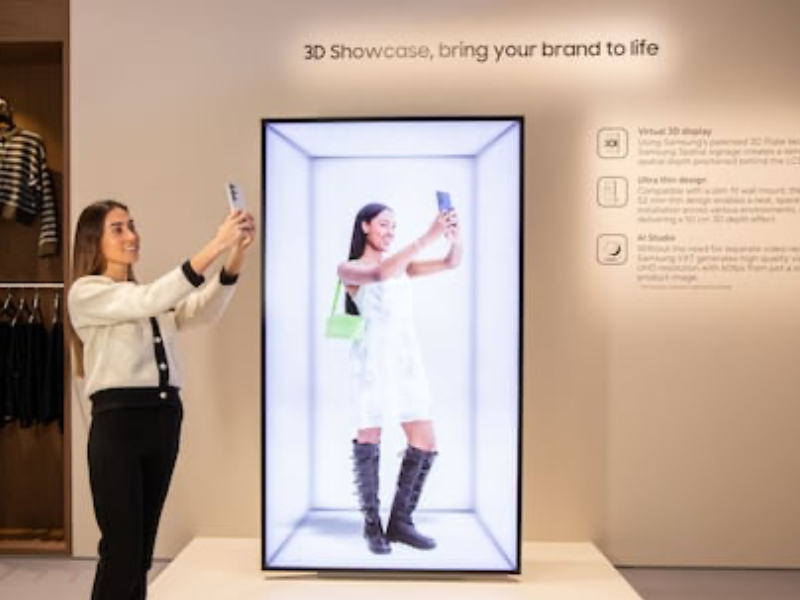
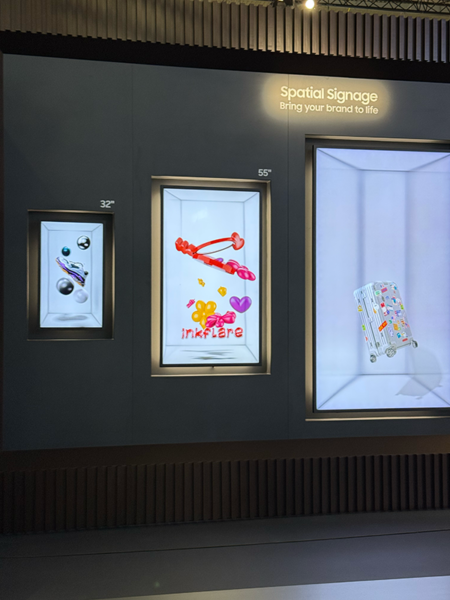
    One of the most visible innovations at Samsung’s booth was its spatial signage technology, designed to deliver a three-dimensional visual effect without the need for specialized glasses.

    Powered by CMS UXT, the platform converts conventional 2D content into immersive 3D-style presentations. For enterprises and public-facing organizations, this capability opens new opportunities for high-impact communication without significantly increasing content production costs.

    From an operational standpoint, spatial signage is particularly relevant for:

    • Corporate lobbies and experience centers
    • Executive briefing rooms
    • Training and simulation spaces
    • High-visibility information displays

    By enabling 3D-style visualization through software rather than custom hardware, Samsung lowers the barrier to adoption and makes immersive signage more accessible to mainstream deployments.

    Color E-Paper: Energy-Efficient Information Displays

    Samsung also highlighted its EM13DX color e-paper display, which represents a different kind of innovation: ultra-low power visual communication.
    The 32-inch display weighs approximately 2 kilograms and can be managed through Samsung’s dedicated e-paper application. Designed for static or semi-static content, the platform consumes minimal power while maintaining high visibility.

    For corporate and institutional users, this technology is well suited for:

    • Wayfinding and directory signage
    • Room scheduling displays
    • Policy and safety communications
    • Temporary information boards

    In facilities where energy efficiency and maintenance costs are critical, color e-paper provides an alternative to traditional LCD and LED signage. It also aligns with sustainability initiatives that are increasingly influencing procurement decisions.

    VXT and AI-Driven Content Creation

    Samsung’s VXT platform continued to evolve at ISE 2026, positioning itself as both a content management system and a creative enablement tool.

    A notable enhancement is AI-assisted content generation, which allows users to create video and visual assets using natural language prompts. Instead of relying exclusively on external agencies or in-house designers, organizations can rapidly generate compliant, branded content for internal and external displays.

    For IT and AV leaders, this reduces:

    • Content production bottlenecks
    • Dependency on specialized creative resources
    • Delays in updating critical messaging

    When integrated with Samsung’s display hardware, VXT supports faster communication cycles and greater consistency across enterprise environments.

    The Wall All-in-One: Scalable Premium Visualization

    Samsung’s The Wall All-in-One microLED platform remains a cornerstone of its high-end display strategy. At ISE 2026, Samsung emphasized ease of deployment and system integration alongside visual performance.

    Designed for environments that require continuous operation and exceptional clarity, The Wall is increasingly deployed in:

    • Network operations centers
    • Executive command rooms
    • Security and surveillance hubs
    • Corporate visualization suites

    By simplifying installation and configuration, Samsung reduces the traditional complexity associated with large-format LED systems. This makes premium visualization more viable for organizations that may not have specialized LED expertise in-house.

    Display Infrastructure for Critical Operations

    A significant portion of Samsung’s showcase focused on command-and-control applications. Through combinations of LED walls, professional LCD displays, and centralized management software, Samsung demonstrated how its ecosystem supports real-time situational awareness.

    Use cases include:

    • Transportation monitoring
    • Utilities and infrastructure management
    • Corporate security operations
    • Emergency response coordination

    In these environments, reliability, redundancy, and clarity are paramount. Samsung’s portfolio enables organizations to build multi-layered visualization systems that can adapt to evolving operational needs.

    VXT Device Management: Enterprise-Scale Control

    Beyond content and hardware, Samsung continues to invest in device lifecycle management. VXT’s device management capabilities allow administrators to monitor, configure, and update displays remotely.

    Key benefits include:

    • Centralized firmware updates
    • Performance and uptime monitoring
    • Policy enforcement
    • Reduced on-site maintenance

    For enterprises managing hundreds or thousands of endpoints, these tools are essential for maintaining consistency and minimizing support costs. They also align Samsung’s display infrastructure more closely with IT governance frameworks.

    Awards as Strategic Validation

    Samsung’s record-setting performance in ISE 2026 award categories served as external validation of its technical and design leadership. While not the primary focus of the company’s messaging, these recognitions reinforced confidence among partners and end users evaluating long-term investments.

    For decision-makers, such recognition reduces perceived risk when standardizing on a single vendor for mission-critical deployments.

    Why It Matters for You

    Samsung’s ISE 2026 presentation highlighted a mature, platform-oriented approach to enterprise displays. Rather than competing solely on panel specifications, the company is building an integrated ecosystem that spans creation, delivery, management, and visualization.

    For corporate and command-and-control leaders, this approach delivers tangible advantages:

    • Advanced visualization through spatial and LED technologies
    • Lower operational costs via energy-efficient displays
    • Faster messaging with AI-assisted content tools
    • Scalable infrastructure for critical operations
    • Centralized governance through device management

    Together, these capabilities support predictable deployments and long-term operational stability.

    Looking Ahead

    As display systems become more tightly integrated with enterprise IT and operational workflows, vendors will increasingly be judged on ecosystem depth rather than hardware performance alone.

    Samsung’s ISE 2026 showcase demonstrated a clear commitment to this direction. By combining immersive display technologies, intelligent content platforms, and enterprise management tools, the company is positioning its professional display portfolio as a foundational layer for modern organizational communication and control.

    For organizations investing in next-generation visualization environments, Samsung’s innovation-led strategy offers a compelling blueprint for scalable, resilient, and future-ready deployments.

    To see all of AVNation’s ISE 2026 coverage, visit our dedicated page. 

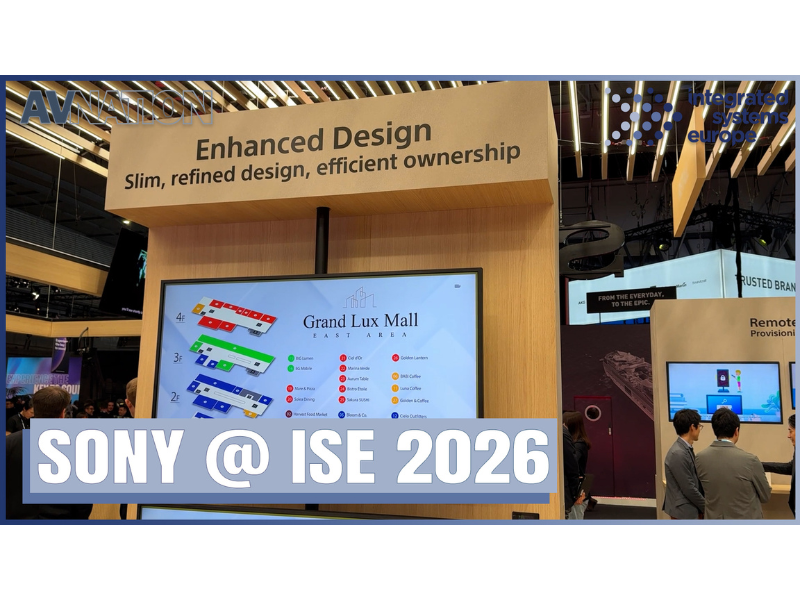
  • Sony Advances Pro BRAVIA Displays with a Focus on Sustainability and TCO at ISE 2026

    Sony Advances Pro BRAVIA Displays with a Focus on Sustainability and TCO at ISE 2026

    Sony is raising the bar for commercial displays with the latest evolution of its Pro BRAVIA professional display lineup, unveiled at ISE 2026. In a conversation with AVNation host Tim Albright, Rich Ventura, VP of Professional Display Solutions, Sony breaks down how the new models are engineered to reduce power consumption, simplify deployment, and lower total cost of ownership, without compromising image quality.

    Sony’s new Pro BRAVIA series introduces a unified cabinet design across multiple models, allowing integrators and designers to maintain a consistent look while scaling brightness and performance based on project needs. Whether deploying a BZ30L, BZ35L, or BZ40L display, customers benefit from the same industrial design, simplifying system design, budgeting, and room planning.

    The updated displays also feature a thinner depth, making ADA compliance easier and reducing the need for specialized low-profile mounts. This design change streamlines installation while improving overall aesthetics in corporate, education, and public spaces.

    Sony has expanded its Deep Black Non-Glare Coating Technology across more of the Pro BRAVIA lineup, delivering strong contrast and reduced reflections in bright environments. Previously reserved for premium models, this display technology is now available at multiple performance tiers, giving customers greater flexibility without compromising image quality.

    A major focus of the discussion was power efficiency and sustainability. Sony’s redesigned backlighting architecture significantly reduces power consumption and heat output compared to previous generations, helping organizations lower energy costs over the product lifecycle. The displays also incorporate recycled plastics made using Sony-developed materials technology, supporting the company’s long-term environmental initiatives.

    Ventura noted that this approach extends across Sony’s professional display portfolio, including LED, Crystal LED, and virtual production solutions. Each new generation is evaluated based on energy efficiency, serviceability, lifecycle management, and ease of deployment for integrators.

    By aligning performance, sustainability, and operational efficiency, Sony’s next-generation Pro BRAVIA displays are engineered to meet the evolving demands of modern commercial AV installations.

    For more information on Sony professional display solutions, visit Sony. To watch the full interview with Tim Albright and explore additional ISE 2026 coverage, visit AVNation.tv.

  • Shure Expands Its Collaboration Portfolio with IntelliMix Bar Pro at ISE 2026

    Shure Expands Its Collaboration Portfolio with IntelliMix Bar Pro at ISE 2026

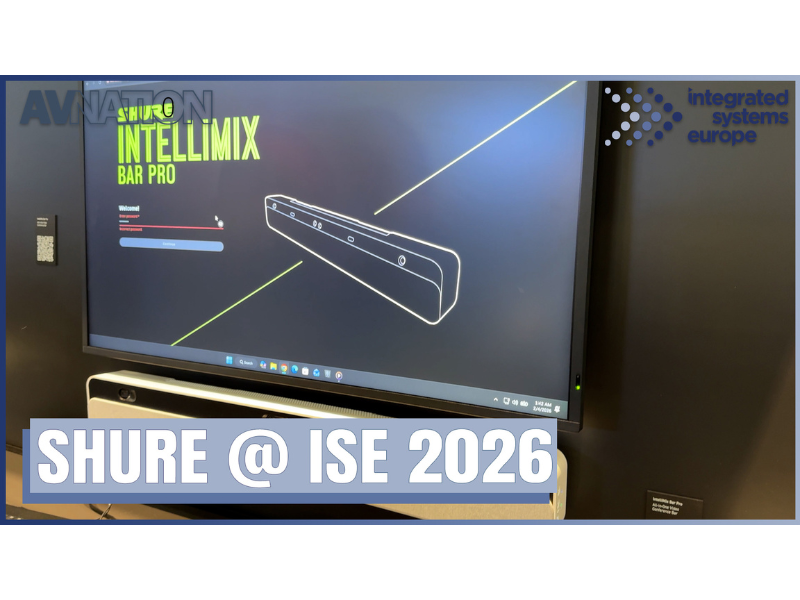
    Rather than simply adding another video bar to the market, Shure is signaling a major strategic shift in its collaboration roadmap. At ISE 2026, AVNation host Tim Albright sat down with Chris Merrick, Associate VP, Global Marketing, Shure in the Shure Content Lounge to discuss the debut of the IntelliMix Bar Pro, a fully integrated audio and video solution engineered entirely by Shure from the ground up.

    Designed for medium to large meeting spaces, the IntelliMix Bar Pro combines four integrated 4K cameras, advanced speaker tracking, and Shure’s renowned IntelliMix DSP technology into a single front-of-room device. Built on Microsoft’s MDEP platform, the solution delivers enterprise-grade security, simplified management, and seamless integration for IT decision-makers while maintaining the audio performance Shure is known for.

    Merrick emphasized that this is not a white-labeled product, but the result of nearly a decade of internal development. From AI-driven noise reduction and automatic gain control to intelligent camera framing and speaker tracking, IntelliMix Bar Pro is designed to create more equitable, natural meeting experiences—especially in larger rooms where traditional video bars struggle.

    With a highly expandable design featuring multiple HDMI, USB, network, and analog connections, the IntelliMix Bar Pro is also built with the future in mind. Shure plans to continue expanding the ecosystem around the platform, giving organizations the flexibility to grow and adapt their collaboration spaces over time.

    Availability for the IntelliMix Bar Pro is targeted for spring 2026, marking a significant milestone as Shure enters the video bar category with a solution that reflects its deep heritage in audio excellence, reliability, and enterprise-ready design.

    For more information about the IntelliMix Bar Pro and Shure’s collaboration solutions, visit Shure. To watch the full interview with Tim Albright and explore complete coverage from the show floor at ISE 2026, visit AVNation.TV.

  • Crestron Champions a Culture of Collaboration Ahead of ISE 2026

    Crestron Champions a Culture of Collaboration Ahead of ISE 2026

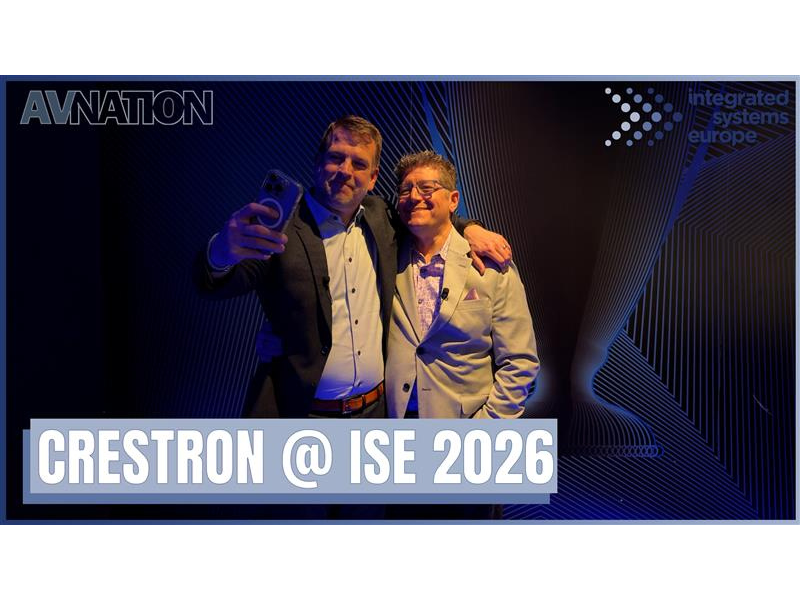
    Before the doors even opened at ISE 2026, the conversation around collaboration was already underway. Broadcasting from the FC Barcelona Museum, AVNation host Tim Albright sat down with Brad Hintze, Brad Hintze, Crestron to explore how the AV industry is redefining the culture of collaboration, and why technology now plays a critical role in how people connect, create, and work together.

    During the interview, Hintze shared how Crestron kicked off the show with an exclusive pre-ISE event, bringing together industry leaders, partners, and Microsoft to discuss collaboration culture and unveil new solutions designed to scale across every type of space. At the center of the discussion was Crestron’s newly engineered compute platform for Microsoft Teams Rooms and Zoom Rooms, built to help integrators deploy consistent, reliable collaboration experiences, from huddle rooms to enterprise-wide rollouts.

    The conversation also highlighted Crestron’s latest advancements in Automate VX, including a new AI-powered camera calibration system that dramatically reduces commissioning time. By using spatial awareness and visual AI, the system eliminates hours of manual measurement, enabling faster, more accurate deployments while improving camera switching, framing, and participant visibility, key elements in delivering seamless collaboration experiences.

    Looking ahead, Hintze emphasized that success isn’t just about deploying technology, it’s about focusing on outcomes. As workplaces continue to evolve, Crestron’s approach centers on creating systems that simply work, scale easily, and support productivity from the moment users walk into a room.

    Learn more about Crestron’s collaboration solutions at Crestron. Watch the full interview and explore complete ISE 2026 coverage at AVNation.TV.

  • Dante at ISE 2026: Audinate Doubles Down on Security

    Dante at ISE 2026: Audinate Doubles Down on Security

    At Integrated Systems Europe 2026, Dante at ISE 2026 was less about celebrating longevity and more about defining the next phase of AV-over-IP.

    As it marks two decades of innovation, Audinate used its presence at ISE to position the Dante platform not just as an audio networking standard, but as a secure, enterprise-ready AV infrastructure layer.

    For enterprise buyers, that distinction matters.

    The conversation has shifted. AV-over-IP is no longer an experiment. It is production infrastructure. And production infrastructure must be secure, manageable and interoperable at scale.

    Security Is Not a Feature. It Is the Foundation.

    In our conversation at the show, Josh Rush emphasized that security is no longer optional in enterprise AV deployments. It has to be built in at multiple levels.

    Dante’s approach is layered:

    • Network-level security that aligns with enterprise IT policies
    • Device-level authentication and management
    • Stream-level protection, including encryption

    That last piece is increasingly important. Encryption has historically been inconsistent across AV-over-IP ecosystems. At ISE 2026, Audinate highlighted growing adoption of encrypted Dante streams, including implementations with manufacturers such as Sennheiser and its conferencing bar solutions.

    The significance is not just that encryption exists. It is that encryption is becoming normalized.

    For enterprise buyers navigating cybersecurity audits, Zero Trust frameworks and internal compliance requirements, that shift reduces friction between AV and IT. Instead of defending why AV devices are exceptions to policy, technology managers can align Dante endpoints and streams with broader network security standards.

    In other words, Dante is evolving from “AV protocol” to “enterprise-grade network service.”

    One Platform, One Pane of Glass

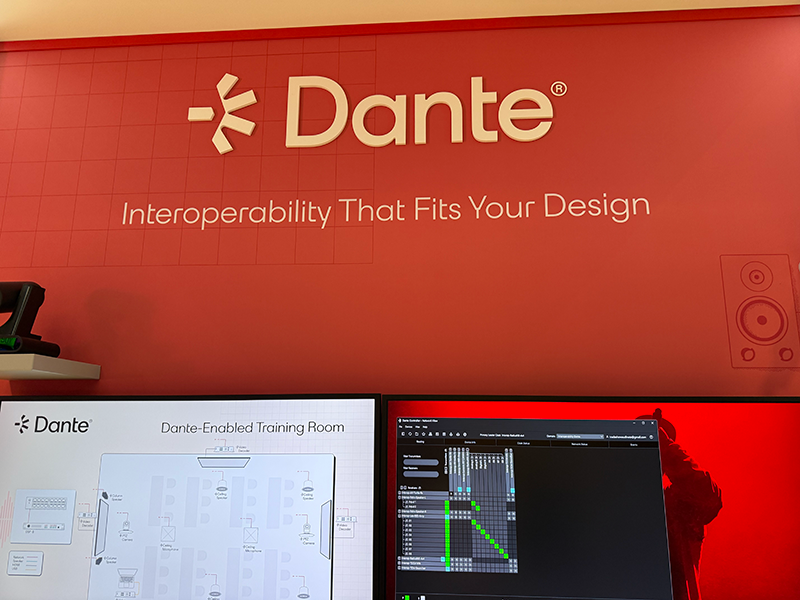
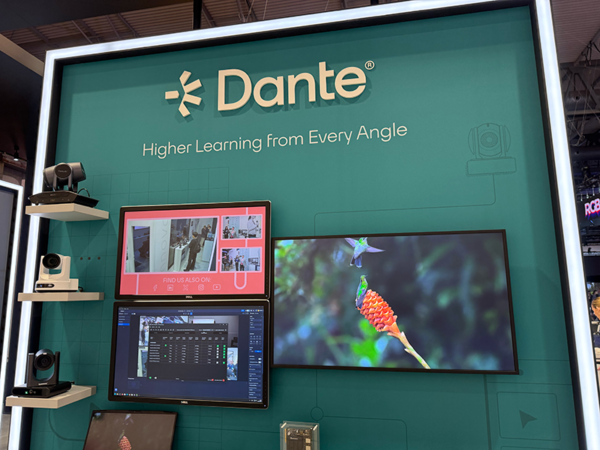
    ISE 2026 Dante wall
    ISE 2026 Dante wall

    Security alone is not enough. Scale requires visibility.

    Audinate’s messaging at ISE focused heavily on platform cohesion. The Dante ecosystem now extends beyond routing audio streams. It encompasses device discovery, management, monitoring and control.

    A key example is Dante Director, which moves device and domain management into a centralized, cloud-enabled environment. The goal is simple but powerful: one pane of glass for managing Dante-enabled devices across locations.

    For enterprises with distributed campuses, multi-building headquarters or global offices, that matters.

    Instead of managing isolated AV networks in each room or facility, technology teams can logically organize devices, define access permissions and maintain control policies across domains.

    From a governance standpoint, this mirrors how IT departments already manage switches, servers and endpoints. The closer AV behaves like IT infrastructure, the easier it is to justify, budget and scale.

    AV-over-IP Is Maturing

    The broader theme at ISE 2026 was the maturation of AV-over-IP. What began as an audio transport technology has expanded into video, control and data.

    At the show, Audinate reinforced that Dante is not just about moving signals. It is about enabling a platform that manufacturers can build on.

    More manufacturers are implementing encryption. More devices are shipping with deeper Dante integration. And more enterprise buyers are specifying network-based AV as the default, not the exception.

    This is where the security narrative becomes strategic.

    When AV-over-IP first gained traction, the focus was flexibility and scalability. Now the focus is resilience. Enterprise stakeholders are asking:

    • Can it be segmented?
    • Can it be encrypted?
    • Can it be centrally managed?
    • Can it align with corporate security policy?

    Audinate’s message at ISE was that the answer to all four is increasingly yes.

    Control Is the Next Layer

    Looking forward, control and remote management are becoming the next major battleground in AV infrastructure.

    Audinate signaled continued investment in expanding remote management capabilities, increasing device visibility and enabling broader control across manufacturer ecosystems. The idea is to reduce the operational overhead of large-scale AV networks.

    For enterprise buyers, operational efficiency is often more important than raw feature sets. The cost of truck rolls, on-site configuration and manual troubleshooting adds up quickly across dozens or hundreds of rooms.

    A secure, remotely manageable Dante environment lowers that operational burden. It also makes AV teams more strategic. Instead of reacting to outages, they can proactively monitor performance and maintain policy compliance.

    This trend reflects a larger industry movement. As AV integrates more deeply with enterprise networks, it inherits the expectations placed on IT systems: uptime, auditability, encryption and centralized control.

    Twenty Years In, Still Platform-Focused

    ISE 2026 also marked a symbolic milestone. Two decades after its founding, Audinate is no longer introducing a disruptive newcomer technology. It is stewarding an ecosystem.

    Dante’s value proposition has evolved:

    • From audio transport to AV platform
    • From room-level routing to enterprise-scale domains
    • From convenience to compliance

    For enterprise decision-makers, that evolution reduces risk. Established ecosystems with broad manufacturer support and maturing security frameworks provide confidence in long-term deployments.

    The takeaway from Dante at ISE 2026 was not flashy demos or radical reinvention. It was steady, strategic progression.

    Security is becoming standardized. Encryption adoption is accelerating. Device management is centralizing. And AV-over-IP is behaving more like enterprise IT infrastructure every year.

    For organizations investing in network-based AV in 2026 and beyond, that is exactly the direction they want to see.

    For all of AVNation’s coverage of ISE 2026, visit our dedicated coverage page.