Cisco is done betting that customers will choose WebEx just because they already own Cisco hardware. In September, the company will launch Devices for Zoom Rooms, according to Cisco. The program puts a certified, native Zoom Rooms experience on select Cisco endpoints, including the Desk Pro G2, Room Bar, Bar Pro, Board Pro G3 and RoomKit.
That is a meaningful shift from where Cisco stood before. Customers who wanted a Cisco room with Zoom software have had to rely on standard SIP interoperability, a workaround that required extra integration work on the back end. The new program replaces that patchwork with a fully certified experience built into the hardware itself.
Cisco is not stopping at Zoom. The company is also deepening its Microsoft Teams Rooms integration, adding dedicated device management channels inside Control Hub and folding Copilot into its agentic tools, according to Cisco. Taken together, the moves signal a clear message: the meeting platform a customer picks, whether Teams, Zoom or WebEx, should not determine whether that customer gets a modernized Cisco room.
What it means for entrenched Cisco shops
Pearl Technology Executive Vice President Jeremy Caldera has spent years installing and supporting Cisco rooms for integration clients, and he called the announcement a genuine surprise. Cisco has long been known as a proprietary-first vendor, he said, and this represents a real shift in that posture.
“Cisco’s been the king of proprietary for how long?” Caldera said. “There’s still those clients who are wholly ingrained in the world of Cisco, but they’re still needing Teams rooms and Zoom rooms.”
Caldera does not expect the announcement to pull new customers into the Cisco ecosystem. Buyers who have already standardized on other hardware platforms are unlikely to switch because of this update alone, he said. However, he sees a clear winner in the deal: organizations already committed to Cisco hardware who previously had to maintain separate SIP-based workarounds to support Zoom or Teams rooms. Those customers no longer need that extra layer, and some had been quietly evaluating other manufacturers because of the added cost and complexity. This update removes that pressure point entirely.
The practical effect, Caldera said, is retention rather than expansion. Cisco protects the customers it already has instead of winning converts from Crestron, HP or other platforms. For AV integrators managing mixed environments, that still matters. Fewer custom SIP integrations mean less maintenance overhead and fewer points of failure in rooms that are already in production.
The higher education vertical offers a useful test case, because AV and IT are unusually intertwined there. Britt Yenser, AV Manager at Northampton Community College and an active member of the Higher Education Technology Managers Alliance (HETMA), said the Cisco-Zoom news speaks directly to a dynamic her sector already lives with daily.
“We say across the industry that AV is IT, but that is extremely true in higher ed,” Yenser said. “We are housed within the IT department. The more that we can communicate clearly with the other IT partners and meet them where they are, the more successful we can be.”
Cisco carries particular weight in higher education IT departments, where campus networking decisions are often made independently of the AV team and Cisco is frequently the default standard. Zoom and Google Meet, meanwhile, are common conferencing choices in that same environment. Before this announcement, an AV team wanting to standardize on Cisco hardware for a Zoom-based campus faced the same integration burden Caldera described. Now, that team can stay inside a hardware platform its IT department already trusts and supports, without a secondary integration layer.
That alignment matters beyond convenience. When AV and IT can standardize on shared hardware, the two departments have one less point of friction in a relationship that already requires constant coordination. A tech manager fighting for network resources or endpoint budget has an easier case to make when the AV hardware sitting on that network is the same brand IT already manages everywhere else.
The bigger picture for buyers
For corporate IT and AV decision-makers weighing a Cisco purchase, the calculus has changed only for a specific group: organizations already leaning toward Cisco hardware who need platform flexibility on the software side. For that buyer, procurement got simpler. Fewer vendors, fewer support contracts and fewer integration points reduce total cost of ownership over the life of the equipment.
For buyers who have not yet standardized on any single hardware platform, this announcement alone probably will not tip the decision. Platform interoperability is one of several factors in a room standardization decision, alongside cost, existing infrastructure and IT department preference. But it does remove one argument against Cisco that competitors could previously use: the idea that choosing Cisco meant locking into WebEx.
Cisco’s September launch will be worth watching closely, particularly for how the certified Zoom experience compares to native Zoom hardware from Zoom’s own certified partners. AVNation will continue to track how the rollout performs once it reaches customers.
Shure and Zoom have expanded their collaboration partnership with new IntelliMix Room Kits and the IntelliMix Foundation System for Zoom Rooms, giving organizations more flexibility in deploying meeting and learning spaces. The solutions are designed to deliver clear, consistent audio and video experiences while supporting Zoom AI features through high-quality audio capture and streamlined room management.
The IntelliMix Foundation System is built for advanced AV environments such as lecture halls, boardrooms, and hybrid classrooms, while the pre-configured IntelliMix Room Kits simplify deployment across standard meeting spaces of all sizes. With enterprise-grade security, remote device management, and scalable deployment options, the new solutions help IT teams and AV professionals create future-ready Zoom spaces. The products will be showcased at InfoComm 2026 and are expected to be available in July 2026.
Shure, a global leader in workplace collaboration solutions, and Zoom Communications, Inc. (NASDAQ: ZM) are reinforcing their commitment to customers by providing reliable, scalable meeting room solutions that easily standardize across Zoom workspaces and higher education environments. Shure now provides greater flexibility with the IntelliMix Collaboration Portfolio by offering the IntelliMix™ Room Kits and IntelliMix™ Foundation System for Zoom Rooms.
Built to support the growing role of human-AI collaboration in meetings and learning, these offerings enable consistent, high-quality audio capture to support more accurate inputs in Zoom AI.
Shure IntelliMix Foundation system includes a powerful compute with built-in IntelliMix Room ® DSP software, alongside an intuitive touch panel. The industry-first compute is designed to reduce or replace the need for external DSP components while delivering exceptional audio for very sophisticated AV rooms.
For IT teams that want straightforward deployment and scalability across standard meeting spaces, they have the option to choose their preferred pre-configured IntelliMix Room Kit, which includes the same powerful compute and intuitive touch panel, the MXA902 Ceiling Array Microphone and Loudspeaker, and an intelligent camera from Huddly. With zero-touch provisioning, IT teams can choose quick and easy deployments based on the room size: whether it is a small space that requires just one microphone and camera, or a larger room demanding different coverage areas and multi-camera options.
Together, these solutions give IT teams and AV professionals a variety of choices for rapid deployment in standard rooms and flexible building blocks for complex spaces.
“The future of work demands spaces that are intelligent, connected, and designed for the AI era. Shure’s IntelliMix Collaboration Portfolio amplifies the power of Zoom Rooms through clear, consistent audio that drives Zoom AI’s most essential capabilities across any room, and any environment,” said Jeff Smith, head of Product, Workplace at Zoom.
Solutions Designed for Different Deployments.
Based on their needs, customers can choose:
IntelliMix Foundation System Base Kit for Advanced AV Rooms
Built for sophisticated AV rooms and complex spaces, the IntelliMix Foundation System provides the flexibility AV professionals need to tailor rooms to unique environments.
o Ideal for lecture halls, divisible rooms, hybrid or HyFlex classrooms, and enterprise spaces, including large boardrooms and high-impact collaboration environments.
o Works with Shure’s Microflex Portfolio to precisely tailor your audio needs. o Flexible video options, including cameras from the Shure Camera Partner Program or other supported camera choices.
Pre-configured IntelliMix Room Kits for Small to Large Rooms
Designed for fast, consistent deployment across small to large standard meeting spaces, IntelliMix Room Kits support organizations looking to standardize at scale.
o Ideal for IT teams seeking consistent performance and simplified management across rooms.
o Zero-touch provisioning enables simple installation and setup.
o Pre-configured, complete systems including premium microphone + loudspeaker, intelligent video, Windows-based compute for Zoom Rooms, and an intuitive touch panel.
o Customers can choose from several kits based on room size: IntelliMix Room Kit 30 for small spaces, IntelliMix Room Kit 50 for medium rooms, IntelliMix Room Kit 70 for large rooms, and IntelliMix Room Kit 80 for larger rooms that require multiple cameras.
“Our deep partnership with Zoom provides the foundation for enterprises and educators to build modern environments that evolve with AI, rather than being constrained by it,” said Wayne Driggers, Director, Strategic Alliances at Shure. “Reliable, AI-powered communication starts with trust, and we want to ensure organizations feel confident when deploying the underlying infrastructure that empowers it”.
Built for Secure, Scalable Zoom Spaces.
Through joint solutions, customers benefit from enterprise-grade security for meetings, lectures, and collaboration in Zoom. Using ShureCloud or Zoom Device Management, IT teams and AV professionals can remotely monitor, manage and update systems in real time to help reduce operational overhead and streamline IT workflows.
With IntelliMix Room Kits and the IntelliMix Foundation System, organizations gain a cohesive, integrated certified solution, backed by a strong partnership, comprehensive global support, and future-ready technology.
The IntelliMix Room Kits and Foundation System for Zoom will be showcased for the first time at InfoComm 2026 and are expected to be available starting July 2026.
Zoom Meetings still exists. The meeting links still work. Users can still click a Zoom link, join a call, turn on the camera, share a screen, and get through a meeting the way they have for years.
What changed is the container around that experience.
Zoom Workplace is Zoom’s broader collaboration app and platform. It includes Zoom Meetings, but it is not limited to meetings. It brings meetings, Team Chat, Zoom Phone, Whiteboard, Mail, Calendar, Scheduler, Zoom Canvas or docs features, and Zoom AI Companion into one work environment.
That distinction matters because most users are not asking a branding question. They are asking an operational one.
Do I need to download something new?
Will my Zoom meetings still work?
Does this change my conference rooms?
Do users need training?
Does IT need to change settings, deployment packages, or support documentation?
That is where Zoom Workplace matters.
What Zoom Workplace includes
The simplest way to understand Zoom Workplace is this: Zoom is no longer only trying to be the app people open when they have a video meeting. Zoom Workplace is meant to be the app people keep open during the workday.
Depending on the license and configuration, Zoom Workplace can include:
Zoom Meetings
Zoom Team Chat
Zoom Phone
Zoom Whiteboard
Zoom Mail and Calendar
Zoom Scheduler
Zoom Canvas, Docs, Notes, or related productivity tools
Zoom Clips
Zoom AI Companion
Workspace and room-related tools connected to Zoom Rooms
Not every organization will use all of those pieces. Some will still treat Zoom as a meeting platform. Others will use it more like a collaboration workspace that competes with Microsoft Teams and Google Workspace.
That is the real Zoom vs Zoom Workplace difference. Zoom Meetings is the familiar video-meeting service. Zoom Workplace is the larger app and platform that surrounds it.
What changed for everyday users
For most users, the first change is cosmetic. The app may now say Zoom Workplace instead of simply Zoom or Zoom Meetings. The icon and interface may look different. The tabs and side panels may expose more tools than users remember seeing before.
That does not mean the old Zoom meeting experience disappeared.
A user who only needs to join a meeting can still do that. A meeting invite still contains a join link. The user can still open that link in the Zoom Workplace app or, when allowed by the host, join from a browser. The meeting behavior is familiar enough that most users will not need formal retraining just to attend a call.
Where users may need help is in the new tools around the meeting.
Zoom Workplace pushes more collaboration into the same app. A user may see chat threads, calendar views, AI Companion prompts, docs, whiteboards, phone features, or post-meeting summaries in places they did not expect. That is useful if the organization is standardizing on Zoom Workplace as a collaboration platform. It is confusing if the organization only told users, “We use Zoom for meetings.”
The user-training issue is not how to click Join. It is explaining what the app now contains and which tools the organization actually wants people to use.
What did not change
The most important thing that did not change is the basic role of Zoom Meetings.
Zoom Workplace did not turn every Zoom link into something new. It did not require users to abandon video meetings. Did not make Zoom Rooms irrelevant. Does not mean that a conference room suddenly works differently because the desktop app has a broader name.
In practical terms, these things remain familiar:
Zoom meeting links still send people to Zoom meetings.
Users can still join from a meeting invite.
The Zoom Workplace desktop and mobile app still handles meeting participation.
Browser joining remains an option when enabled.
Zoom Rooms still function as the dedicated room-system layer.
SIP/H.323 interoperability and room-connector workflows remain separate room and infrastructure considerations.
That last point is important for IT and AV teams.
A rebranded or expanded desktop app does not remove the need to manage meeting-room hardware. The user’s laptop experience and the conference-room experience are connected, but they are not the same thing.
Zoom Workplace app vs Zoom Meetings
The Zoom Workplace app is now the main user-facing app for desktop and mobile. For many users, this is the app they download when they install Zoom.
Zoom Meetings is still the meeting experience inside that app.
Think of it this way. Microsoft Teams is both an app and a meeting experience. Google Workspace is a broader work platform that includes Google Meet. Zoom Workplace now moves Zoom closer to that model.
That can be a good thing for organizations that want fewer separate apps. It can also create confusion for organizations that already have Microsoft 365, Google Workspace, Slack, or another collaboration platform in place.
If the company already uses Microsoft Teams for chat and Zoom for meetings, does IT want users adopting Zoom Team Chat too? Where employees already use Outlook and Exchange, should Zoom Mail and Calendar be enabled? If meeting summaries are available through Zoom AI Companion, who owns the policy for when those summaries can be generated and shared?
Those are not branding questions. Those are governance questions.
What IT teams should check
For IT teams, the shift to Zoom Workplace is less about panic and more about housekeeping.
Start with app versions. Make sure your managed devices are running supported versions of the Zoom Workplace desktop and mobile app. If you use software deployment tools, confirm that the package name, installer behavior, and update process still match your internal documentation.
Then review user training. Users do not need a 90-minute class on Zoom Workplace. They need a clear answer to what changed, what did not, and which features your organization supports.
The next area is AI Companion. This is where IT, legal, compliance, and business leadership need to be aligned. AI-generated meeting summaries, in-meeting questions, chat summaries, and document assistance can be useful. They can also raise questions about retention, sharing, external participants, regulated data, and user consent.
At minimum, IT should review:
Which AI Companion features are enabled
Whether meeting summaries start automatically or manually
Who can receive or share AI-generated summaries
Whether summaries can be shared outside the organization
How AI Companion settings differ by group, role, or account
What users are told when AI features are active
Whether the organization’s legal, privacy, and compliance teams have reviewed the policy
Admins should also check the broader app experience. If Zoom Workplace exposes Mail, Calendar, Phone, Team Chat, Whiteboard, Canvas, or other tools, decide whether those features are part of the official workflow or just available because the app includes them.
The worst version of this rollout is not technical failure. It is silent feature creep. Users start using tools IT did not document, compliance did not review, and support teams were not trained to troubleshoot.
What this means for Zoom Rooms
This is where the AV side matters.
Zoom Workplace affects the user and app layer. Zoom Rooms still live in the room layer.
A Zoom Room is not just “Zoom on a screen.” It is a managed meeting-room system. A room may include a dedicated Zoom Rooms appliance or computer, a controller, a scheduling display, cameras, microphones, speakers, displays, touchscreens, network connections, and device-management settings.
That room has to work before the meeting starts. It has to launch reliably. Has to route audio correctly. It has to show the right camera. Has to handle screen sharing. It has to stay updated. Has to remain supportable when something breaks five minutes before an executive meeting.
Zoom Workplace does not eliminate any of that.
In fact, the broader Zoom Workplace strategy may make the room experience more important. If users are doing more inside Zoom before and after the meeting, they will expect the physical room to feel like part of the same workflow. They will expect calendar joins, whiteboard access, AI features, room booking, content sharing, and hybrid participation to behave consistently.
That requires coordination between IT, AV, facilities, and workplace teams.
A Zoom Room still needs:
Certified or compatible room hardware
Properly configured cameras and microphones
Displays sized for the room
A controller users understand
Calendar integration
Network reliability
Audio processing that matches the room
Firmware and app update management
Remote monitoring
A support process for failed joins, audio problems, and device issues
This is why Zoom Workplace should not be treated as a simple app rename in enterprise environments. The app may be the most visible change, but the room system is where user confidence is won or lost.
For organizations evaluating broader platform changes, this connects directly to conference-room migration planning. AVNation has covered that larger question in how to switch conference rooms from Zoom or Teams to Visio, where the real issue is not the meeting service alone. It is what happens to the room when the collaboration platform changes.
The real risk is unclear ownership
Zoom Workplace sits at the intersection of several teams.
IT owns identity, deployment, security, and admin policy.
AV owns the room experience, cameras, microphones, displays, and support standards.
Facilities may own room scheduling, space planning, and workplace experience.
Legal and compliance may own retention, AI policy, and external sharing rules.
Users just want the meeting to work.
That split is where confusion happens.
If Zoom Workplace is “just Zoom,” no one reviews the new pieces carefully. If Zoom Workplace is treated as an entirely new platform, teams may overcomplicate what is still a familiar meeting experience for most users.
The right answer is in the middle. Treat Zoom Workplace as the expanded Zoom app and collaboration platform. Do not treat it as a replacement for Zoom Meetings. Do not treat it as irrelevant to room support.
It is a user-experience change, an IT-management change, and a workplace-technology change.
What users should know
For everyday users, the message should be simple.
Zoom Workplace is still where Zoom meetings happen. The app may include more tools than before, including chat, phone, calendar, whiteboard, docs, and AI Companion features. Your organization may not use every tool inside the app. Follow internal guidance on which features are approved.
Users should also understand that AI Companion is not just another button. If meeting summaries, in-meeting questions, or AI-generated notes are enabled, those features may create records of meeting content. Users should know when AI features are active and how summaries are shared.
This is similar to the confusion around presence in Microsoft Teams. A small interface change can carry more meaning than users expect. In Teams, the green status dot often gets misread as a productivity signal. AVNation covered that issue in how long Microsoft Teams stays green. Zoom Workplace creates a different version of the same problem: the app shows more information and more options, but users need context to understand what those signals and tools actually mean.
The same applies to free and paid meeting tools. As AVNation explained in [what you actually get with free Google Meet](ADD INTERNAL LINK), the practical question is rarely whether a product technically works. The better question is whether it gives the organization enough control, reliability, and support for the meetings that matter.
What IT and AV teams should do next
The best next step is not a large migration project. It is a short readiness review.
Confirm what version of the Zoom Workplace app is deployed. Review which Zoom Workplace features are enabled. Check AI Companion settings. Update help desk language so users know the app name changed. Confirm whether Zoom Team Chat, Mail, Calendar, Phone, Whiteboard, and Canvas or docs tools are approved for use.
Then look at Zoom Rooms separately.
Room systems should be checked for supported software versions, device compatibility, controller behavior, firmware status, audio and camera defaults, and monitoring. If users are being encouraged to use new meeting features, make sure the room experience supports the same expectations.
The question is not whether Zoom Workplace is the same as Zoom. The question is whether your organization understands which layer it is talking about.
For users, Zoom Workplace is the app where Zoom meetings happen. lass=”yoast-text-mark” />>When it comes to IT, it is a broader managed collaboration platform. >If you’re in an AV team, it is one more reason the conference room cannot be treated as an afterthought.
The bottom line
Zoom Workplace is not a separate replacement for Zoom Meetings. It is Zoom’s broader collaboration app and platform, with Meetings inside it.
The core meeting experience remains familiar. For IT teams, the app now carries more policy, training, AI, and deployment considerations. In AV teams, Zoom Rooms still require managed hardware, software, support, and room-design discipline.
So, is Zoom Workplace the same as Zoom?
Yes, in the sense that it is still the Zoom app most users will use to join meetings.
No, in the sense that Zoom Workplace is now much more than a meeting button.
Is Zoom Workforce the same as Zoom FAQ
Is Zoom Workplace the same as Zoom?
Yes and no. Zoom Meetings still exists, but Zoom Workplace is the broader app and collaboration platform that includes Meetings along with chat, phone, whiteboard, calendar, docs or Canvas features, and AI Companion.
Do I need Zoom Workplace to join a Zoom meeting?
Not always. The Zoom Workplace app is the main desktop and mobile app for joining Zoom meetings, and it usually provides the best experience. Depending on the meeting settings, users may also be able to join from a browser or by phone. Some users can join a Zoom meeting without a Zoom account.
Is Zoom Meetings going away?
Zoom Meetings is still part of Zoom Workplace. The branding around the app has expanded, but the core meeting experience remains central to Zoom’s platform.
What is included in Zoom Workplace?
Zoom Workplace can include Zoom Meetings, Team Chat, Zoom Phone, Whiteboard, Mail, Calendar, Scheduler, Zoom Canvas or docs features, Clips, Zoom Rooms integrations, and Zoom AI Companion. Exact availability depends on the organization’s license, settings, and rollout.
Does Zoom Workplace affect Zoom Rooms?
Yes, but indirectly. Zoom Workplace affects the user and app layer. Zoom Rooms remain the dedicated room-system layer, with hardware, controllers, cameras, microphones, speakers, displays, calendar integration, and admin support. IT and AV teams should manage those layers together, but not confuse them.
Is Zoom Workplace free?
The Zoom app can be downloaded and used with free Zoom accounts for basic meeting use. Paid Zoom Workplace plans add more business features, management controls, and access to AI Companion features depending on the plan. Organizations should match the license to the level of control and support they need.
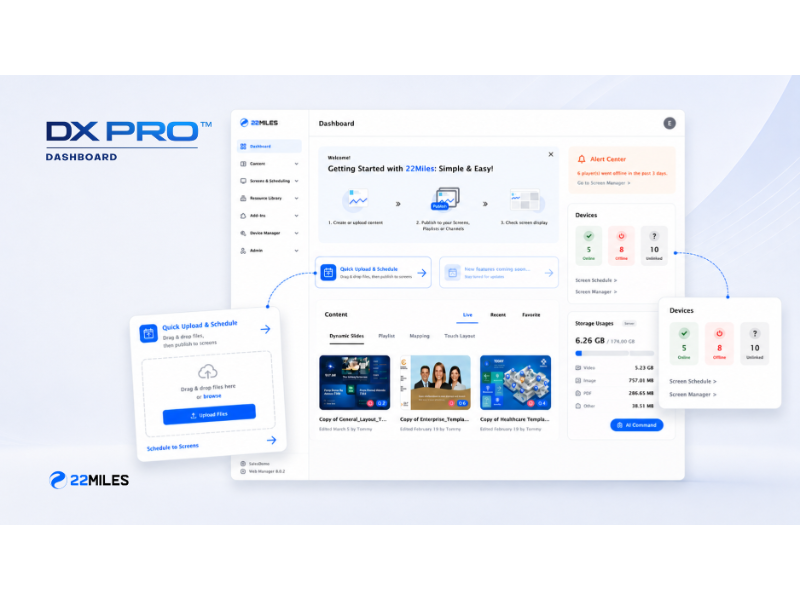
22Miles has launched DX Pro™, a new web-native platform designed to simplify enterprise visual experience management. The platform combines digital signage, wayfinding, videowalls, interactive displays, and space management into a single browser-based interface. Built for both cloud and on-premises deployments, DX Pro helps AV and IT teams manage large-scale screen networks with centralized device monitoring, governance controls, and content management tools.
The platform also introduces AI-powered features that make content creation and wayfinding deployment faster and easier. AI Template Designer allows users to generate signage content using simple text prompts, while AI Map File Creation converts standard 2D floor plans into editable wayfinding maps. With integrations for Microsoft Teams, Zoom, SharePoint, Google Workspace, and other enterprise tools, DX Pro is positioned as a scalable solution for organizations looking to unify and modernize their visual communication infrastructure.
22Miles, a leading visual experience platform provider for over 20 years, today announced the launch of DX Pro™, a unified web-native management platform for visual communications applications such as digital signage, wayfinding, immersive experiences, and space management. DX Pro brings content creation, device management, fleet monitoring, and governance into a single browser interface, with support for both cloud and on-premises deployment.
“Too often, digital signage and other visual experiences are treated as disconnected projects, with different tools, vendors, and support contracts for every screen type and location. Enterprise IT teams end up with a fragmented stack they can’t govern or scale,” said Tomer Mann, Chief Revenue Officer at 22Miles. “DX Pro gives them what they’ve needed: a single platform with the deployment flexibility to run in the cloud or on-premise, the fleet visibility to manage tens of thousands of screens across hundreds of locations, and the governance controls that enterprise infrastructure demands.”
Platform Capabilities
DX Pro supports the full range of enterprise visual experience needs within a single, scalable platform: digital signage, dynamic wayfinding, videowalls, mobile applications, and multi-touch and interactive experiences. Organizations can standardize on DX Pro for initial deployments and expand to more complex applications over time without changing their software stack or adding tools.
DX Pro also delivers the fleet visibility and governance modern IT infrastructure demands, with self-service device and license management, a fleetwide Alert Center, and Device Overview providing at-a-glance player health with direct links to individual screen managers. User group management gives administrators clear visibility into group assignments and access controls across the organization.
Enterprise Integrations and Content Workflow Improvements
DX Pro is designed to make content updates fast and intuitive while supporting the access controls and governance workflows enterprise operations require. Map editing, screen grouping, and mass scheduling tools enable content teams to manage large, multi-location deployments efficiently, while DX Pro’s emergency overwrite capability allows instant full-network content takeover, triggered manually or integrated directly with enterprise emergency notification services. Native enterprise integration capabilities include Microsoft Places, Zoom Enterprise, Teams, Outlook Space Finder, SharePoint, Office 365, Google Workspace, and major social media platforms.
AI-Native Content Tools
22Miles also continues to infuse AI into the platform. DX Pro introduces two AI-native capabilities that reduce the technical barrier to content creation and wayfinding deployment:
AI Template Designer generates production-ready signage content from plain-language prompts, with full element-by-element editorial control for enterprise communications standards.
AI Map File Creation converts standard 2D floor plans into editable SVG wayfinding maps, reducing the time and specialist involvement required to deploy interactive wayfinding at new locations.
Availability
DX Pro is available now. To schedule a platform demonstration, visit 22miles.com/dxpro or visit the 22Miles booth C5753 at InfoComm 2026 for a live demonstration. Existing 22Miles customers can contact their account manager to discuss upgrading to DX Pro.
The Channel Pulse Q1 2026 data is a channel report. But buried in every finding about what resellers sell is a mirror image of what your organization should be buying.
Microsoft Teams has won the meeting room.
Not won as in leads the market. Won as in: 98% of channel partners cite it as a primary hardware driver. Won as in: the vendors rising in channel confidence are those most tightly aligned with Teams certification. Won as in: the vendors losing ground are losing it because they do not fit the Teams-native model cleanly enough.
That is the headline finding from the Channel Pulse Q1 2026 Landscape Report, published by BlueTouch Paper. The report draws on face-to-face interviews with resellers across five continents. It is a channel document. However, it tells buyers something important about where the rooms they manage are headed.
The counterargument deserves acknowledgment
Some organizations run Zoom-first estates, and Zoom still commands meaningful reseller attention as a strong second platform. A slice of the market maintains Cisco Webex estates, typically tied to legacy Cisco hardware. Google Meet serves education and SMB niches. There are legitimate reasons to run a non-Teams-primary environment.
Furthermore, the Blue Touch Paper methodology has a built-in bias worth naming. Resellers believe Teams will dominate partly because they have organized their businesses around selling Teams-aligned hardware. Of course they predict the ecosystem they have bet on will win.
That is a fair critique. Yet the data reflects behavior, not just opinion. Resellers are selling what customers are buying. The consolidation trend is customer-driven. Buyers are making these choices already. The channel is following them.
Which means you are likely living this reality in your organization right now, whether or not you have named it explicitly.
The MDEP problem is coming whether you are ready or not
The most quietly significant finding in the Blue Touch Paper report is not about Microsoft Teams dominance. That story is already well established. The more important finding is about MDEP.
MDEP, or the Microsoft Device Ecosystem Platform, is Microsoft’s framework for ensuring that Teams Rooms devices meet consistent standards for security, manageability, and long-term feature access. Think of it as certification with teeth. Today’s Teams certification tells you a device works with Teams. MDEP tells you a device slots into Microsoft’s enterprise management and security stack in a standardized, future-proof way.
The Blue Touch Paper survey found that most resellers cannot yet explain MDEP clearly. Most clients have not asked about it. Yet 47% of channel partners predict a negative sales impact for vendors who do not adopt it. The implication: vendors without MDEP compliance may face exclusion from future Teams Rooms ecosystems.
This matters for buyers because hardware decisions made today lock in platform eligibility for three to five years. If you buy from a vendor who misses MDEP adoption, you may find your room systems fall outside Microsoft’s supported ecosystem long before your next refresh cycle.
Add MDEP to your evaluation criteria now. Your reseller may not raise it yet. Raise it yourself.
CVI is costing you money it no longer earns
The report contains a quietly damning finding about CVI. Cloud video interoperability, the technology many organizations paid meaningful money to deploy, now appears in fewer than 10% of deployments. Native guest join, the built-in ability to join a cross-platform meeting directly from a Teams Room, handles most scenarios adequately for 65% of channel partners.
Technology debt is real. Paying for solutions to problems that no longer exist is a specific kind of waste. Review your CVI spend this quarter. The default assumption should be that native guest join covers your needs. The burden of proof should fall on CVI justification, not on dropping it.
The prescription is simple, even if the execution is not
Name your primary platform. Align your hardware to it. Audit your certification status. Ask your vendors about MDEP. Review your CVI spend.
None of that is complicated. However, it requires your organization to treat room technology as a strategic infrastructure decision rather than a series of isolated procurement choices. The Blue Touch Paper data shows the channel already understands this. Resellers know your rooms connect to platform strategy, licensing decisions, OS selection, and AI readiness simultaneously.
The channel has already decided what meeting rooms look like in 2027. The question is whether your procurement process has caught up.
Tim Albright is president at AVNation. They have held no consulting relationships with the manufacturers or vendors discussed in this article.
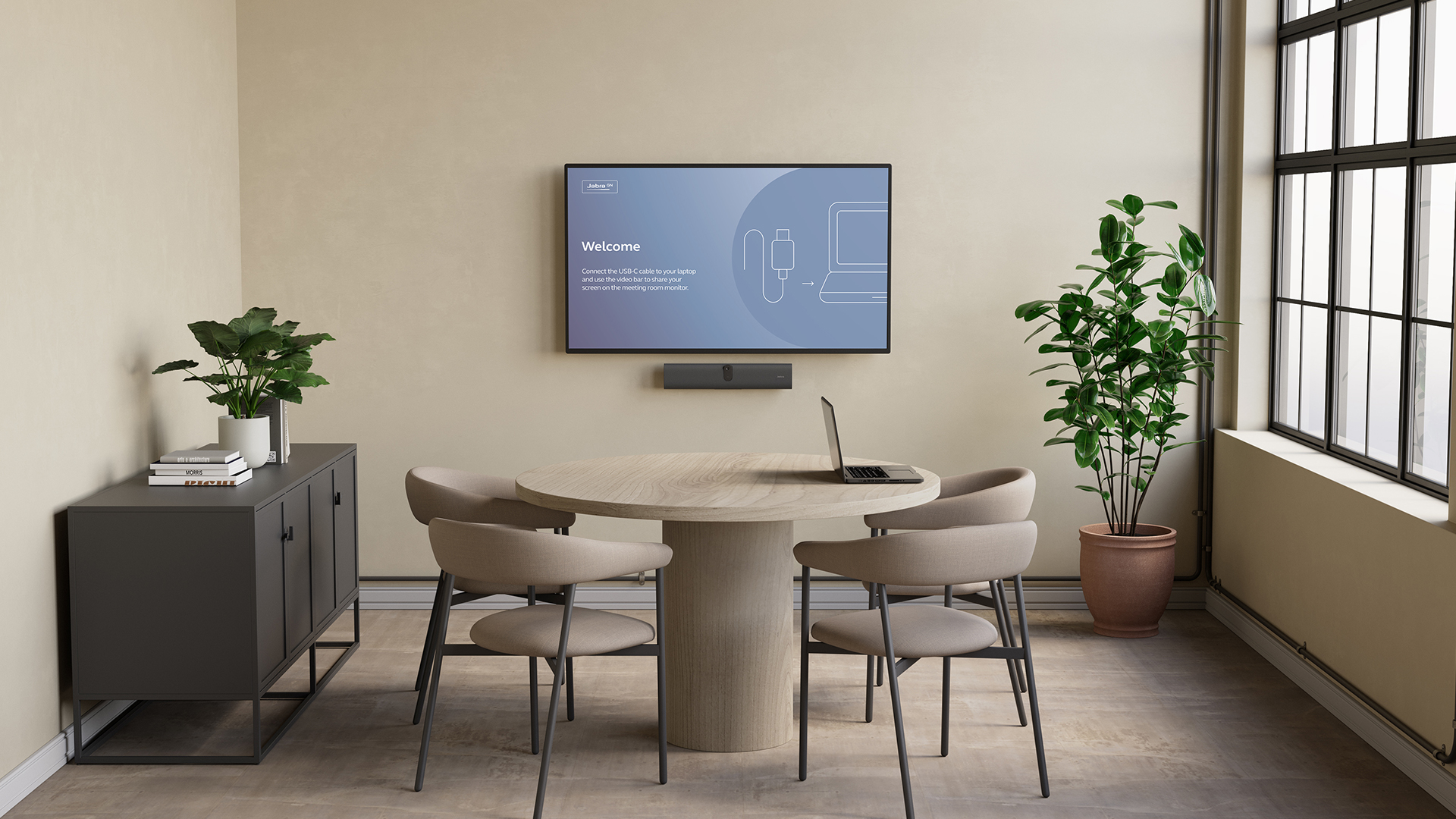
Jabra has launched the Jabra PanaCast U30, a compact USB video bar designed to simplify BYOD (bring-your-own-device) video collaboration in small meeting rooms and huddle spaces. Built for rooms with up to six people, the solution combines intelligent video features, professional-grade audio and easy deployment to help organizations create better hybrid meeting experiences without the high cost or complexity often associated with small-room setups. Users can simply connect their laptop using a single USB-C cable and instantly start meetings on platforms like Microsoft Teams and Zoom.
The PanaCast U30 features a 120-degree field of view, AI-powered video modes like Intelligent Zoom and Virtual Director, plus six microphones and a built-in speaker for clear and natural conversations. Designed with IT teams in mind, the solution offers flexible mounting options, simplified installation and centralized device management through Jabra Plus. With support for local firmware updates and enhanced security through Microsoft Device Ecosystem Platform (MDEP), the device provides an efficient and scalable collaboration solution for modern hybrid workplaces.
Jabra today announces the Jabra PanaCast U30, a USB video bar built for bring-your-own-device (BYOD) collaboration in small meeting spaces and huddle rooms for up to 6 people. Combining intelligent video technology, professional audio performance and simplified deployment in a compact device, it delivers a simple and affordable way to equip more small rooms for high-quality hybrid meetings.
Many organizations want to support video collaboration in every meeting space, but equipping smaller rooms can be difficult due to cost and complexity. As a result, many rooms still lack the technology needed for effective hybrid meetings.
“Small meeting spaces are where many of the most important conversations happen,” says Holger Reisinger, Senior Vice President, Jabra Video Business Unit. “As teams look to support hybrid work, there’s a growing need to make more of these spaces meeting-ready. With the Jabra PanaCast U30, we’re delivering intelligent video and professional audio in a compact, easy-to-deploy solution that makes it easier to equip more small rooms for video meetings.”
Built for a simple BYOD experience
The system is designed for a better BYOD experience that allows users to walk into a room, connect their own device with a single USB-C cable and start the meeting using their preferred platform, including Microsoft Teams and Zoom.
Before they even connect, the room display shows built-in wallpapers with clear on-screen instructions, guiding users so meetings can begin without delay and reducing support requests. In an upcoming release, customers will be able to create and upload their own custom wallpaper to the systems home screen through Jabra Plus.
Wide coverage and intelligent video for small rooms
Video performance is optimized for small spaces through a wide 120° field of view (FoV), ensuring participants around the table are fully in view, even in more compact room layouts.
Features such as Intelligent Zoom, Virtual Director and Dynamic Composition automatically follow the conversation in the room, adjusting the view as people speak to keep participants clearly in frame.
Combined with a built-in speaker and six microphones, the system delivers full-duplex, room-filling Jabra audio so conversations feel natural and fluid, with every voice clearly heard both in the room and on the call.
Designed to reduce complexity and speed up deployment
Rolling out video collaboration across multiple small meeting spaces requires solutions that are fast to install and easy to support. Multiple mounting options, including wall, VESA and table stand, allow the system to adapt to different room layouts and requirements.
The packaging allows key components to be accessed and configured without removing the device from the box, while integrated cable routing and on-device guidance help ensure clean, repeatable setups across rooms.
Ongoing management is equally simple. With Jabra Plus, IT teams can monitor device health, deploy updates and manage multiple rooms from a single interface. The PanaCast U30 can be managed over the network or directly via USB, giving IT teams flexible control depending on their environment. For settings that require offline control, firmware updates can also be performed locally, supporting security-conscious organizations without adding operational complexity.
What’s included in the Jabra PanaCast U30:
BYOD experience
Connect any device with a single USB-C cable and start meetings instantly right out of the box, removing the complexity of multiple cables.
Wide-angle video
A 120° field of view ensures everyone is clearly visible, even in compact meeting spaces.
Intelligent Video Modes
AI-powered video features automatically follow the conversation, keeping participants clearly in frame.
Professional audio performance
Delivers rich, room-filling sound so every voice is clearly heard.
Simple, repeatable deployment
Packaging is designed to allow fast configuration, with flexible mounting options and clean cable management for consistent installation across multiple rooms.
Secure and easy management
PanaCast U30 is an MDEP-based solution (Microsoft Device Ecosystem Platform), delivering strengthened security and enhanced meetings experiences. On-screen guidance helps users get started, while the Jabra Plus app enables simple remote management with local update options for secure environments.
New data from Blue Touch Paper reveals where the UC market is moving. Here is what IT and AV buyers need to act on now.
The conversation happening in the channel right now is not about products. It is about platforms.
Channel Pulse, a quarterly market intelligence program run by Blue Touch Paper, published its Q1 2026 Landscape Report this spring. Blue Touch Paper interviews its global Channel Advisory Board (CAB). A community of AV, IT, and unified communications (UC) resellers across North America, South America, Europe, APAC, and the UK. Each interview happens face to face on a video call. The result is a ground-level view of where the market is actually moving, not where vendors say it is going.
The Q1 2026 findings are sharp and consistent. Microsoft Teams dominates hardware decisions. Platform certification has become a dealbreaker for enterprise buyers. Cloud video interoperability (CVI) is fading fast. And a new Microsoft framework called the Microsoft Device Ecosystem Platform (MDEP) is about to change which devices your reseller recommends.
Here is what each of those findings means for the person responsible for the rooms.
Microsoft Teams now decides your hardware
Ninety-eight percent of channel partners in the Blue Touch Paper survey cite Microsoft Teams as a primary hardware sales driver. That number deserves a moment. It means nearly every reseller you speak to starts room design with Teams certification as the baseline requirement.
The practical implication is straightforward. If your organization runs Microsoft 365, your hardware choices narrow considerably. Microsoft certifies room devices through a formal testing process. Certified hardware delivers consistent feature support, including automatic camera framing, noise suppression, and Copilot integration. Uncertified hardware may join a Teams call. However, it will not deliver the full platform experience.
Moreover, Teams AI features expand over time. Certified hardware will enable them first. Uncertified hardware may never catch up.
The Blue Touch Paper report names Logitech, Cisco, Neat, Yealink, Q-SYS, and Shure as the vendors gaining channel momentum. Conversely, HP Poly, Crestron, Barco, Jabra, and EPOS are losing ground. Channel partners give consistent reasons for both trends. The growing vendors align tightly with Teams, deploy easily at scale, and carry strong commercial terms. The declining vendors struggle with slower innovation and weaker native fit with the Teams ecosystem.
For buyers, vendor trajectory matters. A reseller’s enthusiasm for a brand reflects something real about that brand’s roadmap investment and support structure.
Your OS choice is a room strategy decision
Channel partners in the Blue Touch Paper survey sold Windows-based devices 60% of the time and Android-based devices 40% of the time. That split is not arbitrary. It reflects two distinct deployment patterns.
Windows devices suit complex, premium, and AI-heavy rooms. Windows supports more advanced Microsoft Teams Rooms (MTR) capabilities. It also aligns with enterprise IT security policies and offers compute upgradeability. That means you can swap the PC module without replacing the whole room system. Windows additionally gives Microsoft more surface area for Copilot and AI feature delivery.
Android devices suit standard meeting rooms better. They cost less upfront, deploy more simply, and deliver a consistent, appliance-like experience. For organizations standardizing dozens or hundreds of rooms at volume, Android is often the right answer.
The key question to ask your integrator is not “Windows or Android?” in isolation. Instead, ask which room types you are solving for. Then let that determine the OS. Define the room category first, and the OS decision follows naturally.
MDEP: the standard reshaping vendor eligibility
Here is where the Blue Touch Paper report gets interesting for buyers. Microsoft has introduced a framework called the Microsoft Device Ecosystem Platform (MDEP). MDEP is Microsoft’s program for validating that Teams Rooms devices meet consistent standards for security, manageability, and long-term feature access inside the Teams ecosystem.
Think of it as a deeper level of certification. Today’s Teams certification tells you a device works with Teams. MDEP tells you a device integrates into Microsoft’s broader device management and security framework in a standardized way. In practice, that affects everything from remote device management to AI feature access to enterprise security compliance.
The Blue Touch Paper survey found that most resellers are not yet discussing MDEP with clients. Most clients have not asked about it either. However, 47% of channel partners predict a negative sales impact for vendors who do not adopt MDEP. The channel’s reasoning is direct: vendors without MDEP solutions may lose eligibility for future Teams Rooms ecosystems entirely. Certification expectations will harden, and non-MDEP devices may fail to meet enterprise criteria.
For buyers planning multi-year refreshes, MDEP status deserves a place on your vendor evaluation checklist now. Ask your hardware suppliers directly whether their roadmap includes MDEP compliance and by when. Vendors who cannot answer that question clearly carry higher long-term risk.
CVI’s quiet collapse
CVI allows a native Teams Room to join a video conference running on a different platform, such as Zoom, Webex, or Google Meet, without a separate BYOD (bring your own device) laptop in the room. For several years, CVI served as an important bridge technology during the multi-platform transition.
The Blue Touch Paper report shows CVI’s role is shrinking fast. Fewer than 10% of current VC deployments include a CVI solution. The primary driver is native guest join, which is the built-in ability to join a meeting on a different platform directly from a Teams Room. Native guest join now handles most cross-platform scenarios adequately.
Sixty-five percent of channel partners call native guest join mostly or fully sufficient. Pexip leads the remaining CVI market for organizations that still need it, particularly large enterprises running mixed Cisco Webex and Teams estates.
If your organization has been paying for CVI licenses, revisit that spend. For most deployments, native guest join covers the requirement at no additional cost. The Blue Touch Paper data suggests CVI now serves a niche rather than a standard use case.
Platform consolidation is your new reality
The Blue Touch Paper report asked resellers whether their customers were consolidating onto fewer platforms. Only 4% reported no change. The overwhelming majority described consolidation happening, with many moving strongly or completely onto a single platform.
The driver is simplicity. A single platform means a single admin tool, a single certification path, a single hardware standard, and a single support escalation path. Organizations that committed to Teams are going deeper into Teams. That trend strengthens hardware decisions, license purchasing, and vendor selection simultaneously.
For buyers still running mixed estates, Teams in some rooms and Zoom in others, the cost and complexity of that approach will only grow. The channel increasingly designs for one platform at a time. Maintaining two competing native room ecosystems means maintaining two separate hardware, support, and upgrade tracks indefinitely.
Five things to do now
The Blue Touch Paper report is a channel-facing document. Its findings, however, map directly to decisions IT and AV buyers face today.
Audit your current room estate against Teams certification. Uncertified hardware will fall further behind as AI features expand inside the platform.
Define your OS strategy by room type before your next procurement cycle. Use Windows in complex and executive spaces, Android in standard rooms, unless your security policy dictates otherwise.
Add MDEP to your vendor evaluation criteria now, even if your next refresh is 18 months away. Vendors who cannot commit to MDEP compliance are a higher long-term risk.
Review your CVI spend. Native guest join handles most cross-platform scenarios. If CVI remains justified in your environment, document exactly why.
Name your primary platform and design toward it. The cost of multi-platform ambiguity compounds over time.
Data cited in this article comes from the Channel Pulse Q1 2026 Landscape Report, published by Blue Touch Paper. The report is available at bluetouchpaper.tech.
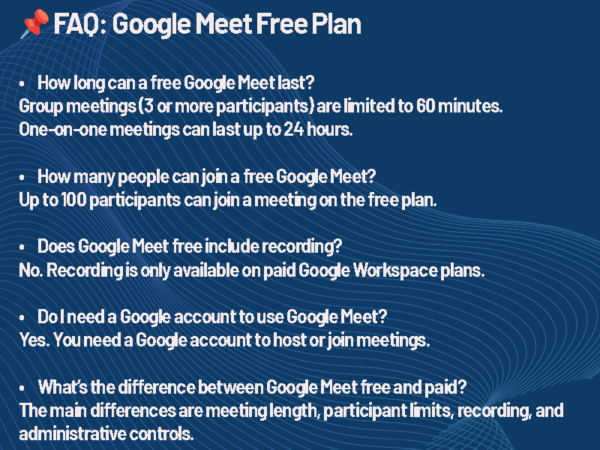
Google Meet is free, but free does not mean unlimited for every kind of meeting. With a personal Google account, one-on-one meetings can run up to 24 hours. Group meetings with three or more participants are limited to 60 minutes.
That is the answer most people are looking for. But for businesses, schools, nonprofits, and workplace teams, the more important question is not whether Google Meet works. It is whether the free version gives your organization enough control, reliability, and visibility for the meetings that matter.
“This meeting will end in 8 minutes.”
If you have seen that warning during a vendor review, staff meeting, board update, or client presentation, you already understand the problem. The tool may be free, but the interruption is not.
Here is what Google Meet’s time limit really means, what changes with paid Google Workspace plans, and how to decide which version makes sense for your organization.
What is the Google Meet time limit?
Google Meet’s time limit depends on the type of account and the type of meeting.
For users without a paid Google Meet or Google Workspace subscription, one-on-one meetings can last up to 24 hours. Meetings with three or more participants can last up to 60 minutes. Google says participants receive a warning at 50 minutes, and the meeting ends at 60 minutes unless the host upgrades.
That distinction matters.
A one-on-one support call may never run into the limit. A team meeting, client presentation, training session, or committee meeting can hit the cutoff quickly.
For casual use, that may be fine. Everyone clicks the link again and rejoins. In a professional setting, that disruption can break momentum, create confusion, and make the meeting platform look less reliable than it really is.
Is Google Meet free?
Yes. Google Meet is free for anyone with a Google account.
The free version includes the core features most people expect from a video meeting platform. Users can host video meetings, invite participants, share screens, and use real-time captions. For small teams, informal conversations, and short meetings, that may be enough.
But the free version has limits that matter in professional environments. The biggest one is the 60-minute cap on group meetings. The others are less visible but just as important: limited administrative control, no native meeting recording for free personal accounts, and less visibility for IT teams responsible for managing workplace technology.
That is the trade-off. Free Google Meet gives users access. Paid Google Workspace gives organizations control.
Is Google Meet Free FAQ
What happens when Google Meet reaches the time limit?
When a free Google Meet group call approaches the limit, participants receive a warning before the meeting ends. At the 60-minute mark, the meeting ends.
The workaround is simple. Start the meeting again or have everyone rejoin through the same link if it remains available. For a casual team check-in, that may only cost 30 seconds.
In a business meeting, it can cost more than time.
If the meeting includes executives, clients, remote employees, vendors, or training participants, the interruption becomes part of the experience. People stop focusing on the content and start focusing on the platform. That is not what you want from a meeting tool.
When the free Google Meet plan makes sense
The free version of Google Meet can be the right choice in some cases.
It works well for small teams that run short internal check-ins. A 15-minute standup, a quick one-on-one, or a casual project sync will not usually run into the 60-minute group limit.
It also works for organizations that already live inside Google’s tools. If users are already working in Gmail and Google Calendar,
Meet is easy to schedule and easy to join.
The free plan also makes sense when meetings do not need to be recorded. If your organization does not need recordings for training, compliance, documentation, or absent stakeholders, that limitation may not matter.
For personal use and small informal teams, Google Meet’s free plan is genuinely useful. The issue starts when organizations try to use a free personal-account tool as the backbone of a managed meeting environment.
When “free” starts costing more than it saves
The 60-minute limit is the most obvious restriction, but it is not the only one IT and facilities teams should consider.
The free version of Google Meet does not give an organization the same level of centralized control that comes with Google Workspace. That means fewer tools for managing users, enforcing policies, reviewing meeting activity, or standardizing how meetings are created and joined.
For a business, school, healthcare organization, or public-sector agency, that can become a governance issue.
A meeting platform is not just a piece of software anymore. It is part of the workplace experience. It touches identity, calendars, rooms, cameras, microphones, displays, security policies, and support workflows.
That is why the free version can create a mismatch. You may have professional meeting rooms, enterprise-grade displays, managed cameras, and standardized conference spaces, but the meeting itself may still be running on individual accounts with limited organizational oversight.
Here is the simplest way to think about the difference between free Google Meet and paid Google Workspace plans.
Free Google Meet is best for individual users and informal meetings. Paid Google Workspace plans are built for organizations that need longer meetings, business email, administrative controls, recording, attendance tools, and stronger governance.
Feature
Free Plan
Paid Plans
Max Participants
100
Up to 500+
Meeting Length
60 minutes (group)
Up to 24 hours
Recording
Not available
Available
Breakout Rooms
Limited / Not included
Included
Admin Controls
Basic
Advanced
Security & Compliance
Standard
Enhanced
Integration (Calendar, Drive, etc.)
Basic
Full ecosystem
This is where Google Meet pricing becomes less about features and more about workflow.
The paid plans do not just add more buttons. They remove friction for organizations that need meetings to be reliable, manageable, and supportable.
Which Google Workspace plan do you need for Google Meet?
Google Meet is included in Google Workspace. The features available to your organization depend on the Workspace edition you choose.
Business Starter is the entry-level business plan. It includes 100-participant video meetings and removes the practical 60-minute group-call limitation that affects free personal accounts. It is a good fit for small teams that need professional email and longer meetings but do not rely heavily on recording.
Business Standard is the more useful floor for many organizations. It supports 150-participant video meetings and includes meeting recording. For teams that need to record trainings, client meetings, internal updates, or stakeholder briefings, this is where Google Meet becomes a more serious business tool.
Business Plus supports larger meetings, with up to 500 participants, and adds features such as attendance tracking and stronger security and compliance tools. It is better suited for mid-size organizations, regulated environments, and teams running large internal meetings or town halls.
Enterprise plans are for larger organizations with more advanced security, compliance, and administrative requirements. At that point, the decision is usually less about Meet alone and more about how Google Workspace fits the broader IT environment.
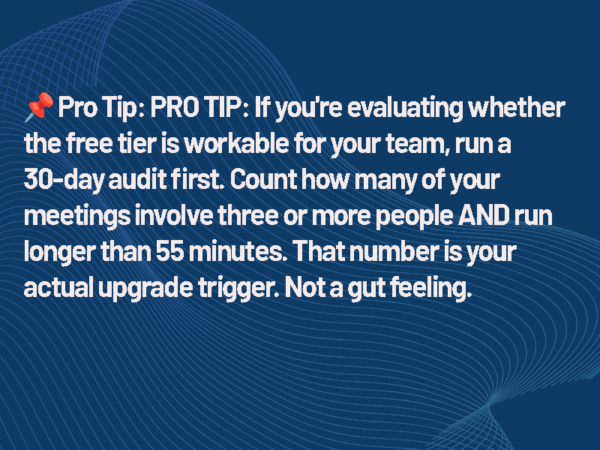
Is Google Meet Free Pro Tip
What IT and facilities teams should pay attention to
For end users, the question is usually simple: “Will my meeting end after 60 minutes?”
For IT and facilities teams, the question is bigger: “Can we support this as part of our workplace technology environment?”
That means looking beyond the meeting timer.
Can users authenticate through the organization’s identity system? Can admins manage access when someone leaves? Can meeting policies be enforced consistently? Can meetings be recorded when documentation is required? Can the help desk support users without guessing which account created the meeting?
Those questions matter more as meeting rooms become more standardized.
A conference room is no longer just a display, a table, and a speakerphone. It is a managed collaboration space. The meeting platform connects to room scheduling, cameras, microphones, displays, network policies, and user expectations.
If the platform is unmanaged, the room experience becomes harder to support.
What about compliance?
Organizations in regulated industries should be especially careful with free personal accounts.
Google Workspace can support certain compliance needs, including HIPAA-related workflows, but organizations must use the right services, accept the appropriate Business Associate Agreement when required, and configure the environment correctly. A free personal Google account is not the same thing as a managed Workspace environment.
That does not mean every organization needs the most expensive plan. It does mean regulated organizations should not treat the free version of Google Meet as a compliance-ready meeting platform.
For healthcare, finance, education, government, and other sensitive environments, the licensing decision should involve IT, security, legal, and compliance teams before Google Meet becomes part of standard meeting-room operations.
The meeting room question
For AV and workplace teams, Google Meet’s free tier creates a practical question: what kind of room are you building?
If the room is for occasional use, short calls, or informal collaboration, the free version may be enough. If the room is used for executive meetings, client presentations, remote learning, all-hands meetings, or recorded sessions, the free version probably is not the right foundation.
The platform should match the stakes of the room.
A huddle room used for quick internal check-ins has different requirements than a boardroom. A classroom has different requirements than a small nonprofit office. A healthcare consultation space has different requirements than a casual project room.
The mistake is treating all meetings the same.
Frequently asked questions about Google Meet time limits
Does Google Meet have a time limit?
Yes. Free personal Google Meet accounts allow one-on-one meetings up to 24 hours, but group meetings with three or more participants are limited to 60 minutes.
How long can a free Google Meet last?
A free one-on-one Google Meet can last up to 24 hours. A free group meeting with three or more participants can last up to 60 minutes.
Does Google Meet end after 60 minutes?
For free group meetings, yes. Google Meet warns participants before the limit, and the meeting ends at 60 minutes unless the host upgrades.
Can you restart a Google Meet after the time limit?
Yes. In many cases, users can start another meeting or rejoin using the meeting link. That workaround may be fine for informal use, but it can be disruptive in professional meetings.
Is Google Meet free for business?
Google Meet can be used for free with a personal Google account, but businesses that need longer meetings, recording, admin controls, and stronger management should use Google Workspace.
Which Google Workspace plan is best for Google Meet?
For many small organizations, Business Standard is the practical starting point because it includes meeting recording and supports larger meetings than Business Starter. Business Plus is a better fit for larger meetings, attendance tracking, and stronger compliance needs.
The bottom line
Google Meet is free, and for the right use case, the free version works well.
But the Google Meet time limit matters. Free group meetings with three or more participants are limited to 60 minutes. That may be fine for casual use, but it can become a real problem in business meetings, training sessions, classrooms, and managed conference rooms.
For organizations, the decision should not be based only on price. It should be based on the role meetings play in daily work.
If Google Meet is just a convenient way to talk, the free version may be enough. If Google Meet is part of your organization’s meeting-room strategy, workplace experience, training process, or compliance environment, a paid Google Workspace plan is usually the better fit.
The question is not only, “Is Google Meet free?”
The better question is, “What do our meetings need to accomplish, and what happens if the platform gets in the way?”
The AV landscape moves fast. To get these insights delivered directly to your inbox so you never miss a beat, Subscribe to the AVWeek Podcast here.
Microsoft Teams usually changes your status from Available, shown as green, to Away, shown as yellow, after a few minutes of inactivity. In most workplace environments, users experience that change after about five minutes without keyboard or mouse activity.
That simple answer is why people search for this topic. But it does not explain the bigger problem.
The green dot in Microsoft Teams has become a workplace signal. People use it to decide whether someone is available, whether they are responsive, and sometimes, whether they are working. That is where things get messy.
Teams status is not a productivity measurement. It is a presence signal based on activity, calendar state, device behavior, and app status. When people treat it as proof of work, the system starts creating more confusion than clarity.
The 5-Minute Timer Nobody Explains
What happens when Teams goes idle
Here is how Teams status works, why it turns yellow, what users can control, and what IT and workplace leaders should understand before they use presence as a management shortcut.
The quick answer: how long does Teams stay green?
Microsoft Teams typically stays green while the app sees you as active and available.
That usually means:
You are signed in to Teams
Your device is awake
Your computer is not locked
You are not in a meeting or call
You do not have a conflicting calendar event
Teams detects recent activity from your device
Once Teams stops seeing activity for a few minutes, it can switch your status from Available to Away. Microsoft describes this automatic change as happening after “a few minutes.” In day-to-day use, many users see that shift after about five minutes.
That timing can feel exact, but it is better to think of it as a short inactivity window rather than a user-controlled timer.
What Actually Triggers a Status Change?
The important point: Teams is not checking whether you are working. It is checking whether the signals it uses still say you are available.
Why Teams turns yellow when you are still working
This is the part that frustrates users.
You may be reading a document, reviewing a proposal, watching a training video, thinking through a project, working on a second screen, or talking with someone in the room. From your perspective, you are working. From Teams’ perspective, your device may look inactive.
That is how someone can be actively engaged in work and still appear Away.
Teams presence is based on signals. Those signals include device activity, the state of the Teams app, calendar events, calls, meetings, and the device where you were most recently active. Individually, each signal makes sense. Together, they can create status changes that feel inconsistent.
The result is a presence problem, not a people problem.
Why “Away” Doesn’t Mean What You Think
A yellow status does not always mean someone stepped away. It may simply mean Teams stopped receiving the kind of activity signal it uses to show someone as Available.
What actually triggers Teams status changes?
Teams presence is affected by more than whether the app is open.
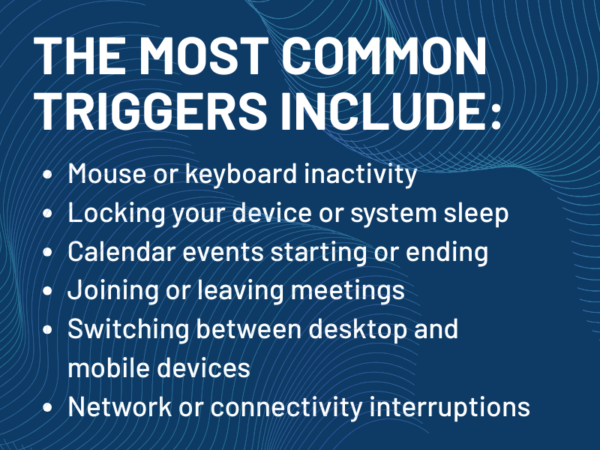
The most common triggers include:
Mouse or keyboard inactivity
Locking your computer
Your computer entering idle or sleep mode
Joining or leaving a meeting
Starting or ending a call
Calendar events that mark you as busy, out of office, or in a meeting
Using Teams on another device
Teams running in the background on mobile
Network or connectivity interruptions
That is why Teams status can seem unpredictable. It is not one setting in one place. It is the result of several workplace systems interacting at once.
Can You Change How Long Teams Stays Green?
A user may think, “I was at my desk the whole time.” Teams may only see, “The device has not shown activity for a few minutes.”
Those are not the same thing.
Can you change how long Teams stays green?
Not in the way most users want.
There is no simple Microsoft Teams setting that lets users or IT administrators change the automatic timeout from five minutes to 15, 30, or 60 minutes. Teams does not offer a standard “keep me green longer” control for the desktop app.
Users can manually set a status, but there is an important limitation: Microsoft allows status durations for statuses other than Available. In other words, you can set Do Not Disturb, Busy, Be Right Back, Away, or Appear Offline for a set period of time, but you cannot simply set Available for two hours and force Teams to keep you green.
That distinction matters.
You can control how you communicate availability. You cannot fully override how Teams detects activity.
How to keep Teams status accurate
There is a difference between keeping Teams “green” and keeping Teams status accurate.
Trying to force a green status all day is the wrong goal. A better goal is making sure Teams reflects your actual availability as clearly as possible.
Here are the legitimate options users should know.
Set your status manually when needed. If you are focused, presenting, stepping away, or unavailable, set the status that matches the situation. This gives coworkers a clearer signal than relying only on automatic presence.
Use status duration. If you need an hour of focused work, set Do Not Disturb for an hour. If you are away for lunch, set Be Right Back or Away for the right amount of time. Teams will reset the status when the duration ends.
Keep your calendar accurate. Teams uses calendar information to show when you are in a meeting, busy, or out of office. If your calendar is wrong, your Teams presence can be wrong too.
The Multi-Device Problem Most People Miss
Most common Teams triggers
Check device sleep settings. If your computer locks or goes to sleep quickly, Teams may show you as Away or Offline sooner than expected. Adjusting device sleep settings may help, depending on your organization’s policies.
Use the Teams for Web presence setting where available. Microsoft provides a Teams for Web option called “Keep my current status when I’m active outside of Teams on the web.” When enabled, Teams can detect activity outside the app so your status does not switch to Away while you are working in other browser tabs or apps.
Avoid fake activity tools. Mouse jigglers, fake activity apps, and similar workarounds may violate workplace policy and create security problems. They also miss the larger point. If employees feel they need tools to prove they are working, the organization has a trust problem, not a Teams problem.
What the green dot really means
The green dot means Teams sees you as Available.
It does not mean:
You are productive
You are watching Teams
You are ready to respond immediately
You are working on the thing someone wants
You are physically sitting at your desk
You are not in deep focus
This is where managers, teams, and organizations often misread the signal.
Presence is useful for communication. It helps coworkers decide whether to message, call, wait, or schedule time later. But it becomes unreliable when people treat it as a performance metric.
Someone can be green and distracted. Someone can be yellow and deeply productive.
Teams status is an availability cue. It is not a work report.
The multi-device issue most people miss.
Presence in Teams is not tied to one device forever. If you are signed in on a desktop and a mobile device, Teams may use the device where you were most recently active to determine your presence.
That creates strange situations.
You may be working at your desk, glance at Teams on your phone, and then have your mobile device influence your presence. If the mobile app goes into the background, Teams may show you as Away even though you are still sitting at your computer.
The reverse can also happen. You may leave your desk but remain active on another device, which can make your presence appear more available than you really are.
This matters in hybrid work environments because employees are rarely using one device in one location. They move between laptops, phones, tablets, meeting rooms, and browser sessions. Presence follows that behavior, and sometimes it follows it poorly.
What Happens When Teams Goes Idle?
When Teams switches from Available to Away, a few visible things change.
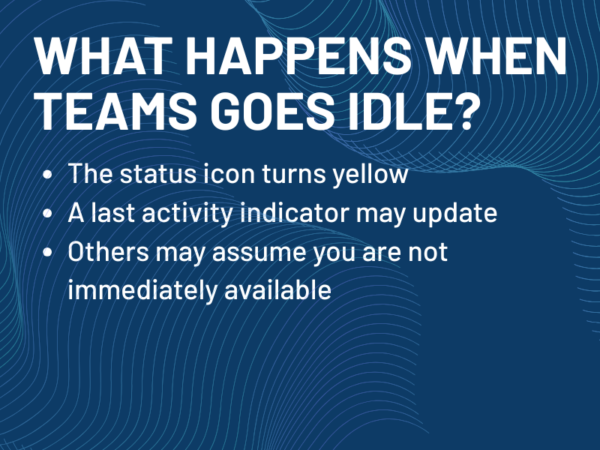
The status icon turns yellow. A last-seen or away-since indicator may appear, depending on the organization’s configuration. Coworkers may assume you are not immediately available.
What does not happen is just as important.
You are not logged out. Messages still arrive. Calls can still come through unless your status or notification settings prevent them. Teams is not blocking collaboration. It is only changing the signal other people see.
That is why users should not panic when Teams turns yellow. It is not a system restriction. It is a presence update.
What IT and AV leaders should pay attention to
For IT, facilities, and workplace teams, Teams presence is not just a user-experience issue. It is connected to broader workplace systems.
Device sleep policies affect presence. So do endpoint management settings, network reliability, VPN behavior, Microsoft 365 calendar configuration, mobile-device usage, and meeting-room workflows.
That means inconsistent presence may not be a Teams problem by itself. It may be a symptom of how the workplace environment is configured.
This becomes especially important in organizations with shared spaces, meeting rooms, front-desk devices, hot desks, and hybrid work policies. A room system, scheduling panel, or shared workstation may create a different presence expectation than a personal laptop.
Presence vs Productivity
The user sees the dot. IT sees the system behind the dot.
Both perspectives matter.
The management problem: presence is not productivity
This is the real issue.
The green dot has become shorthand for work. If someone is green, they are working. If someone is yellow, they are not. That interpretation is easy, fast, and often wrong.
Knowledge work does not always create mouse movement. Reading, planning, reviewing, thinking, writing on paper, and meeting in person may all produce little or no device activity. That does not make them less valuable.
When organizations use Teams presence as a productivity proxy, employees learn the wrong lesson. They learn to manage the dot instead of managing the work.
That creates bad behavior on both sides. Managers start watching status. Employees start worrying about status. Trust erodes, and the collaboration tool becomes a source of anxiety.
Teams presence should help people communicate. It should not become a surveillance shortcut.
What IT and AV Leaders Should Pay Attention To
From an enterprise perspective, presence is not just a user experience issue. It is tied directly to infrastructure and policy.
Device sleep settings, network performance, VPN behavior, and multi-device usage all influence how presence is reported. Inconsistent presence is often a downstream symptom of those upstream decisions.
That makes this less about “fixing Teams” and more about understanding how workplace systems interact. Presence accuracy is not controlled in one place. It is shaped across the environment.
That guide covers practical methods, limitations, and what to consider before using any workaround.
Frequently asked questions about Teams status
How long does Microsoft Teams stay green?
Microsoft Teams usually stays green while Teams sees you as active and available. In many environments, it changes from Available to Away after about five minutes of inactivity, though Microsoft describes the automatic change as happening after a few minutes rather than publishing a user-configurable timer.
Why does Teams turn yellow so fast?
Teams can turn yellow when your computer is inactive, locked, idle, or asleep. It can also change based on calendar events, calls, meetings, mobile app behavior, or which device was most recently active.
Can I change the Teams away timeout?
There is no standard Teams setting that lets users extend the automatic Available-to-Away timeout on the desktop app. You can manually set certain statuses for a duration, but you cannot force Teams to keep you Available for a set period.
How do I keep Teams status green?
The better goal is to keep Teams status accurate. Keep your calendar current, adjust device sleep settings where appropriate, set status manually when needed, and use status duration for focused work or time away. Teams for Web also includes a setting that can help keep your status accurate when you are active outside Teams.
Does mouse movement keep Teams active?
Mouse and keyboard activity can affect whether Teams sees you as active, but presence is not based on one signal alone. Calendar state, app state, device state, and multi-device behavior can also affect status.
Does Teams track productivity?
No. Teams presence is not a productivity measurement. It shows availability based on activity and status signals. It does not prove whether someone is working, focused, distracted, or productive.
Can my employer use Teams status to monitor me?
Your organization can see certain Microsoft 365 activity and usage data depending on its administrative settings, but Teams presence itself is an availability indicator. It should not be treated as a complete record of work or productivity.
The Bottom Line
Microsoft Teams usually changes from green to yellow after a few minutes of inactivity, often around five minutes in everyday use. That behavior can frustrate users, especially when they are working in ways Teams cannot easily detect.
But the larger issue is not the timer. It is what people believe the timer means.
Green does not mean productive. Yellow does not mean lazy. Away does not always mean away.
Teams presence is useful when it helps people communicate. It becomes harmful when organizations treat it as a productivity score.
For users, the best approach is to understand what Teams is actually showing and use manual status settings when they help. For IT and workplace leaders, the best approach is to set clear expectations: presence is a signal, not proof.
Understanding that difference is the first step toward using Teams more effectively.
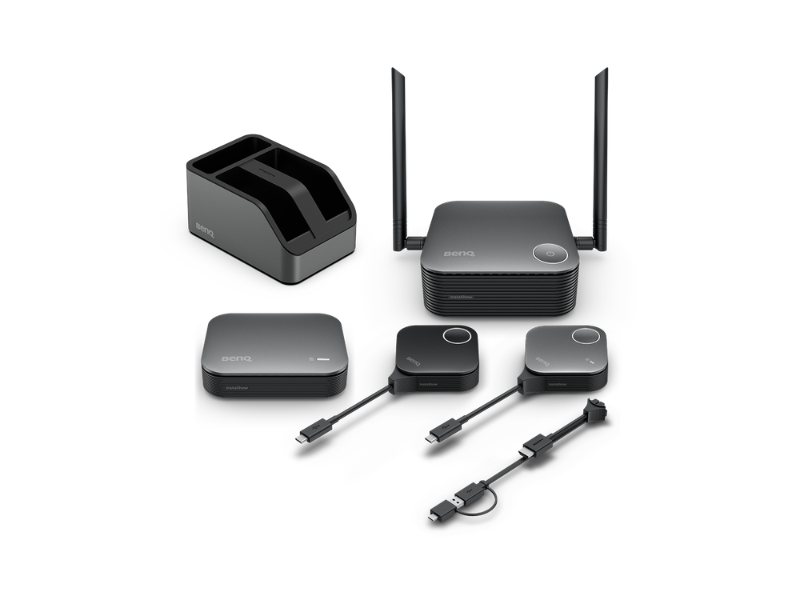
BenQ has launched the InstaShow VS25, a new app-free wireless conferencing solution designed to simplify hybrid meetings in corporate and executive spaces. Unlike traditional BYOM systems that depend on software installations and cloud connections, the VS25 operates entirely through hardware, allowing users to start meetings instantly without apps, drivers, or network logins. This reduces compatibility issues, security concerns, and performance strain on presenters’ devices.
Powered by Wi-Fi 6 MU-MIMO and built with enterprise-grade security standards, the VS25 delivers ultra-low-latency performance, secure point-to-point communication, and flexible room integration through its Wireless Media Bridge architecture. By eliminating software dependencies and complex setups, BenQ positions the VS25 as a reliable, secure, and cost-effective solution for IT teams managing modern hybrid collaboration environments. BenQ, a global leader in display and collaboration solutions, today announced the InstaShow VS25, a wireless conferencing system built to make hybrid meetings easier and smoother. Designed for corporate meeting rooms and executive spaces, the VS25 delivers app-free, hardware-based wireless conferencing with ultra-low-latency performance for easy in-room and remote collaboration.
As more organizations adopt hybrid work, modern conference rooms must support easy in-room collaboration and reliable participation for remote attendees. While wireless presentation has become standard, many wireless conferencing solutions still rely on CPU-intensive Bring Your Own Meeting (BYOM) apps layered on top of popular video conferencing platforms. This creates performance bottlenecks, security exposure, and friction for guests.
The InstaShow VS25 eliminates those challenges. The VS25 removes the need for apps, drivers, network logins, or cloud connections, so meetings can start instantly and run smoothly, no matter who is presenting or what device is used.
Key features include:
Wireless BYOM conferencing and offline local screen sharing, enabling seamless participation for both in-room and remote attendees.
True app-free operation using direct video-port capture, which eliminates the heavy burden on the presenter’s computer, time used to install software, and potential compatibility issues.
Ultra-low-latency Wi-Fi 6 MU-MIMO wireless performance with automatic channel selection, resulting in easy installation, and minimizing lag during live meetings.
Wireless Media Bridge architecture for room camera and audio that can be placed anywhere in the room, eliminating long USB cable runs and app-based camera routing.
Secure, point-to-point wireless communication that does not record presenters’ screens or need dedicated cloud connections, protecting sensitive meeting content.
Enterprise-grade, hardware-based security, including router-level encryption, HDCP support, and security protections certified with the latest CVSS 4.0 standards.
“Hybrid meetings fail when technology slows people down or asks them to adapt on the fly. The InstaShow VS25 was made to do the opposite by letting meetings start immediately and working the same way for everyone, every time,” said Bob Wudeck, senior director of business development, BenQ. “By eliminating apps, downloads, cloud connections, and network logins, the VS25 delivers a faster, more reliable, and more secure wireless conferencing experience.”
The VS25 is different from the conferencing solutions available today. Its hardware-only, media-bridge design helps avoid performance, connectivity, and privacy risks from downloadable apps and cloud-connected receivers. The result is faster meeting starts, predictable performance, and a more professional experience for both guests and IT teams, all at an affordable price point compared to competitors.