Category: HigherED

  • AVer to Highlight Smart Classroom Solutions at FETC 2026

    AVer to Highlight Smart Classroom Solutions at FETC 2026

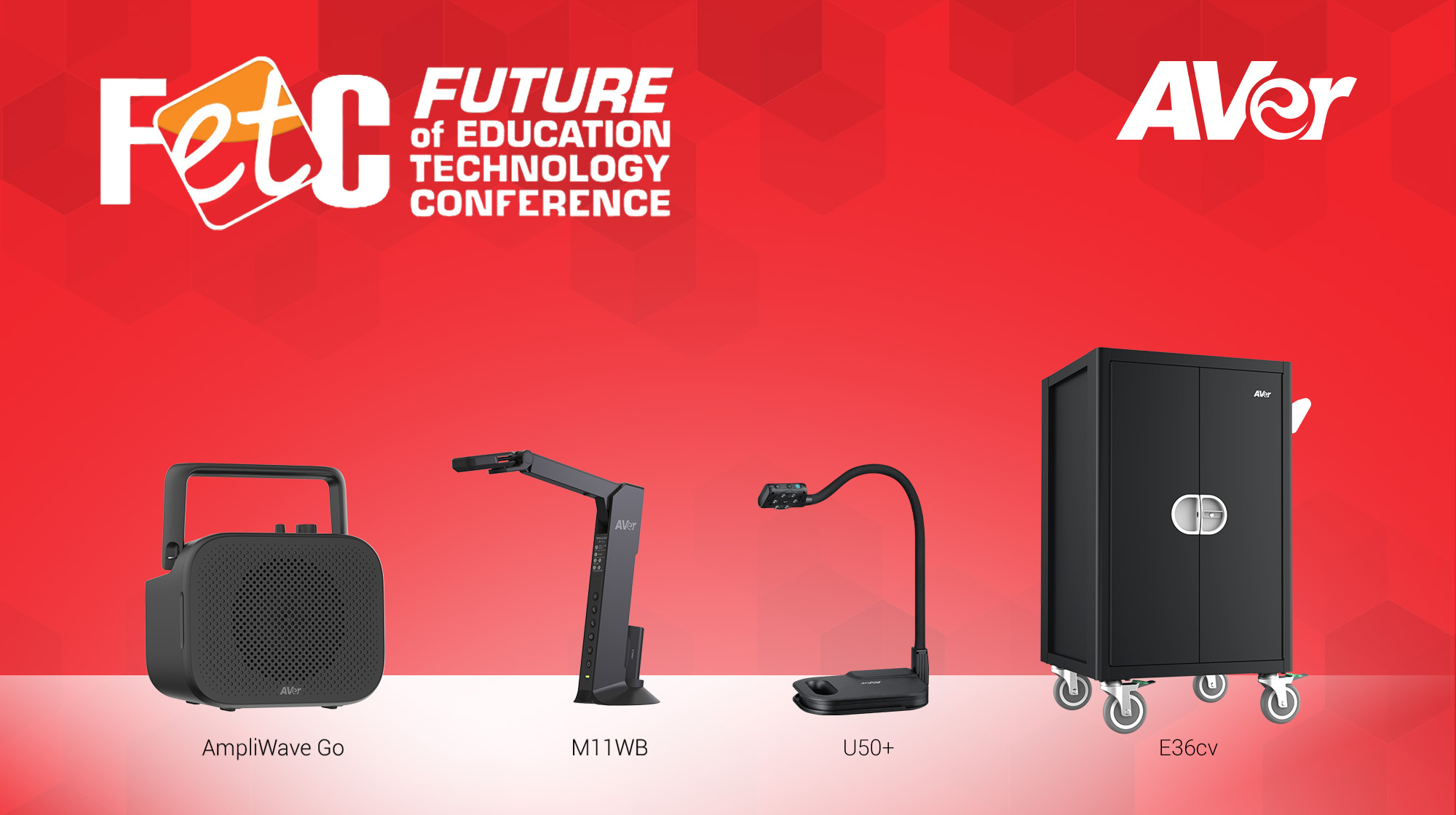
    AVer Information Inc. will showcase a range of smart classroom solutions at the Future of Education Technology Conference (FETC) 2026, taking place January 11–14 in Orlando. The company will demonstrate its AmpliWave Go wireless audio system, M11WB wireless document camera, U50+ FlexArm USB document camera, and E36cv charging cart-solutions designed to support in-person, remote, and hybrid learning environments across K–12 and higher education.

    According to Mike Garcen, AVer’s focus at FETC is on practical, reliable tools that enhance clarity and engagement in the classroom. The showcased solutions emphasize clear audio, high-resolution visual presentation, portability, and efficient device management, helping educators create inclusive and flexible learning experiences regardless of teaching format.

    AVer Information Inc., an award-winning provider of video collaboration and education technology solutions, will showcase its AmpliWave Go wireless audio system, M11WB wireless document camera, U50+ FlexArm USB document camera, and E36cv charging cart at the Future of Education Technology Conference (FETC) 2026, January 11–14, 2026, in Orlando, Florida. FETC brings together educators and education technologists to engage with thought leaders and practitioners focused on instructional technology across classrooms, schools and districts.

    “Educators are looking for tools that are practical, reliable and adaptable to a wide range of classroom environments,” said Mike Garcen, Senior Director of Product and Marketing for AVer Information Inc. USA. “At FETC, we’re focused on showing how our document cameras, charging carts, and classroom audio solutions support clear instruction, whether teaching happens in person, remotely or in a hybrid setting.”

    AVer will showcase the AmpliWave™ Go, a compact and portable classroom audio system designed to amplify engagement wherever learning happens. Delivering 30W RMS of clear sound, it ensures every student can hear the teacher, while the wireless microphone with over 8 hours of battery life keeps instruction uninterrupted. Budget-friendly and easy to integrate, AmpliWave Go can be mounted, carried, or placed on a tripod—helping create an inclusive, dynamic learning environment in any classroom.

    AVer will highlight the M11WB, a wireless document camera designed for in-person, remote and hybrid instruction. The M11WB captures content in 4K resolution with up to 29X zoom, allowing educators to display fine details such as student work, diagrams and experiments. The M11WB includes a built-in microphone and LED lighting to support clear audio and visuals in live and streamed lessons.

    AVer will present the U50+ FlexArm USB-powered document camera, designed for portable and space-conscious teaching environments. The U50+ features a 13-megapixel camera with 24X digital zoom and supports 4K image and video output. The U50+’s lightweight design and adjustable arm allow educators to capture and share content from multiple angles and store the device easily when not in use.

    In addition, the AVer E36cv charging cart provides a simple, secure way to store, charge, and transport up to 36 laptops, Chromebooks, or tablets in busy classrooms. With intelligent charging, built-in cable management, and a compact, mobile design, the E36cv helps schools keep devices powered, organized, and ready for learning without taking up valuable space.

  • AV over IP in Higher Education: From Hype to Higher Purpose

    AV over IP in Higher Education: From Hype to Higher Purpose

    For years, AV over IP (AVoIP) has been a polarizing subject in higher education. Some campus technology leaders felt like it was pushed before its time, marketed as the inevitable replacement to traditional switching and distribution even when it wasn’t ready for prime time. Others leaned in early, seeing it as a way to modernize operations, reduce costs, and position AV as a true IT-aligned service. Regardless of which side you are on you can’t deny that AV over IP in higher education is the standard today.

    However, the conversation has shifted. AVoIP is no longer an experiment or “flavor of the week.” In many higher education environments, it’s quickly becoming the default choice. Especially for new builds and major capital projects. The focus now is less about if institutions will move to AVoIP and more about how to deploy it sustainably and intelligently.

    Is AVoIP Being Forced?

    In recent years one of the strongest themes to emerge was the split perception of whether AVoIP is being “forced” on campuses. Some managers described a sense of fatigue, comparing the push for AVoIP to other hyped technologies like 8K video. This is where a tech is marketed aggressively but not immediately relevant to day-to-day needs. For these professionals, vendor-driven pressure overshadowed practical value in the early years.

    Others have framed the shift differently, calling themselves “positive disruptors.” For them, AVoIP wasn’t something imposed by manufacturers but a tool they actively championed to escape outdated, analog-bound systems. In some cases, they faced resistance at their institutions but eventually won over administrators that embraced the move wholesale.

    The reality is somewhere in between. While no one is being “forced” to adopt, campuses that want to stay current and competitive increasingly see AVoIP as the logical step forward.

    What Problems Does It Solve?

    For most, the appeal of AVoIP is less about buzzwords and more about solving practical, recurring problems in higher ed AV.

    • Replacing aging infrastructure. Legacy matrix switchers and HDBaseT backbones are hitting end of life. AVoIP offers a more flexible replacement without the massive expense of chassis upgrades.
    • Flexibility for complex use cases. Medical schools streaming surgeries to hundreds of students, or universities creating overflow spaces for popular lectures, need video to move seamlessly across rooms and floors. AVoIP enables that kind of distribution without dedicated cable runs.
    • Simplification and cost savings. Institutions want fewer cables, easier installations, and less reliance on custom programming. Many managers described plug-and-play troubleshooting and the ability to restore settings quickly without advanced coding knowledge.
    • Remote management. With small teams responsible for hundreds of classrooms, remote monitoring is no longer optional. AVoIP makes it easier to log into devices, identify issues, and even resolve them without dispatching staff.
    • Scalability. Whether adding an extra display in a lecture hall or scaling from a basic classroom to a HyFlex environment, AVoIP allows incremental growth. For budget-constrained public institutions, this flexibility is essential.

    AVoIP solves not just the what of video distribution but the how of support and sustainability in higher education.

    What Higher Ed Wants Next

    Even as adoption grows, campus leaders are vocal about what they want manufacturers to improve. First up is interoperability. The strongest demand is for a common standard across vendors. Higher ed decision-makers are tired of proprietary silos and want a Dante-like model for AV signals. Next up is troubleshooting help. Institutions want systems that provide clearer diagnostic information, even AI-assisted suggestions for resolving issues before they escalate.

    Colleges and universities also need unified management. This is driven from the increase of rooms to manage and a shrinking workforce. Instead of juggling multiple portals and control platforms, tech managers want more cohesive dashboards for monitoring, control, and updates. Finally, a secure system to ensure stability. Security remains a concern, particularly for managers with IT or cybersecurity backgrounds. Device-level standards for encryption and access are high on the wish list.

    Lessons from the Field

    One of the most consistent insights across institutions is the importance of cross-team collaboration. Successful deployments were those where AV and IT/networking teams partnered from the start. Involving manufacturer engineers early, providing network documentation, and aligning on multicast traffic needs all reduced the risk of disruption.

    On the flip side, there’s a significant risk of costly mistakes when communication breaks down. Misconfigured VLANs or underestimating bandwidth needs can lead to outages and finger-pointing between AV and IT. Higher ed institutions can’t afford to treat AV and IT as separate silos anymore. They are part of the same system.

    Training also emerged as a critical piece. Campuses need staff who can “speak both languages”. Those that are comfortable enough with network terminology to collaborate with IT, but grounded in AV use cases and workflows. This cultural alignment often determines whether AVoIP deployments thrive or stall.

    When It Fits and When It Doesn’t

    AVoIP isn’t the answer everywhere. For small, standalone classrooms or older buildings with limited infrastructure, the return on investment may not justify the added complexity. In those spaces, Zoom Rooms, BYOD kits, or even traditional point-to-point connections can be more cost-effective.

    Where AVoIP shines is in multipurpose, high-flexibility spaces: large lecture halls, auditoriums, and classrooms designed to scale with changing needs. The ability to add endpoints, reroute signals, and centralize monitoring delivers significant long-term value. Doing the ROI calculations of AV over IP in higher education is increasingly part of your job  as an IT or AV manager.

    AV over IP in Higher Education

    AV over IP in higher education is no longer just about keeping up with industry buzz. It’s about enabling campuses to scale, adapt, and sustain AV services with limited resources. The technology has matured, and its benefits align closely with higher ed’s current challenges. Getting the flexibility, remote management, and scalability for your campus is crucial to keeping up to date with AV technology.

    Success requires more than hardware. It depends on collaboration between AV and IT, a willingness from manufacturers to prioritize standards and interoperability, and a recognition that not every space requires the same solution.

    For higher ed decision-makers, AVoIP isn’t being “forced.” It’s being chosen. That’s because, when done right, it solves problems that no other approach can address as effectively.
  • Higher Education AV Funding: Big Grants vs Standards

    Higher Education AV Funding: Big Grants vs Standards

    When COVID relief funds poured into higher education, many institutions seized the opportunity to upgrade their AV infrastructure. Entire campuses were retrofitted for hybrid learning almost overnight. But as the panelists on AVNation’s AVWeek 733 reminded us, one-time higher education AV funding creates as many long-term questions as it solves.

    “Occasionally higher education will get what I call a big pot of money,” said host Tim Albright. “You can do 10 new rooms, maybe a lecture hall. But in five to seven years, when the refresh cycle comes along, that big pot is gone. How do you manage that?”

    The Sustainability Challenge

    For Ryan Gray, from Yavapai College, the challenge has no neat answer. “It really is different from place to place, and we live at the mercy of the values of the institution,” he explained. Some universities view a grant or gift through a sustainability lens, tying it to longer-term upkeep. Others take a more immediate approach: you don’t look a gift horse in the mouth.

    The tension between urgency and sustainability defines much of higher education AV funding. Gray noted that the institutions who fare better often “tie AV upgrades into facilities management or other standards that are already valued across campus. A heat pump may have a 25-year lifespan, AV equipment only five to seven, but if you can hitch your technology planning to those existing processes, you stand a better chance.”

    To listen to the full AVWeek episode, go here

    When Standards Save Budgets

    Chris Kelly, of Creighton University, illustrated the stakes with a story from his campus. “We’ve got this big fancy video wall. Someone tossed out a bunch of money, but now one of the screens is going bad. They don’t make the screens anymore, it’s not under warranty, and we’ve got a major event coming up. There’s no pot of money sitting there to replace it.”

    His team’s stopgap solution: moving displays around to hide the failing unit. But the deeper lesson was clear. “If we’d standardized on displays we already use across campus, we’d have had spares on hand. Standardization gives you breathing room when the funding cycle runs dry.”

    Even in the best-funded environments, refresh cycles pile up. “The more buildings you get, the more five- and seven-year cycles overlap,” Kelly said. “Without budgets growing at the same pace, something eventually has to give.”

    Planning for Day 1,000, Not Day One

    The panelists agreed that while one-time dollars are tempting, higher ed decision-makers must resist the urge to build beyond their ability to refresh. Gray summed it up bluntly: “If there were a great answer, we’d all have it solved. The best thing we can do is anchor AV to processes the institution already understands and plan for day 1,000, not just day one.”

    When it comes to higher education AV funding, institutions should resist the temptation to let one-time grants dictate their standards. Instead, new technology investments should be aligned with existing campus refresh policies to ensure consistency and long-term viability. Standardization plays a crucial role in this process, as relying on common equipment makes it easier and far more cost-effective to replace or repair systems when budgets tighten. Ultimately, one-time funding is best applied to scalable, repeatable solutions that can support sustainability over the long term, rather than flashy, bespoke projects that are difficult to maintain once the initial money runs out.


  • SDVoE Alliance Expands SDVoE Academy with Two New Education Tracks

    SDVoE Alliance Expands SDVoE Academy with Two New Education Tracks

    The SDVoE Alliance has expanded its free online SDVoE Academy with two new certification tracks: Video Basics and Networking Basics. These programs are designed to help AV and IT professionals build a strong foundation in video technology and networking concepts, making it easier to work in today’s converged AV-over-IP environments. Participants can also earn CTS RUs, adding professional value to their learning.

    The Video Basics Certification introduces learners to the essentials of video distribution over Ethernet, while the Networking Basics Certification covers core IT networking skills like Ethernet, IP addressing, switching, and protocols. Together, these courses bridge the gap between AV and IT, empowering professionals to design and manage reliable, scalable AV networks for the future.

    The SDVoE Alliance, a nonprofit consortium of technology providers collaborating to standardize the adoption of Ethernet to transport AV signals in professional AV environments, announces the expansion of the SDVoE Academy with the two new education tracks, the SDVoE Video Basics Certification and the SDVoE Networking Basics Certification. Participants who complete the SDVoE Video Basics Certification or the SDVoE Networking Basics Certification are eligible to receive CTS RUs, adding even more value to their professional development.

    “Our goal with the SDVoE Academy has always been to empower audiovisual professionals with the knowledge and skills they need to succeed,” said Stephane Tremblay, president of the SDVoE Alliance. “These new certification tracks make critical video and networking concepts accessible to everyone, bridging the gap between AV and IT and ensuring our community is prepared for the challenges of converged environments.”

    The Video Basics Certification offers participants a comprehensive introduction to the fundamentals of video technology. The course guides participants through the intricacies of video distribution over Ethernet, helping them gain proficiency in key terms and concepts while understanding their significance in real-world applications. The Video Basics Certification is ideal for industry professionals seeking to enhance their understanding of video fundamentals and apply this knowledge to the design and deployment of modern audiovisual systems. By completing the Video Basics Certification, learners will be equipped with a strong foundation that supports future growth in advanced video applications.

    The Networking Basics Certification empowers participants to confidently step into the world of IT networking, with a focus on AV-over-IP systems. The course covers the fundamentals of Ethernet, switching, IP addressing, and other core networking concepts essential for designing and supporting high-performance AV networks. Course participants will explore the OSI model, IP transport, and transport protocols such as TCP and UDP, while also learning about bandwidth management, security considerations, and interoperability principles. Whether newcomers to networking or experienced professionals seeking to strengthen their foundation, participants will gain the critical skills required to build reliable, scalable, and future-ready AV networks.

    Together, the SDVoE Alliance’s new certification tracks build on the SDVoE Academy’s mission to establish a trusted educational resource for AV professionals, including designers, integrators, manufacturers, and end users. With more than 6,000 students enrolled and over 120 courses delivered, the Academy already offers two professional certification programs, the SDVoE Certified Design Partner and the SDVoE Certified Developer. The SDVoE Academy is a free, self-paced online learning platform dedicated to advancing education in AV signal management technology.

  • Open AV in Higher Education: The Future of Campus AV Systems

    Open AV in Higher Education: The Future of Campus AV Systems

    Walk into any campus AV department today, and you’ll see a patchwork of platforms: one for monitoring, another for control, and maybe a third for scheduling. Each tool operates in its own silo, creating complexity for IT and AV teams already stretched thin. That’s why the higher ed AV community is rallying around a new concept: Open AV in higher education.

    On the latest episode of EdTech, panelists explored what open AV could mean for universities and why the push for cloud-based monitoring and management is gaining traction.

    “Sixty percent of people surveyed said they use some kind of cloud-based monitoring,” noted Scott Tiner of Bates College. “What are the other 40% doing? … It’s very clear that those of us who build and use these systems really want this open AV, single pane of glass.” For higher ed institutions balancing thousands of classrooms, consolidation isn’t just convenient, it’s critical to academic continuity.


    Home Grown Solutions

    Ernie Bailey from UAMS highlighted how open systems directly support proactive service. “We’re developing our own single pane of glass for our classrooms right now. Not only can we see what’s going on, we can touch it right there and solve problems before the instructor knows there’s an issue.” Preventative maintenance like this ensures technology never becomes the barrier to teaching and learning.

    At large, decentralized universities, the challenge is even greater. “At Ohio State, we’re decentralized,” explained Andy Vogel. “What we use doesn’t necessarily mean what Arts and Sciences uses. It would be great to have an open thing that still allows us to be decentralized but also have a common tool. That allows us to have a common language and ultimately deliver white glove service all across the board.” In other words, open AV in higher education is about consistency, even across fragmented organizations.

    Still, there are hurdles. “Anytime we purchase pretty much any product that has cloud in it, our networking team has an extra set of questions,” said Erin Maher-Moran of Johns Hopkins University. “I get that, because when you introduce a cloud system into campus infrastructure, it raises red flags. But the demand is there, and end users are getting more vocal about it.”

    Demand for Open AV in Higher Education

    That demand could be the catalyst higher ed needs. For manufacturers, the message is clear: the walled garden approach is running up against its limits. As more universities adopt cloud-first strategies, decision-makers will look for AV partners who can integrate seamlessly, respect data governance, and empower IT/AV teams to deliver reliable classroom experiences.

    As Bailey summed it up: “They insist that everyone else let them touch their things, but they don’t want anyone touching theirs.” That tension may well determine whether the next decade of higher education AV is defined by silos or by open, interoperable ecosystems that truly serve students and faculty alike.

    To listen to the full episode of EDTech 133 click here.


  • AVer Joins HETMA as Gold Partner to Drive Collaboration and Communication in Higher Education Technology

    AVer Joins HETMA as Gold Partner to Drive Collaboration and Communication in Higher Education Technology

    AVer Information Inc. USA has become a Gold Partner of HETMA (Higher Education Technology Managers Alliance), reinforcing its commitment to improving AV and collaboration tools across college campuses. This partnership highlights AVer’s dedication to supporting hybrid and engaging learning environments through advanced video solutions. As part of this collaboration, AVer backs HETMA’s peer-reviewed “Approved Program,” helping institutions confidently adopt reliable, future-ready AV technologies.

    AVer’s award-winning AI-powered cameras, like the TR315 with 4K tracking and hybrid capabilities, are already making waves in the higher ed AV space. The partnership with HETMA puts a spotlight on tools that boost classroom engagement and simplify integration with popular platforms, helping IT leaders create smarter and more flexible learning setups.

    AVer Information Inc. USA, an award-winning provider of video collaboration and education technology solutions, announces its role as a Gold Partner of HETMA (Higher Education Technology Managers Alliance). AVer’s partnership reflects the company’s dedication to empowering higher education through advanced audiovisual technology and aligns seamlessly with HETMA’s mission to enhance AV technology across college campuses nationwide.

    HETMA is a leading organization dedicated to raising awareness of technology issues specific to higher education. Through collaboration with manufacturers like AVer, as well as administrators and technology managers, HETMA champions initiatives that drive meaningful AV solutions tailored to the academic community.

    As a Gold Partner, AVer will be recognized by HETMA as a catalyst for technology innovation and adoption in the higher education sector. A key initiative supported by this partnership is the HETMA Approved Program, a rigorous, independent, peer-reviewed product evaluation that streamlines technology adoption for institutions. AVer’s support of this program ensures colleges and universities can confidently implement cutting-edge solutions that meet the demands of modern learning environments.

    “AVer is honored to partner with HETMA as a Gold Partner,” said Mike Garcen, Director of Product at AVer Information Inc. USA. “This partnership amplifies our shared goal of bringing transformative audiovisual technologies into higher education and empowering institutions with tools that create engaging, hybrid-ready learning spaces.”

    “AVer’s commitment to innovation and user-centered design makes them a natural fit for the HETMA community”, said Troy Powers, HETMA Vice-Chair. “As a Gold Partner, they’re not just supporting our mission; they’re actively helping shape the future of higher ed AV. We’re excited to work with AVer to bring powerful, accessible solutions into classrooms nationwide.”

    AVer’s portfolio of video collaboration solutions is designed with higher education in mind. From immersive lecture capture to interactive hybrid classrooms, AVer’s AI-powered cameras deliver unmatched performance with features such as crystal-clear 4K resolution, powerful 30X optical zoom, and seamless integration with leading Learning Management Systems (LMS) and video platforms.

    Notably, AVer’s TR315 AI Auto Tracking Camera recently earned the Best Camera Technology (PTZ) award at HETMA’s Higher Ed AV Awards during InfoComm 2025. The TR315 features advanced capabilities including NDI technology, 12X optical zoom, 8MP sensor and 4K 60 fps resolution. The TR315’s proprietary AI-driven features include Presenter Mode for smooth tracking of speakers, Zone Mode for prioritizing presentation content over movement, and Hybrid Mode for seamless transitions between pre-defined zones. These modes deliver precision and versatility, enhancing audience engagement and simplifying content creation. With simultaneous USB and IP output and hybrid auto-tracking, the TR315 provides flexibility and performance.

  • Magic on a Budget: Higher Ed AV Solutions That Stretch Every Dollar

    Magic on a Budget: Higher Ed AV Solutions That Stretch Every Dollar

    “I make magic with no money.” That’s how Lisle Waldron, Manager of Multimedia and AV Services at the University of Trinidad and Tobago, summed up his job on AVNation’s EDTech podcast. And anyone working in higher ed AV knows the feeling. You are constantly looking for higher ed AV solutions on a budget.

    In episode 129, Waldron joined a panel of AV professionals to unpack the growing pressure on universities to deliver high-end AV experiences without high-end budgets. The discussion spanned everything from tariffs to translation tech, but a central theme emerged: delivering effective higher ed AV solutions means doing more with less.

    The New Normal: Expectations Without the Budget 

    Hybrid classrooms. Lecture capture. Broadcast-quality production. These used to be add-ons. Now, they’re table stakes. 

    “Students are used to seeing broadcast-level quality all the time now,” said Ernie Bailey of UAMS. “We almost have to be there.” 

    The pandemic accelerated demand for robust AV infrastructure, but budgets didn’t scale with expectations. For tech managers, delivering results has become an exercise in resourcefulness. 

    YouTube Aesthetics, Academic Impact 

    Interestingly, it’s not just broadcasters pushing the envelope anymore, it’s creators. Students consume content from YouTube, Twitch, and TikTok all day long. Those expectations bleed into how they evaluate their academic experience. 

    “Education is a visual medium,” said Rob Rasberry. “Instructional design is starting to borrow production techniques to make courses more viable and interesting.” 

    This shift has lowered the barrier to entry for high-quality video. Tools once reserved for studios, like PTZ cameras and streaming encoders, are now affordable enough to be part of scalable higher ed AV solutions.

    When the Gear Has to Stretch 

    At institutions like Waldron’s, the challenge isn’t just access to gear it’s the economic forces behind it. Tariffs, supply chain disruptions, and local currency issues can triple the price of standard AV equipment. 

    “A $100 projector can cost me $400 in one week,” Waldron shared. “Instead of equipping 16 classrooms, I might only reach four.” 

    Those realities shape procurement decisions in profound ways. And it’s not just international schools feeling the heat. 

    “We’ve bought computers that are already technically obsolete,” said Scott Tiner of Bates College. “But it’s cheaper than buying the next model under a tariff increase. We’re stockpiling to avoid paying double later.” 

    Quality vs. Access: What Really Matters? 

    When asked whether he’d rather build a state-of-the-art 8K studio or spread that money across 10 classrooms, Waldron didn’t hesitate. 

    “I’d take the 10 classrooms. Every time. Because students care more about access than polish.” 

    This is a guiding principle for many higher ed AV solutions: prioritize reach, reliability, and flexibility over perfection. 

    Higher ED AV Solutions Innovation 

    Despite the challenges, there’s optimism. With creativity and shared insights, AV teams are finding smart ways to meet rising expectations without blowing up the budget. 

    “We’re seeing better gear, smarter workflows, and a new generation of AV professionals who know how to stretch a dollar,” said Rasberry. “That’s where the magic really happens.” 

    The Bottom Line 

    The future of higher ed isn’t about 8K displays or AI-generated avatars. It’s about enabling consistent, scalable, student-centered experiences. And that’s what the best higher ed AV solutions are doing on every budget, in every region, under every constraint.


    Go here to listen to the full episode of EDTech. 

  • What Higher Education Needs to Know About AV Tariffs

    What Higher Education Needs to Know About AV Tariffs

    As higher education prepares for summer AV upgrades and classroom refreshes, a new challenge is quickly gaining attention: tariffs on audiovisual equipment. In the March 2025 episode of EDTech, the panel of AV professionals—including Ernie Bailey, Scott Tiner, Jennifer Unitas, and host Erin Maher-Moran—tackled the big question: what does higher education need to know about AV tariffs and their real-world impact on campus planning?

    A Race Against Time and Red Tape

    Ernie Bailey, an AV leader in academic healthcare, is already feeling the pressure. “I’ve got a big quote out right now and the vendor keeps calling, saying tariffs might take place before the purchase order gets processed,” he said. “But I can’t move faster—75 people have to sign off.”

    This story underscores a common problem in higher ed procurement: slow institutional processes colliding with fast-moving market forces.

    Learning from the COVID Era

    Scott Tiner drew parallels to lessons learned during the pandemic. “You can’t predict everything, but you can plan for volatility,” he said. “We’re already buying gear now for summer installs—just in case.”

    Tiner also stressed the importance of avoiding proprietary systems. “Standardized, non-proprietary AV designs helped us stay agile during COVID, and they’ll help again as tariffs disrupt supply chains.”

    Expect New Rules from Vendors

    For Jennifer Unitas, the impact of AV tariffs is showing up in procurement policies. “One of our vendors now requires a usage survey for every purchase—where it’ll be installed, what kind of space, etc. That’s new,” she explained. “We’ll probably see more of that as everyone adjusts.”

    These new requirements reflect how deeply tariffs—and the fear of supply chain delays—are now shaping vendor-client relationships. These new requirements only complicates what higher education needs to know about AV tariffs even more.

    Supply Chains Are More Fragile Than You Think

    The panel agreed: even if a product is assembled in a tariff-exempt country, its components may not be. “You don’t always know where the little parts come from,” Tiner noted. “You think it’s a domestic product, and then it gets hit with fees anyway.”

    Maher-Moran added, “It’s like a ripple effect—just because one country isn’t on the tariff list doesn’t mean they aren’t impacted by their own upstream suppliers.”

    What Higher Ed Tech Teams Should Do Now

    So, what should higher education know about AV tariffs going forward?

    1. Start your purchasing process early. “If you’re planning summer installs, get those RFQs out now,” Maher-Moran advised.
    2. Communicate clearly with your vendors. If a project might stall or change, let them know so they can manage risk too.
    3. Standardize your classroom tech. Consistent system designs reduce lead times and support headaches—even under shifting supply conditions.
    4. Avoid vendor lock-in. Proprietary platforms are harder to replace or substitute during delays.

    A Final Word of Advice

    “Manufacturers aren’t just raising prices—they’re reacting to the same global forces we are,” said Tiner. “The more transparent we all are, the better we can weather what’s coming.”

    For higher education AV teams, this isn’t just about budgets—it’s about resilience. Knowing how to respond now could mean the difference between a completed summer project and a scramble in September.

    Want to stay ahead of changes like this? Catch the full discussion on the EDTech podcast, available on YouTube and your favorite podcast app.


  • UCLA Digital Spaces Selects PlaceOS to Revolutionize Campus Experiences

    UCLA Digital Spaces Selects PlaceOS to Revolutionize Campus Experiences

    UCLA Digital Spaces has partnered with PlaceOS to launch a multi-year initiative aimed at transforming the UCLA campus into a smart, connected, and user-friendly environment. This collaboration will use PlaceOS’s automation platform to integrate technologies across the entire campus—from classrooms and study spaces to dorms and event venues. The goal is to create seamless, personalized experiences for students, faculty, and visitors through smart room scheduling, app-based navigation, audiovisual control, environmental automation, and advanced analytics.

    The project kicks off in Fall 2025 with a pilot phase introducing intelligent services like AI-powered BruinCast streaming, interactive digital signage, and automated lighting and climate systems. Future phases will expand these features campus-wide, guided by real-time feedback and data. By doing this, UCLA aims to become a benchmark for smart campus design, showing how technology can improve both the user experience and operational efficiency in higher education.

    UCLA Digital Spaces, the audiovisual design and support division of Digital & Technology Solutions responsible for shaping the future of campus environments, announced a multi-year strategic product development alliance with PlaceOS, a leading platform for smart workplace and campus automation. This collaboration aims to transform how students, faculty, and visitors interact with UCLA’s physical spaces through intelligent, data-driven, and highly personalized experiences.

    “As technologists, it is our duty to view the campus not as a series of disconnected venues, but as a single, interwoven ecosystem designed to foster collaboration, innovation, and community,” notes Dr. Joe Way, Executive Director, Digital Spaces at UCLA. “Classrooms should no longer be viewed as four walls and a projector,” continues Way. “They are integrated spaces, aimed at fostering engagement and creating unified opportunities. We have a responsibility to look at the campus as a holistic entity, tying in all systems to create human-centered experiences from the dorm, to the classroom, to study spaces, entertainment venues, residential life, and communications.”

    By leveraging PlaceOS’s cutting-edge platform, UCLA Digital Spaces will integrate an innovative, dynamic suite of services across campus, leveraging a cloud-first strategy to automate audiovisual control and distribution, advanced room booking, wayfinding, environmental controls, space utilization analytics, streaming, learning tools, remote management and control, and event coordination. The result will be a seamless, adaptive, accessible, and sustainable campus environment that meets the evolving needs of its diverse community.

    “Personally, it’s exciting to be back innovating in the university space—where my co-founder and I first started our careers. Universities are uniquely positioned to connect all systems and benefit from automation, improving both user experience and operational efficiency, explains Jonathan McFarlane, CEO of PlaceOS. He continues: “At the very least, this removes double-handling but with UCLA’s innovative thinking, we can go much further—not just demonstrating a smart campus to the broader IT and building industries, but setting a new benchmark for what a smart city can be.”

    The first phase of the project will focus on deploying PlaceOS modules through an innovative pilot program scheduled to launch in Fall 2025. This initial deployment will introduce a robust suite of features, including cloud-first, app-based navigation tools; advanced audiovisual control and automation; intelligent room scheduling; interactive digital signage systems; comprehensive asset management; integrated AI enhancements; and a reimagined BruinCast cloud-streaming service. In addition, the pilot will implement intelligent lighting and climate control systems designed to improve sustainability, accessibility, and operational efficiency.

    Subsequent phases will expand functionality to additional stakeholders across campus, incorporating real-time user feedback, space utilization data, and advanced analytics. This iterative approach will ensure that solutions evolve responsively, continuously optimizing the campus environment to meet the dynamic needs of students, faculty, staff, and visitors. Over time, the project aims to establish UCLA as a global model for intelligent campus design, where technology and human experience are seamlessly intertwined. “We believe this initiative will fundamentally reshape the role of technology in higher education,” added Way. “For the first time, our campuses will be treated as the interconnected, interdependent communities they are meant to be.”

  • Why Classroom AV Standardization Matters More Than Ever

    Why Classroom AV Standardization Matters More Than Ever

    When you’re running hundreds of classrooms across multiple buildings—or even campuses—consistency isn’t a luxury. It’s a necessity. That message came through loud and clear on the February episode of AVNation’s EDTech, recorded live on the show floor at ISE in Barcelona.

    When AV is consistent, everyone wins.

    Our guests, Patrick Angielczyk from Mohawk College and Teddy Murphy from the University of Pikeville, know the daily reality of higher ed AV. Between them, their teams support more than 500 learning spaces—and they’re doing it with just a handful of people. For institutions like theirs, classroom AV standardization isn’t just a best practice. It’s survival.

    The Problem with Patchwork AV

    “We’ve never really had a standard,” Patrick said. “We’re trying to not only upgrade our classrooms, but also to develop a standard so that we have the same user interfaces, user experience, from room to room to room.”

    Sound familiar? Faculty members don’t want to relearn how to use the technology every time they walk into a new room. Support teams can’t afford the overhead of troubleshooting ten different systems across ten different spaces. When every room is its own unique setup, maintenance becomes a nightmare—and user satisfaction tanks.

    Standardization Isn’t Just About Hardware

    The conversation at ISE reinforced a growing truth in higher ed: AV standardization isn’t just about picking the same projector or DSP. It’s about creating a unified experience—one that gives faculty confidence, helps students stay focused, and allows support staff to solve issues fast.

    “Maybe not every room can have all the bells and whistles,” said EDTech host Erin Maher-Moran, “but you can scale it and try to at least make something similar across the board.”

    That mindset—balancing scale with simplicity—is where many institutions are headed. Whether you’re dealing with lecture halls, active learning classrooms, or huddle spaces, the goal is to create a seamless UI/UX from one room to the next.

    Lessons from the Show Floor

    At ISE, Patrick and Teddy both mentioned how eye-opening it was to see how European universities approach technology. The AV tech may look the same, but the philosophies vary—and there’s value in that perspective shift. As Patrick put it, “You name it, it’s all under one roof.” And that includes ideas worth stealing.

    From immersive XR classrooms to advances in digital signage, what caught their attention wasn’t just flashy tech—it was tech that could be standardized, supported, and scaled back home.

    The Real Win? Faculty Confidence

    Standardization doesn’t just help the tech team. It helps faculty teach better.

    If instructors walk into a room and know exactly how to start class, adjust audio, share content, or connect remote students, they’re more likely to embrace the technology—and less likely to call for help.

    That’s the bottom line. When AV is consistent, everyone wins.

    Want to hear the full conversation?
    Listen to Episode 127 of EDTech from the ISE show floor—available now on AVNation.tv and wherever you get your podcasts.