“I make magic with no money.” That’s how Lisle Waldron, Manager of Multimedia and AV Services at the University of Trinidad and Tobago, summed up his job on AVNation’s EDTech podcast. And anyone working in higher ed AV knows the feeling. You are constantly looking for higher ed AV solutions on a budget.
In episode 129, Waldron joined a panel of AV professionals to unpack the growing pressure on universities to deliver high-end AV experiences without high-end budgets. The discussion spanned everything from tariffs to translation tech, but a central theme emerged: delivering effective higher ed AV solutions means doing more with less.
The New Normal: Expectations Without the Budget
Hybrid classrooms. Lecture capture. Broadcast-quality production. These used to be add-ons. Now, they’re table stakes.
“Students are used to seeing broadcast-level quality all the time now,” said Ernie Bailey of UAMS. “We almost have to be there.”
The pandemic accelerated demand for robust AV infrastructure, but budgets didn’t scale with expectations. For tech managers, delivering results has become an exercise in resourcefulness.
YouTube Aesthetics, Academic Impact
Interestingly, it’s not just broadcasters pushing the envelope anymore, it’s creators. Students consume content from YouTube, Twitch, and TikTok all day long. Those expectations bleed into how they evaluate their academic experience.
“Education is a visual medium,” said Rob Rasberry. “Instructional design is starting to borrow production techniques to make courses more viable and interesting.”
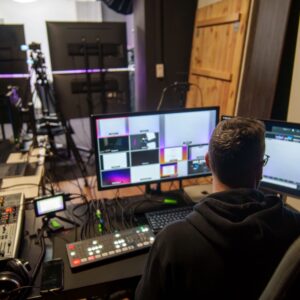
This shift has lowered the barrier to entry for high-quality video. Tools once reserved for studios, like PTZ cameras and streaming encoders, are now affordable enough to be part of scalable higher ed AV solutions.
When the Gear Has to Stretch
At institutions like Waldron’s, the challenge isn’t just access to gear it’s the economic forces behind it. Tariffs, supply chain disruptions, and local currency issues can triple the price of standard AV equipment.
“A $100 projector can cost me $400 in one week,” Waldron shared. “Instead of equipping 16 classrooms, I might only reach four.”
Those realities shape procurement decisions in profound ways. And it’s not just international schools feeling the heat.
“We’ve bought computers that are already technically obsolete,” said Scott Tiner of Bates College. “But it’s cheaper than buying the next model under a tariff increase. We’re stockpiling to avoid paying double later.”
Quality vs. Access: What Really Matters?
When asked whether he’d rather build a state-of-the-art 8K studio or spread that money across 10 classrooms, Waldron didn’t hesitate.
“I’d take the 10 classrooms. Every time. Because students care more about access than polish.”
This is a guiding principle for many higher ed AV solutions: prioritize reach, reliability, and flexibility over perfection.
Higher ED AV Solutions Innovation
Despite the challenges, there’s optimism. With creativity and shared insights, AV teams are finding smart ways to meet rising expectations without blowing up the budget.
“We’re seeing better gear, smarter workflows, and a new generation of AV professionals who know how to stretch a dollar,” said Rasberry. “That’s where the magic really happens.”
The Bottom Line
The future of higher ed isn’t about 8K displays or AI-generated avatars. It’s about enabling consistent, scalable, student-centered experiences. And that’s what the best higher ed AV solutions are doing on every budget, in every region, under every constraint.
Go here to listen to the full episode of EDTech.
- AVNation Staff

- AVNation Staff
- AVNation Staff
- AVNation Staff