Category: HigherED

  • Why Projector Brightness Standards Matter More Than Ever in Higher Ed AV

    Why Projector Brightness Standards Matter More Than Ever in Higher Ed AV

    In a sea of spec sheets, projector brightness might seem like just another number. But a recent lawsuit between Epson and Vava is a sharp reminder of why projector brightness standards aren’t just technical trivia — they’re critical for trust, performance, and decision-making in higher ed AV.

    Listen to EDTech Episode 126 here.

    Brightness Specs Under the Microscope

    Epson recently settled a lawsuit with Vava, claiming the company overstated brightness levels for its laser projectors. The core issue? Vava allegedly used marketing measurements that didn’t conform to ISO 21118, the internationally recognized projector brightness standard.

    For IT and AV managers responsible for classrooms, lecture halls, and hybrid learning spaces, this matters — a lot.

    Real-World Impact

    Ernie Bailey of the University of Arkansas for Medical Sciences didn’t mince words during a recent AVNation EdTech episode: “If I’m going to buy 40 or 50 projectors to go into classrooms, I want to know that if it says it’s a 4,000- or 6,000-lumen projector, it’s going to be the same brightness no matter what manufacturer I use.”

    He shared a troubling anecdote: when a 12,000-lumen classroom projector failed, he temporarily replaced it with a 6,000-lumen model. The difference? “In white light situations, you can barely tell. That bothers me.”


    Without Standards, Even AI Gets It Wrong

    Bailey also pointed out a growing concern in the age of automation and AI-assisted specification: “If you’re gonna start using AI to find the best projector for a room, and the specs are skewed by the manufacturer, AI’s not going to figure that one out. They didn’t use the ISO standard.”

    The ISO 21118 standard exists specifically to ensure consistent projector brightness measurements — especially critical when buying at scale or evaluating new vendors.

    It’s a Matter of Trust

    Rob Rasberry from Drexel noted the unusual nature of the Epson–Vava case: “This wasn’t a patent fight or a ‘we did it first’ argument. This was one manufacturer saying, ‘You’re outright lying.’ That’s a whole different thing.”

    Unlike tech ownership disputes, this one centers on a shared expectation: if you say it’s 6,000 lumens, it better be 6,000 lumens — using the agreed-upon projector brightness standard.

    Why Accuracy Matters in Higher Ed AV

    Sometimes, small differences in brightness can have major consequences. Bailey noted:

    “If we were teaching a pathology course where pink and purple side by side mean different things, I might have an issue.”

    Scott Tiner of Bates College echoed the importance of reliable specs for streamlining purchasing and setup across campus deployments. When brightness claims don’t hold up, it leads to frustration, rework, and wasted budget.

    Keep the Standards Alive — and Ask for Them

    Erin Maher-Moran of Johns Hopkins put it simply: “AV tends to be funny about standards. But there are a few that are well-established. At least get those right.”

    She’s right. ISO 21118 isn’t new. It’s reviewed, updated, and maintained — and should be demanded on every spec sheet, quote, and RFP.

    Don’t Just Trust the Label. Ask the Right Question.

    If you’re an IT or AV manager tasked with upgrading classrooms, specifying projectors for lecture halls, or integrating hybrid learning spaces, don’t just go by the lumens printed on the box.

    Ask if those numbers conform to ISO 21118. Ask for the projector brightness standard.
    Make it part of your RFP. If a manufacturer dodges the question? You’ve got your answer.

    As we increasingly rely on automation, remote support, and long-term AV investments, let’s make sure our decisions are rooted in facts — not fluff.
  • NextLVL courts next gen with talent summit at Pace University

    NextLVL courts next gen with talent summit at Pace University

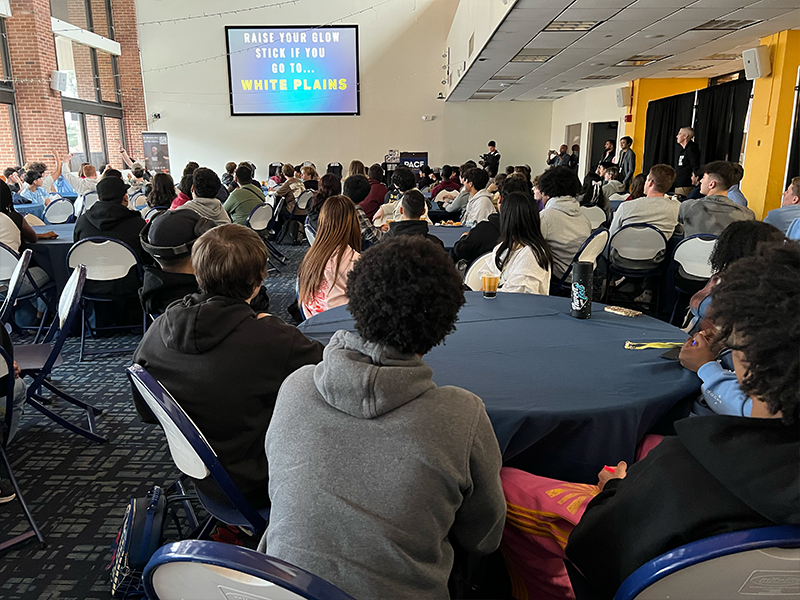
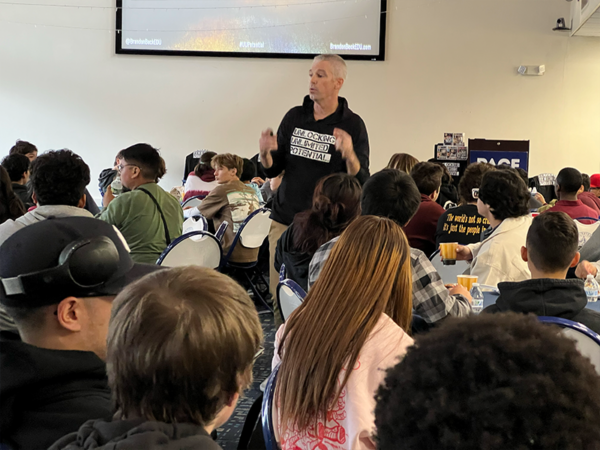
    Nearly 150 high school students gathered at Pace University’s Pleasantville campus for the second annual AV Talent Summit — an ambitious effort to get more young people interested in audiovisual careers. The event took place on November 20, supported by NextLVL Learning, is significantly larger than last year’s inaugural summit.

    Industry heavyweights like Sennheiser, Legrand | AV, and Q-SYS showed up to talk with the next generation of AV professionals. Students from White Plains, Ossining, and — yes — Sleepy Hollow filled Pace’s Kessel Student Center to hear from industry leaders and learn about career opportunities in the tech sector.

    Brandon Beck, Ed.D
    Brandon Beck, Ed.D

    The summit kicked off with a keynote from Brandon Beck, Ed.D., who shared a wild story about literally catching on fire while playing with gasoline as a teen (seriously) before turning his life around to become an educator and author. His message to the room of 16-18 year olds? Everyone’s a leader in some capacity, even if they don’t realize it yet.

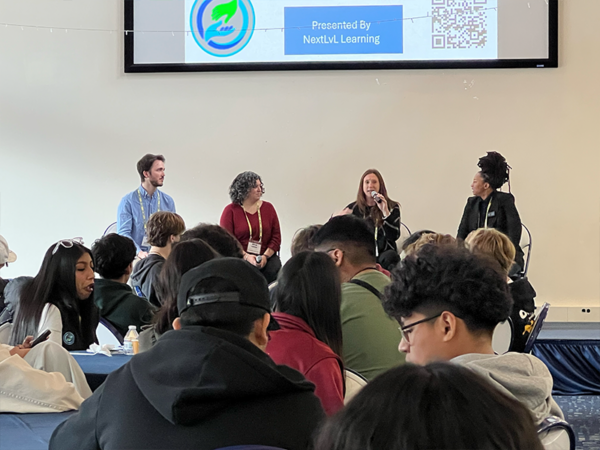
    A panel moderated by Alesia Hendley (Sennheiser) and featured Kristin Bidwell of Audiovisual Consulting Team, Erica Carroll of CharBett Strategies and Bradford Terry of Pace Univeristy followed. Their advice was refreshingly direct: network aggressively, build your personal brand, and don’t be afraid to showcase your skills. “If you can sell yourself, you can sell anything,” Hendley told the crowd.

    NextLVL Panel
    NextLVL Panel

    Bidwell shared a story highlighting her career so far; designing the audio at San Francisco 49ers Levi Stadium. “Imagine building something that will be there for years and years,” Bidwell said as she highlighted the unique experiences audiovisual professionals enjoy.

    The most interesting moments came during the student panel, moderated by Brittany DiCesare of Control Concepts, where current Pace undergrads made it clear they’re not just looking for jobs — they want actual careers. Full Sail University reps got the room buzzing with talk of esports opportunities, from racing sims to audio engineering programs.

    NextLVL Learning, founded by George Chacko and Rich Miller III, organized the event. While some in the industry stress about talent shortages, they’re actually doing something about it.

  • NextLVL Learning Aims to Rewire AV Talent Pipeline

    NextLVL Learning Aims to Rewire AV Talent Pipeline

    In a world where experience is king, it’s the AV industry that makes it go round. From The Sphere to your favorite concert, it’s the audiovisual pros that make it happen. But there’s a problem: the industry is facing a talent crisis, and it’s looking pretty homogeneous.

    The AV Industry’s Diversity Problem

    Let’s break it down with some cold, hard stats: according to Zippia, a whopping 91% of AV technicians are men, with an average age of 43. Only 16% are in their 20s, and fewer than 39% are non-white. It’s like stepping into a time machine set to “tech bro past.”

    Enter NextLVL Learning, Inc., a non-profit that’s determined to flip the script on AV careers. Born from the minds of Pace University’s George Chacko, this organization is on a mission to show the next generation that AV is more than just “roadie for rockstars” – it’s a legit career path with serious potential.

    From Campus Event to Industry Disruptor

    It all started with the AV Talent Summit at Pace University last year. Picture this: 200 industry pros and high school students crammed into a room, suddenly realizing that AV isn’t just about plugging in speakers. The event was so popular, that they had to bring in extra chairs – a clear sign that they were onto something big.

    Fast forward to October 2024, and NextLVL Learning is officially a non-profit, ready to shake things up. Their secret weapon? Experiential learning. “We believe in learning by doing,” says Chacko. Forget boring lectures and homework – these guys are all about hands-on experience, culminating in an “AV Olympics” that puts skills to the test.

    InfoComm Takeover and Mentor Matchmaking

    NextLVL Learning isn’t messing around. They’re planning to send at least five students to InfoComm 2025, the AV industry’s biggest shindig. But this isn’t your average field trip – each student will be paired with a mentor on the show floor, getting an insider’s view of the industry that you can’t find in any textbook.

    The organization is cooking up a mentor/mentee program that’ll pair college students with industry pros. And because this is 2024, there’s talk of a badging system that’ll let students flex their new skills on LinkedIn. It’s like gamifying your career path, and we’re here for it.

    Summits, Road Trips, and Industry Domination

    The NextLVL team is gearing up for its second annual AV Talent Summit, and this time, they’re taking over the entire Pace University campus center. AVIXA, the AV industry’s association, is even jumping on board to add a second day of pro-development sessions.

    But why stop there? NextLVL Learning is planning to take their show on the road in 2025, hitting up Florida and the West Coast to create a “triangle of support” across the U.S. It’s like the Chicago Bulls’ triangle offense, but for nurturing AV talent.

    The Bottom Line

    NextLVL Learning is out to prove that AV is more than just “Taylor Swift concerts,” as Chacko puts it. With a rockstar board of directors and industry support pouring in, they’re poised to rewire the AV industry from the ground up.

    Want to join the AV revolution? Head over to TheNextLVL.org and get ready to level up your tech game. The future of AV is looking brighter – and a whole lot more diverse.

  • AV Tech Manager Training

    AV Tech Manager Training

    Our lives are increasingly dominated by screens, speakers, and smart devices. You are the wizards behind the curtain – the AV professionals – who are more crucial than ever. But as technology races forward, how tech gurus keep up? Enter the new frontier of AV education, where industry giants are revolutionizing the way we learn about audiovisual technology.

    AVIXA: The Disneyland of AV Learning

    Imagine a theme park, but instead of roller coasters, you’ve got tracks of specialized AV knowledge. That’s essentially what AVIXA has created with its comprehensive training program. From “General AV Knowledge” for the wide-eyed newbies to “Designer” courses for the pixel-perfect perfectionists, AVIXA’s got a ride for everyone.

    But the real showstopper? Their 30-day Training Pass. It’s like an all-access bracelet to the AV knowledge kingdom. For a whole month, you can gorge yourself on on-demand training modules, sampling everything from the basics of signal flow to the intricacies of projection mapping. It’s a buffet of bytes and bits that would make even the most jaded tech veteran’s eyes light up like a well-calibrated OLED display.

    And if virtual learning isn’t your jam, AVIXA has in-person options too. You can hit up one of their partner locations, or crash a conference. It’s like AV education à la carte, and you’re the chef.

    Crestron: The Hogwarts of Home Automation

    Meanwhile, Crestron is transforming its Technical Institute into what can only be described as the Hogwarts of home automation. Their suite of training programs promises to turn mere mortals into masters of control systems, automated environments, and AV over IP faster than you can say “Alexa, dim the lights.”

    From the foundational “Technology Architect” track to the mind-bending “Custom Programming” course, Crestron is offering a smorgasbord of tech skills that would make even Tony Stark jealous. Want to design user interfaces that would put Iron Man’s J.A.R.V.I.S. to shame? There’s a course for that. Fancy yourself as the next big thing in residential tech? Crestron’s got you covered with their “Residential” track.

    But it’s not all about flashy interfaces and home automation. Crestron is also diving deep into the world of unified communications with their “Crestron Flex” course, promising to turn you into a video conferencing wizard. And for those who dream in algorithms, the “Custom Programming” track offers the chance to create bespoke experiences using SIMPL or C# – because who doesn’t want to code their way to the perfect automated life?

    Extron: The 24/7 AV Feast

    Extron isn’t just throwing course materials at a wall and seeing what sticks. They’re crafting a virtual learning experience that’s more immersive than your favorite VR game. With small group sizes in their online workshops, you’ll get more personal attention than a celebrity at a boutique hotel. And for those who prefer to learn in stealth mode, their self-paced courses let you absorb AV wisdom whenever inspiration strikes.

    Extron’s online instructor-led courses provide as close to a real-world experience as possible without the risk of accidentally unplugging the CEO’s presentation. Students receive personal attention from the same industry-recognized instructors who have conducted their in-person training for years. Each student has access to virtual hardware and their own instance of the software. It’s like having your own personal AV playground, minus the risk of breaking expensive equipment.

    Q-SYS: The Netflix of AV Knowledge

    Last but certainly not least, Q-SYS is serving up a buffet of audio knowledge that’s as free as it is fabulous. Their online training is like Netflix for AV nerds, complete with binge-worthy content and presenters so entertaining you might forget you’re actually learning.

    Imagine a world where every word in every video is searchable (yes, even that obscure audio term you can never remember), where you can learn at 3 AM in your pajamas, and where real-world scenarios prepare you for audio challenges better than any textbook ever could. From newbies to seasoned pros, Q-SYS is dishing out modules faster than you can say “automatic mixing,” all wrapped up in a non-linear package that lets you jump around like a kid in an audio playground.

    The Future of AV Education

    As we stand on the precipice of a new era in AV technology, these industry leaders are ensuring that the next generation of tech wizards are armed with the knowledge they need to shape our audiovisual future. Whether you’re a seasoned pro looking to stay ahead of the curve or a curious newcomer ready to dive into the world of AV, there’s never been a better time to learn.

    So whether you dream in schematics, see the world in HDMI cables, or just really enjoy the satisfying click of a perfectly programmed control panel, there’s a course out there for you. Just don’t be surprised if you start talking to your toaster or trying to swipe left on your bedroom curtains. After all, in the world of AV, the line between science fiction and reality is getting blurrier by the day.

    As we hurtle towards a future where our environments are smarter, our communications are seamless, and our experiences are more immersive than ever before, one thing is clear: the AV professionals of tomorrow are being forged in the virtual classrooms of today. And with AVIXA, Crestron, Extron, and Q-SYS leading the charge, the future of AV is looking brighter than a 4K HDR display on full blast.

    These are the big ones but I’m certain I missed some. What are your favorite AV educators? Comment below.

  • Standardizing Technology in University Classrooms

    Standardizing Technology in University Classrooms

    In the evolving landscape of higher education, the role of technology in classrooms has become increasingly crucial. As universities strive to enhance the learning experience and prepare students for a tech-driven world, the question of how to effectively standardize classroom technology has come to the forefront. A recent discussion on EDTech shed light on the challenges and strategies involved in creating a cohesive technological environment across campus.

    The Case for Standardization

    One of the primary drivers for standardization is the need for consistency and ease of use. Ernie Bailey of the University of Arkansas Medical Sciences (UAMS) highlighted this point, sharing his institution’s experience: “We came up with a package that meets all of those needs, and we’ve been rolling that out for a few years now… minimal training for the faculty. ‘Cause if they’ve been in one room, they all work the same. They all look just the same.”

    This approach addresses a common pain point for both faculty and students. When instructors move between classrooms, they shouldn’t have to worry about learning new systems or troubleshooting unfamiliar equipment. Similarly, students benefit from a consistent experience, allowing them to focus on the content rather than the technology.

    Simplicity Over Bells and Whistles

    A recurring theme in the discussion was the importance of prioritizing simplicity and reliability over cutting-edge features. Bailey emphasized this perspective, stating, “Our job in education is to get the students educated… We want them thinking about the education and our job is to be invisible and to enhance the teaching.”

    This sentiment was echoed by Rob Rasberry of Drexel University, who noted, “Keep it simple. Faculty like it simple… The trend has been not innovation, just have it work.” This approach ensures that technology serves as a tool for education rather than becoming a distraction or obstacle.

    The Standardization Process

    While the benefits of standardization are clear, the process of implementing it can vary between institutions. Scott Tiner from Bates College described their approach: “We don’t have a set standard in the sense of there’s a written document, which tells you every model of whatever that will be in a room, but our standard rooms are the same. They have the same set of equipment.”

    This flexible approach to standardization allows for some adaptability in back-end equipment while maintaining a consistent user experience. Tiner explained that they ensure any changes in equipment are easily swappable and familiar to support staff.

    Challenges in Implementation

    Despite the benefits, implementing standardized technology is not without its challenges. One significant hurdle is getting buy-in from faculty, particularly when it comes to new technologies like interactive whiteboards. Erin Maher-Moran from Johns Hopkins University noted, “We haven’t been able to get faculty really to buy in to the interactive boards.”

    Michael Gunderson from Highland Community College shared a cautionary tale about the importance of faculty engagement: “We just installed two interactive displays in brand new classrooms… Our product champion for those devices left us before the project was completed. So now I’ve got a floor full of faculty going, ‘What is this and why is it here? And what are we going to do with it?’”

    This experience underscores the need for ongoing communication with faculty and the importance of having champions within the teaching staff to promote and guide the use of new technologies.

    The Role of Feedback

    To navigate these challenges and ensure that standardization efforts meet the needs of both faculty and students, gathering and acting on feedback is crucial. Rasberry emphasized this point: “Always get feedback. Um, you don’t necessarily have to recognize it. Some of it is good. Some of it is bad, but always get feedback.”

    He shared an experience where the installation of interactive displays in older classrooms led to pushback from faculty who preferred traditional chalkboards. This situation highlighted the importance of thorough consultation before making significant changes to classroom technology.

    Balancing Innovation and Practicality

    While the focus on simplicity and reliability is paramount, there’s still a place for innovation in classroom technology. The key is finding the right balance and ensuring that any new technology aligns with educational goals. As Bailey put it, “There are times and places for the wow, for all the fancy stuff, but it’s not in the classroom when there’s a limited amount of time for the teaching.”

    Tiner added an interesting perspective on the need for technology to relate to both faculty and students: “It doesn’t have to be innovative to relate, but it has to have, it has to be able to get the students to buy into it.” This suggests that the most effective classroom technology is that which seamlessly integrates into the learning process, regardless of how cutting-edge it may be.

    The Ultimate Goal: Enhancing Education

    Throughout the discussion, one theme remained constant: the primary purpose of classroom technology is to enhance the educational experience. As Bailey eloquently stated, “When Dr. Smith leaves her office to come and give a lecture, she’s thinking about what she’s teaching or anything new. She’s not wondering which button she’s supposed to push… We want them thinking about the education and our job is to be invisible and to enhance the teaching.”

    Gunderson reinforced this idea with an anecdote about faculty feedback: “I had an unsolicited visit by an instructor… He walked into my office one day and he says, ‘Mike, you know what I like about you? Your stuff just works.’” This simple statement encapsulates the true measure of success for classroom technology standardization.

    As universities continue to navigate the complex landscape of educational technology, the focus on standardization, simplicity, and reliability will likely remain key priorities. By creating consistent, user-friendly environments that prioritize the needs of both faculty and students, institutions can ensure that technology truly serves its purpose: enhancing the quality of education and preparing students for the challenges of the future.

  • The Higher ED Technology Storm Brewing

    The Higher ED Technology Storm Brewing

    IT managers, tech departments, and in-house integrators are the teams that are the frontlines of AV and IT in colleges. These are the individuals who keep the wi-fi and projectors working for instruction and education. Their jobs have gotten harder since the pandemic. We’re not talking about the latest technology choices. The storm that is brewing for Higher ED comes in the form of budget shortfalls clashing with faculty expectations.

    As higher education institutions navigate an increasingly complex technological environment, IT and tech managers face a unique set of challenges. From budget constraints to the aftermath of pandemic-era funding, these professionals are tasked with maintaining cutting-edge learning environments while balancing fiscal responsibilities.

    Budget Balancing Act

    One of the most pressing issues facing higher education technology managers is the perennial challenge of budgeting. Erin Maher-Moran from Johns Hopkins highlights this struggle, noting, “One of the biggest challenges facing Higher Ed IT/Tech Managers this year is keeping a balanced budget. With needs of faculty increasing, classroom systems need to do more while maintaining ease of use and often times flexibility to cater to a variety of pedagogy.”

    This sentiment is echoed by Mike Pedersen, Iowa State University, who emphasizes the broader context of declining enrollments nationwide. “For most schools, finding the right amount of budget has always been a challenge. However, with overall enrollments trending down nationwide, schools are having to be extra careful with their budgets, and that includes IT and Tech,” Pedersen explains.

    To address these budgetary constraints, technology managers are employing a variety of strategies. Maher-Moran describes a more strategic approach to upgrades: “I’ve had to become more strategic about what upgrades we are making in learning environments. I’ve been working with the Classroom Advisory committee to survey faculty to find what are the most important needs in the rooms and trying to establish a long-term plan of major room renovations.”

    Pedersen takes a different tack, focusing on making a compelling case for senior leadership. He states, “I constantly remind them that classroom technology serves the core purpose of our existence – education.” By quantifying the cost of technological failures in terms of lost tuition value, Pedersen presents a powerful argument for continued investment in classroom technology.

    The HEERF Hangover

    Don Merritt, PhD from University of Central Florida introduces a unique challenge facing higher education technology managers in the wake of the COVID-19 pandemic: what he terms “The HEERF Hangover.” This refers to the aftermath of significant federal funding that was provided to educational institutions during the pandemic through the Higher Education Emergency Relief Fund (HEERF).

    Merritt explains, “A considerable amount of federal funding came to education because of the pandemic. We used it to add hybrid options to many of our spaces, and in the process addressed other AV needs. Those were non-recurring federal funds, though, and most states are not filling the budget gap created by that windfall.”

    This situation has created a complex set of problems, including increased expectations from faculty and staff, equipment without lifecycle budgets, and the challenge of supporting more technology with fewer staff. Merritt notes, “We’re now supporting more equipment and services with fewer people. Both projects and regular support are suffering.” The other issue this creates is a coming storm of refresh cycles. The initial purchase of equipment was done with COVID-era federal funding. The time will come in 5 – 7 years where those rooms will need to be refreshed. The federal funding will not be there. The question becomes will they get refreshed and if so, with what money?

    To address these issues, Merritt emphasizes the importance of clear communication with end-users and a focus on sustainable, supportable technology solutions. “We’re working hard to create reasonable tech refresh plans to address depreciating equipment. We’re also working hard to ensure that our designs are easy to support so that we don’t need as many bodies responding to tickets and incidents,” he states.

    The Role of Associations and Integrators

    In navigating these challenges, higher education technology managers are turning to professional associations and integrators for support. Maher-Moran highlights the value of associations in providing educational opportunities and resources, especially when travel and training budgets are limited. She notes, “Groups like HETMA are able to offer opportunities like the Roadshows, Virtual Conference and Lunch and Learns with minimal to no cost to the schools.”

    Pedersen emphasizes the collaborative nature of higher education IT, stating, “One of the great things about the higher education vertical is how collaborative everyone is; while our admissions and athletics may compete, higher ed IT staff are extremely cooperative.”

    Merritt underscores the personal and professional value of these associations, sharing, “Joining the right group can really open doors for you. It’s all about meeting people who get what you’re dealing with day-to-day, people who can throw you a lifeline when you need it.”

    When it comes to working with integrators, all three experts stress the importance of tailored approaches and open communication. Maher-Moran advises integrators to “learn how to truly listen and by treating Tech Managers proper regard.” Pedersen emphasizes the need for integrators to understand the varying levels of audiovisual experience and talent across different institutions, stating, “There is definitely not a one-size-fits-all approach for higher education.”

    Merritt adds, “We need integrators to understand that every institution will be different, and you need to figure out who we are if we’re going to work together successfully.”

    Looking Ahead

    As higher education technology managers continue to navigate these challenges, there is a sense of both concern and optimism for the future. Merritt expresses worry about a potential “shakeout” in the industry but also notes the strength of the AV community, particularly in higher education.

    Despite the obstacles, the experts remain committed to leveraging technology to enhance the educational experience. By fostering collaboration, embracing strategic planning, and maintaining open lines of communication with all stakeholders, these professionals are working to ensure that higher education institutions can continue to provide cutting-edge learning environments in an ever-evolving technological landscape.

    As the field continues to change, the insights and strategies shared by these experts offer valuable guidance for technology managers across the higher education sector. Their experiences underscore the importance of adaptability, collaboration, and strategic thinking in navigating the complex intersection of technology and education.

  • Blurring Lines Between AV and IT

    Blurring Lines Between AV and IT

    In today’s increasingly connected world, the lines between audiovisual (AV) technology and information technology (IT) are becoming increasingly blurred. As organizations across various sectors grapple with the rapid pace of technological advancement, a new paradigm is emerging – one where AV and IT are no longer separate entities, but rather two sides of the same coin.

    This shift is particularly evident in higher education, where the traditional roles of IT departments are expanding to encompass a wide range of AV responsibilities. From managing network-connected projectors to orchestrating complex video streaming setups, IT professionals are finding themselves at the forefront of a technological convergence that’s reshaping the way we think about both fields.

    The Rise of the IT/AV Hybrid

    As AV technology becomes more sophisticated and network-dependent, many organizations are creating hybrid IT/AV roles to bridge the gap between these once-distinct domains. These new positions often require a unique blend of skills, combining traditional IT certifications with AV-specific qualifications like the Certified Technology Specialist (CTS) certification from AVIXA.

    This trend is particularly pronounced in educational institutions, where budget constraints and the need for efficient resource allocation are pushing departments to consolidate their tech support functions. In K12, the days of having a dedicated AV tech are long gone, and it’s getting to that point in Higher ED and corporate. It’s all under IT because the need for carts of projectors rolled into a room and expertly set up is gone, with computers connected to in-room projectors.

    The Challenges of Convergence

    While the integration of AV and IT offers numerous benefits, it’s not without its challenges. Many IT professionals find themselves suddenly responsible for complex AV setups without the specialized training traditionally associated with the field. This can lead to frustration and a steep learning curve as IT departments adapt to their expanded roles.

    Projector alignment, acoustics, or troubleshooting a video wall are just a few “AV-centric” skills that IT is now responsible for knowing. Or at least having someone on staff who does. These specialized tasks underscore the need for ongoing training and skill development as the worlds of AV and IT continue to merge.

    The Network Effect

    One of the primary drivers behind the AV-IT convergence is the increasing reliance on network connectivity for AV devices. From IP-enabled projectors to networked audio systems, modern AV equipment often requires the same level of network management and security considerations as traditional IT infrastructure. Additionally, you have the rise in popularity of AV over IP where not just

    Almost every Audio Visual devices are IP enabled for connectivity and administration,. This network integration not only simplifies device management but also opens up new possibilities for centralized control and automation of AV systems.

    The Future of AV/IT Integration

    As we look to the future, it’s clear that the trend towards AV/IT integration is likely to continue. However, there’s ongoing debate about the extent to which these fields should merge and the best organizational structures to support this convergence.

    Some argue for complete absorption of AV into IT departments, citing the increasing overlap in technologies and the need for streamlined support processes. Others advocate for a more nuanced approach, where AV remains a distinct specialty within the broader IT umbrella, allowing for the preservation of specialized skills while benefiting from closer collaboration with IT teams.

    If you just “follow the money” you would tend to be in the camp that AV is IT. I’m hesitant to use all so I’ll merely say almost all AV purchases are made with IT budgets.

    Show Me The Money
    Show Me The Money

    The Human Element

    Amidst all the talk of technology and integration, it’s important not to lose sight of the human element in this equation. The convergence of AV and IT is not just about managing devices and networks – it’s about creating seamless, intuitive experiences for end-users.

    In many organizations, IT departments are finding themselves on the front lines of user support, not just for traditional computing issues but also for AV-related challenges. AV support these days is as much ‘teach me how to use Windows/Teams’ as it is ‘I have an actual AV problem,. This highlights the expanding scope of tech support in the age of AV/IT convergence.

    A Call for Collaboration

    As the debate over AV/IT integration continues, one thing is clear: the need for increased collaboration between AV specialists and IT professionals has never been greater. Whether operating as distinct departments or as part of a unified team, the complex challenges of modern technology environments demand a collaborative approach that leverages the strengths of both disciplines.

    By fostering a culture of mutual respect and knowledge sharing, organizations can navigate the complexities of this technological convergence and unlock new possibilities for innovation and efficiency. As we move forward into this new era of integrated technology management, the ability to bridge the gap between AV and IT will likely become a key differentiator for organizations across all sectors.

    In the end, the convergence of AV and IT is not just about technology – it’s about reimagining the way we approach problem-solving and innovation in an increasingly connected world. As these once-distinct fields continue to merge, we stand on the brink of exciting new possibilities in how we create, manage, and interact with technology in our daily lives.

  • How In-House Integrators are Reshaping the AV Landscape

    How In-House Integrators are Reshaping the AV Landscape

    In recent years, a new term has been gaining traction in the audiovisual (AV) industry: “In-House Integrator” (IHI). This emerging role is reshaping how organizations approach their AV needs, particularly in educational institutions and large corporations. But what exactly is an in-house integrator, and how is this trend impacting the AV industry as a whole?

    Defining the In-House Integrator

    An in-house integrator typically refers to an internal team within an organization that handles tasks traditionally outsourced to AV integration firms. BC Hatchett, of Vanderbilt Univeristy, describes it as “an internal team for an organization or school that does the same type of work that would be typically handled by AV integration firms.”

    James King, UNLV,  offers a more nuanced definition, viewing an in-house integrator as “a person whose main focus is to provide the best AV solution for their unique end users and unique environment.” This highlights the specialized knowledge that in-house teams bring to the table, understanding the specific needs and constraints of their organization.

    Craig Underwood from Moravian Univeristy expands on this concept, describing in-house integration as “any organization’s internal team that takes ownership of the design, installation, and maintenance of its technology systems.” He notes that while educational institutions often come to mind, any organization with significant mission-critical systems could benefit from an in-house integration team.

    The Growth of In-House Integration

    The rise of in-house integration is a relatively recent phenomenon. Hatchett notes that just a few years ago, in-house integration was still considered a niche offering. However, several factors have contributed to its growth:

    1. Upskilling of internal teams: As organizations invest in their staff’s technical skills, they become more capable of handling complex AV tasks.
    2. Network-based device management: The shift towards network-based systems has made it easier for internal IT teams to manage AV equipment.
    3. Recognition of AV as critical infrastructure: Organizations increasingly view AV systems as essential, rather than optional, driving investment in internal capabilities.

    James King attributes the growth to two main factors:

    1. Dissatisfaction with external dealers: Some organizations, particularly in higher education, found that external dealers were offering over-complicated and unnecessary solutions, failing to address the true pain points of end-users.
    2. The unique support needs of higher education: The short windows for resolving issues in academic settings necessitated on-site support personnel with AV knowledge. As these staff members expanded their skills, they naturally took on more comprehensive roles in AV integration.

    Craig Underwood credits the Higher Education Technology Managers Alliance (HETMA) for raising awareness of in-house integration in the education sector. He also notes that industry organizations like AVIXA have increasingly recognized and elevated the role of technology owners.

    Relationship Between Dealers and In-House Integrators

    The rise of in-house integrators has naturally led to questions about their relationship with traditional AV dealers. While some might view this trend as a threat to established business models, our experts suggest that a more nuanced perspective is needed.

    Hatchett advises dealers to view in-house teams as a benefit, emphasizing the potential for collaboration. He suggests that dealers can provide valuable industry-wide insights, offering a “macro view” that helps in-house teams stay current with broader AV trends.

    King echoes this sentiment, encouraging dealers to treat in-house integrators as true partners, akin to other integration companies. He stresses that in-house integrators bring unique value through their deep understanding of their organization’s environment and stakeholders.

    Underwood offers a balanced view, acknowledging that while some dealers might feel threatened, the relationship can be mutually beneficial. He points out that in-house integrators often reduce project risk for dealers by providing detailed knowledge of the organization’s infrastructure and bureaucracy. Additionally, in-house teams can offer valuable long-term feedback on system performance, helping dealers refine their offerings.

    Mike Brown-Cestro of CAVLO and Embassy Services takes a pragmatic approach, viewing the relationship as “neither a threat nor a benefit – it’s just what is.” He notes that while many clients have internal AV teams, they often focus on maintenance and simple upgrades, leaving larger capital projects to external contractors.

    Best Practices for Collaboration

    For successful collaboration between dealers and in-house integrators, our experts offer several recommendations:

    1. Flexibility: dealers need to be flexible, as in-house teams’ capabilities and needs can vary widely.
    2. Clear communication: Establishing open lines of communication and mutual respect is crucial for building strong partnerships.
    3. Value-added services: Dealers should look for opportunities to complement in-house teams’ capabilities, filling gaps and providing specialized expertise.
    4. Industry insights: dealers can add value by sharing broader industry trends and best practices from other organizations.
    5. Respecting boundaries: be mindful of liability issues, particularly when it comes to installation advice involving safety-sensitive areas like electrical work or rigging.

    The Future of AV Integration

    As in-house integration continues to grow, it’s clear that the AV industry is evolving. Rather than viewing this trend as a threat, forward-thinking dealers are adapting their services to complement and support in-house teams.

    Underwood sums up the situation well: “The needs are changing, not going away.” While in-house teams may handle more day-to-day tasks, there will always be a need for specialized expertise, particularly during busy periods or for complex projects.

    Moreover, the growth of in-house integration underscores the increasing importance of AV systems in modern organizations. As Hatchett notes, “If anything, it shows that AV is looked at as a critical offering, not a nice to have.”

    The rise of in-house integrators represents a significant shift in the AV industry landscape. By fostering collaborative relationships and focusing on value-added services, both in-house teams and traditional dealers can thrive in this new environment. As organizations continue to recognize the critical nature of AV systems, the demand for skilled professionals – both internal and external – is likely to grow, creating opportunities for those who can adapt to this changing landscape.

  • Extron technology deployed in 210 rooms at US university

    Extron technology deployed in 210 rooms at US university

    Extron has provided the AV technology for Utah Tech University’s new 15,000 sq metre Science, Engineering and Technology (SET) building.

    The US university’s senior AV administrator, Shaun Hayes, tasked local integrator Marshall Industries with installing AV switching, distribution, control and audio amplification equipment in 35 classrooms, labs, lecture halls and conference rooms.

    Beyond the new-build AV systems installed in the SET building, the university’s staff implemented an extensive AV standardisation initiative, retro-fitting a mix of AV systems and unreliable hardware in 175 rooms across 31 buildings to create standard systems based on Extron technology.

    “The major technical delineators were Extron’s AV system control and remote support models, which make it extremely easy for AV professionals to design, configure and manage complex rooms,” says Hayes.

    In the SET building, AV assets include single-screen classrooms, large lecture halls with multiple screens and anatomy labs with multiple dissection tables that each have a camera and display to facilitate group viewing without having to crowd around the tables.

    Each of the 20 standard classroom features an AV system based on a DTP CrossPoint 4K Scaling Presentation Matrix Switcher with built-in audio amplifier and control processor. Content is displayed via an 86″ flat-panel display or a projector, depending on the classroom design.

    The instructor uses a 7″ TouchLink Pro touchpanel to select from five HDMI inputs: the instructor station PC, a document camera, a guest laptop, content from wireless devices delivered via a ShareLink Pro 500, or video from an auto-tracking PTZ camera.

    Wireless mics allow instructors to reinforce their voices via a single ceiling speaker driven by the switcher’s built-in amplifier. A directional mic array in the ceiling picks-up room audio. Video and audio are fed through an Extron MediaPort 200 USB scaling bridge to the instructor station PC, which uses a conferencing application to connect to remote students.

    The 20 standard classrooms feature AV systems with the same design, which allow professors to teach in any classroom with tools that are familiar. The uniformity also facilitates system maintenance.

    The large classrooms and lecture hall deploy the same AV system design as the standard classrooms, with more projectors and flat-panel displays. Two ceiling-mounted directional mic arrays have been installed to cover the increased area, while each room features two 7″ Touchlink Pro touchpanels.

    These larger spaces are equipped with up to 12 ceiling speakers, driven by an XPA amplifier fed by an audio signal processor, as well as a presentation matrix switcher configured with more input and output ports.

    “The campus-wide standardisation initiative focused on consistency,” says Hayes. “Instructors teach in multiple classrooms during a typical day. We want to provide them with a dependable and uniform AV experience in every room. We also leverage GlobalViewer Enterprise to implement a strong AV management back-end to maximise AV system uptime.”

    In the two anatomy labs, video cameras have been installed above each of the 16 dissection stations. A NAV Pro AV-over-IP system allows video from any dissection station to be viewed on any or all of of the 16 86” flat-panel displays on the wall at the head of each table, plus four additional 43″ screens.

    The labs feature ShareLink Pro 500s for wireless content sharing from portable devices. They employ MediaPort 200 USB scaling bridges to deliver audio and video to remote students participating in lab sessions via conferencing applications.

    Wireless mics and a ceiling-mounted directional mic array in each lab deliver audio to 10 ceiling speakers through a signal processor and an MPA 601 amplifier. Users control AV system functions from a wall-mounted 7″ TouchLink Pro touchpanel.

    Three conference rooms with identical AV systems feature a A DTP2 switcher, which allows users to select from two HDMI sources connected via cables accessed through a Cable Cubby in the conference table.

    Anyone in the room with a portable device can contribute AV content wirelessly via a ShareLink Pro 500. A DTP2 receiver supplies the selected video content to a 75″ flat panel display and sends the audio content to ceiling speakers via an MPA 601 amplifier.

    The Dean’s Conference Room features an identical AV system design, but the flat-panel display is 86″, and a UC camera, microphone and video codec are added to equip the room for videoconferencing.

    Eight small study rooms are equipped with an HC 402 Meeting Collaboration System to facilitate idea sharing. When a presenter connects their laptop to the HDMI jack on the system wall-plate, the AV system powers on, and the presenter’s video and audio come through the room’s 43″ flat-panel display.

    “Before the standardisation on Extron, we received dozens of support calls every week,” says Hayes. “Now, our support call volume is down to five or less a week.”

  • Counterfeit AV in Higher ED

    Counterfeit AV in Higher ED

    How counterfeit AV impacts relationship

    On a recent episode of EDTech, our panel discussed the L-Acoustics “destruction party’ held in Florida. What does counterfeit AV do to the relationships end-users have with dealers and manufacturers? It’s the job of dealers and companies to make sure the products that end up in someone’s system come from the authorized factory. As more fake gear comes on the market, everyone needs to be on the lookout for gear that isn’t authorized, or under warranty.

    This is not an isolated incident. Ernie Bailey of the University of Arkansas Medical School said counterfeit AV was not something they worried about until it happened to them. “We went through a similar situation with some products from a reputable AV vendor, but they’re the ones that contacted us and said, we just found out that we shipped you some counterfeit document cameras.  They said we found out after we shipped them and we have the real ones coming back and we’d like to come to replace them and they did, they took good care of us.”

    Backstory

    L-Acoustics held an unusual ‘destruction party’ in Florida to dispose of 136 fake speakers seized in a recent counterfeiting case.  The company invited local partners to smash the counterfeit goods with sledgehammers before sending them for recycling.

    The speakers were confiscated from event rental company Se7ven Sounds Music after a court found them guilty of trademark infringement and unfair competition against L-Acoustics. Se7ven Sounds was ordered to pay $5 million in damages, in a case covered extensively by local Florida news outlets.

    Kevin Harman from the University of Buffalo said, “I would always say make sure you know who you’re working with. When you send out that RFP, look at these companies who are coming back to you, see if any of them are on state contracts, see if any of them are on,  or at least have good reviews out there somewhere.”

    Counterfeit AV Recycling

    Wood from the speaker cabinets will be repurposed, metal reused in appliances, and plastic given new life in furniture and car parts.

    L-Acoustics said the open destruction was a chance for partners affected by the counterfeits to “have fun and release some frustration”. The company warned fake speakers lack proper safety checks and quality control, risking catastrophic failures and endangering lives.

    Verify

    Stories like the L-Acoustics counterfeit AV gear bring up another point. That is to trust but verify your suppliers. Anyone can get scammed and the crooks are getting craftier by the day.

    “I have to imagine that some of these, these resellers are getting scammed like any of us would,” says Scott Tiner. “They’re getting a phone call, Oh, I’m your new dealer at such and such a place. It’s bizarre and just raises the point you’ve got to pay attention to everything.”

    To hear the entire conversation, listen to EDTech Episode 114. The group discusses counterfeit AV, relationship selling, and what we’ve learned from the supply chain issues.