At IBC 2025, LED manufacturers were in the spotlight for how they are enabling immersive environments such as virtual sets, XR stages, and curved backdrops. For higher education institutions investing in media labs or corporate organizations looking to enhance brand communication, those capabilities are increasingly relevant. Absen, led in Europe by General Manager Emma Liu, arrived with a clear message: virtual production is not one-size-fits-all. Each application has unique requirements, and the difference between success and frustration comes down to matching technology, budget, and people to the right use case.
Absen at IBC 2025

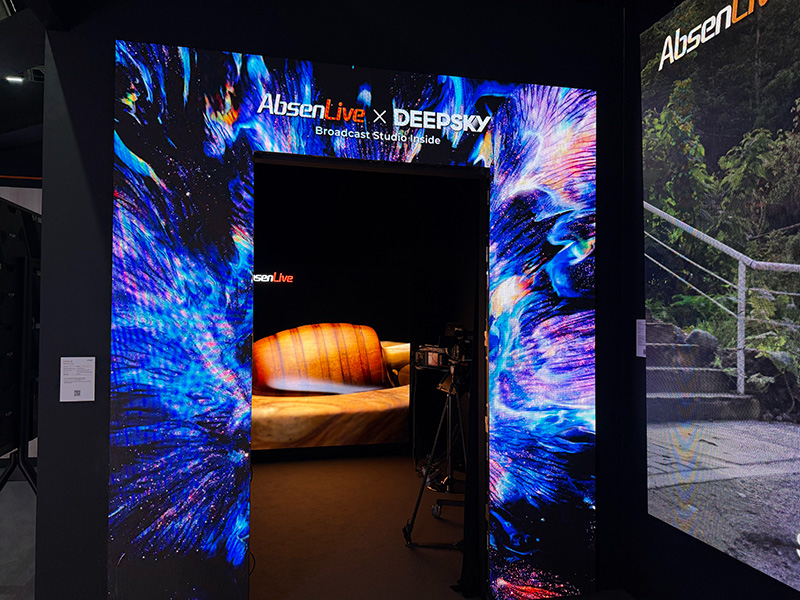
Absen has built its global reputation by providing LED solutions across rental staging, fixed installation, and high-end virtual production. At IBC 2025, the company showcased its PR Series, designed specifically for the demanding world of virtual production. These panels are engineered to deliver the brightness, color fidelity, and refresh rates needed for XR and AR environments where content must look flawless on camera. Alongside the PR line, Absen displayed its Saturn (SA) Series in a curved configuration, demonstrating how flexible designs can create immersive environments for live events, theatres, or university performance centers.
The booth itself was structured to guide visitors through distinct applications. One area highlighted virtual production, complete with LED backdrops and ceilings; another focused on rental and staging environments; and a third showcased conference and fixed installation options. The variety reinforced Liu’s point that different sectors and applications demand different specifications. What works for a corporate conference room will not be the same as what is required for a broadcast studio or an XR training environment.
Education and Training
One of the strongest themes in Absen’s IBC messaging was the role of education. Liu emphasized that installing LED walls is only the beginning. To unlock the full potential of virtual production, institutions must also invest in training students and staff to operate the systems effectively. Producing in XR or AR requires a professional level of expertise, spanning calibration, camera tracking, lighting design, and media content preparation. Without skilled people, even the most advanced technology will underperform. For universities, this challenge doubles as an opportunity: building LED-based production environments can prepare students for careers in rapidly growing sectors of media and entertainment.
Budgeting Beyond Hardware
Another reality that Liu raised is the complexity of budgeting for virtual production. The LED panels themselves are only one part of the investment. Institutions must also account for control systems, rigging, cooling, power infrastructure, and safety considerations, especially when working with curved or ceiling installations. In higher education settings, these costs must be weighed alongside the educational and reputational benefits of immersive facilities. For corporate AV teams, the return often comes in the form of more engaging content, stronger brand storytelling, and the ability to host events that feel world-class.
Implications for Higher Ed and Corporate AV
For decision makers, Absen’s IBC presence underscored several key insights. Virtual production technology must be carefully matched to the needs of the application; over-specifying wastes resources, while under-specifying leads to disappointing results. Success also requires ongoing investment in skills and training, as professional operators and content creators are the ones who will turn an LED volume into a functioning production environment. Infrastructure planning cannot be an afterthought, since issues like cooling, power, and structural support often determine whether projects succeed or stall. Finally, immersive LED environments carry value beyond pure functionality. For a university, a state-of-the-art XR stage can attract students and partnerships. For a corporation, it can elevate internal communications and external brand presence.
Looking Ahead
What remains to be seen is how quickly institutions adopt technologies like the PR Series in Europe and beyond. The decisive factor may be whether manufacturers like Absen can support training and integration programs that help organizations go from demonstration to real-world deployment. Questions about total cost of ownership will be critical in the months ahead. For now, Absen’s showcase at IBC 2025 made one thing clear: virtual production is maturing rapidly, and for those willing to budget appropriately and build professional teams, the rewards can be transformative.

Tim Albright is the founder of AVNation and is the driving force behind the AVNation network. He carries the InfoComm CTS, a B.S. from Greenville College and is pursuing an M.S. in Mass Communications from Southern Illinois University at Edwardsville. When not steering the AVNation ship, Tim has spent his career designing systems for churches both large and small, Fortune 500 companies, and education facilities.
- Tim Albright

- Tim Albright
- Tim Albright
- Tim Albright