Technology needs in today’s business and educational campuses are evolving rapidly. In the new era of hyper-connected workers and students collaborating in-person, remotely, or in a hybrid scenario, or in the roll-out of digital signage systems, we often hear that the pursuit of better AV tools has now transformed into the pursuit of the ideal AV “ecosystem.” While that term can be overused, the stakes couldn’t be more real. For IT and AV leaders managing workplaces, global campuses, and even displays in public spaces, the promise of robust ecosystems that can reduce operational friction between hardware and software solutions, increase system reliability, and make technology easier to deploy, manage, and evolve is an exhilarating one. Are we as an industry getting there? We are, if you follow the industry leaders at the vanguard of this technology sea-change. Sony is at the forefront – but intentionally not alone – in establishing ecosystem best practices.
Creating robust ecosystems
What defines an AV ecosystem, as opposed to a typical AV system cobbled together with many vendors’ solutions? “In a true ecosystem,” says Kianna Pompa, Product Manager, Sony BRAVIA Displays, “products, technologies and services are designed to work together seamlessly. It’s not about spec’ing and installing products from different companies then hoping you can get them all to work together harmoniously. You create an experience where yes the end user can choose some of their preferred devices, but you insure with your ecosystem provider partners that all the solutions are not only fully compatible with each other but work together synergistically within the larger network, including if necessary an IoT or AV over IP landscape.”
Ultimately the goal of AV ecosystem design is to ensure that the whole is meaningfully greater than the sum of its parts. The only way to get there is with alliances among AV providers that go beyond marketing talk and focus on reliability, and reducing friction across multiple AV hardware and software components of the system.
Bob Bavolacco, Director, Strategic & Technology Partnerships at Crestron, describes that partnering process succinctly, and with real-world examples of its success. “We actually learn from our partners,” he says. “Sony is a key part of our strategy. For example – we went to Sony, and asked them to help us when we were creating Crestron’s AirMedia, that provides BYOB conferencing and wireless presentation in digital signage. We don’t do this in a vacuum. We asked Sony, and we standardized, and that’s why we have Korbyt, and Appspace, as applications out of the gate. And we have a larger roadmap for our AV ecosystems thanks to our alliance with Sony. On a weekly basis our engineers are talking to Sony engineers – because our customers want this high level of integration.”
“We actually learn from our partners. And we have a larger roadmap for our AV ecosystems… thanks to our alliance with Sony.”
– Crestron’s Bob Bavolacco
What becomes clear when talking to industry leaders and top solution providers is that the relationship between Sony and its partners is less like “compatibility testing” and more like joint product development. In addition to Crestron, good examples of this approach are Appspace, and Korbyt.
Many are familiar with Appspace as a cloud-based CMS (content management system) provider for digital signage, but the company has evolved beyond providing only typical digital signage solutions, and now can transform “signage” into robust workplace experience platforms. AppSpace’s entire platform thrives on the assumption that it can run across many vendors’ hardware solutions, including displays – an assumption that can’t be made lightly. For AppSpace, the stakes are high. Tom Pennella, Senior VP of Sales at Appspace says that “without the ecosystem approach, we would not survive.” Fortunately, Sony’s willingness to open up APIs, provide early engineering samples, and collaborate deeply on development with Appspace makes that work.
Another key Sony Alliance Partner is Korbyt. Korbyt helps customers build content feeds that broadcast simultaneously across digital signage, desktop, web, and mobile. They’ve evolved into what’s now called the workplace experience platform, which includes much more than digital signage. It’s digital signage, but it’s also space management, and more.
Andrew Gildin, VP, Global Partners and Sales at Korbyt, frames the company’s reliance on ecosystem partners, with Sony at the top of that list, with this question: “Is the customer getting more value out of a joint Sony + Crestron + Korbyt solution, say, than they would from each of those companies separately? The essential point is that partnership is a two-way street – it extends beyond provider relationships, important as those are Partnership is also about solving the customer’s business objectives.”
Indeed, the customer’s business objectives should guide ecosystem priorities. Every provider partner reinforces Sony’s model – and that works because it is built backwards from the customer, not forward from the manufacturer.
Openness as a defining technical approach, not a marketing phrase
The end-goal of industry leaders like Crestron, Sony, Korbyt, and Appspace? It is not an ecosystem built to keep people in, or certain products out. It is an ecosystem built to pull people together with the overarching goal of making life easier for AV and IT managers and making the technology experiences better for end users. And that distinction matters – it can actually transform how global organizations deploy and support AV infrastructure.
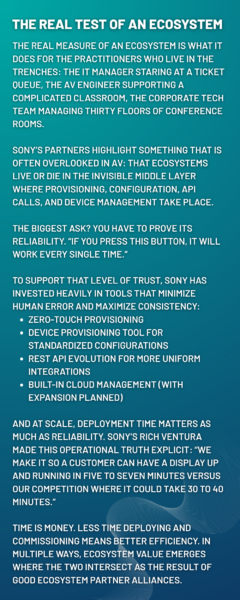 Sony’s ecosystem strategy is highlighted with a refreshing anecdote from Rich Ventura, VP of Professional Display Solutions at Sony. “The first week I started with Sony, 5 years ago,” he notes, “I asked, who are our partners? What are my customers’ pain points, and can we, together, help them get past those pain points? We can’t do all this by ourselves – how do we the solution partners, make each other better? And make the customers better?”
For any manufacturer, those questions are far from simple and raising them transparently is significant in itself. It signals the philosophy behind Sony’s approach to partnerships, integrations, and the broader AV/IT ecosystem that must seamlessly coexist across meeting rooms, classrooms, corporate offices, and campuses. Rather than attempting to build a walled garden with its solutions, Sony has invested deeply in making its products compatible, controllable, and extendable with other solution providers. Kianna Pompa framed it this way, “We turn the process into something that is more open source – and that facilitates, not hinders, letting the customer decide on their exact mix of user-facing AV tools.”
Sony’s approach is about strategic clarity. The modern workplace is no longer a single stack. It is a constant negotiation between displays, BYOD workflows, digital signage platforms, room scheduling applications, control systems, media transport protocols, and cloud platforms. No vendor, not even the world’s largest, can credibly claim to have every piece of hardware or software needed to complete the ecosystem. Rather than fighting the complexity, Sony leaned into it. Rather than isolating their hardware, they “opened up.”
That openness shows up in tangible ways: more than 50 signage platforms certified on Sony SOC displays; publicly available cloud APIs; and dedicated engineers whose full-time job is making sure control and signage partners can integrate before a new product ships. For customers’ IT and AV teams, that means the ecosystem isn’t something they’re forced into. It’s something they can assemble around existing standards, workflows, and global templates.
This is not the typical ecosystem pitch built around lock-in. Sony does not insist on a Sony-only signage platform or a proprietary content system. Instead, more than 50 signage platforms can run natively on Sony’s System-on-Chip (SoC), with Sony publicly posting cloud APIs so partners can build their own integrations if they wish.
Sony’s Kianna Pompa puts the goal plainly. “We don’t want to lock you down into only using a Sony service.”
In an industry where vendors often pursue vertical integration at the expense of flexibility, Sony has taken the opposite path. This openness is not merely philosophical—it is operational, and it is engineered into the product line. Rather than fighting the complexity, Sony leans into it. Rather than isolating their hardware, they opened it up. That philosophy radiates through all the partners – Crestron, Korbyt, Appspace, and many more – who have joined the Sony Alliance Partnership.
Global standardization: a real-world ecosystem requirement
Enterprise AV is now global by default. It’s common to have a customer headquartered in New York, with engineering in London, operations in Singapore, training in Bangalore. Technology has to work the same everywhere.
“So many enterprise customers have asked us for global solutions”, Pompa says. “Sony’s response goes far beyond regional sales coordination. We launched a global AV solutions website listing what models are available per country – critical for organizations trying to standardize room templates across continents. And when exact hardware parity isn’t possible, Sony’s account managers “quarterback” the process, ensuring equivalent models; identical control behaviors, uniform SOC and signage support, even local deployment assistance
Pompa explains how this works in practice, “The account manager is the liaison – bringing in any other Sony member that would support the account.”
For IT and AV teams supporting dozens or hundreds of sites worldwide, this makes global standardization possible. Bringing on global partners – whether Crestron, Appspace, or any of the dozens of Sony’s Alliance Partners – ensures that it’s a more sustainable business model.
What IT and AV end users can take from Sony’s approach
After looking at Sony’s model and hearing from some of its closest ecosystem partners, several high-level lessons apply directly to IT and AV professionals building their own organization’s technology strategies:
- Openness scales, across both space and time. Closed systems eventually break.
- in pursuit of better system performance.
- Reliability comes from consistently following the partnership model, not cobbling together the AV system and hoping it all works together seamlessly.
- Global standardization and efficiency at scale is achievable—but only with deliberate alignment.
Conclusion
An ecosystem thrives only when everyone involved understands who it truly serves. It’s not built for the manufacturer, nor for the partner network – it’s designed for the person who walks into a room and starts a meeting effortlessly, and for the signage manager who depends on nonstop reliability even as content shifts in real time. Success isn’t defined by the number of integrations or logos attached; it’s defined by simplicity in use, management, deployment, and in ongoing evolution. When the customer experiences that ease, the ecosystem is fulfilling its purpose. Achieving this is possible today by following the lead of industry pioneers – Sony among them – who are setting new standards for ecosystem best practices.

Tim Albright is the founder of AVNation and is the driving force behind the AVNation network. He carries the InfoComm CTS, a B.S. from Greenville College and is pursuing an M.S. in Mass Communications from Southern Illinois University at Edwardsville. When not steering the AVNation ship, Tim has spent his career designing systems for churches both large and small, Fortune 500 companies, and education facilities.
- Tim Albright

- Tim Albright

- Tim Albright

- Tim Albright