A new Canon PTZ partnership and a relabeled Voyager workflow position virtual production for broadcasters with smaller budgets.
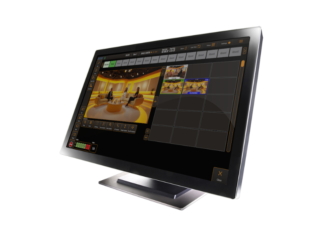
At NAB Show 2026 in Las Vegas, Ross Video pushed virtual production toward smaller broadcast budgets. The company paired its Unreal Engine-based Voyager rendering platform with Lucid Director. Lucid Director is the control layer for what Ross has long called trackless production. Notably, Ross is retiring that term. Meanwhile, the company announced a bundled partnership with Canon’s CR-N500 and CR-N700 broadcast PTZ cameras. Together, the moves frame the pitch clearly. Ross wants broadcasters to believe a half-million-dollar studio can match results that once required budgets thirty times that size.
Tracked, Trackless, and the Cost Gap Between Them
The tracked-versus-trackless distinction matters here. In a tracked virtual workflow, multiple physical cameras feed real-time tracking systems. Each camera reports its position, lens zoom, and focus data. Then a render engine generates a unique virtual background per camera, frame by frame. The output looks great. However, the cost adds up quickly. Each camera needs its own render engine and tracking hardware.
A trackless workflow takes a different approach. The talent stands in front of a green screen with a single locked-off camera. Software then keys the talent into the virtual environment. From there, virtual camera moves replace physical ones. One render engine handles the full job. As a result, capital costs drop sharply.
Ross is now positioning trackless as the entry point rather than the compromise. According to the company, broadcasters can start with a single trackless setup and add tracked cameras later. That framing matters because Ross is competing for first-time virtual production buyers. Many smaller broadcasters and corporate communications teams have watched virtual production from the sidelines. The trackless onramp gives them a way in without locking out future expansion.
Why is Ross dropping the trackless label? The company has not said publicly. However, the term suggests a workaround rather than a workflow in its own right. Renaming it likely reflects a push to position the approach on equal footing with tracked production. Watch for new terminology at IBC 2026.
Voyager and the Unreal Engine Asset Advantage
Voyager itself runs on Epic Games’ Unreal Engine 5.3. That foundation matters for a reason that product announcements often bury. The Unreal Engine has a deep asset marketplace and an active developer community. As a result, broadcasters using Voyager can pull from existing virtual sets, props, and animations. Some assets are free. Others cost only a few dollars. By contrast, custom-built virtual sets can run into six figures per scene.
The Voyager platform supports HD-SDI, NDI, 12G-SDI, and SMPTE ST 2110 transport. Lucid Director sits on top as the control surface for trackless workflows. In addition, Lucid Studio handles the tracked variant for studios that scale up. Ross has used Voyager on major productions including CCTV’s Spring Festival Gala in China. Smaller deployments are now the company’s clear focus.
The Canon Partnership: PTZs as Primary Cameras
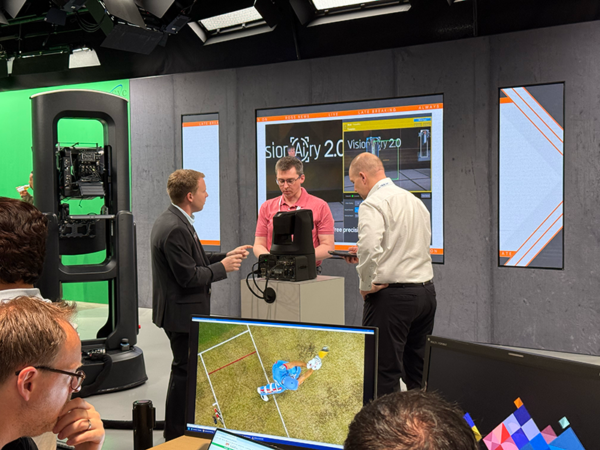
The Canon partnership rounds out the bundle. Customers ordering Voyager can now buy the CR-N500 or CR-N700 PTZ cameras directly through Ross. Both cameras are 4K-capable, with NDI support. The CR-N700 adds 4K60p 4:2:2 10-bit HDR, 12G-SDI output, and a 1-inch CMOS sensor for stronger low-light performance.
Several Canon features stand out for Ross’s target use cases. First, both cameras use Canon’s eye-detection autofocus instead of older contrast-based focus systems. Eye detection responds faster and tracks faces more accurately. That matters when the subject is an executive presenter or on-air talent. Second, the CR-N700 includes optical image stabilization. That feature originally came from Canon’s consumer line. However, it earns its keep in venues with vibration, including sports facilities and busy event spaces.
Third, the CR-N700 includes a Crop function that Ross described as dual-image capture. According to Canon’s specifications, the camera can output the full wide shot. The user can also set up to two cropped 1080p windows from the same sensor. As a result, one PTZ can deliver both a wide angle and a tight shot at the same time. For lower-budget productions, that effectively doubles the camera count without adding hardware.
What This Means for Broadcasters
For broadcasters planning a virtual production build, the pitch lands in a specific spot in the market. The largest tracked LED volumes still belong to the biggest studios. Meanwhile, the smallest livestream operations get by with green screens and basic chroma keying. Ross is targeting the wide middle: facilities that need on-air-quality output but cannot justify a tracked multi-camera build.
That middle is broader than it looks. Regional broadcasters fit. So do houses of worship with broadcast operations, government chambers, university broadcast programs, and corporate communications teams. All of these buyers have watched virtual production prices fall. Many have been waiting for an entry point that does not box them out of future growth.
The Voyager-plus-Canon bundle answers that wait. However, two cautions are worth flagging.
First, Unreal Engine workflows still carry a real learning curve. Free assets do not equal free production. Lighting a scene to match a virtual background takes skill. In addition, camera calibration and color matching add work even in a trackless setup. Buyers who underestimate that curve will find the system harder to operate than a demo suggests.
Second, the trackless approach has real limits. Virtual camera moves cannot replicate the parallax of a physical handheld shot. Layered foreground elements work, but they add complexity. Productions that depend on dynamic camera energy will eventually want tracked cameras. Ross’s start-trackless-and-add-tracked framing is honest about that path. Buyers should plan their growth accordingly.
Pricing and Availability
Ross did not disclose Voyager-plus-Lucid Director bundle pricing at the showcase. Standalone Canon CR-N500 cameras retail in the mid four-figure range. Standalone CR-N700 units retail in the five-figure range. Ross has not published its bundle pricing publicly. Broadcasters evaluating the system should expect direct sales conversations rather than off-the-shelf quotes.
The Broader Picture
Virtual production has been the most hyped category in broadcast for several years. After the peak around the Mandalorian in 2021 and 2022, many smaller deployments stalled when budgets tightened. Then the work shifted toward what actually performed. Trackless studios, hybrid green-screen-plus-LED setups, and lower-cost Unreal Engine deployments all gained ground. Ross’s NAB 2026 pitch sits squarely in that pragmatic phase.
The Canon partnership also signals something larger. PTZ cameras have moved up-market in the past three years. The category once meant huddle rooms and basic livestream rigs. Today, broadcast-grade PTZs appear in studio environments. Eye-detection autofocus, optical image stabilization, and 4K60 HDR position cameras like the CR-N700 alongside traditional broadcast camera chains. Ross is betting that broadcasters running mid-budget studios will accept PTZs as primary cameras alongside virtual production.
That bet has economics behind it. PTZs eliminate camera operators. They reduce floor space. Pair PTZs with trackless virtual production, and a five-person team can collapse to one or two roles. The math works for a lot of buyers.
For broadcasters and broadcast-minded corporate teams evaluating virtual production this year, the Voyager-plus-Canon stack deserves a closer look. The pitch is not perfect. However, the price point and upgrade path are the strongest case Ross has yet made for entry-level virtual production.
Catch all of AVNation’s NAB 2026 coverage here.

Tim Albright is the founder of AVNation and is the driving force behind the AVNation network. He carries the InfoComm CTS, a B.S. from Greenville College and is pursuing an M.S. in Mass Communications from Southern Illinois University at Edwardsville. When not steering the AVNation ship, Tim has spent his career designing systems for churches both large and small, Fortune 500 companies, and education facilities.
- Tim Albright

- Tim Albright

- Tim Albright
- Tim Albright