Originally designed as an opportunity for farmers and ranchers to showcase their work, the RODEOHOUSTON® Super Series—aka Houston Livestock Show and Rodeo™—has grown from a small regional exhibition founded in 1932 into one of the largest cultural and economic events in the United States. Since 2003, it has been staged at NRG Stadium, where it was held this year from March 2-22, along with a slew of concerts by Tim McGraw, Lainey Wilson, Kelly Clarkson, Lizzo, Luke Bryan, Chris Stapleton, Dwight Yoakam, Shaboozey, and many others.
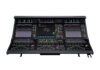
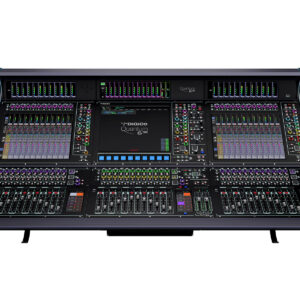
Befitting its current place in sports media, RODEOHOUSTON had top technology in place this year to assure visitors—more than 2.7 million of them over the course of three weeks—had great sound to go with the dramatic visuals. That included DiGiCo’s flagship Quantum852 mixing console, deployed there for the first time via Houston-based LD Systems, a Clair Global brand, which used the desk to mix the largest rodeo event in the world. The console was accompanied by a pair of DiGiCo SD-Racks and an Orange Box in the main patch room, plus four SD-Mini Racks distributed throughout the stadium.
“This is a high-profile event that operates around the clock for 21 days straight,” observes LD Systems President Rob McKinley, who also served as the Project Manager for the event. “Every technical element is mission-critical, with minimal time for recovery if any issues arise. Therefore, my role is to support the team with the tools and resources they need to perform flawlessly, and if there is an issue, that there is rock-solid backup to quickly recover. DiGiCo has provided a great tool in the Quantum product to elevate our engineers’ performance, thereby creating a greater fan experience. DiGiCo provided excellent support, with Julian Gates onsite for several days to ensure the Quantum852 performed, which it did with flying colors. Everyone was pleased with the outcome and we look forward to many more great events with DiGiCo.”
As sports and entertainment continue to converge, tools like the Quantum852 become critical for being able to address the entire spectrum of audio needs. “My role sits somewhere between a live sports mix and a show mix,” explains LD Systems A1 for the event Rafael Rosales. “I’m managing everything the audience hears during the rodeo: announcers, effects, playback, interviews… and making sure it all translates clearly across a very large space.”
Scale—of the venue, the event, and the technology needed to present it—is the single biggest challenge. “The scale is a big part of it, but it’s really the combination of scale and speed,” Rosales says. “You’re working with a very large PA, long throw distances, and a high noise floor from the
crowd and the arena itself, while also dealing with open microphones, especially announcers in front of the PA. So gain-before-feedback, bleed control, and intelligibility are constant priorities. At the same time, the show moves very quickly. You can go from an intense event straight into an interview, then into playback, and back into competition within seconds. Each of those elements behaves very differently sonically.
“But, beyond that, the goal is immersion,” he continues. “I’m using a wide network of microphones—ambient mics around the arena, effects mics on gates and chutes, chuck wagons, lavaliers on contestants and contractors, and so on. The intention is that no matter where someone is seated it feels like they’re right there on the dirt, hearing the details of the action as it happens.”
This is why Rosales says the Quantum852 is the platform he chose to manage this complex production on, because it offers him the processing depth, visibility, and reliability he needs for this scale and scope of show. “On the input side, I rely heavily on Mustard Processing—dynamic EQ, multiband compression, and the Mustard Source Expander—to stabilize each channel before it even reaches my mix,” he explains, referring to DiGiCo’s onboard tube/EQ/dynamics processing modeled from highly sought-after analog units. “With over 100 inputs active I can’t physically ride every fader all the time, so I build that control into the channels themselves. That way, even if I’m not touching a source at a given moment, it’s still behaving in a controlled and predictable way. Playback feeds are a good example of that. They all come in with different tonal signatures and dynamics, so I use multiband compression to smooth those differences so everything sits in a consistent sonic space. I also extend that approach to my busses, using dynamic EQ and multiband compression, to keep groups balanced as multiple elements stack up. Another thing I really like is the amount of metering and data the console gives me. I have a lot of visual feedback in front of me at all times—levels, dynamics, processing activity—which helps me make fast decisions in a very dynamic environment.”
Anyone familiar with rodeo arts knows the significance of eight seconds—the minimum time a rider has to stay on a bull to qualify. In a sport measured in seconds, the ability to match the audio workflow pace to that of the events is critical. Again, says Rosales, this is why he chose the Quantum852.
“In this environment speed and access are everything,” he says. “I’m working with over 120 inputs, so I rely heavily on macros and spill sets to organize the console around how the show actually unfolds. I can instantly jump to specific zones, whether it’s a section of the arena, announcers, or playback, and only see what I need in that moment. That means I’m not searching for channels; I’m going directly to where the action is happening. Physically, the desk also supports that workflow: having a large number of faders available, depending on layout, lets me keep key inputs and groups under my hands without constantly banking.
“The dual-engine design is also critical: it gives me seamless redundancy that is essential when you’re effectively running a live, broadcast-style mix for that many people. It really comes down to preparation and speed. I use processing to control my inputs before they hit the mix, rely on visual metering to stay informed, and use the workflow tools to react instantly. That’s what allows me to deliver a mix that feels both clear and immersive for the entire stadium.”
Thomas Ruffner, LD Systems Audio Ops Manager and a Systems Engineer on the Houston Livestock Show and Rodeo project, also had high praise for the DiGiCo elements of the show’s production, but he additionally made observations about how critical the support was from the company and its related teams. “It’s worth highlighting the absolutely amazing support we receive from DiGiCo and its US distributor, Group One,” he says. “Whether we’re adopting a new platform like the Q852, or just working through scenarios with existing DiGiCo equipment, the customer service they provide is truly second to none. The team at Group One is really fantastic at making sure we have the tools, knowledge, and real-time support necessary for success with a powerful platform like Q852 at the helm of a complex show like RODEOHOUSTON. Vendor support is a major deciding factor when choosing which tools we use, and the DiGiCo and Group One teams never disappoint!”
- AVNation Staff
- AVNation Staff
- AVNation Staff
- AVNation Staff