Your Zoom rooms can now do what broadcast studios have done for two decades. With Vizrt CaptivAIte , the end user just flips a toggle.
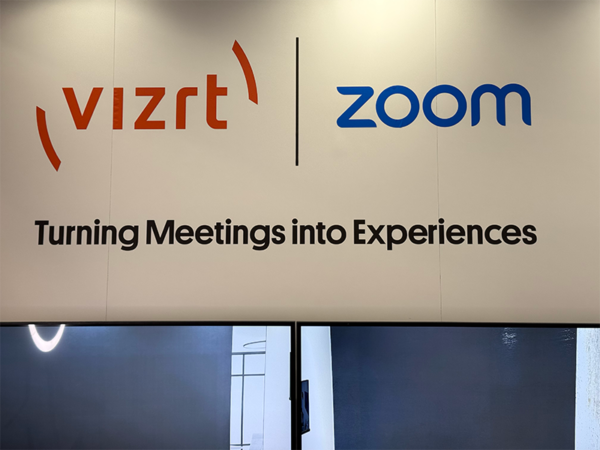
Vizrt used NAB 2026 to move Captivate from preview to shipping product, and the timing is not a coincidence. The device is aimed squarely at the growing number of organizations that have invested in Zoom Rooms as their video conferencing infrastructure and are now asking a harder question: how do we make these meetings actually worth showing up for?
CaptivAIte is a hardware appliance that joins a Zoom room as one more device alongside the cameras, compute, and controller already there. What it adds is the ability to overlay augmented reality (AR) graphics. Lower thirds, virtual backgrounds, data feeds, and live graphics from other sources all directly into the meeting frame, visible to every participant in the room and on the call. The person presenting stays on screen. The graphic floats beside them, behind them, or around them. It looks like a broadcast, because the underlying technology is the same one that has powered broadcast graphics for years.
The setup is an integrator job. The operation is not.
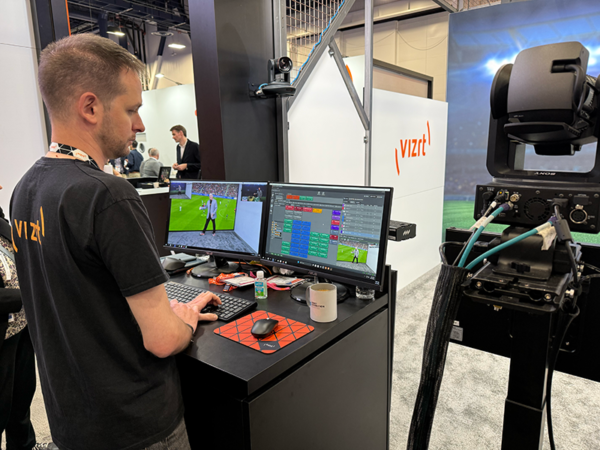
The calibration process is where the technical work happens, and Vizrt has designed it to be completed during installation rather than handed off to the end user. The integrator points the room’s pan-tilt-zoom (PTZ) cameras around the space. Panning, tilting, letting the system see what the room contains. And Captivate’s AI builds a spatial map from what the cameras observe. No tracking hardware. No specialized camera systems. Standard PTZ cameras that are probably already on the spec sheet.
Once that map is built, the AI knows where physical space is. It can hold a virtual object in a fixed position as a camera pans across the room, maintaining the spatial relationship between the graphic and the room’s geometry. From that point forward, the integrator’s work is done.
What gets handed to the customer is their Zoom room controller with CaptivAIte integrated into it. The interface is four tabs covering the categories of content available to the system. Sources the room can pull from. Each source is a toggle switch: graphic in, graphic out. A person with no AV or broadcast background can sit down and run it. That accessibility is the product’s stated mission, and it is the reason it belongs in a conversation about enterprise AV rather than broadcast production.
Catch all of AVNation’s NAB 2026 coverage here
NDI is the architecture underneath
The reason CaptivAIte can pull from as many sources as it can is that it is built on Network Device Interface (NDI), Vizrt’s IP video protocol. This is the fact IT and AV decision-makers need to sit with for a moment.
Any NDI source on the network is available to CaptivAIte. That means cameras and displays in other Zoom rooms on the same network are accessible as inputs. It means a PowerPoint presentation running on a laptop can come in as a live video source without any additional hardware. And via NDI Bridge, the protocol’s tool for carrying NDI traffic across the open internet, a camera feed from a remote location, whether that is another campus or another continent, can appear in the local meeting as a placeable AR element.
For organizations already building NDI into their AV infrastructure, CaptivAIte slots in without adding a new protocol layer. For organizations that are not, this is worth understanding: the sources available to CaptivAIte grow with the NDI footprint of the network. The device is an endpoint in an ecosystem, and that ecosystem has real range.
Where the use cases actually land
The obvious corporate applications like town halls, executive briefings, and all-hands meetings are real, but the more interesting territory is training. Corporate training is often where production value matters most and where it is least likely to exist today. A monthly training session delivered over Zoom to a distributed workforce is exactly the kind of event where engagement collapses when the presenter vanishes behind a full-screen slide deck. Captivate allows the presenter to stay in frame, with the content around them rather than replacing them.
Education follows the same logic. Satellite campuses and hybrid classrooms are already operating on the same video conferencing infrastructure as corporate meeting rooms. A lecturer who can keep students focused on them as a person. While data, diagrams, and visualizations appear around them, it is a fundamentally different teaching experience than a voiceover a PowerPoint. Medical education adds a specific application: procedure statistics, coordinate data from surgical systems, and real-time metrics can be pulled in as sources and overlaid in-frame for teaching and documentation.
The less obvious market is organizations that already produce broadcast-quality content and want their internal communications to reflect that investment. A large sports media network running Zoom across hundreds of rooms has already built out on-air graphics packages and brand identity. CaptivAIte allows that brand to appear in internal meetings without rebuilding the production workflow. The same applies to any organization whose external presence looks significantly more polished than its internal communications. Which is most of them.
What Vizrt CaptivAIte costs
The hardware is $9,995. Software runs on an annual subscription; current pricing is available on Vizrt’s product page. Managed services are available for organizations that want Vizrt’s team to build custom virtual sets rather than building in-house.
The entry point is realistic for a boardroom or training room budget. The more relevant question for most organizations is whether the PTZ cameras and managed network required to support it are already in place. Because if they are, the integration story is straightforward.
CaptivAIte is available now. For full specifications and subscription pricing, visit Vizrt’s product page.

Tim Albright is the founder of AVNation and is the driving force behind the AVNation network. He carries the InfoComm CTS, a B.S. from Greenville College and is pursuing an M.S. in Mass Communications from Southern Illinois University at Edwardsville. When not steering the AVNation ship, Tim has spent his career designing systems for churches both large and small, Fortune 500 companies, and education facilities.
- Tim Albright

- Tim Albright

- Tim Albright

- Tim Albright