Can Microsoft Teams track your location? Not in the live GPS-tracking way many employees worry about. Microsoft Teams does not give your employer a real-time map of where you are, and it is not designed to follow your physical movement throughout the day. But Teams does sit inside the larger Microsoft 365 admin, security, and compliance environment, where employers may be able to see activity, login records, device details, network information, work location status, and some location-related data tied to emergency calling or IT troubleshooting.
That distinction matters.
Most of the confusion around Microsoft Teams location tracking comes from treating Teams as one thing. To employees, Teams is the chat, meeting, and calling app they use every day. To IT teams, Teams is also part of a much larger administrative environment that includes Microsoft Entra, Microsoft Purview, device management, network logs, and Teams Phone.
So the better question is not only whether Teams can track your location. The better question is what kind of visibility your employer has, where that data comes from, and how it should be explained.
Teams is not the same as the Microsoft 365 admin environment
Microsoft Teams itself is a collaboration app. It handles chat, meetings, calls, files, presence, and workplace communication. In daily use, it shows whether you are available, busy, away, in a meeting, presenting, or offline.
That is not the same thing as location tracking.
The broader Microsoft 365 environment is different. IT administrators may have access to audit logs, sign-in records, device compliance information, IP addresses, conditional access data, and security alerts. Those tools exist for security, compliance, troubleshooting, and account protection.
That is where most of the location-related visibility lives.
Teams may be the app employees notice, but Microsoft 365 is the system administrators manage. If an employer is reviewing where a login came from, whether a device is managed, or whether an account signed in from an unusual region, that is usually happening through Microsoft Entra, Microsoft Purview, endpoint management, network tools, or security platforms. It is not a manager opening Teams and watching a dot move on a map.
This is the core distinction: Teams shows collaboration signals. Microsoft 365 can show administrative and security signals.
Those are related, but they are not the same.
What Microsoft Teams actually tracks
Teams tracks activity and presence. That means it can show whether you are available, away, in a meeting, on a call, or presenting.
That status is based on signals such as keyboard or mouse activity, calendar events, meetings, calls, and device behavior. If you stop interacting with your device, Teams may eventually show you as away. That does not mean Teams knows where you went. It only means the system is no longer seeing activity from the device.
This is why presence can be misleading. Someone may be reading a document, reviewing a proposal, taking notes on paper, or working in another system without touching the keyboard. Teams may still interpret that as inactivity.
Related: [How long does Microsoft Teams stay green?]
Teams also supports work location features. Users can set a work location for the day, such as office or remote, and that information may be visible to others depending on the organization’s setup. In some cases, Teams can show location context around whether someone is in the same office building. That is workplace visibility, not GPS tracking.
The app can also use location permissions for specific features, including emergency calling and IT troubleshooting. On personal devices, that usually involves operating system and app-level permission prompts. On organization-managed devices, those settings may be controlled by IT policy.
The simple version: Teams can show status, work location, and certain location-related signals. It is not a live employee-tracking system.
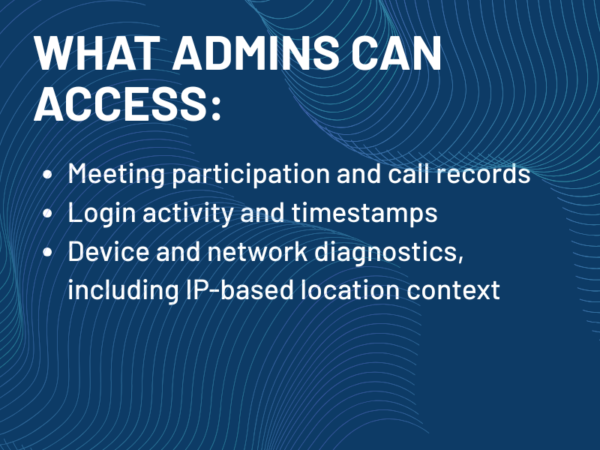
Admin Access
What admins CAN access
- Meeting participation and call records
- Login activity and timestamps
- Device and network diagnostics, including IP-based location context
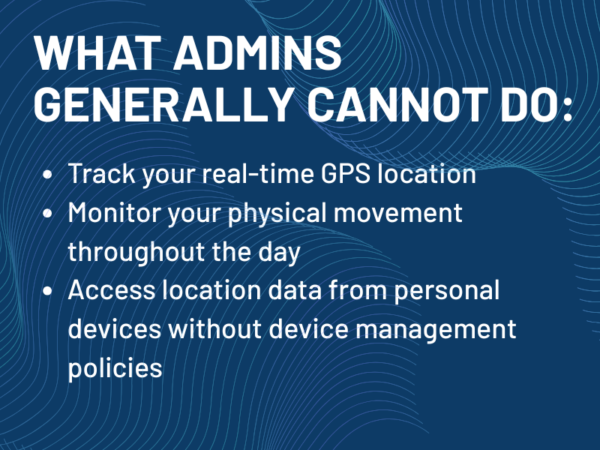
What admins generally CANNOT do:
- Track your real-time GPS location
- Monitor your physical movement throughout the day
- Access location data from personal devices without device management policies
That distinction is where most of the confusion around Microsoft Teams location tracking lives.
What your employer can see in Teams
What an employer can see depends on licensing, admin permissions, device management, security settings, and company policy. A small business using basic Teams settings will not have the same visibility as a large enterprise with Microsoft Purview, Microsoft Entra, Intune, conditional access, Teams Phone, and managed devices.
In general, employers may be able to see:
- Your Teams presence status
- Meeting attendance and participation records
- Call history and call quality data
- Sign-in times and login history
- IP address and general location context from sign-ins
- Device details, such as operating system and browser
- Whether a device is managed or compliant
- Teams audit events, depending on logging and licensing
- Work location information you have set or shared
- Emergency location information tied to Teams Phone and emergency calling
That sounds like a lot, and in enterprise environments, it can be. But it is still different from real-time GPS tracking.
Your employer generally cannot use Teams to:
- Watch your live physical location on a map
- Track your movement throughout the day
- See where you go when you step away from your desk
- Pull GPS data from your personal phone without permission or management controls
- Treat a yellow Teams status as proof that you are not working
- Know what you are doing away from your device
This is where the workplace trust issue starts. Employees often experience all of this as “Teams is tracking me.” IT teams usually see it as security, compliance, support, and operations data. Both reactions are understandable. The problem is when organizations never explain the difference.
Teams Phone and emergency location
Teams Phone adds another layer to the location conversation.
Emergency calling requires accurate location information. If someone places an emergency call through Teams Phone, the system needs to help route that call properly and provide dispatchable location information where required. That is not surveillance. It is a safety and compliance function.
In managed environments, IT administrators can configure emergency locations and dynamic emergency calling. That may involve mapping network elements such as wireless access points, Ethernet switch ports, switches, and subnets to physical locations. When the Teams client detects the network it is connected to, it can use that information to determine the appropriate emergency location.
For example, a user connected to office Wi-Fi in Building A may be associated with one emergency location. A user connected to a different floor, subnet, or office network may be associated with another. If that user makes an emergency call, the location information can be sent along with the call depending on the organization’s configuration, carrier setup, and country or region.
Remote work complicates this. Employees working from home may be prompted to confirm or update an emergency address. Teams may also rely on device location permissions to help detect when a user has moved to a new physical location.
That is why Teams location prompts can feel surprising. An employee may see a request for location access and assume the company wants to monitor them. In many cases, the request is tied to emergency calling, network troubleshooting, or admin insight. But if the organization has not explained that, the employee is left to guess.
And people rarely guess in the employer’s favor when privacy is involved.
IP address and network-based location
The most common form of location visibility is not GPS. It is network-based location.
When you sign in to Microsoft 365, use Teams, connect through a virtual private network (VPN), or access company resources, your IP address may be logged. That IP address can be associated with a general location, such as a city, region, country, office network, or internet service provider.
This is useful for security. If an employee normally signs in from Missouri and the account suddenly appears to sign in from another country, that may trigger an alert. A device connects from a known corporate network, that may help IT apply the right access policy. If a user reports call quality problems, network information can help diagnose the issue.
But IP-based location is not the same as physical location.
What an IP Address Gives Up
An IP address may point to an internet provider’s network, a VPN exit point, a corporate data center, a cloud security provider, or a general geographic region. It may be accurate enough for risk detection, but it is not precise enough to say someone is sitting in a specific room at a specific moment.
For AV and IT teams, network-based location becomes even more important in meeting spaces. Conference room systems, Teams Rooms devices, scheduling panels, occupancy sensors, and managed networks can all create signals about how spaces are being used. A room may show as occupied. A Teams Room device may show call quality data. A network may show that a device is connected in a specific building.
That is operational visibility. It helps support rooms, troubleshoot meetings, and manage hybrid workspaces. But it also raises policy questions. Who can see that data? How long is it retained? Is it used for support, space planning, productivity measurement, or employee oversight?
Those questions should not be answered after someone complains.
Can Teams track your activity?
Yes, but not in the way the phrase often implies.
Teams can show activity signals. It can show whether you are available, away, busy, in a meeting, or presenting. Administrators may also have access to meeting participation, call data, audit logs, and usage reports depending on the Microsoft 365 setup.
That does not mean Teams measures productivity.
This is one of the most common mistakes organizations make. Presence is not performance. A green status does not prove someone is working effectively. A yellow status does not prove someone is slacking. A meeting attendance record does not prove contribution. A login timestamp does not tell the whole story of a workday.
Teams can show signals about work. It cannot explain the quality of that work.
Managers who treat Teams presence as a productivity tool create the exact behavior they say they do not want. Employees start managing the indicator instead of managing the work. That leads to mouse jigglers, unnecessary status changes, performative availability, and less trust on both sides.
The technology is not the real problem. The interpretation is.
What employers should explain clearly
Organizations do not need to hide the fact that Microsoft 365 creates logs. They should explain it.
A clear policy should tell employees:
- What Teams data is visible
- What Microsoft 365 audit and sign-in data is collected
- Whether location permissions are used
- Whether work location is self-reported or automatically detected
- How Teams Phone emergency location works
- Whether company-managed devices have different settings than personal devices
- Who can access the data
- Why the data is used
- How long the data is retained
- Whether the data is used for performance management
That last point matters.
There is a major difference between using Teams logs to investigate a compromised account and using Teams presence to judge whether someone worked hard enough. One is a security function. The other is a management choice.
Employees deserve to know which one is happening.
What employees should know
If you are using Microsoft Teams at work, assume your activity inside the work environment is visible at some level. That does not mean someone is reading every message or watching every movement. It means work systems create records.
The safest practical assumptions are:
- Your presence status may be visible
- Your meetings and calls may create records
- Your work location may be visible if you set or share it
- Your sign-ins may include IP address and general location data
- Your device may report more information if it is company-managed
- Teams Phone may use emergency location data
- IT administrators may have access to audit and troubleshooting logs
- Teams is not a live GPS tracker for your employer
If you are using a personal device for work, pay attention to the permissions you grant. Location access, device management, and work profile settings matter. If your employer requires mobile device management to access company resources, that should come with a clear explanation of what the company can and cannot see.
If it does not, ask.
Why the Microsoft Teams location tracking myth exists
The myth exists because hybrid work changed the meaning of visibility.
In the office, managers used to rely on physical cues. They could see who was at a desk, who was in a meeting room, who had stepped away, and who seemed available. In hybrid work, those cues moved into software.
The green dot became the new glance across the office.
That is a problem because the green dot was never designed to carry that much meaning. Teams presence is a communication signal. It helps people know whether someone might be available. It is not a full picture of attention, effort, location, or output.
At the same time, employees have become more aware of workplace monitoring tools. They know software can collect data. Know companies can review logs. They know remote work has made some managers anxious. So when Teams asks for location permission or shows an away status after inactivity, the reaction is predictable.
“Are they tracking me?”
The honest answer is more complicated than yes or no.
No, Teams is not a live GPS tracker for managers. Yes, Teams and Microsoft 365 can produce location-related and activity-related data. And yes, employers should be transparent about how that data is used.
Microsoft Teams location tracking FAQ
Can Microsoft Teams track your location?
Microsoft Teams does not track your live location in the way a GPS app does. It does not give your employer a real-time map of your movements. However, Teams can use location-related information for features such as work location, emergency calling, IT troubleshooting, and Microsoft 365 security logs.
Can my employer see my location on Microsoft Teams?
Your employer may be able to see general location-related information, depending on your organization’s settings. That may include work location you set in Teams or Outlook, IP-based sign-in location, emergency location information for Teams Phone, or device and network data used by IT. That is not the same as seeing your live physical location throughout the day.
Does Teams track GPS location?
Teams may request location permission from your device for specific features, including emergency calling and admin troubleshooting. But that does not mean your manager can open Teams and track your GPS location in real time. The exact behavior depends on device permissions, whether the device is managed by your organization, and your company’s Microsoft 365 policies.
Can Teams show if I am working from home?
Teams can show your work location if you set it, such as remote or in office. Microsoft 365 sign-in logs may also show general IP-based location context. But Teams does not automatically prove you are working from home unless your organization has other systems, network data, or device policies that support that conclusion.
Can Microsoft Teams track your activity?
Teams can show activity signals, including presence, meeting participation, calls, and status changes. Administrators may also have access to Teams audit logs and Microsoft 365 usage data. That activity data should not be treated as a complete measure of productivity.
Can Teams detect where I am through my IP address?
Microsoft 365 sign-in and audit data can include IP addresses. Those IP addresses may suggest a general location, such as a city, region, country, corporate network, or VPN endpoint. IP-based location is useful for security and troubleshooting, but it is not the same as precise physical tracking.
Does Teams Phone use my location?
Teams Phone can use emergency location information so emergency calls can be routed correctly. In managed environments, IT teams can configure network-based emergency location mapping using Wi-Fi access points, switch ports, switches, and subnets. Remote users may also be asked to confirm or update an emergency address.
Can my employer track my personal phone through Teams?
Not simply because Teams is installed. On a personal device, location access usually depends on operating system permissions, Teams app permissions, and whether you have enrolled the device in company management. If your employer requires device management for work access, they should clearly explain what data is collected and what is not.
Is Microsoft Teams location tracking legal?
That depends on the country, state, industry, device ownership, company policy, employee notice, and how the data is used. From a workplace trust standpoint, the better standard is transparency. Employees should be told what data is collected, why it is collected, who can access it, and whether it is used for performance management.
The bottom line
Microsoft Teams does not give your employer a live GPS feed of your day. But it does create visibility.
Parts of that visibility is simple, such as presence and meeting activity. Some of it comes from the broader Microsoft 365 environment, such as sign-in logs, IP addresses, device details, and audit records. Others are tied to safety and compliance, such as Teams Phone emergency location.
The mistake is pretending those are all the same thing.
For employees, the practical answer is this: Teams is not secretly following you around, but work systems do create records about how and where you connect.
For employers, the responsibility is just as clear. Do not leave employees to guess what the technology is doing. Explain it. Put it in policy. Train managers not to treat presence as productivity. Emergency location, security logging, and workplace analytics need to be understood before they become a trust problem.
Teams is not tracking where you go.
It is reflecting how your workplace has decided to manage visibility.

Tim Albright is the founder of AVNation and is the driving force behind the AVNation network. He carries the InfoComm CTS, a B.S. from Greenville College and is pursuing an M.S. in Mass Communications from Southern Illinois University at Edwardsville. When not steering the AVNation ship, Tim has spent his career designing systems for churches both large and small, Fortune 500 companies, and education facilities.
- Tim Albright

- Tim Albright

- Tim Albright

- Tim Albright