The Partner Alliance for Safer Schools (PASS) started over 10 years ago. This year, PASS joined the Safe and Sound Schools organization for its Summer Summit. Those two days in North Carolina delivered a clear lesson. Technology can be a piece of the answer for safer schools, but not all of it. Even so, as AVNation is a technology publication, our main focus in covering this event was school safety technology. We came away with a whole lot more.
PASS in action
One of the biggest things PASS does is the Safety and Security Guidelines for K-12 schools. They are now on their seventh edition. It’s a checklist outlining safety guidelines in classrooms, foyers, and hallways. There are four tiers to the guidelines. As Chuck Wilson, Chair, PASS, said, “Tier four isn’t necessarily better than tier one. It depends on your school’s needs.”
Volunteers from PASS held four PASS in action sessions during the two days. Safe and Sound Schools and PASS held the Summer Summit at West Cabarrus High School in Concord, North Carolina. That detail mattered. Hosting the event in an actual school made the PASS in action sessions possible.
Technology tour
Each PASS in action tour split participants into four separate areas to experience. This included classroom interior, foyer and entry safety, camera systems, and communication systems. The PASS Layers and Components framework names five areas of protection. They are District-Wide, Digital Perimeter, Campus Exterior Perimeter, Building Perimeter, and Classroom and Interior.
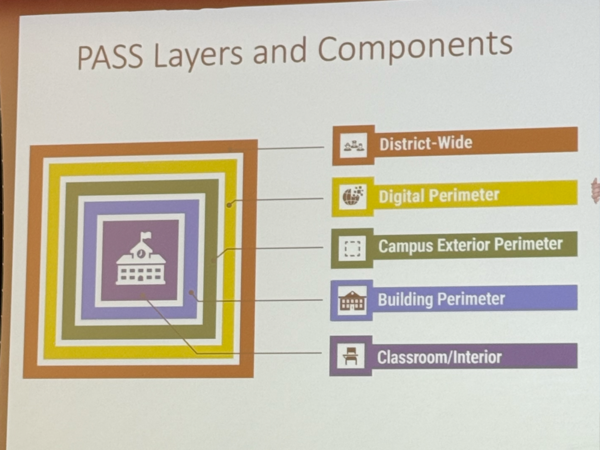
Each guide walked through the PASS guidelines and assessed the school’s systems. They pointed out the differences between Tier 1 and Tier 4. Some of the systems at West Cabarrus were well within Tier 4. Others sat on a spectrum between Tier 1 and Tier 4.
What made this tour valuable was the practical application. It gave people who understood the technology, but not the school safety applications, working knowledge. They could take that knowledge back to their school, organization, or integration firm.
Keynotes on safety
Sessions both days highlighted various areas of safety. Topics ranged from early detection of at-risk students to cybersecurity of the school system. Thursday kicked off with Michele Gay, co-founder of Safe and Sound Schools. Gay relayed her experience as a mother who lost her child in the Sandy Hook shooting.
Gay walked through the day’s events and highlighted areas to address. Yes, these included technical considerations. One aspect involves the ability of young or disabled students to lock doors from inside. This requires door hardware with large, easily adjusted handles. But she also discussed the shooter.
She didn’t name him specifically. Instead, she discussed what people around him could have done in the lead-up to that fateful day. This was more of a warning-sign discussion. The people in that person’s life could reach out, assess warning signs, and get them help.
Shooting avoided
That talk teed up the Friday morning keynote by Molly B. Hudgens. The title of Hudgens’s talk was “Saving Sycamore: The School Shooting that Never Happened.” In 2016, Hudgens was a middle school counselor who talked a student out of going through with a school shooting.
Hudgens had spent almost 20 years researching school shootings and developing red-flag warning systems. That day, her years of preparation faced the ultimate test. She has since written a book about that day. She now talks about how to notice warning signs in troubled students.
PASS and beyond
One thing Gay discussed about Safe and Sound Schools was its various pillars. These include mental health, wellness, community, law and policy, and, of course, safety and security. PASS and the AV industry fit squarely into the safety and security pillar.
Manufacturers have developed advanced systems. From gunshot detection to AI-enabled cameras, these systems go further than anything available even two years ago. But technology is only one piece of the answer. It’s gratifying to see AV play a part in something as meaningful as keeping our kids safe.

Tim Albright is the founder of AVNation and is the driving force behind the AVNation network. He carries the InfoComm CTS, a B.S. from Greenville College and is pursuing an M.S. in Mass Communications from Southern Illinois University at Edwardsville. When not steering the AVNation ship, Tim has spent his career designing systems for churches both large and small, Fortune 500 companies, and education facilities.
- Tim Albright

- Tim Albright

- Tim Albright

- Tim Albright