AI-powered camera features are becoming increasingly common in professional AV, but not every room needs automated tracking. Sony’s latest PTZ cameras take that reality seriously.
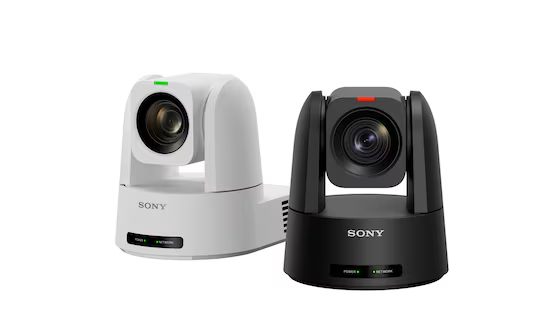
At InfoComm 2026, Sony highlighted the SRG-AS10 and SRG-XS10, two new pan-tilt-zoom (PTZ) cameras that share the same basic imaging and connectivity foundation while targeting different applications. Both feature 10x optical zoom, support 4K60p output, provide HDMI output and IP streaming, and work with several commonly used streaming protocols. The difference is AI: the SRG-AS10 includes built-in AI for auto-framing, while the SRG-XS10 leaves it out.
Watch the conversation here.
For AV teams, that creates a refreshingly practical purchasing decision. Instead of asking whether AI is available, they can ask a more useful question: Does this particular room actually need it?
Why Sony built essentially the same camera twice
The decision to offer AI and non-AI models is intentional. Sony sees plenty of applications where organizations need the camera’s core performance but gain little from automated framing.
“Well, there’s a lot of applications where they don’t need the autoframing. I’ll give you an example. Telemed carts, like you’re not moving. You don’t need to be framed. So why pay the extra for the AI? There’s also situation like it being 10x is going to go well with smaller, like meeting spaces. You’re not following anybody. You got a bunch of people sitting there in a chair. So, there’s a couple of applications. The AI is really for presenter tracking, if you will.” –Drew Buttress, Sony
That example gets directly to the point.
A camera mounted on a telemedicine cart may need dependable 4K video, optical zoom, and network connectivity, but its subject is relatively stationary. Similarly, a smaller meeting room with participants seated around a table may not benefit enough from presenter tracking to justify adding it.
The equation changes in a classroom, training room, presentation space, or other environment where someone regularly moves across the front of the room. That’s where the SRG-AS10’s AI-based auto-framing becomes more relevant.
Rather than forcing the same feature set into every deployment, Sony is effectively giving designers a common camera foundation that can be matched more closely to the room.
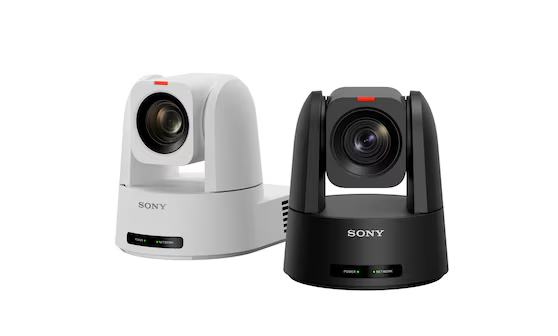
Credit: Sony
4K and streaming stay consistent across both models
Choosing the non-AI SRG-XS10 doesn’t mean stepping down from the core video capabilities of the AI-equipped model.
Both cameras offer 10x optical zoom and 4K60p output. HDMI handles direct 4K output, while IP streaming opens the cameras to network-based workflows. According to Buttress, the cameras support Real-Time Streaming Protocol (RTSP), Real-Time Messaging Protocol Secure (RTMPS), Secure Reliable Transport (SRT), and NDI HX.
That protocol support broadens where the cameras can fit. A corporate meeting room, healthcare deployment, classroom, or production environment can have very different requirements for moving video, even when the underlying camera needs are similar.
The important part for system designers is that those streaming capabilities aren’t dependent on selecting the AI version. Sony keeps the distinction focused primarily on whether automated framing is required.
One network cable can simplify the installation
The cameras also offer two approaches to power. Users can connect a 65-watt USB-C power supply, although Sony does not provide that supply, or use Power over Ethernet Plus Plus (PoE++).
PoE++ can make the physical deployment considerably more flexible because camera locations no longer need to be dictated by convenient access to local power.
But there’s a bigger advantage when network-based video and control enter the equation.
“That is absolutely right. A single home run. And what’s nice is with NDI and with VISCA over IP, I can do power, stream the video out, as well as control the camera.” -Drew Buttress, Sony
For AV teams deploying cameras across multiple rooms, consolidating power, video transport, and control onto the network can reduce some of the infrastructure surrounding each endpoint. It also gives designers more freedom when positioning cameras in spaces where running separate cables would be difficult or expensive.
Sony will offer both cameras in black and white, another small but useful consideration for installations where cameras need to blend into different room designs.
The smarter AI strategy may be knowing when to skip it
Sony’s SRG-AS10 and SRG-XS10 arrive at an interesting moment for professional AV. AI features are rapidly becoming part of cameras, microphones, collaboration systems, and control platforms, but their presence alone doesn’t make an AV system better.
The real question is whether the feature solves a problem in that particular room.
Presenter tracking can be valuable when a lecturer or speaker needs freedom to move without requiring a camera operator. In a telemedicine cart or fixed meeting-room application, the same capability may provide little practical benefit.
Sony’s approach gives buyers the option to make that distinction without giving up the fundamental camera capabilities they need.
For AV and IT teams planning standardized deployments across different room types, that could be the more important story behind these two cameras. AI is available when the application calls for it, but it doesn’t have to become another feature organizations pay for simply because it’s there.
- AVNation Staff
- AVNation Staff
- AVNation Staff

- AVNation Staff