Part of AVNation’s NAB 2026 coverage.
The Audio-Technica stand at the NAB Show this year was telling two different stories. The first was the kind of thing broadcast audio engineers expect from the company: a new stereo microphone with design lineage from the thousands of mics Audio-Technica deployed at the Milan-Cortina 2026 Winter Olympics. The second was the kind of thing those engineers used to ignore. A pair of on-camera shotguns aimed at the solo “run-and-gun” content creators who increasingly do work that, ten years ago, only a broadcast crew did.
The announcements split cleanly along that line. The BP350ST stereo microphone is a tool for the first group. The SG1 and SG1 LE on-camera shotguns are aimed squarely at the second. Audio-Technica is betting that those two audiences are converging, and the lineup is shaped around that bet.
A stereo plant mic with broadcast bones
The BP350ST uses mid-side stereo. MS stereo, in the shorthand most broadcast audio engineers use. The technique combines a forward-facing cardioid microphone, which captures the center of the sound field, with a sideways-facing figure-of-eight microphone, which captures the sides. Circuitry combines them into a conventional left-right stereo signal whose width can be dialed in. MS has been a standard broadcast technique for decades, and it has the useful property of folding down cleanly to mono. A real concern when the same audio feeds a broadcast that some viewers will hear through a phone speaker.
What’s new is the packaging. Audio-Technica is selling the same microphone in two body styles that share a single power-supply module. The module decodes the MS signal to stereo and offers three output options: narrow, wide, or raw MS. Narrow and wide commit to a stereo image at the source; raw MS hands the decoding off to a console or a postproduction environment downstream.
Universal Broadcasting
The first body style, designated UB for “universal broadcasting,” is a compact unit with a magnetic cover designed for hidden placement on a set. A “plant mic,” in the film term Audio-Technica uses for it. The example the company offered was Moto America, the U.S. motorcycle racing series, where a stereo bed of pit-lane ambience is part of how the broadcast feels live. The use case generalizes. Any production trying to give viewers a sense of being somewhere has the same problem: getting clean stereo ambience from a single hidden mic without phasing two separate cardioids together. This is the small but real win.
The second body style, designated UL, mounts on a camera. It swaps the cardioid center capsule for a narrow shotgun while keeping the figure-of-eight side capsule. Because the electronics live in the offboard module rather than in the microphone itself, the camera-mount unit is shorter than a comparable shotgun would otherwise be. Useful for keeping the mic out of the frame on shorter lenses. (The UL designation, Audio-Technica’s representative acknowledged, may be a Japanese-language convention that did not translate.)
For broadcast and live events teams, the BP350ST is straightforwardly interesting. Two specialized body styles sharing a single decoder is the kind of inventory simplification that large operations notice, and the Olympic-scale field testing gives the product real provenance. The competition is well-entrenched, and the BP350ST will have to earn its way against incumbents whose stereo broadcast products have been refined over decades. That fight will play out in trucks and rental houses, not in press briefings.
The corporate-broadcast crossover
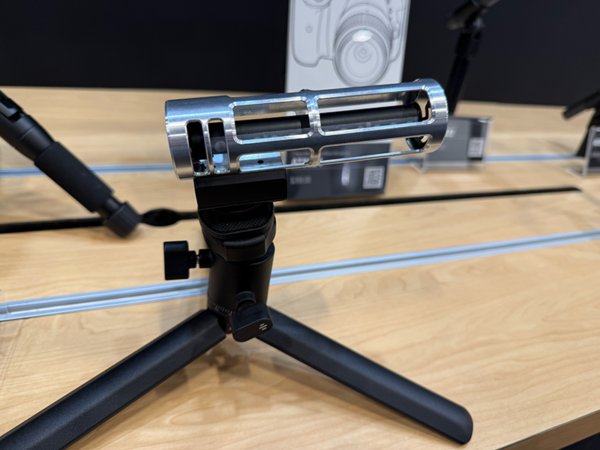
The SG1 and SG1 LE are aimed at a different audience. They’re on-camera shotgun microphones with the now-standard feature set. Internal shock mounting, a low-cut filter, monitoring at the mic itself, plus two design decisions worth a closer look.
The first is the SG1’s accessory shoe and external input. The shoe is sized to mount one of the miniature wireless receivers that have become standard kit for solo video producers; products from RØDE, DJI, and Sony all sit in roughly this form factor. The input routes the shotgun audio to the left channel and the wireless receiver to the right, which gives a producer a boom track and a lav track on a single recorded stereo file. Anyone who has tried to sync separately recorded wireless audio to camera audio in post will recognize the workflow improvement. It isn’t unprecedented. RØDE in particular has been pursuing similar integration logic for years. But Audio-Technica’s execution is clean.
The second is what Audio-Technica calls “safe mode”: a duplicate of the SG1’s signal recorded at -6dB on the right channel as a distortion safety. Field recorders have offered this kind of feature for years; on-camera mics typically have not. It’s most useful when peaks are unpredictable. A concert, a sports event, or a press conference where someone might decide to shout. And the cost of clipping the only track is losing the moment.
The SG1 LE drops both features. It shares the SG1’s capsule, interference tube, and mounting hardware but removes the internal rechargeable lithium-ion battery (drawing power from the camera’s accessory port instead) and strips out the external wireless input and the safety track. Audio-Technica positions it as a substantially cheaper option for producers who want the audio quality without the workflow features.
Corporate Broadcast
For the corporate broadcast use case like executive briefing centers, all-hands video production, and in-house podcast and video studios, the SG1 is the more interesting product. The wireless-input integration matches the workflow most one- and two-person corporate video teams actually run: a camera, a presenter wearing a lavalier, and a need to capture both cleanly without a field mixer or a separate recorder. The SG1 will have to outperform the corporate-video reference shotgun on audio quality, but the design is squarely aimed at this customer.
The LE is harder to place. Corporate teams that don’t need the wireless integration are usually buying further down-market, where products like the RØDE VideoMic NTG sit, and Audio-Technica will need to be aggressive on price to compete. Solo content creators and freelance videographers, who also operate below the SG1’s price point, may find the LE a more natural fit. Pricing for both models has yet to be announced.
What it adds up to
The Audio-Technica NAB 2026 lineup makes a small but clear statement about how the company sees its market. The BP350ST is the kind of product a long-established broadcast manufacturer makes. Refined, conservative in concept, well-engineered, and aimed at customers who have been buying broadcast microphones from Audio-Technica for decades. The SG1 and SG1 LE are an attempt to apply that same engineering posture to a market the company has historically been less central in: the in-house corporate video team, the conference room production cart, and the run-and-gun electronic news gathering (ENG) kit that a single producer takes on the road.
The lineup assumes those audiences are converging. That broadcast-grade engineering increasingly matters to corporate buyers, and that small-form-factor flexibility increasingly matters to broadcast buyers. That assumption is reasonable. An executive all-hands streamed to forty thousand employees is, functionally, a broadcast, and the people running it deal with most of the same problems a network sports producer does. The BP350ST will compete on its sound; the SG1 will compete on its workflow. Both are real fights worth watching.
For now, the announcement worth flagging to readers in both camps is the SG1’s wireless-receiver integration. Broadcast professionals will recognize the workflow. Corporate AV teams should pay attention because, for the first time in this product category, the workflow is being designed for them.
AVNation’s coverage of NAB 2026 is conducted independently.

Tim Albright is the founder of AVNation and is the driving force behind the AVNation network. He carries the InfoComm CTS, a B.S. from Greenville College and is pursuing an M.S. in Mass Communications from Southern Illinois University at Edwardsville. When not steering the AVNation ship, Tim has spent his career designing systems for churches both large and small, Fortune 500 companies, and education facilities.
- Tim Albright

- Tim Albright

- Tim Albright

- Tim Albright