PTZOptics used NAB 2026 to formally release its Horizon control software out of beta and to preview a higher-end broadcast camera planned for later this year — a pair of announcements aimed squarely at the seam between corporate AV production and traditional broadcast.
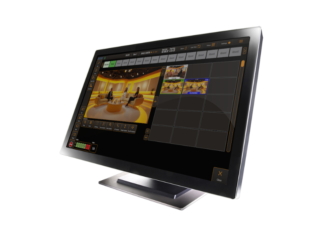
Horizon, which the company has demonstrated in beta across several show cycles, is now standard on all of PTZOptics’ 4K cameras at no additional cost. The release includes a web-based interface that runs on a tablet and gives a single operator broadcast-style control. Things like color management, preset programming, voice tracking, and auto-tracking across multiple pan-tilt-zoom (PTZ) cameras, each addressable on its own tab. A desktop version is on the roadmap, the company said, but no date was given.
Corporate AV Cameras
For corporate AV deployments like lecture halls, large meeting rooms, and houses of worship, a tablet-based, multi-camera control surface lowers the bar for who can run a show. PTZOptics’ pitch is that an operator who is neither a systems integrator nor a broadcast engineer can drive a multi-PTZ production from a tablet in the room. Whether the interface delivers on that in real deployments is the question that matters.
The company also showed a V-mount battery adapter that supplies Power over Ethernet (PoE) to the camera, allowing untethered operation when a fixed PoE drop is impractical. Any standard V-mount battery will work, the company said; runtime varies by broadcast load.
Catch all of AVNation’s NAB 2026 coverage
Zoom Zoom
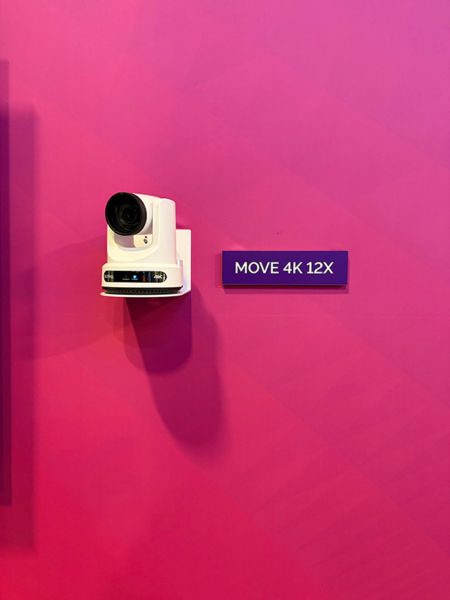
Super Zoom, a feature now available across the PTZ and fixed studio lines, digitally doubles optical reach by cropping into the sensor. On the fixed-camera line, the same mechanism produces a 1080p digital PTZ crop within a 4K frame, effectively delivering a second framing from a single physical camera. Transition speed is programmable through Horizon, which PTZOptics positioned as a deliberate counter to the snap-and-blur character of typical digital zoom. Useful for slower, more cinematic moves in auditoriums and large venues where physical camera positions are limited.
The bigger tease: a dedicated broadcast-grade camera scheduled for full reveal at IBC 2026 in September. PTZOptics declined to share a name, model number, or price, but said the camera will use a 1-inch image sensor and offer multiple SDI outputs. A step up-market from the company’s current lineup, which has historically targeted production companies, the pro AV channel, and entry-level broadcast. If the spec sheet holds, it puts PTZOptics in more direct competition with established broadcast PTZ vendors at the higher end of the category.
Camera AI
The company also signaled a broader push into AI and computer-vision partnerships, framing its cameras as the input layer for downstream automation: environmental controls, occupancy reasoning, and post-production effects driven by what the camera sees. PTZOptics did not name partners and pushed back on what it called “AI washing” elsewhere in the industry. That story is one to watch rather than a shipping product.
The substantive news here is Horizon’s general availability. The broadcast camera is a placeholder until IBC, and the AI work is a positioning statement. For AV teams weighing a 4K PTZ refresh, the more useful question is whether the software now justifies the upgrade. Which is roughly the argument PTZOptics is making.

Tim Albright is the founder of AVNation and is the driving force behind the AVNation network. He carries the InfoComm CTS, a B.S. from Greenville College and is pursuing an M.S. in Mass Communications from Southern Illinois University at Edwardsville. When not steering the AVNation ship, Tim has spent his career designing systems for churches both large and small, Fortune 500 companies, and education facilities.
- Tim Albright

- Tim Albright

- Tim Albright

- Tim Albright