Extron hosted customers at its Las Vegas Experience Center during the week of InfoComm 2026, offering a focused look at where the company is heading across several product lines. And a new Extron Ecofficient initiative. Joe da Silva, Vice President of Marketing at Extron, walked AVNation through recent launches and a sustainability initiative that deserves attention from anyone specifying AV for corporate facilities.
Extron Ecofficient they built themselves
The most significant announcement from the briefing has nothing to do with a specific product. Energy Star, the federal program that provided a recognized sustainability benchmark for electronics, withdrew from the Pro AV market. That exit left manufacturers without a credible, third-party label to point customers toward.
Extron responded by creating its own. The company calls it its Extron Ecofficient initiative. According to da Silva, the program establishes tiered sustainability ratings based on energy consumption and standby behavior. Extron applies those ratings across its product line, giving specifiers a consistent reference point when sustainability is part of a procurement conversation.
Da Silva noted that Extron held one of the strongest Energy Star track records in the Pro AV industry before the program’s exit. The company had more certified products than most of its competitors. That context matters. This is not a company inventing a green label for marketing purposes. It is a company filling a gap left by a program it genuinely supported.
At least one other manufacturer has already inquired about adopting the standard. Whether it grows beyond Extron’s own catalog is an open question. For now, the initiative gives corporate AV and IT buyers a concrete way to evaluate Extron products against sustainability requirements that increasingly show up in enterprise procurement policies.
More USB-C options
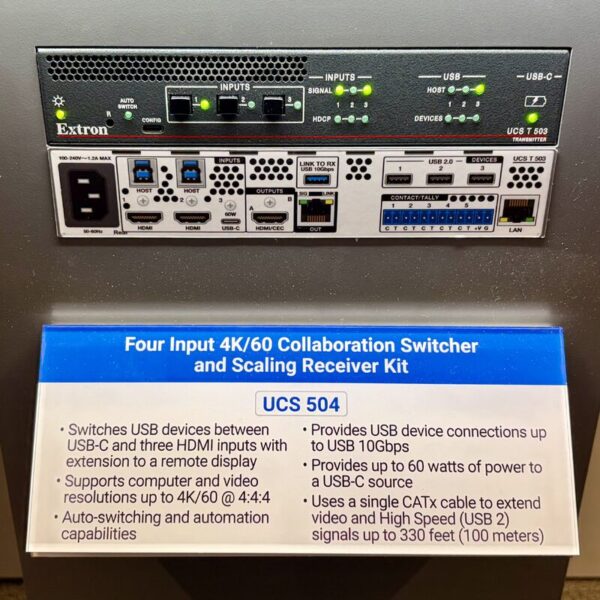
Da Silva was direct about where Extron’s product development is heading. USB is proliferating across product lines.
The clearest example is the new DTP3 switcher. The unit ships in a 4×2 configuration and includes USB-C with a 100-watt power delivery capability. Notably, it also passes data through the USB-C connection, which da Silva said many competing products do not support. For a corporate meeting room with a single cable connection at the table, that distinction matters.
The IN series and DTP3 product lines are also evolving. The updated products carry the same core functionality as their predecessors in smaller, more current form factors.
Touch panels and room scheduling
Extron is now on its fifth-generation TouchLink touch panel line. The updated screens offer improved viewing angles and HTML5 support. An optional adapter module mounts to the back of the panel and adds a control port, digital I/O, and relay connections, effectively turning the display into a standalone control node without requiring a separate processor.
The panels currently support up to HD resolution for video and streamed H.264 content.
The room scheduling panel line follows the same design language. Extron also recently began shipping the SSI 100 System Status Indicator. The engravable backlit acrylic lens of these room occupancy and scheduling indicators can be customized in Extron’s new online configuration software, and the order feeds directly into Extron’s production facility. Extron ships a finished, custom unit in response.A built-in validation layer flags graphics that will not reproduce cleanly on the acrylic surface, preventing production problems before the order ships.
Critically, the SSI 100 and the new TLS 35 Series Scheduling Panels require no server infrastructure and carry no recurring license fees. They connect directly to Exchange or similar calendar systems. That license-free model is increasingly rare and worth calling out explicitly for IT managers who budget for SaaS costs across their AV infrastructure.
The eSports kit as a template
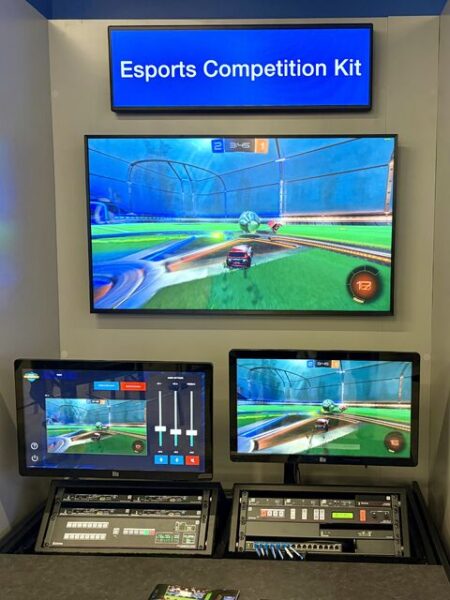
Extron’s Esports Competition Kit arrived in the market as a portable, tournament-ready package. The concept was straightforward: ship everything needed for a five-on-five competition in a single box, with hardware simple enough for a non-technical program administrator to operate.
The market responded in an unexpected direction. Universities are installing the kits permanently in classrooms. Programs beyond Esports, including cybersecurity training and athletics, are finding uses for the same infrastructure. The kit is functioning as a general-purpose AV deployment template as much as a tournament solution.
That outcome is worth noting for corporate buyers. A product designed around simplicity and portability, configured for a specific vertical, is finding traction in adjacent applications. The underlying principle, complete hardware in a manageable package that non-specialists can operate, translates directly to enterprise AV.
What it means for you
Extron continues to innovate. And their history of developing products in-house continues. It has long been known that Extron developed their own power supplies, amplifiers, and video processing. With Extron Ecofficient initiative, they have also crafted their own sustainability metrics. It remains to be seen what the uptake on the program will be.
See all of AVNation’s InfoComm 2026 coverage here.

Tim Albright is the founder of AVNation and is the driving force behind the AVNation network. He carries the InfoComm CTS, a B.S. from Greenville College and is pursuing an M.S. in Mass Communications from Southern Illinois University at Edwardsville. When not steering the AVNation ship, Tim has spent his career designing systems for churches both large and small, Fortune 500 companies, and education facilities.
- Tim Albright

- Tim Albright

- Tim Albright

- Tim Albright