Ross Video had a straightforward problem with its Ultrix platform: customers were running out of room.
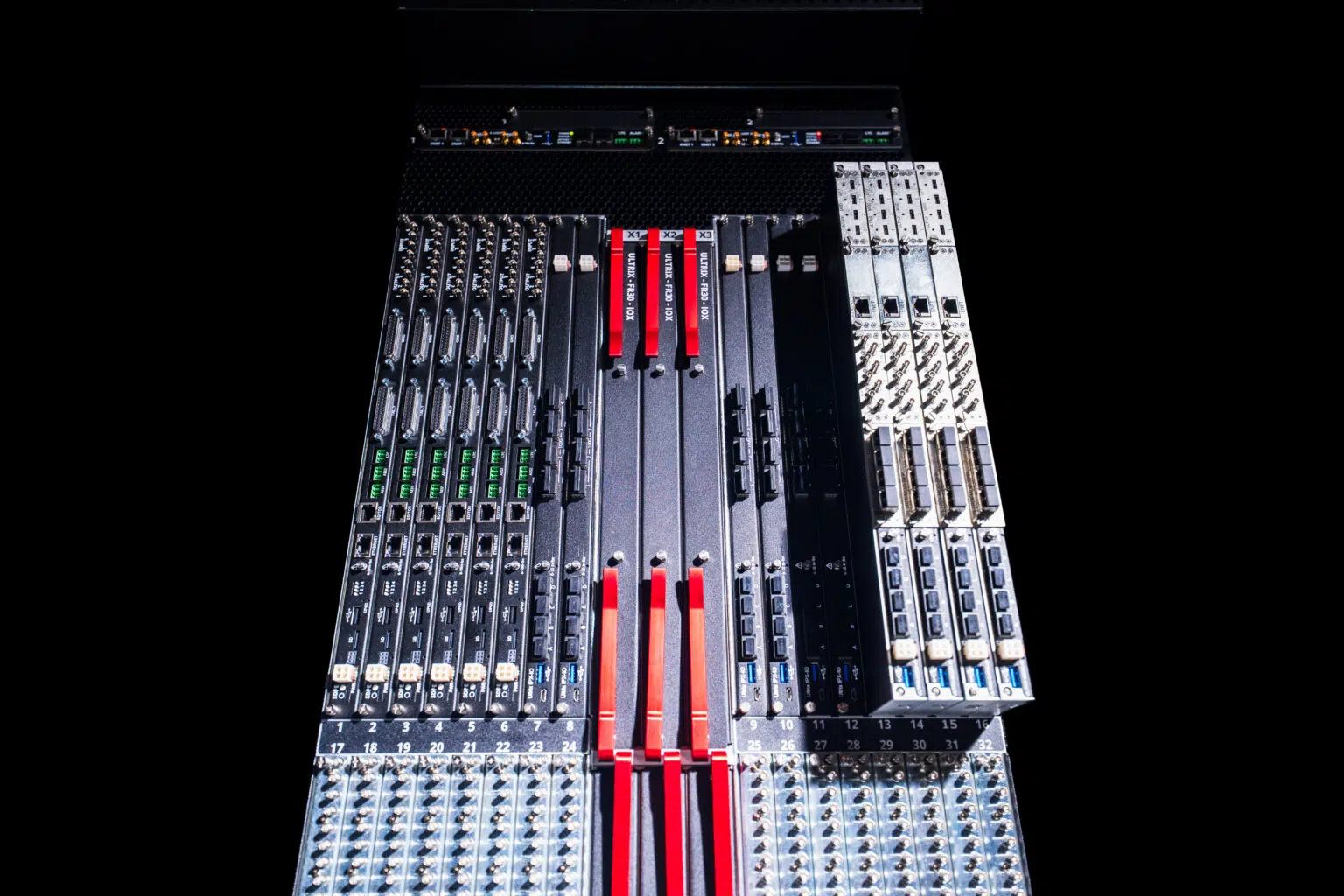
That is a good problem for a manufacturer to have, but it becomes a very real infrastructure challenge for broadcasters, sports venues, production teams, and large media facilities. At IBC 2026, Ross Video answered it with the Ultrix FR30, the company’s largest Ultrix system yet and a significant expansion of its hyperconverged media infrastructure platform.
The reason behind the larger system was surprisingly simple.
“The biggest complaint we had about it is that people were filling it,” said Brian Davies of Ross Video.
That comment gets to the heart of the FR30. This is not simply a bigger chassis for the sake of having a bigger router. Ross is responding to production environments where video, audio, processing, graphics, control, and increasingly complex workflows are converging around centralized infrastructure. Ross video Transcription
When “bigger” actually matters
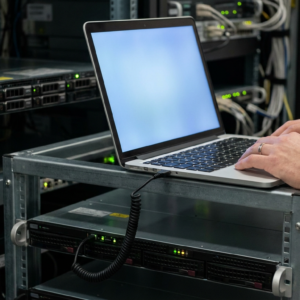
The Ultrix FR30 is a 30RU system that Ross says can support up to 576×576 UHD inputs and outputs in a single chassis. Davies described it more conversationally as capable of “over 500 by 500 video,” alongside thousands of audio sources when Dante and MADI mixes are brought into the equation. IBC Ross video PR
For large production facilities, those numbers matter because scale can quickly become an architectural issue. Adding more sources and destinations traditionally means adding infrastructure around them, which can increase rack space, cabling, operational complexity, and the number of systems teams have to manage.
Ross is taking a different approach with Ultrix. Rather than treating routing as an isolated function, the platform brings multiple production capabilities into a software-defined infrastructure. The FR30 extends that concept into environments that have simply outgrown smaller configurations.
Davies sees it as something that can sit at the heart of a facility.
“I honestly, you can put that in the central part of any facility now, and it’s going to be your central operation for taking all your audio-video needs and distributing them where they need to go.”
That may be the more important story behind the FR30. Capacity is impressive on a specification sheet, but centralized infrastructure becomes valuable when it reduces the number of separate systems required to make a production environment work.
Ross is looking beyond the router
The FR30 was not the only indication at IBC that Ross Video is thinking more broadly about production infrastructure.
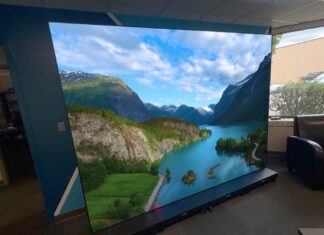
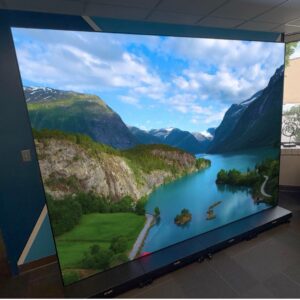
Davies also demonstrated Vertex, the media server technology acquired by Ross and making its IBC debut. Vertex takes the company into applications such as immersive environments and projection mapping, territory that stretches beyond Ross Video’s traditional broadcast roots.
One demonstration recreated an ice-rink projection-mapping application based on an experience at Munich’s SAP Garden. The larger point was not simply the visual effect. Vertex gives Ross another route into experiential environments where media needs to interact with a physical space rather than remain confined to a conventional display or broadcast output.
As Davies explained, that represents new territory for the company.
“It’s something we’ve never been able to sort of get into with that sort of space because we’re traditionally broadcast, but Vertex has sort of bridged that gap.”
That shift should be interesting to AV professionals outside traditional broadcast. Sports facilities, corporate auditoriums, live-event spaces, and immersive installations increasingly borrow tools and workflows from broadcast production. At the same time, broadcast manufacturers are moving into spaces that once sat more squarely within Pro AV.
The lines are getting harder to draw.
Complex production without a 20-person crew
Ross also showed how Ultrix fits alongside its broader production portfolio, including Carbonite production switchers, the TD5 control surface, XPression graphics, and DashBoard control.
The interesting part is not simply that Ross sells all those products. It is how the company is trying to make sophisticated production workflows accessible without requiring every operator to have years of broadcast experience.
Davies used DashBoard as an example. A complex action can be presented to an operator through a straightforward control, a button to put live stock information on a screen, for instance, or another to select a camera.
That becomes particularly relevant as broadcast-style production expands into corporate, education, sports, and other environments where organizations may want higher production values without maintaining a traditional broadcast crew.
As Davies put it, “You don’t need a broadcast crew of 20 to operate this stuff like you might have done traditionally in an OB truck.” With DashBoard, he said, organizations can expose the controls operators actually need rather than the full complexity sitting behind them. Ross video Transcription
The FR30 signals where production infrastructure is heading
It would be easy to look at the Ultrix FR30 and focus entirely on its size. After all, a 30RU chassis capable of handling hundreds of UHD video paths is difficult to ignore.
But the bigger takeaway from Ross Video at IBC 2026 is convergence.
Routing, audio, graphics, production switching, experiential media, and control are increasingly becoming parts of a connected production architecture rather than independent technology islands. At the same time, the people operating those environments are no longer exclusively traditional broadcasters.
The FR30 gives Ross more room at the top end of that transition. Vertex takes the company into new visual experiences. And DashBoard points toward making all that technology manageable for a wider group of operators.
Ross built a bigger Ultrix because customers were filling the old one. What happens inside all that new capacity may ultimately be the more interesting story.
- AVNation Staff
- AVNation Staff

- AVNation Staff
- AVNation Staff