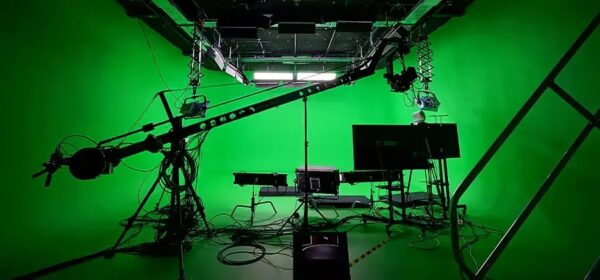
Today’s broadcast video production environments are integrating real-time computing, robotics, and advanced display systems to enable visually creative capabilities that far surpass the traditional “green screen” of chroma key compositing. Camera operators and their subjects are no longer guided solely by written descriptions or strategically placed markers on a monochrome stage. Direct-view LED (DVLED) video wall systems are a key part of this innovative shift, providing expansive surfaces that can display detailed virtual environments visible to actors and optimized for direct camera capture. The supporting software and hardware that power and record this content ensure pixel-perfect accuracy, blurring the line between the virtual and the real.
THE STAGE IS SET
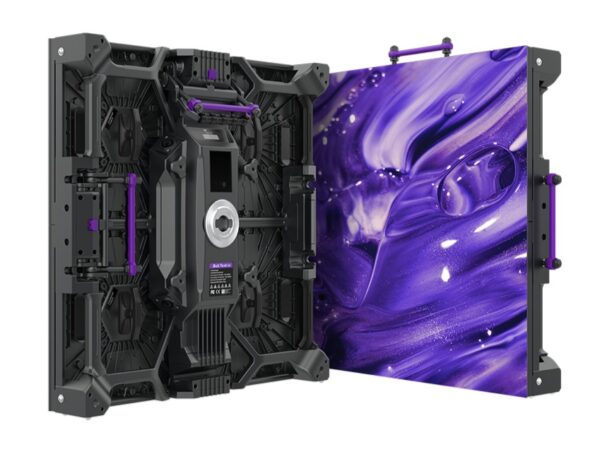
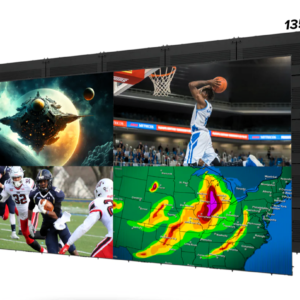
The origins of direct-view LED, as eye-catching digital signage and high-end display systems, stem from its nearly unlimited scalability and durable, high-performance pixels. These features make it an excellent choice for use as a programmable background in an extended reality (XR) studio setup. DVLEDs in these configurations are composed of uniform panels covered with tiny RGB LEDs grouped into larger modules that seamlessly tile to create screens of any size, including flat and curved surfaces. For XR stage applications, DVLED displays feature production-friendly characteristics, including anti-reflective coatings, high pixel densities that minimize moiré, and camera-friendly refresh rates.
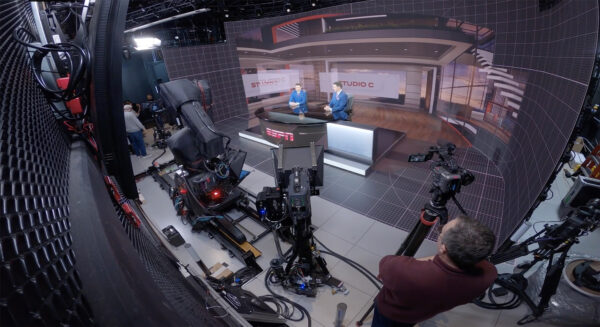
XR stage design isn’t limited to using DVLEDs only as a digital background; floor and ceiling display surfaces are increasingly common, with the former engineered to withstand regular foot traffic. The ESPN Catalyst Stage, located at the company’s headquarters in Bristol, Connecticut, is an example of a dedicated immersive studio that features a wrap-around DVLED display with a floor element. The Catalyst Stage’s “LED volume” comprises approximately 11 million pixels covering a space measuring 30 feet wide, 15 feet tall, and 15 feet deep.
MAKING IT HAPPEN
DVLED’s excellent color reproduction and contrast make it an ideal display technology for XR applications. DVLED can also support high-speed refresh rates of up to 7,680 Hz – roughly 25 times faster than the game mode on the fastest consumer TVs. Precise synchronization of the DVLED’s pixels through a generator lock (genlock) signal, along with supporting software and hardware, is crucial for reducing visual glitches in live multi-camera productions and when integrating 3D rendered graphics created with software like Unreal Engine.
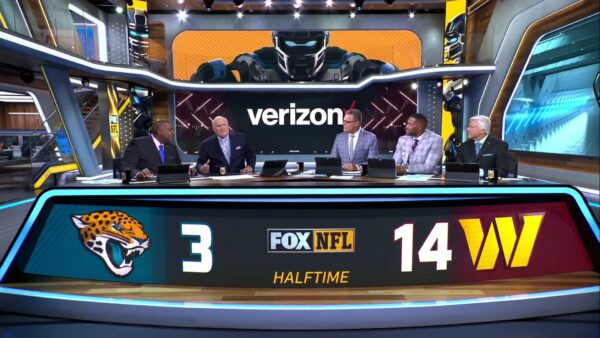
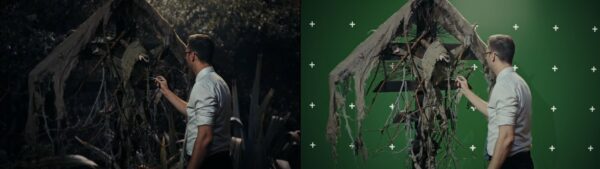
GhostFrame is an example of a software toolset used to create workflows for XR stage productions. The GhostFrame software leverages the high refresh rates made possible by DVLED technology to enable content creators to capture a scene with multiple distinctly unique backgrounds in a single take, including chroma key elements that offer flexible replacement options for post-production. A GhostFrame-generated workflow with the precise timing of genlocked gear can also embed cues and content into the DVLED stage that are visible to performers or camera tracking systems, but will not appear in the captured footage.
In-camera capabilities are keeping pace with the needs of XR studio production. Professional digital cameras, such as the 8K RED V-Raptor [X], offer genlock capabilities and the ability to record multiple tracks (in camera) simultaneously, each with a unique presentation on synchronized DVLED display. The V-Raptor’s global shutter and high-speed sensor also eliminate common motion artifacts when capturing the high dynamic range output of a DVLED video wall.
![RED V-Raptor [X] 8K camera - Image credit: RED Digital Cinema](https://www.avnation.tv/wp-content/uploads/2025/11/07_RED_V-RaptorX_-600x600.jpg)
The ability of a robotic camera to precisely follow motion on an XR stage has made it a crucial addition, enhancing efficiency and consistency in live capture settings. Pro-grade products, such as the Studiobot XL from Mark Roberts Motion Control, can be programmed for triggered automations, automatic tracking of actors or presenters, or operated manually using a joystick and control panel. Multiple robotic cameras working on an XR stage can be individually assigned home positions and safe zones, enhancing production efficiency and preventing collisions with studio equipment.
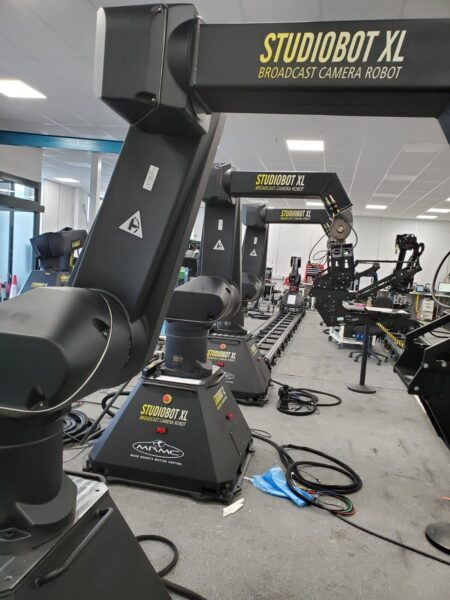
For XR stages that use real-time 3D graphics, the accuracy of genlocked robotic cameras, along with parallax effects, allows for greater visual appeal as camera movements can be synchronized with the display output to improve the 3D effect of a rendered object or text.
An Art Form
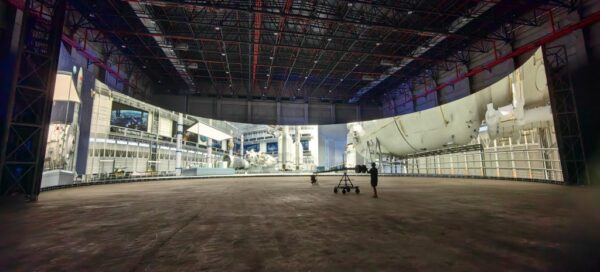
There is a low-key arms race among XR stage developers to build the largest possible spaces. At the Versatile AI Virtual Film Base in Deqing, China, Absen and Versatile Media unveiled a virtual production volume in July 2025, featuring a 270-degree curved screen approximately 50 meters in diameter and 12 meters high. The roughly 1,700 square meters of DVLED display technology surrounding the stage space is equivalent in area to four standard basketball courts. At the time of its announcement, this DVLED display claimed the record for the highest pixel count on a single screen.
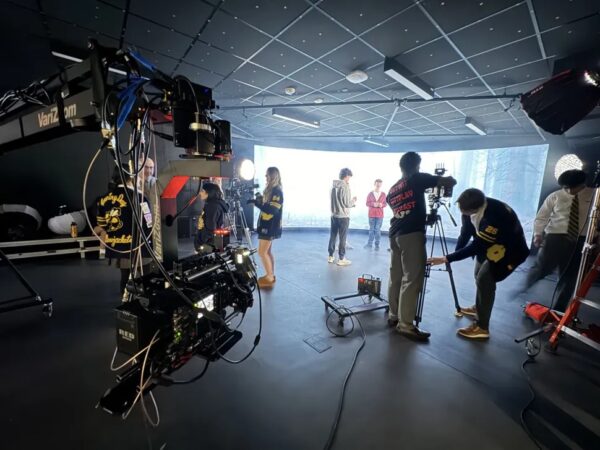
Schools are also incorporating XR stage environments to support the training of the next generation of authors who blend digital media with live-action performances. The Detroit Country Day School partnered with Brompton Technology to create one of the first virtual production studios in a pre-college educational institution. The facility features a 26-foot-wide by 8-foot-tall INFiLED DBmk2 DVLED display configuration, providing a 1.9mm pixel pitch and running at a 4K resolution.
Future Art
Extended reality (XR) in broadcast or film production usually refers to the integration of real sets, DVLED video display surfaces, and 3D graphics, all visible to cameras and participants. XR is also a broad term that covers virtual reality (VR) and augmented reality (AR). The 2025 Venice Film Festival featured a Venice Immersive program that awarded an hour-long, free-roaming VR experience, which combined photogrammetry-captured elements, Gaussian splatting techniques, and actors shot on a chroma key stage, all integrated through custom-designed 3D editing software.

DVLED display use in digitally enhanced productions will continue to grow because it offers flexible efficiency, appreciated by some creative artists and content creators. Other video producers I’ve spoken with prefer using authentic physical set designs for reasons including the interactive realism for actors, established workflows, and cost savings. The XR stage combines some of my favorite technologies, including brilliant pixels, video processing, and robotics. However, traditional techniques such as custom set building and green screen use remain valuable tools in the visual artist’s toolkit.

Robert is a technologist with over 20 years of experience testing and evaluating consumer electronics devices, primarily focusing on commercial and home theater equipment.
Robert's expertise as an audio-visual professional derives from testing and reviewing hundreds of related products, managing a successful AV test lab, and maintaining continuous education and certifications through organizations such as CEDIA, the Imaging Science Foundation (ISF), and THX.
More recently, Robert has specialized in analyzing audio and video display systems, offering comprehensive feedback, and implementing corrective measures per industry standards. He aims to deliver an experience that reflects the artists' intent and provides coworkers and the public with clear, insightful product information.
- Robert Heron
- Robert Heron
- Robert Heron

- Robert Heron