Category: Features

  • Life after the death of the matrix

    Futurecasting video distribution

    In the grand history of the AV community, several have come along and cried the end of this or that technology. 3D, 5 wire cabling, plasma displays. And now, the matrix switch.
    Justin Kennington from the SDVoE Alliance has declared the “Death of the Matrix Switch”. He says. “ our industry stands at the precipitous of a new transition” from distributing data using matrix switches to advanced AV over IP solutions. He also calls out the commercial AV integration space as “something of a holdout” in the broader community when it comes to embracing AV over IP.
    What does that mean? It means that those lovely old boxes we used to connect gazintas and gazoutas together are going away. But, I want to disagree with Justin slightly. With all due respect, the matrix switch is not dead. It has simply moved on.
    Moved on is one of several euphemisms for death and dying but with the assumption that the person is not gone completely but they have simply moved to a new reality, an afterlife if you will. Today we will talk about the afterlife of the matrix.

    And in this context, the afterlife or heaven has a name you are familiar with; the cloud. The cloud is where the matrix went to die. It is the matrix version of “All Dogs go to Heaven”.
    We still need to send gazintas to the gazoutas. But how do we do that in this new paradigm? The network. The network is the new network.
    This can be anything from a cloud application that routes the desired signal to the output. In education, where my background lies, we would install hundreds of wallplates with RGBHV in either 5 wire or VGA connection, HDMI, and display port connections. These would be wired back to the old matrix. But it’s gone.
    Now, the connection is what we used to call a “network jack”. An RJ45. But, how. Several different ways. This can be done with a special encoder, and SDVoE manufacturer for example, that encodes the video signal into bits and bytes. These are then sent through the network, or cloud, to a receiver. This can be a stand-alone device or embedded decoder in a display. From there the information is decoded and you see a picture.
    But, it doesn’t have to be. There is software now that allows you to encode the computer display and stream it from the source. Now, this is currently only available in certain computers but it could be, in theory, deployed to sources; BluRay players, document cameras, and wireless connectivity.
    Now the video is in the cloud in 1s and 0s. Floating in the ether. Right above you. Let’s get it off the “information superhighway”. Well, a private highway.
    The signals travel through the switches and down another pathway to the displays. From here we have a couple of options. In an SDVoE system that currently means landing in a decoder made by the manufacturer and from there to a display. That means a video wall, projector, or display. I said currently. Imagine if you will a projector or display with nothing more than an RJ45 jack in the back to put it on the same network. But that isn’t possible. Is it? Of course, it is. For years manufacturers have embedded the ability to decode streaming signals from sources streaming or directly from a mobile device or laptop. It would be relatively simple for an SDVoE member to create this technology. If only SDVoE had a member that created displays. You know, like Christie and Sony just to name two.
    But, you may say, that’s a point of failure. I can’t troubleshoot that. Actually, no. This design is actually fewer points of failure. Let’s talk about the legacy design of a video distribution system.
    You have a source. Let’s say it’s a PC at the podium in one of your lecture halls. From the PC you plug in an HDMI cable and plug that into the wall. You aren’t field terminating that wall plate but either plugging in another HDMI cable or the wall plate is a transmitter for transmitting the signal over twisted pair.
    This goes up to a physical matrix by either the twisted pair or the HDMI. From there, there are internal switches that happen and put the video onto another HDMI or twisted pair cable. From there it goes to the projector to a receiver. In the receiver, it is plugged into the projector. That’s 5 or 6 points of failure for you to troubleshoot. In this new design, there are two. PC to network, network to display.
    So, you’re ready now to go out and rip out all of your old matrix boxes and throw them in the trash. I mean, recycle them. Let’s not do that.
    This may be simplistic but replace as you refresh. When I was a technology manager we had a refresh cycle of 7 years. That meant every seven years a system got overhauled in our 200 plus spaces. Don’t run home and rip out all of your physical matrixes. However, as you refresh those systems that require newer technology, assess whether it makes sense to replace those old matrix systems. The signals being passed over the network has matured to the point where both the manufacturers and integrators are able to successfully manufacture and deploy video over the network, completely bypassing the physical matrix. It isn’t the future, it’s now.
  • Millennium Sounds Makes Tech Stand Out in New Control4 Certified Showroom

    Another Control4 Certified Experience

    The goal of most custom integrators is to blend smart home technology into a client’s residential décor as seamlessly as possible. While this approach usually works out great inside a home, it can be a little less successful within a company’s showroom where clients may prefer to see what exactly they are getting for their money.

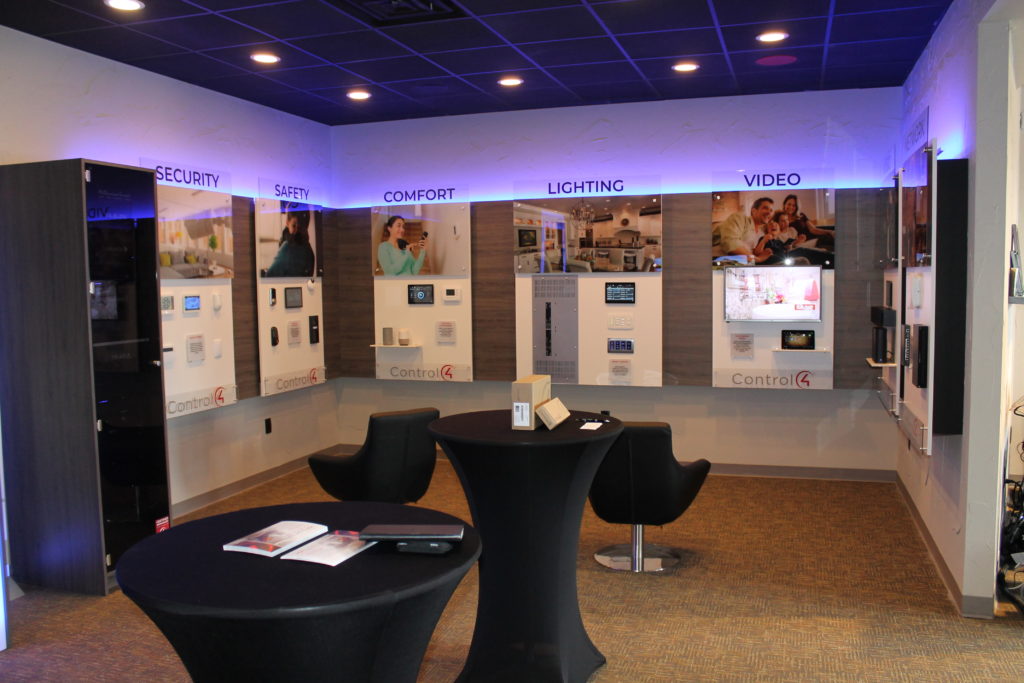
    The Control4-centric area of the Millennium Sounds showroom in Indianapolis.

    Millennium Sounds initially took the more typical “blended in” approach with the technology in its showroom, which is prominently located along a busy retail corridor on the north side of Indianapolis. But, thanks to support from Control4’s exclusive Certified Showrooms program, the integration company recently renovated to a more forward-facing style, where Control4 equipment and its various affiliated brands are presented in multiple on-wall kiosks, under familiar categories like “Lighting,” “Music,” “Networking,” and “Security.”
    Millennium was one of only 150 Control4 dealers worldwide to be chosen to demonstrate its professionally installed smart home expertise in this fashion. These exclusive showrooms were promoted heavily leading up to #C4Yourself Day, May 31, 2018, when grand-opening event in five countries and 25 markets, attracted potential new customers for ribbon cuttings, local celebrities, live music, prizes, and interactive demonstrations of Control4 Smart Home experiences.
    Millennium Sounds owners Matt Reeve (left) and Bill Lehman

    At Millennium’s Indianapolis showroom, co-owners Bill Lehman and Matt Reeve walked guests and potential clients through their new Control4-certified space, explaining the potential of Control4 in their smart home installations. “We’ve sectioned everything out,” Lehman explained of his company’s demonstration space. “Before, we had everything integrated in, so it kind of disappeared. But, people were like, ‘I don’t get it; I don’t see anything.’ That was kind of the point, but, it was hard for people to understand what they were getting. Control4 gave us the guidelines for our certified showroom, which involved sectioning everything out.”
    The company turned to a local fabricator to build the custom kiosks, acquiring the appropriate artwork and photos to bring the technology categories to life.
    A tour around the room is meant to start with the “Networking” stand, as it represents the backbone of any system. Within that display, Millennium showcases a Pakedge router, switcher, and access point. In the “Music” section, the company offers a Triad One and a Triad custom soundbar, which was custom built specifically for the relatively narrow width of the display. Millennium also showcases the Triad One’s compatibility with TuneIn, Tidal, Napster, Deezer, and Pandora on a 10-inch portable controller. Under “Video Distribution,” Millennium sends content to a TV within the display itself and also to three other TVs set up in an adjoining family room showcase. These models include a Samsung Frame TV (with Triad custom soundbar and sub), a 75-inch LED TV, and a Seura mirror TV. Sources include Netflix, Apple TV, Vudu, and cable.
    Under the “Lighting” display, Millennium shows what people can expect from panelized lighting, where low-voltage wires out to the home’s various lighting control keypads converge in a central location. Clients can see how custom buttons on a dimmer switch can be programmed and engraved to simplify the user interface experience; a Help button triggers panic lights and a recorded voice for older clients in need, for instance, and traditional Dinner and Party modes provide corresponding dimming levels.
    Control4 thermostats with Google and Amazon integration are located under the “Comfort” category and a camera, door station, and door locks are displayed under the “Security” heading. “In this display, the door station is going to ring all of the touchscreens and then you can answer and view the cameras,” Leyman explained during a tour. “The big advantage of a Control4 touchscreen versus an iPad or tablet is that you can intercom back and forth or you can pick which room that you want to page.”
    The company differentiates “Safety” from “Security,” with “Safety” explaining how door locks can send emails or texts with assigned codes to specific people. “Security,” on the other hand, shows how Millennium integrates a DSC alarm system to arm and disarm the system with a Control4 touchscreen. All of Control4’s available sensors are also on display in the Security kiosk.
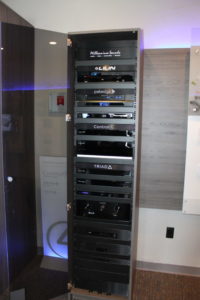
    Millennium went even further in its showroom setup by displaying the system’s rack out front in the showroom, with the various manufacturer brands engraved with nameplates to clarify what brands are in the stack. Above, Triad speakers are blended into a black drop-tile ceiling with matching grilles, and a couple of Ferrari red-colored models are also included to show how Triad will custom paint anything.


    Although Millennium procured a local fabricator for the Certified Showroom’s display vignettes, Control4 rep Adam Gold pointed out that Control4 was willing to help supply those resources, alternatively, depending on the specific needs of their chosen dealers.
    “There are different types of showrooms—storyboard showrooms, like this one, and immersive showrooms, where you’re in a large room ‘living’ with everything,” Gold said during #C4Yourself Day. “In my opinion, this tells the best story—the full flavor of what they can do in their own home. The majority of dealers did something similar, just depending on the size of their showroom, and how much room they had to dedicate to it.”
    Gold also pointed out that while other manufacturers might have an experience center in one location in a major market, the Certified Showroom approach enables Control4 to have experience centers in hundreds of locations around the world, providing much more exposure for its dealers. Control4’s marketing campaign to end users is meant to create awareness of home automation and provide its dealers with leads for their investment. There’s a specific microsite that has Certified Showrooms listed and it has a prominent location on the Control4 website.
    “It’s a significant investment by our dealers that we certainly appreciate,” Gold said. “It’s great for us; it’s great for our dealers. The bottom line is when their customers come in, it helps them tell a story in a certain way.”
     

  • Why I’m Proud to Be a Women in AV!

    WAVE founder, Jennifer Willard, reflects on InfoComm 2018

    By Jennifer H. Willard, founder of Women in AV
    I was equal parts excited and anxious heading to InfoComm18 to see the progress our AV industry’s made on the inclusion of more professional women in our workforces, leadership roles, and decision-making on the future direction of AV.
    There was every reason to be optimistic as days before the show, AV Technology Europe published their June news edition here, and for the first time in AV history, they dedicated 11-pages to “Shining a Light on Diversity in AV” and the challenges facing females in a male-dominated tech industry. I can’t recall anything receiving that much attention and a huge testament to the many industry leaders striving to make AV an industry where women feel respected, welcome, and encouraged to pursue their career goals and dreams.
    And, I’m ecstatic to say IC18 only got better from there! Certainly, no one’s claiming females’ representing less than 20% a victory. But, the transformation in attitude and efforts to offer women and young girls opportunities to advance, be trained, and achieve success was as undeniable as it’s energizing and here to stay.
    While there were countless examples of positive and inspiring growth for Women in AV at IC18, these three key areas stood out for me.
     

    1. More Professionals, Less Eye Candy.

    When I founded Women in AV in 2011, the show floor was a much different place for professional females.  We were still celebrating the Best of Booth Babes slideshows and provocatively dressed women still outnumbered those of us there as AV Pros. Not only did it take almost a complete tour this year to find a booth with videos of women draped over sports cars, but, Conference Technologies (CTI) even found manufacturers like LifeSize flipping the entire script brilliantly to include Booth Dudes! Check out CTI’s Women in AV adorable meme here
     

    Booth guys at InfoComm 2018
    This was InfoComm 2018

    InfoComm 2010
    This was InfoComm 2010


    More importantly, there’s a visible increase in the number of female AV Pros at the show, both representing their companies and walking the floor as attendees! Without question, professional females outnumbered any signs of Booth Babes, and that’s something we all can be extremely proud to be part of making possible.
     

    1. Incredible Support from Men and Internationally.

     
    Men in the AV Industry have always played a crucial and direct role in the success of Women in AV, be it as our mentors, sponsors, and biggest supporters from the very beginning. Throughout our seven years, men such as Tim Albright, founder of AV Nation TV and Chuck Wilson, Executive Director of NSCA, have championed our success by generously offering WAVE much-needed resources, tools, and platforms to make our voices heard and push for recognizing the presence and contributions of female AV professionals here in the US.
    Across the pond, UK’s Kevin McLoughlin of 1 Wimpole St. , has similarly supported founding WAVE member Abigail Brown of Openingz, to grow our London WAVE Chapter to over 200 members itself who with other UK/EMEA leaders host bi-monthly events for the past four years. And, they’re just getting started!
    I was thrilled meeting Kevin and Owen Ellis, of AV User Group, at InfoComm18 to discuss how our two organizations share similar strategic missions for our members and explore ways to collaborate in the future in support of each other.  Ellis said it best on how they want to support professional women in the AV Industry stating, “We want to Bring More Women, Keep More Women, and Help More Women.”


    Jennifer Willard and Kevin McLoughlin
    Jennifer Willard and Kevin McLoughlin at InfoComm 2018

     
    And, they are indeed. McLoughlin’s 1 Wimpole St. with sponsor StarLeaf will host the 1st of its kind Women in AV Summer Spectacular with an all-female panel of AV owner/end-users in London on July 26th, 2018.  You can register to attend here and stay tuned for details on how to watch the event live-streamed from anywhere in the world!
     

    1. Talk of Governance and Policy.

    Perhaps, the best part of IC18 was at the very end when I saw a Twitter post from the phenomenal Women in AV, Dawn Meade, Senior AV Solutions Architect with Northrop Grumman. So much momentum for moving women forward has come from the amazing AV professionals in our industry, and, this was no exception.
    She shared,
     

    Dawn Tweet
    Dawn Tweets Jamais Sans Elles


    JamaisSansElles is French for “Never Without Her” and represents a collective of 100+ French professionals committed to not participating on a panel discussion without at least one female. What I love about this and Meade’s post is both represent a ground-up, grassroots effort of dedicated experts (men and women) using their voice and station to promote diversity on their terms, in their everyday lives.
    They’re not asking for anyone’s permission or a policy to be written in order to make progress real. They’re creating change themselves—by their example on how to, individually and collectively, foster a future with greater gender equality.
    Our road ahead is still long to see a world reflected back at us of equal numbers, treatment, and opportunity for everyone with a dream to be successful in the career or path of their choice.
    However, reflecting on how far the AV Industry’s come in just seven years through the incredible support and yeoman’s efforts of men and women who are as Gandhi says, being the change we want to see, fills me with hope we’re going in the right direction to leave the future of AV a much better place than the one we came from. That, alone, should make us all feel proud of and confident in how many more incredible things we’ve yet to accomplish together for Women in AV!!
    Join us at www.womeninav.com  | LinkedIn Women in AV Group and follow us on Twitter at @WomeninAV | Facebook at Women in AV!


  • PSNI Supersummit 18: Young AV

    Listening to the upcoming generation

    At PSNI’s Supersummit 2018 Kirsten Nelson sat down with a group of young AV professionals at 2018’s PSNI SuperSummit. They talked company culture, incentives, and the generation behind them. What support to this generation looks like, the importance of culture in the workplace, and how the future of AV will look with them at the helm.

  • PSNI Supersummit 18: Tech Roadmap

    Looking ahead to the future of ProAV

    At PSNI’s Supersummit 2018 AVNation’s Tim Albright sat down with audiovisual leaders in manufacturing and integration. They discuss the future of voice control and ProAV on the network. They also talk about how mergers and acquisitions will continue to define and evolve the audiovisual industry.

  • Kramer talks AV Network, InfoComm 2018

    New Kramer US CEO on network AV

    At InfoComm 2018 George Tucker talked with Clint Hoffman about Kramers continuing push in an audiovisual network. Kramer Control is evolving, their new DSP product is network based, and the company is developing SDVoE products to send AV signals over the 10 gig network.
    To watch the rest of AVNation’s InfoComm 2018 coverage click here.

  • PSNI Supersummit 18: End User

    Getting what customers want from the source

    During PSNI’s Supersummit in February 2018 Kirsten Nelson sat down with a group of end users. This group spans from corporate to education They discuss the biggest pain points these end users have, what they wish audiovisual integrators knew about their job, and where the IT department lives in the decision making process.

  • Three of Nine

    Continuing the conversation with SCN’s The Nine

    SCN’s The Nine celebrates nine of the brightest up and coming audiovisual professionals. We began the conversation with two of the nine. On this episode, we talk with three of SCN’s the Nine about furthering the audiovisual industry, working across generations, and the biggest influences on their ProAV careers.
    To watch our interview with the rest of The Nine click here.

  • Day One. My First InfoComm: Confessions of an End-User

    DAY 1
    OK, so maybe not entirely a full Day 1. This is that special day with content before the Exhibit Halls open. My first role on-site is setting up for AVNation. Despite these responsibilities I was able to sneak off and attend the Newcomer’s Orientation where I learned about Avixa, upcoming programing, cool swag and, of course, the fancy Opening Night Party.
    A definite highlight of my day was noticing the walls of the women’s restroom vibrate from the audio demo rooms. It was like having the coolest sound system in my living room. I met the guys from KV2 Audio in room N210. They cranked the music and I was immersed in the sound. It was the most satisfying beat drop, feeling the bass in my chest. Intense, fun and reminds me of concerts in my 20s.
    The exhibit hall opens tomorrow, and I have to admit I’m pretty excited. The previews I’ve seen online show some very cool, shiny, innovative products. The new Integrated Life Pavilion is completely targeted at me. This area of the show floor features products like Virtual Reality, Internet of Things, Artificial Intelligence, and others. These are products and experiences I’ve included or looked at including in my event designs.
    And tonight, we party. I expect to see some amazing audio and visual experiences…in party form.
    Tomorrow, Day 2: The Hall Opens

  • SCN The Nine Part 1

    Talking with two of The Nine

    Each year SCN puts together a list of up and coming audiovisual professionals. The SCN The Nine is that list created by the magazine and celebrates ProAV’s brightest young professionals. This year AVNation is sitting down with a number of these AV professionals to find out their views on where the industry is headed, what got them into the industry, and advice for the generation behind them.
    On this episode, we talk with Alesia Hendley and Luke Jordan.