When I first unpacked Sennheiser’s TeamConnect Bar S, I expected another compact soundbar aimed at small-to-medium rooms. What I found instead was a deceptively capable, enterprise-ready system that feels every bit like a Sennheiser product. It’s a clean design with exceptional audio and a focus on reliability over flash. The price is typically $1,299 MSRP. To celebrate their 80th anniversary, the company is making the TeamConnect Bar S only $699 MSRP until the end of 2025.
Setup and Design
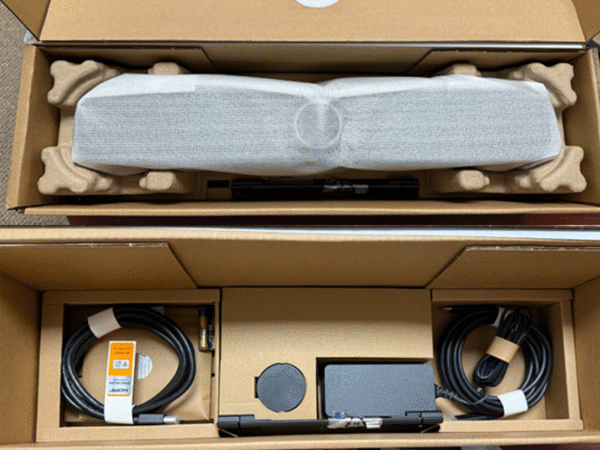
Sennheiser’s engineers clearly thought about the IT teams who have to deploy these in bulk. Setup is refreshingly straightforward: a single power cable, USB-C, and an HDMI out if you’re tying it to a display. PoE + is supported, and the whole bar can be mounted above or below the display with standard brackets. It’s plug-and-play friendly but doesn’t skimp on enterprise control.
The unit itself feels solid, a bit heavy, and well-built. It’s about as wide as a 55-inch display and has that understated Sennheiser industrial aesthetic: functional without trying to be a design statement.
Audio Performance
If you’ve spent any time with Sennheiser’s ceiling microphones, you know their pedigree in audio capture. That same DNA shows up here. The TeamConnect Bar S uses beamforming mics that automatically adjust pickup patterns, keeping voices clear while minimizing HVAC noise and room echo.
On playback, the speakers are tuned for voice intelligibility first, not cinema-style bass. That’s a good thing in the UC world. Voices sound natural and consistent across Teams, Zoom, and Webex calls. Even in a 15-by-20-foot conference room, the Bar S held its own without distortion or drop-off.
Camera and Video
The integrated camera is a pleasant surprise. At 4K resolution with 120-degree field of view, it captures everyone at the table without fisheye distortion. Framing is fast and fairly intelligent. It doesn’t over-correct or whip from speaker to speaker like some competitors. In testing, the auto-framing logic felt natural, staying wide during group discussions and tightening only when a single participant took the floor.
Control and Integration

Sennheiser’s Control Cockpit platform gives IT admins a full dashboard view across multiple rooms: firmware updates, device status, and mic level adjustments, all from a browser interface. That level of visibility makes it easier to deploy hundreds of units without sending techs room-to-room. In today’s enterprise UC environments this is standard and expected. Sennheiser meets that expectation.
The Bar S also supports third-party control systems via API, which means integration with Crestron, Extron, or Q-SYS is straightforward. For enterprises standardizing across multiple collaboration platforms, that flexibility is worth its weight in gold. Though I did not test this connection, it appears those that have did so with little issues.
Everyday Use
From a user standpoint, this is plug-in and go. Connect a laptop via USB-C and it’s recognized immediately. The experience is consistent, predictable, and quiet, exactly what you want in a meeting space. There’s no need for additional microphones or DSP; the Bar S was clearly tuned to be a complete package for small rooms.
Sennheiser isn’t trying to win the low-cost BYOD market with this one. It’s aimed at organizations that value long-term reliability and centralized management. The TeamConnect Bar S makes the most sense in huddle spaces, small conference rooms, or hybrid setups where consistency and ease of deployment matter more than flashy features.
Sennheiser TeamConnect Bar S Review
The TeamConnect Bar S is a reminder that Sennheiser knows how to balance engineering precision with practical deployment. It’s not trying to reinvent the category. It’s just doing it better than most of the competitors in this space. For enterprises looking for a BYOD-friendly, IT-manageable conferencing solution, this one deserves serious consideration.

Tim Albright is the founder of AVNation and is the driving force behind the AVNation network. He carries the InfoComm CTS, a B.S. from Greenville College and is pursuing an M.S. in Mass Communications from Southern Illinois University at Edwardsville. When not steering the AVNation ship, Tim has spent his career designing systems for churches both large and small, Fortune 500 companies, and education facilities.
- Tim Albright

- Tim Albright

- Tim Albright

- Tim Albright