A hybrid indoor/outdoor PTZ, a broadcast camera with software virtual camera capabilities, and a $1,495 controller that retrofits AI tracking onto cameras you already own.
Bolin Technology arrived at NAB 2026 with three new products and a clean story to tell. The company, celebrating its 10th year as a brand, has spent the past two years letting its existing lines mature. Now it is pushing forward. The announcements span two distinct audiences: corporate AV teams building broadcast-quality internal production environments, and traditional broadcasters looking to expand what a PTZ can do on a real production.
Here is what Bolin showed, what each product actually does, and what decision-makers in both camps should take away.
The Range: One Camera for Indoor and Outdoor
The first product is called the Range. The problem it solves is simple. If you run a rental house, a multi-campus facility, or any operation with both indoor and outdoor camera needs, you have historically maintained two different camera inventories. Indoor cameras blend into architectural environments but cannot survive rain or extreme temperatures. Outdoor cameras handle the elements but look industrial mounted in a boardroom or church.
The Range closes that gap. It carries an IP65 environmental rating, which means it handles rain, dust, and temperatures from -40 to 150 degrees Fahrenheit. It looks like an indoor camera. According to Bolin, it also has a rain wiper built directly onto the lens to clear moisture without manual intervention.
The core specs are competitive. The Range shoots 4K at 60 frames per second with a 25x optical zoom. It includes a roll axis, which lets you rotate the image block up to 270 degrees. That matters when a camera mounts at an angle or when a director wants a Dutch tilt without repositioning the entire unit.
On the connectivity side, the Range covers the full range of IP protocols: NDI, RTSP, RTMP, and SRT. It also outputs 12G-SDI and HDMI independently of the IP stream. And it supports UVC, meaning you can run a USB cable directly to a laptop and use it as a webcam-style source without any additional hardware. That last feature is straightforward and useful for pop-up production environments.
Local recording to a microSD card is also built in.
The speed claim worth noting: Bolin says the Range moves at 300 degrees per second, which the company describes as the fastest pan speed in the industry. We have not independently verified that claim against current competitor specs, but if it holds up, it makes the Range a credible option for live sports coverage where tracking fast movement is the primary challenge.
For corporate broadcast teams: The Range addresses a real operational headache. A campus environment with an outdoor amphitheater, a covered loading dock event space, and a traditional conference room can now run a single camera model across all three. That simplifies spares inventory, operator training, and integration configuration.
For traditional broadcasters: IP65-rated PTZs already exist, but they tend to look like security cameras. The Range’s form factor is notable because it can sit at a presenter’s eye level in a studio setting without looking out of place, then move outside for a satellite location. The pan speed, if verified, extends its usefulness into sports applications.
Pricing for the Range was not disclosed at NAB.
Catch all of AVNation’s NAB 2026 coverage
The R9-L420: A Broadcast PTZ That Acts Like Two Cameras
The second product is the R9-L420. This is a purpose-built broadcast PTZ mounted on a studio tripod. It targets live production environments where picture quality and operational reliability are non-negotiable.
The sensor is a 1-inch chip shooting 4K at 60 frames per second with 20x optical zoom. Those numbers are solid for a PTZ at this level. But the two features that distinguish it from a standard broadcast PTZ are autofocus and its dual-SDI architecture.
Autofocus
Most PTZ cameras use contrast-detection autofocus. It works, but it hunts, especially in low-contrast scenes or when a subject moves quickly across the frame. The R9-L420 adds phase-detection autofocus (PDAF) and face-detection autofocus on top of contrast detection. PDAF is the same technology that made mirrorless cameras so much faster to lock focus than DSLRs. It measures the phase difference of incoming light to calculate focus distance directly, rather than searching for peak contrast. The result is faster acquisition and more reliable tracking on moving subjects.
For a PTZ camera, that is a meaningful upgrade. Focus reliability is one of the primary reasons broadcast directors hesitate to use PTZs in high-stakes production.
Dual SDI With Crop Regions
The R9-L420 has two independent 12G-SDI outputs. The first carries the main wide shot. The second output lets operators define three crop regions within the frame. You set the crop zones in advance, and then you select which one you want to output.
In practice, this means one camera at the front of a stage can deliver a wide establishing shot on SDI-1 while SDI-2 cycles through tight shots of three different presenters. The operator switches between crop zones rather than calling a second or third camera. You get multiple virtual camera angles from a single physical unit.
For corporate broadcast teams: This is the more important product for in-house broadcast operations. A company running an all-hands meeting, a town hall, or a leadership address can dramatically reduce its camera count without reducing its production value. Fewer cameras mean fewer operators, less rigging, and a simpler signal chain. The PDAF and face-detection autofocus means that reduction in camera count does not come at the cost of the focus reliability your executives will notice on screen.
For traditional broadcasters: The dual-SDI crop architecture gives a TD a software virtual camera that requires no additional processing hardware. Genlock and timecode support make the R9-L420 a clean integration into an existing broadcast plant. The 1-inch sensor and 4K60 put it in a class where it can hold its own beside manned cameras in a multi-camera production.
The R9-L420 also records locally to SSD and includes a built-in display for settings and live preview. Pricing was not disclosed at NAB.
The KBD Plus: A $1,495 Controller That Gives Old Cameras New Tricks
The third product is the KBD Plus, and it is the one most likely to move quickly off shelves.
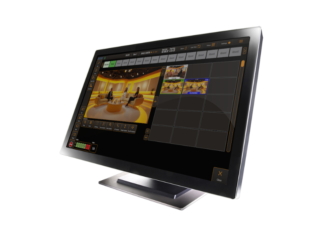
At $1,495, the KBD Plus is an all-in-one PTZ controller built around a touchscreen that decodes up to four IP camera feeds simultaneously. Operators can view all four in a quad split or switch to a full-screen view of any single camera by touching it. Control follows: touch the camera you want to drive, and the joystick controls that unit. HDMI and USB outputs let the controller serve as a decoder, feeding a monitor or a computer directly.
The KBD Plus also functions as a quasi-switcher. As you select which camera to control, the output follows your selection. It also records to an onboard SSD.
But the feature that sets the KBD Plus apart from a standard controller is AI tracking that works on cameras that do not natively support tracking. The controller analyzes the video feed from a connected camera, identifies a subject, and sends PTZ movement commands back to the camera to keep that subject in frame. The camera itself does not need AI capability. The controller provides it externally.
That matters because it extends the useful life of existing camera infrastructure. If you have a fleet of PTZ cameras that work well but predate AI tracking, you do not need to replace them. You upgrade the controller and keep your cameras.
For corporate broadcast teams: At $1,495, the KBD Plus fits inside a single facility budget line. An IT or AV manager running a small event production operation can add tracking capability to a room without a capital project. The quad-view touchscreen also reduces the operator skill floor, which is relevant when the person running the camera for an all-hands meeting is not a trained camera operator.
For traditional broadcasters: The AI tracking retrofit is most useful for smaller broadcast operations and live streaming setups where the camera infrastructure is solid but aging. For facilities that already have modern AI-capable cameras, the KBD Plus is still a capable and affordable control surface, but the tracking feature will be less of a differentiator.
What to Take Away From Bolin’s NAB
Bolin made three focused bets at NAB 2026. The Range solves a camera inventory problem for multi-environment deployments. The R9-L420 reduces camera count in live production while adding focus technology that closes a real gap between PTZs and manned cameras. The KBD Plus puts AI tracking within reach for organizations that cannot or do not want to replace existing hardware.
None of these are vaporware announcements. All three were on the show floor for demonstrations. Pricing for the Range and R9-L420 was not available at NAB. The KBD Plus is priced at $1,495.
If you are building a corporate broadcast environment and can evaluate only one of these, start with the R9-L420. The dual-SDI crop feature alone can change the conversation about how many cameras a production actually needs.
If you are a traditional broadcaster looking to extend what your PTZ infrastructure can do, the KBD Plus at $1,495 is an easy conversation to have with your engineering team.

Tim Albright is the founder of AVNation and is the driving force behind the AVNation network. He carries the InfoComm CTS, a B.S. from Greenville College and is pursuing an M.S. in Mass Communications from Southern Illinois University at Edwardsville. When not steering the AVNation ship, Tim has spent his career designing systems for churches both large and small, Fortune 500 companies, and education facilities.
- Tim Albright

- Tim Albright

- Tim Albright

- Tim Albright