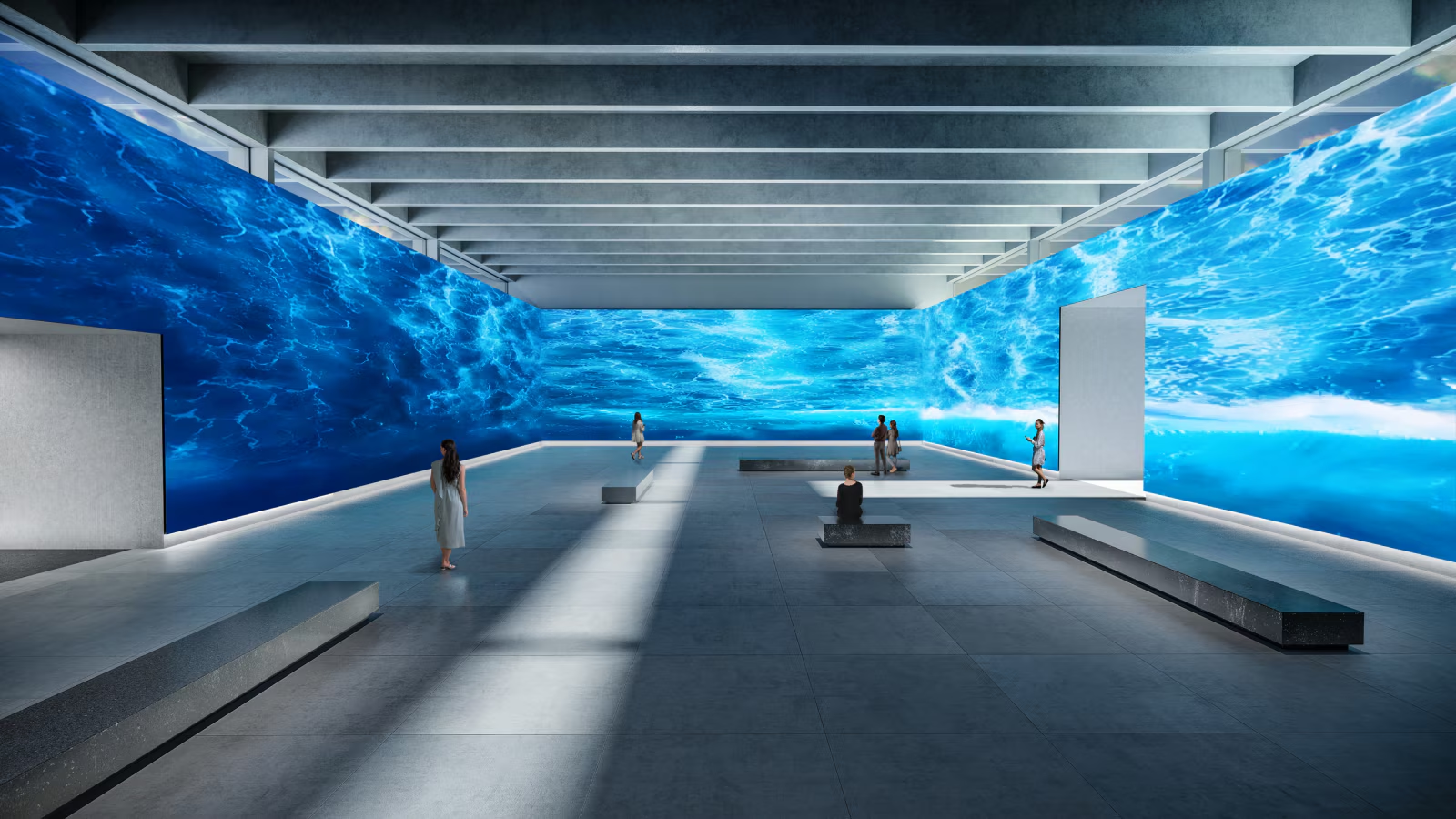
Most digital signage conversations start with a rectangle. Susan Wilhite wants to end them looking at different digital signage form factors.
Wilhite is the Senior Director Business Development for Bluefin, a commercial display manufacturer that specializes in non-standard form factors. At InfoComm 2026 in Las Vegas, she described a company built around a simple frustration: the 16:9 panel is everywhere, but it is not always the right answer.
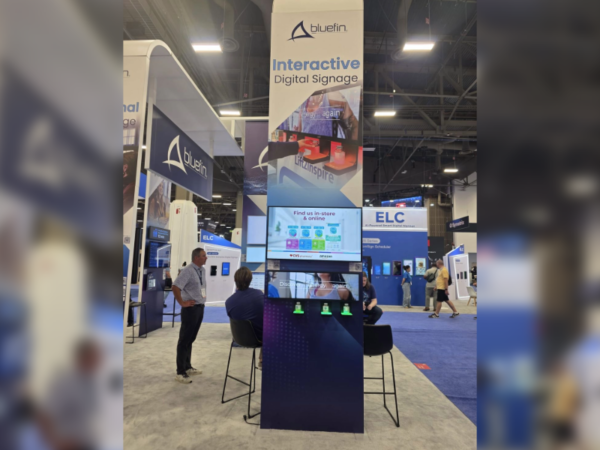
“I don’t want to just be another TV,” Wilhite said. Bluefin’s booth made the point visually. Ultra-wide displays, circles, squares, countertop units, and portrait-orientation menu boards filled the space. Each form factor addressed a use case a standard flat panel cannot.
Hardware built for commercial deployment
Bluefin manufactures commercial-grade displays rated for 24/7 operation. The line covers a wide range of form factors: circular displays, ultra-wides, standard landscape and portrait panels, and countertop units from 10.1 inches up to 21.5 inches. They carry both touch and non-touch versions. The company targets higher education, healthcare, transit, corporate environments, and retail.
The product line divides into two broad categories. Screens 15.6 inches and larger in the Flex OS line ship with built in operating systems options such as BrightSign, Windows, Linux or Andriod, and also includes HDMI input and a USB-C port. Those inputs allow users to bypass the built-in OS entirely and drive the display from an external source, helping to future-proof the screen. The 10.1″ and 13.3″ smaller screens are available as all-in-one solutions. The various digital signage form factors matters for installations for customers who need options. Whether they already have a content management system or are starting from scratch.
Wilhite also noted a deliberate long-term play: Bluefin sells touch-enabled glass on nearly every installation. The reasoning is practical. Touch panels use glass instead of standard LCD, which holds up better in high-traffic locations. Even if they don’t need touch in the beginning, a customer who decides to add interactivity in two years does not need to replace the display.
“How long do you want this screen to last?” she said. That question drives the spec conversation before price does.
Operating systems and content management
Bluefin does not manufacture its own content management software. Instead, the company guides customers toward platforms that fit their existing workflows. Wilhite’s approach is to ask what software a customer already uses, then match the display configuration accordingly.
For installations that need a self-contained solution, Bluefin’s Flex OS line supports integrated digital signage players from third-party providers. For installations that need more processing power, the HDMI input accommodates a dedicated external computer. Wilhite described a circular display installation at a cultural institution where the content required a high-end graphics card. The solution was a plug-in connection to a capable external PC, with Bluefin’s display serving as the output device.
The architecture is designed with longevity in mind. Built-in digital signage players simplify deployment, reduce hardware requirements, and create a cleaner installation. As technology and software needs evolve over time, the integrated HDMI input provides flexibility, allowing customers to add an external source if desired without replacing the display. This approach helps protect the investment while giving organizations the freedom to adapt to future requirements.
The therapy session: Bluefin’s consultative sales model
Wilhite’s description of a typical Bluefin customer conversation is instructive. Most customers arrive with a vague objective and a conventional solution already in mind. The job is to get past both. And to introduce new digital signage form factors.
“A lot of times they don’t know what they want to do,” she said. The process involves asking questions until the underlying need surfaces. The customer says they need a display. The real need might be wayfinding above an elevator bank, patient-status communication outside clinical rooms, or an interactive showcase for a university athletics program.
She described a conversation with a university revamping its athletics facilities. The default assumption was a standard panel. After discussion, the team landed on a square and ultrawide displays cycling through athlete profiles and school history. The form factor made the installation distinctive rather than generic.
Healthcare illustrates the same pattern. A medical facility used Bluefin’s 21.5-inch countertop units for patient check-in. Outside clinical rooms, smaller displays in the 10- to 15-inch range provided staff-facing status information. Patient privacy limits what can appear on those screens, but the displays can show fall-risk indicators, isolation protocols, or care-team notes without exposing personal information. The use case exists at many facilities. The conversation just has to get there.
Industry education and the DSF connection
Wilhite’s challenge at InfoComm was familiar to anyone selling non-commodity hardware. The product category requires explanation before it requires a sales conversation. A customer who does not know circular displays exist cannot ask for one.
“I didn’t know you had that” is a common response, Wilhite said. The solution is not a denser catalog. It is consistent presence, industry education, and examples that make abstract possibilities concrete.
For customers who want to deepen their digital signage literacy before committing to a project, Bluefin points them toward the Digital Signage Federation (DSF). Frank Pisano, Bluefin’s CEO, is the President of the DSF board. The organization provides educational resources for end users at various stages of digital signage maturity. In Wilhite’s view, a customer who understands digital signage broadly is a better customer for everyone. They arrive at vendor conversations with clearer goals and more realistic expectations.
Bluefin also shares real-world installation examples from its installed base to help prospects visualize outcomes outside the trade show booth.
Why this matters for you
The broader point Wilhite made at InfoComm is worth taking seriously. The 16:9 panel dominates procurement discussions not because it is always the best tool, but because it is the most familiar one. Procurement teams default to it. Integrators quote it. Budgets assume it. IT and AV buyers need to know about different digital signage form factors.
Form factor is not decoration. A circular display above a university entrance communicates institutional identity in a way a standard flat panel cannot. An ultra-wide above an elevator bank provides floor-directory information in the natural orientation for that content. A countertop unit at a clinical check-in station fits the physical environment a wall-mounted display does not.
None of that requires a larger budget. It requires a different conversation. According to Wilhite, that conversation starts with a simple question: what are you actually trying to accomplish?
The answer, she said, usually leads somewhere more interesting than a rectangle.
Find all of AVNation’s InfoComm 2026 coverage here.

Tim Albright is the founder of AVNation and is the driving force behind the AVNation network. He carries the InfoComm CTS, a B.S. from Greenville College and is pursuing an M.S. in Mass Communications from Southern Illinois University at Edwardsville. When not steering the AVNation ship, Tim has spent his career designing systems for churches both large and small, Fortune 500 companies, and education facilities.
- Tim Albright

- Tim Albright

- Tim Albright

- Tim Albright