The Challenge
The evolution of NASCAR has made races more data-driven and dynamic than ever. That has required traditional control operations to shift into a higher gear to meet those high-velocity demands. Officials, who were typically located in a control tower at each track, faced limitations with the display technology they were using. They needed a new way to visualize and monitor the increasing number of information and video feeds, while enhancing safety and enabling split-second evaluation of incidents and potential penalties.
The Solution
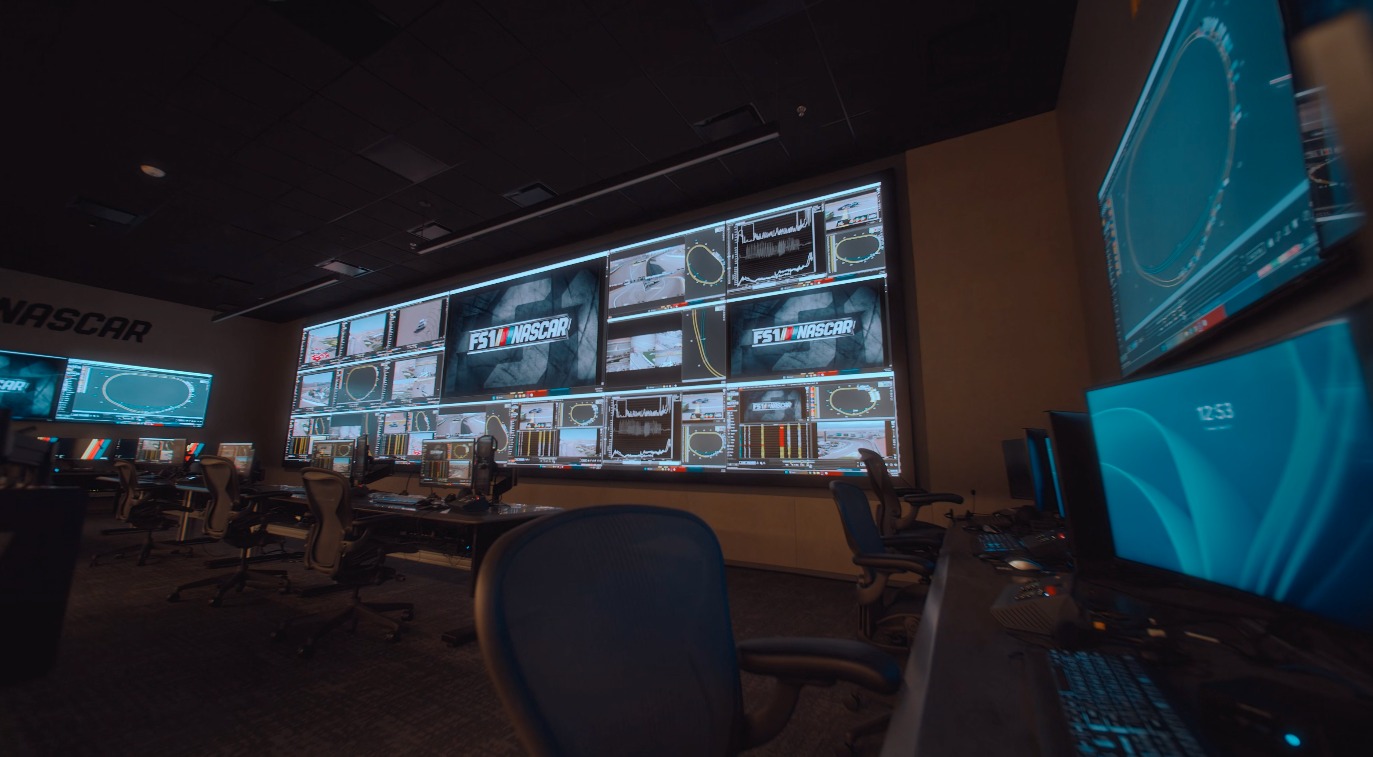
NASCAR sought to create a state-of-the-art remote race control room within its NASCAR Production Facility in Concord, North Carolina. The facility would provide an operational extension of race control at the track, enabling officials to monitor races with greater visibility and collaboration. Working with Samsung as its technology partner, NASCAR designed a command center powered by advanced display solutions, including Samsung’s high-resolution, ultra-large LED display, The Wall, which can host multiple video, data and statistics feeds simultaneously in real time.
“Officials now have a centralized environment where they can view the race with multiple data feeds and video sources in real time.”– Michael McDermott, Executive VP, Consumer Electronics at SEA
The Results
NASCAR’s remote race control room, powered by Samsung display technology, has given officials unprecedented visibility across every race. With the ability to display multiple data sources in a single environment, officials can now visualize track activity, monitor car telemetry and collaborate in real time, reducing the risk of missed calls and enabling faster, more accurate decision-making. The investment has improved operational efficiency, enhanced race safety and provided NASCAR with a future-proof solution for managing the growing volume and innovation of race data.
The Solution
A wall of display technology
NASCAR partnered with Samsung to build the remote race control room at the NASCAR Production Facility in Concord, North Carolina. The room acts as an operational extension of race control at the track, enabling officials to monitor races with greater visibility using Samsung display technology.
“What we conceived for this room is a level of support for those in the tower that was never available before,” Miller said.
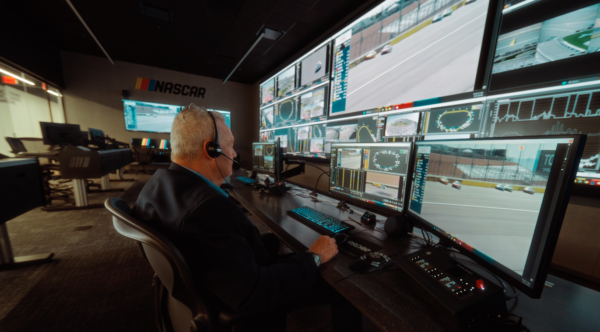
Fully equipped with Samsung display technology, the control room now features The Wall — an ultra-large LED display measuring 32 feet wide by 9 feet tall — as its centerpiece. With high-resolution, high-contrast MicroLED technology, it serves as the ideal command center hardware for race monitoring. The vast screen real estate can display multiple data feeds and live visuals with pinpoint precision, so officials can clearly see all aspects of the race like never before.
The Wall features a customizable layout with multiple sections, each controlled by dedicated workstations that let operators push specific content to different quadrants of the screen.
“Each one of those quadrants on the wall is controlled by a computer, so anything that we generate can go into its associated quadrant,” Miller explained.
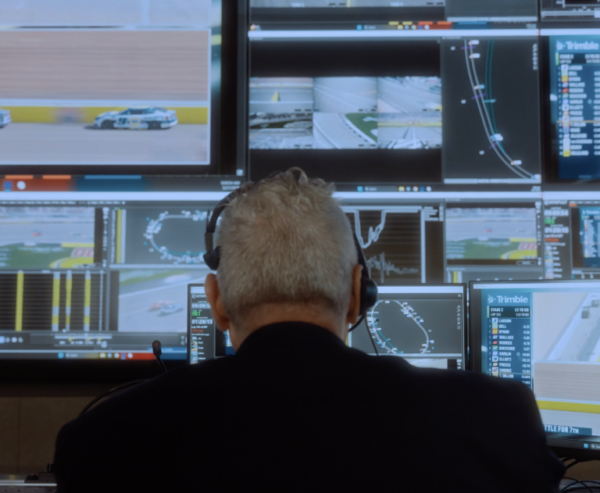
During a race, the central section of The Wall typically shows the live broadcast feed, mirroring what viewers see at home. This helps his team track the primary action around the circuit. Surrounding sections display a variety of race data, including feeds from:
- More than 80 broadcast cameras
- In-car cameras
- Engine control units
- Optical tracking cameras
- Pit-road officiating systems
- Official cameras positioned at the pit, start and finish lines, restart zones and other key locations
That consolidation of the action dramatically improves officiating, explained Michael McDermott, executive vice president of Consumer Electronics Business at Samsung Electronics America. “Officials now have a centralized environment where they can view the race with multiple data feeds and video sources in real time.”
Moreover, they can access radio communications between drivers and teams, with speech-to-text displayed clearly on the screen, allowing them to monitor how situations are unfolding.
Supporting the visual ecosystem is a network of additional Samsung displays, including 25 ViewFinity S6 (S60D)
QHD HDR10 High Resolution monitors and seven ultra-wide, curved 49 Inch Odyssey G9 G95C monitors. The Odyssey G9s offer a large screen for officials at workstations to simultaneously view and assess multiple data sources, enhancing their ability to efficiently support track operations.
The high resolution of the displays also adds value, as they can show large volumes of real-time information in easy-to-read detail, particularly the numbers and statistics being monitored during a race.
“Having the television feed in the large middle quadrant is really sharp. Then seeing all of the other feeds in the smaller quadrants is just better than looking at it on a computer screen,” said Miller.
Working in collaboration with race control staff at the track, the remote room functions as an extension of officiating operations, providing additional analysis, monitoring and replay capabilities that enhance accurate, fast decision-making throughout the race.
“We’re in constant contact with the people at the racetrack in the tower and are able to help with any calls,” Miller highlighted. “We’re able to add personnel and eyeballs to all of those video feeds so that we don’t miss anything.”
The Technology
The Wall
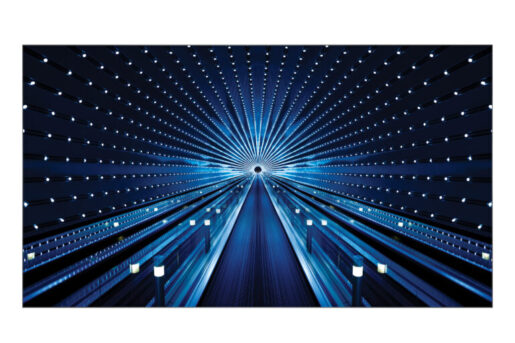
A deep black background and enhanced depth delivers an unmatched viewing experience. With a simplified installation process and a built-in control box, The Wall: All-in-One is the ideal LED video wall.
The Results
Greater visibility, accurate analysis, faster decision making
Now entering its second season of operation, the remote race control room has transformed NASCAR’s ability to monitor races, analyze incidents and make officiating decisions more effectively, thanks to the greater visibility it provides.
Having previously relied on individual computer monitors and isolated replay systems, the new ecosystem of Samsung display technology enables officials to view multiple race feeds and data streams simultaneously, improving situational awareness during critical moments.
“The biggest benefit is to be able to see everything in real time and visualize far more things than you could with just a computer in front of you,” Miller said.
The Wall display also improves collaboration among officials. When it’s necessary to analyze an incident or replay angle, the feed can be instantly shared on The Wall for others in the room to review, too — a huge improvement over everyone crowding around a couple of monitors.
“Samsung technology, with The Wall, has allowed us to do things we weren’t able to do before, because, it’s like having 20 monitors in front of you, as opposed to probably two or three sitting at a single work station,” Miller enthused.
Powered by Samsung displays, the control room also provides a place to visualize and aggregate the unprecedented amount of race insight and safety-monitoring data that NASCAR officials now have access to. Officials can now track engine health and other technical data for every car during the race, something that was not previously possible.
“Samsung technology, with The Wall, has allowed us to do things we weren’t able to do before, because, it’s like having 20 monitors in front of you, as opposed to probably two or three sitting at a single work station,”
— Scott Miller, competition strategist at NASCAR
“We can now monitor engine data and telemetry, or if anything is failing,” Miller said. “Before this remote race control room was implemented, we just didn’t have a place for all that data to go.”
For NASCAR, the technology within the race control room has accelerated a generational leap in race operations. It provides greater situational awareness of all the action on the asphalt, improving collaboration and race safety. For Miller and his team of officials, it has supported their roles and made race calls more efficient and accurate.
This major step forward in how races are monitored and officiated keeps NASCAR on track with broader advances in the sports world, according to McDermott. “Across the sports world, control rooms are being centralized so that operators can see data and action in real time. These environments allow organizations to combine video, data analytics and communications to deliver real-time decision making so that there’s no interruption in the action.”
The new vision the partnership provided also roots NASCAR back in what drives its ultimate mission, added McDermott. “Samsung and NASCAR are committed to utilizing technology to drive better experiences: for the teams, the officials, the operators and ultimately the fans.”
- AVNation Staff
- AVNation Staff
- AVNation Staff
- AVNation Staff