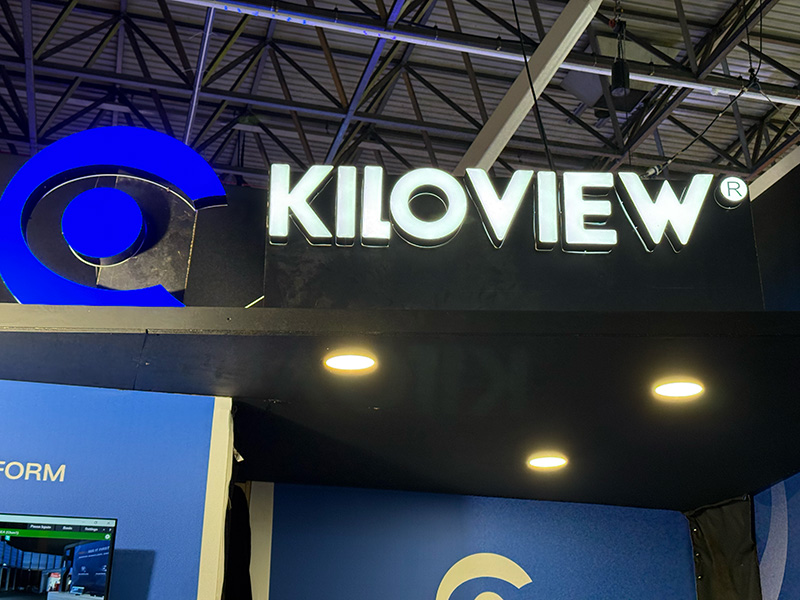
Kiloview brought its Hybrid AV-over-IP workflow to the RAI Amsterdam. The pitch centers on a familiar broadcast problem: too many cables, too little visibility into what’s happening on the network.
The ‘trailblazer’ pitch
Judy Zuo, Vice President of Kiloview, said Kiloview builds the infrastructure other AV-over-IP tools run on. That includes encoding, decoding, transmission, and management, so video and audio move reliably with low latency.
Four stops, one workflow
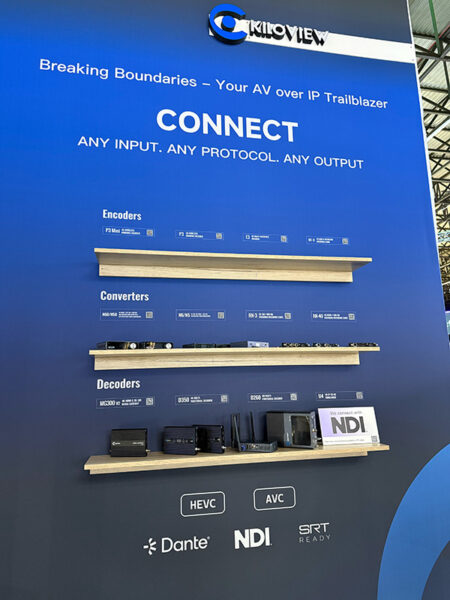
Kiloview organizes its IBC2026 booth around four stages: capture, control, management, and production. Each stage uses a specific product, and the four are meant to work as one system.
- Capture: P Series wireless bonding encoders bring video back from field and remote locations
- Control: KiloLink Station Pro receives, monitors, and manages feeds centrally, with up to eight bonded channels
- Manage: AVX24-4 Media HUB gives visibility across the IP network and handles up to 24 NDI sources at 4K60
- Produce: Cradle Series RF02 extends the workflow into routing, processing, and software-defined production
Kiloview is also giving IBC visitors an early look at NDI 6.4 and new U4 applications. Those extend NDI video into meeting rooms, live streaming, monitoring, and displays beyond the studio.
Built around visibility, not just conversion
Zuo said trust in the network is customers’ most common worry when they move to IP. “We don’t really trust the network” is one of the common concerns integrators raise, she said. Kiloview’s answer is to make network status visible on the same interface operators already use.
Color-coded status indicators show whether a connection is healthy, Zuo said, and operators can check any device with one click. Kiloview also builds in redundancy for routers, so a failed connection can switch to a backup device automatically.
Two protocols, one box
Kiloview’s encoders and decoders lean on two main protocols, staff said: NDI and SRT. NDI handles on-site and internal routing, Zuo said, while SRT covers remote transmission across the open internet. Many Kiloview boxes convert one signal into multiple IP formats at once. A single unit can take in SDI or HDMI and send out NDI, SRT, and RTMP simultaneously.
Why choose Kiloview, staff say
Zuo acknowledged the AV-over-IP market has many converter makers that look similar on a spec sheet. Kiloview’s answer is breadth, according to Zuo. Customers can buy encoders, routers, and management software from one company instead of stitching pieces together. Zuo also said Kiloview holds a leading share of the NDI market and a sizable share of SRT deployments. The company did not cite independent figures to support that claim.
Where Kiloview sees demand
Broadcast remains Kiloview’s largest market, according to Zuo, especially studios and live production built around NDI. However, corporate AV has grown quickly over the past two years. Auditoriums and training rooms are adopting broadcast-style workflows for hybrid meetings and streaming. Education is following a similar path. Universities want to route video signals across buildings, Zuo said, including live feeds from medical training and operating rooms. Zuo also pointed to government and entertainment venues, including casinos and cruise ships, as newer growth areas.
What it means for you
For AV and IT teams evaluating IP transitions, Kiloview’s pitch centers on accountability as much as hardware. Judy Zuo described a common headache: a converter, a switch, and a decoder often come from different vendors. A failure can turn into finger-pointing about whose fault it is. “Buying more of the workflow from one vendor”, Zuo said, “means fewer places to point fingers when something breaks.”
Visit AVNation’s IBC 2026 coverage page here.

Tim Albright is the founder of AVNation and is the driving force behind the AVNation network. He carries the InfoComm CTS, a B.S. from Greenville College and is pursuing an M.S. in Mass Communications from Southern Illinois University at Edwardsville. When not steering the AVNation ship, Tim has spent his career designing systems for churches both large and small, Fortune 500 companies, and education facilities.
- Tim Albright

- Tim Albright

- Tim Albright

- Tim Albright