Konstantin Knauf, managing director of Qvest, has a short way of describing how systems integration is changing. Engineers used to spend their days sticking cables, Knauf said. Now they spend it “sticking APIs.”
Qvest is a consultant, systems integrator, and managed service provider working across media and non-media companies. The company is showing its capabilities at IBC2026 in Amsterdam through Sept. 14. Kauf pointed to three trends shaping the year ahead. The first is software-defined production. The second is AI moving from experiments into daily workflows. The third is a growing push for data sovereignty.
From broadcast to pro AV
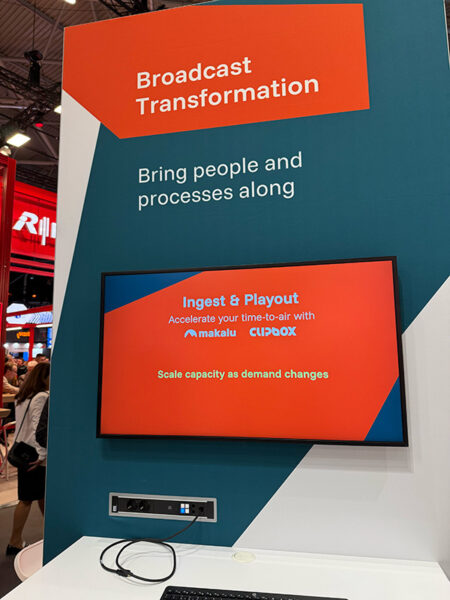
Historically, Qvest worked mainly in broadcast, Knauf said. In recent years, the company has expanded further into pro AV. He said they’re selective about which projects to take. Qvest isn’t chasing routine conference-room installs. The company looks for complex, integrated projects instead.
Knauf pointed to Outernet, an immersive media venue in London, as an example of that kind of work. Qvest handled the backend integration, the control room, content management, and asset storage as part of a citywide revamp project. He said Qvest’s strength shows up when complex technology has to work simply. Knauf pointed to customers like police forces, airports, and public transit systems.
Knauf described Qvest as a systems integrator in the classic sense. About 95 percent of what the company deploys is market-ready product, he said, brought together into one working environment. The remaining work is usually software integration, not hardware manufacturing. That means custom dashboards, missing APIs, or an overlay layer that makes a system easier to use.
Making live production fully software-defined
Knauf pointed to Dynamic Media Facility, or DMF, as the most central trend on the broadcast side right now. The idea is moving core live production functions, like vision mixers and routers, entirely onto software. Knauf said Qvest isn’t shipping much of this yet. Instead, the industry is reaching a point where broadcasters can seriously plan for it.
AI moves from pilot to production
AI is the second big theme, Knauf said, but the emphasis has shifted. He described a lot of early experimentation and money spent just testing AI inside organizations. Now, Knauf said, the industry is moving those experiments into production-ready workflows. Qvest builds what Knauf called AI accelerators to demonstrate that shift to customers directly.
Demand for data sovereignty is growing
Knauf said demand for data sovereignty has grown steadily over the past year and a half. European customers, especially public broadcasters, increasingly want their infrastructure built on local cloud providers rather than the large U.S. hyperscalers. Knauf said public broadcasters face real obligations to protect user data, which drives much of that demand. Commercial broadcasters, he said, care about it less.
Knauf said the trend isn’t limited to Europe. Demand for sovereign infrastructure is also rising in the Middle East, he said. The same shift is happening in critical infrastructure sectors that historically avoided the cloud altogether.
What software does to a systems integrator
The move to software workflows is reshaping systems integrators too, Knauf said. Qvest has invested in its own software development team and reorganized its support division into a globally distributed, round-the-clock operation. Knauf said the underlying skills are simply different now. It’s not about replacing hardware installation. It’s a different operating and support model altogether.
He summed it up simply: engineers used to spend their time sticking cables. Now, he said, it’s sticking APIs.
Competition, mostly local
Knauf said Qvest sees relatively few truly international competitors, since operating across borders is expensive. Ideal Systems, AVI-SPL, and Diversified compete in overlapping spaces, he said, though most competition plays out market by market. Knauf said large technology consultancies like Accenture and Deloitte are less direct rivals. They still show up at the same long-term, strategic projects.
What it means for buyers
For media and AV buyers, Qvest’s pitch centers on the long game rather than any single product. The three trends Knauf described, software-defined production, real-world AI, and sovereign infrastructure, all point toward longer, more complex procurement decisions. Knauf said that plays to Qvest’s advertised strength: making complicated technology simple for the customer holding the budget.
Visit AVNation’s full coverage of IBC 2026 here.

Tim Albright is the founder of AVNation and is the driving force behind the AVNation network. He carries the InfoComm CTS, a B.S. from Greenville College and is pursuing an M.S. in Mass Communications from Southern Illinois University at Edwardsville. When not steering the AVNation ship, Tim has spent his career designing systems for churches both large and small, Fortune 500 companies, and education facilities.
- Tim Albright

- Tim Albright
- Tim Albright

- Tim Albright