Category: IBC 2025

  • Zero Density at IBC 2025

    Zero Density at IBC 2025

    In Amsterdam, Zero Density at IBC 2025 underscored its commitment to transforming not only broadcast workflows but also corporate communications. The company used the show as a stage to spotlight Reality 5.6 and its new Lino workflow—tools that promise to give internal and external communications teams greater flexibility, speed, and control over their messaging. With many organizations aiming to produce more video content without simply increasing budget or headcount, Zero Density’s offerings speak directly to what corporate decision makers want: high impact, low friction.

    To see all AVNation’s IBC 2025 coverage, go here

    Reality 5.6 consolidates on-air graphics, virtual studios, augmented reality (AR), extended reality (XR) and video wall content into a single, template-based environment. According to their recent press release, “With Reality 5.6, we’re delivering a solution that simplifies operations, speeds up graphics design and unlocks creative freedom for broadcasters everywhere.” Baris Zavaroglu, CEO of Zero Density, emphasised that this is “the first platform that enables users to work seamlessly with on-air graphics, AR, video walls and any other type of visual content broadcast productions require.” Those same capabilities are increasingly relevant to corporate settings, where presentations, webinars, internal town-halls or product showcases often demand high-quality visuals and versatile layouts but without the specialised technical teams of a large broadcast outfit.

    UnReal with Zero Density at IBC 2025

    In corporate case studies, the benefits are already visible. Ryan Fitzgerald, Production Manager at Toyota North America, said, “Zero Density came out to kind of be the leader on what we were looking for as far as an internal video studio goes, and checked off all of our boxes.” The appeal lies not only in reliability but also in usability: Frank Arens, Head of Public Relations at RWE, explained, “We do not have a trained studio or sound technician. We use our standardized system with various presets like board meeting chat or presentation for employees. Operating the studio should be simple and standardized. This was a very important aspect to us.”

    Dominik Stoecker, Executive Producer at ifm Group, reflected on how visual freedom in the corporate space matters: “Our experience with the virtual studio has been really great because you’re just limited by your imagination. Whatever you want to visualize you can do it with a studio like this, and that’s a huge advantage.” That kind of flexibility means a corporate comms team no longer needs to book expensive crews or settle for static slides when communicating with stakeholders.

    Zero Density’s presence in Amsterdam also showcased more than just software workflows. Their booth (7.B01) featured live demos on both green screen and LED stages; showed off the Traxis camera tracking and continuous recalibration tools; demonstrated how the Reality Hub web-based control UI integrates with automation, newsroom and multi-channel playout; and exhibited templates for video walls and AR/XR graphics that corporate teams could adapt on short notice.

    Broadcast to Corporate Communications

    For corporate decision makers looking to scale their communications infrastructure, the case for investing in virtual production tools like Reality 5.6 is strengthening strongly. Zero Density already reports over three million live hours produced on Reality by broadcasters, demonstrating reliability under demanding live workflows. That track record, paired with features aimed at reducing technical complexity—template-based design, standardised presets, reliable keying, integrated tracking—means companies can accelerate production, maintain brand consistency across channels and reduce dependency on external vendors.

    In short, at IBC 2025 Zero Density didn’t just roll out new tools: it presented a compelling vision for what corporate video communications could be when equipped with broadcast-grade virtual studio power, but with the usability and cost efficiency that corporate users demand.

  • AWS at IBC 2025: Agentic AI & Enterprise AV

    AWS at IBC 2025: Agentic AI & Enterprise AV

    At IBC 2025, AWS set its sights on problems that resonate deeply with higher-ed and corporate AV/IT leaders: the need for smarter production workflows, confidence in data sovereignty, and practical applications of AI. Stephanie Lone from AWS at IBC 2025 highlighted three themes guiding the company’s work: Agentic AI, Live Production & News, and a new European Cloud built for digital sovereignty. Together, these reflect AWS’s push to make cloud-based media workflows both agile and trustworthy.

    Create, Connect, Captivate

    AWS IBC 2025 workflow
    AWS IBC 2025 workflow

    The booth itself was organized around three verbs: Create Content, Connect Workflows, Captivate Audiences. That framing offered a customer-first perspective: don’t just build technology for technology’s sake, but instead start with the problems media teams face. Whether the challenge is producing more content with fewer resources, moving video quickly across geographies, or ensuring compliance with European regulations, AWS showed how its cloud services and partners fit together.

    Agentic AI in Action

    A striking detail was that two-thirds of the booth demos relied on some form of generative or agentic AI. Rather than simply producing text or images, these AI agents were designed to take on tasks inside media workflows: assembling clips into highlight packages, enriching metadata in real time, or automating quality checks. Tools like AWS’s Framelight AI agent illustrated how production teams could offload repetitive work while still maintaining creative control. For universities or corporate comms teams, AI isn’t just a novelty; it’s becoming embedded in the production pipeline.

    Time-Addressable Media Store

    One of the most concrete demonstrations came through the Time-Addressable Media Store (TAMS). This open API allows organizations like Reuters to capture and share live video across multiple outlets almost instantly, without endless file duplication. By combining cloud storage with event-level metadata, TAMS made it possible to search, retrieve, and distribute clips in seconds. For a campus setting, that kind of efficiency could transform how lecture captures, guest talks, or live events are archived and shared across departments.

    AWS at IBC 2025 Deep Dive

    Behind the demos, AWS also stressed a less glamorous but equally critical factor: observability. Stephanie described how AWS tools can pull logs from multiple sources—flagging dropped frames, 404 errors, or network hiccups—to give teams real-time visibility into system health. For AV managers, especially in distributed environments like universities with multiple lecture halls or corporations with offices worldwide, that operational transparency may be the difference between a smooth event and a support nightmare.

    Digital Sovereignty

    The third major theme spoke directly to European customers: a sovereign cloud designed for peace of mind. This upcoming AWS infrastructure will keep data within Europe and align with strict regulatory frameworks. For public universities and enterprises operating under GDPR and national rules, that commitment isn’t just a checkbox—it’s a prerequisite for moving critical media workflows to the cloud. By emphasizing sovereignty alongside innovation, AWS positioned itself as both forward-looking and pragmatic.

    What It Means for Higher Ed & Corporate AV

    Taken together, AWS’s IBC presence painted a picture of workflows that are more intelligent, resilient, and adaptable. Agentic AI can reduce the manual load on small teams, allowing them to do more with less. TAMS illustrates how content distribution can be faster and less error-prone, opening the door to new collaboration models. Observability promises fewer surprises mid-event, which AV/IT leaders know is priceless. And the sovereign cloud initiative provides the compliance framework that many European institutions have been waiting for before embracing large-scale cloud adoption.

    Future of Production

    For AV and IT decision makers in higher education and enterprise environments, AWS’s IBC 2025 story boiled down to solving real problems: faster workflows, smarter automation, clearer visibility, and compliant infrastructure. While questions remain about adoption speed and training, cloud-native media workflows are no longer an experiment. They are quickly becoming the backbone of modern AV.

    To see all of AVNation’s IBC 2025 coverage go here.

  • Sony at IBC 2025

    Sony at IBC 2025

    At IBC 2025 in Amsterdam, Sony made it clear that live production is entering a new era, with AI-powered tools doing heavy lifting in camera tracking, workflow automation, and spatial content creation. For organisations such as houses of worship, universities and colleges, or any team operating with tight staffing, Sony’s announcements promise both relief and new creative potential. Sony at IBC 2025 made clear statements about automated production and sustainability.

    Sony IBC 2025
    Sony IBC 2025

    One of the standouts is Sony’s OCELLUS camera tracking system, which was demonstrated alongside the Virtual Production Tool Set version 3.0. The company showed how OCELLUS integrates with Sony’s LED display technologies (Crystal LED CAPRI, VERONA) and spatial content production hardware and software to enable automated tracking of talent in studio, virtual or hybrid settings. Sony describes the evolution of this architecture as “connected media ecosystem” where camera, cloud, AI, and IP tools are tightly integrated to reduce setup complexity and operator load.

    Sony at IBC 2025 Higher ED

    In higher education, for example, the ability to rely on AI tracking means professors can move freely around lecture halls without concern for camera operators. Sony claims that its AI-powered tools can adjust camera framing in real time, responding to both motion and spatial context. This kind of automation reduces the burden on technical staff, who often must juggle camera, audio, lighting and streaming tasks simultaneously. One university AV manager quoted by Sony said: “We need tools that anticipate movement, that can track speakers without us having to constantly adjust. Sony’s tracking minimizes our technical overhead so we can focus on content, not camera operation.”

    In houses of worship, many congregations face similar constraints: volunteer staff, limited budgets, and varying levels of technical expertise. Sony’s AI tracking and integrated virtual production hardware allows worship services to look much more professional without hiring a full crew. The precision of systems like OCELLUS, combined with Sony’s LED display solutions, means that churches can project engaging visuals, follow speakers or performers across the stage, or mix live and pre-produced content with less manual intervention. The benefit is two-fold enhanced attendee experience and reduced staffing/operational cost.

    Sony Sustainability

    Sony also emphasised its sustainable and cloud-native tools as part of its exhibit. One of the goals is to enable remote monitoring or control, so that fewer people need to be physically on site. This is especially useful for campus environments or houses of worship with multiple locations one technician can oversee several spaces, schedule automated tracking profiles, and ensure consistent visual quality. Sony’s press materials highlight that its Virtual Production Tool Set 3.0, due later in the year, will enhance remote operation and AI-augmented scene control.

    But there are trade-offs to consider. The initial investment in LED walls, tracking hardware, and higher bandwidth for IP/ cloud workflows may be substantial for smaller institutions. Training is still required, even if operation is easier. Yet for organizations willing to make that leap, the return often shows up in reduced personnel costs, more consistent output, and greater flexibility in programming (whether worship service, lecture, or live event).

    In sum, Sony’s presence at IBC 2025 made a strong case that AI tracking is more than a feature it’s becoming a foundation for live production in sectors where staffing and resources limit what is possible visually. For houses of worship, educational institutions, and lean content teams, the promise is that better visuals, more freedom, and lower operating stress are now reachable.

    Check out all of AVNation’s IBC 2025 coverage here.

  • Matrox at IBC 2025: AVoIP Highways

    Matrox at IBC 2025: AVoIP Highways

    At IBC 2025, one clear theme was the continued march toward open standards and software-defined infrastructures. For higher education and corporate environments, that shift is not academic. It’s essential. Universities and enterprises are tasked with supporting live events, hybrid collaboration, and large-scale distribution of video across campuses and offices. Matrox Video, with a strong broadcast pedigree and a growing AV footprint, used IBC to spotlight how it is re-engineering live production and AV transport to meet those needs.

    To see all AVNation’s coverage of IBC 2025 go here

    The Matrox Legacy

    Matrox has been part of the video technology ecosystem for decades, serving broadcast engineers, OEMs, and AV/IT managers with encoders, decoders, converters, KVM, and SDKs. Their strength has always been reliability, but the conversation in Amsterdam was about flexibility. According to Albierto Cieri, senior vice president at Matrox, the company’s approach now centers on giving developers and integrators the building blocks to design scalable, software-driven workflows that take advantage of commercial IT infrastructure.

    ORIGIN Fabric: The IP “Highway”

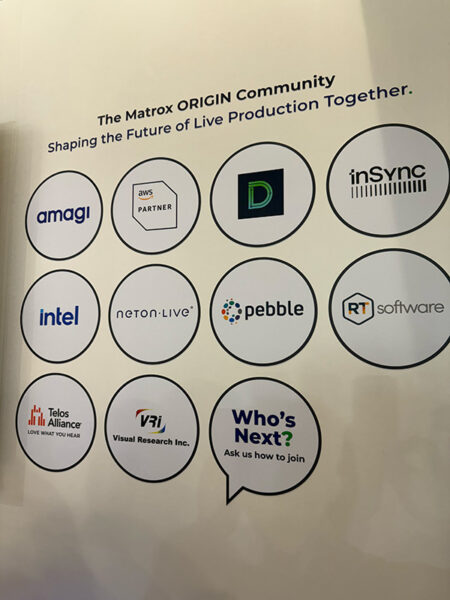
    Matrox Partners IBC 2025
    Matrox Partners IBC 2025

    At the center of Matrox’s message this year was ORIGIN Fabric, a transport framework designed for asynchronous, IP-based media. Cieri described it as a kind of “highway”—a layer that sits underneath applications, ensuring video signals move efficiently across networks. Built to run on AWS as well as on-prem IT environments, Fabric allows DevOps teams to create live production solutions with the agility of software deployment rather than bespoke hardware builds.

    By exposing this as a developer-friendly SDK, Matrox gives universities and corporations the ability to design applications that fit their unique needs—whether that’s live streaming lectures, distributing signage across campus, or managing complex multi-room corporate events. Running on commercial off-the-shelf IT servers also means institutions aren’t locked into proprietary appliances.

    Open Standards First: Matrox at IBC 2025

    A critical message at IBC was Matrox’s support for open standards. Cieri emphasized that campus and enterprise deployments will often begin with ST 2110 in central production environments. From there, content can be distributed more efficiently across the rest of the campus or corporate network using IPMX, the emerging standard tailored for AV. This staged approach reduces complexity: high-end workflows where they’re needed, lighter standards everywhere else.

    Matrox also showed alignment with the MXL (Media eXchange Layer) initiative, a collaboration led by the EBU and Linux Foundation. MXL aims to harmonize how media applications talk to each other. For end users, that translates to fewer compatibility headaches and easier integration across multi-vendor systems.

    Bridging Formats with VION

    Another highlight was the VION gateway, which supports baseband input and IP in/IP out. The gateway’s role is to bring in a variety of IP transports and convert them seamlessly to IPMX. For large organizations juggling older gear alongside newer IP endpoints, this conversion layer is essential. It means that migration to IP doesn’t have to be a disruptive rip-and-replace process.

    What it means for you

    For AV and IT decision makers, Matrox’s IBC 2025 showcase carries several takeaways. ORIGIN Fabric reduces the need to manage multiple point-to-point paths. Instead, it provides a robust, software-defined transport that can adapt as networks scale. With ST 2110 at the core and IPMX at the edge, organizations can plan phased migrations that match their budgets and operational realities. MXL and IPMX support mean IT teams aren’t tied to one vendor’s proprietary ecosystem. In an era where AV and IT must integrate seamlessly, that flexibility reduces risk. VION ensures legacy baseband or non-IPMX transports can still be part of the workflow, easing transitions for campuses or corporations that can’t replace everything at once. The fact that ORIGIN Fabric is already running on AWS signals a readiness for hybrid and cloud-based deployments, whether for disaster recovery, overflow capacity, or remote production.

    What to Watch Going Forward

    Matrox’s announcements point to a pragmatic path: start with standards, add flexibility, and make migration less painful. For universities streaming lectures across multiple campuses or corporations managing global town halls, the value is clear. The question now is adoption. Will IT and AV teams embrace developer-friendly SDKs like ORIGIN Fabric to craft their own solutions, or will they wait for turnkey offerings from integrators? And how quickly will IPMX, still a developing standard, become the default in campus AV?

    IBC 2025 confirmed that IP and IT workflows are no longer the future; they are the present. With ORIGIN Fabric, VION, and its alignment with IPMX and MXL, Matrox is positioning itself as both a bridge and a highway: connecting legacy formats to new standards while paving the way for scalable, resilient, and cost-efficient AV systems. For higher education and corporate decision-makers, that message resonates loud and clear.

  • NDI at Ten: Why It’s Now Mission-Critical

    NDI at Ten: Why It’s Now Mission-Critical

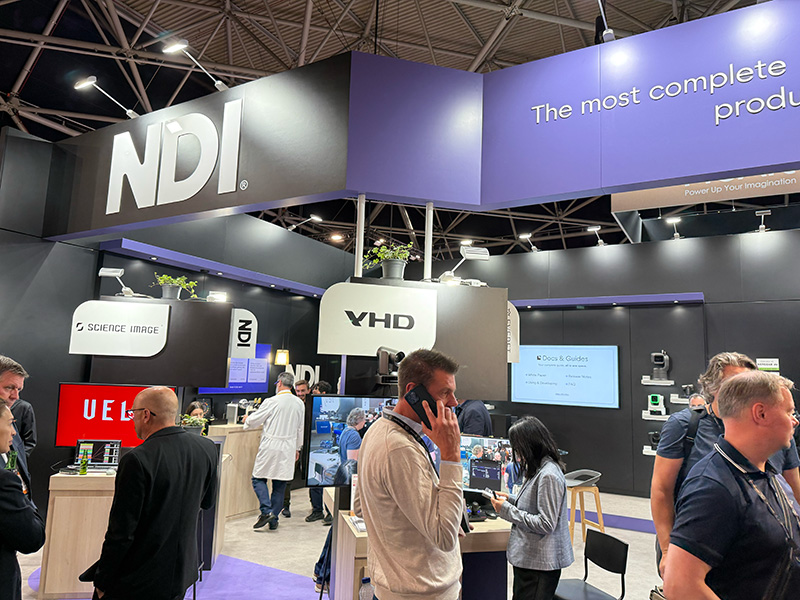
    The Network Device Interface (NDI) standard celebrated its tenth anniversary at IBC 2025 in Amsterdam, but it’s clear that this is not a moment for resting on laurels. From modest beginnings as a tool for replacing individual video cables in local studios, NDI has grown into a broad ecosystem, deeply embedded in broadcast, production, and increasingly in corporate, educational, and live event sectors.

    To see all AVNation’s coverage of IBC 2025 go here.

    At its core, NDI at ten now enables low-latency, high-quality transport of video plus audio and metadata over standard networks. This makes it useful in situations where traditional SDI cabling becomes cumbersome or prohibitive. Especially when you need multiple video sources, flexible camera positioning, or remote inputs. Over IBC’s last show cycles, as IP-based workflows have matured, NDI’s role has expanded beyond mere transport to include discovery, control, monitoring, and integration with cloud and software tools.

    What Was New at IBC 2025

    One of the key announcements was the release and preview of NDI 6.2 / 6.2.1 and the upcoming 6.3. These versions bring refinements in discovery, monitoring, and control features—important when there are many NDI streams on the network. The Discovery Server tools are better at helping devices identify each other, checking compatibility (number of audio channels, codec support) before connections are made, which helps reduce errors and simplified setup.

    Another focus is on expanded hardware and partner ecosystem. Brands like RØDE introduced their first NDI-enabled audio devices. Panasonic showed NDI-enabled remote camera controllers and multi-purpose cameras. This trend of traditionally analog or SDI-oriented hardware becoming “NDI smart” gives organizations more choice and flexibility.

    Also at IBC, “NDI Connected Talks” panels dove into cloud production, the consumerization of broadcast tools, audio-over-IP, and workflows for hybrid/remote production. For corporate or educational users, these are not merely theoretical: they map directly onto problems like under-resourced AV teams, distributed campuses, or remote contributors.

    NDI at Ten with Higher ED and HOW

    In corporate communications, higher education, and houses of worship, the pressures are similar: greater expectation for video quality and more channels or outlets (internal streaming, external, recording, and virtual meetings), often with limited staff, variable budgets, and sometimes older infrastructure. NDI addresses many of these challenges.

    Because it works over regular networks and often requires much less physical cabling or dedicated hardware, NDI can reduce setup time, logistical complexity, and staffing needs. For example, you can have PTZ or mobile cameras, even phones, feeding into the system over Ethernet or WiFi, send graphics or presentation systems as NDI sources, monitor feeds via standard PCs. The simplified discovery tools in newer versions mean fewer manual interventions or troubleshooting. The ability to carry metadata (tally, camera control, remote control) further reduces ancillary gear. (General technical details from the standard, use cases across sectors).

    Case in point: A recent event production workflow (MMG Events via Atomos) used over 200 simultaneous NDI streams across countries to deliver hybrid sessions with tight delivery windows. That kind of scale shows NDI is not just for “small setups” but can scale.

    For worship venues, which often juggle streaming, overflow screens, social-media video, and volunteer teams, NDI permits reusing existing Ethernet infrastructure, reducing dependency on SDI patching or physical signal routing, and enabling remote monitoring or control. Education environments similarly benefit: lecture capture, remote guest lecturers, hybrid classes, streaming to multiple rooms or platforms. All become more manageable.

    Challenges & Considerations

    That said, NDI is not without trade-offs. The network infrastructure needs to be up to the task: bandwidth, switching, buffering, multicast/ discovery etc. Latency, while generally very low, depends heavily on the quality and design of the network. Misconfigured or overloaded networks can introduce delays or quality drops. Also, while many devices now support NDI, integration, training, and compatibility with legacy systems (SDI, HDMI, existing switchers) need to be planned. Some users report that in older articles.

    What’s Next

    The roadmap (NDI 6.3, expanded partner hardware, better control/discovery) suggests that NDI will continue shifting from being a transport protocol to being a full connectivity platform for AV/IT producers. As more devices support it out of the box, as cloud workflows mature, and as hybrid production becomes more common, NDI’s role will only grow. For corporate users, educational institutions, and houses of worship, that means more opportunities to deliver polished video content without having to build a full-broadcast infrastructure.


  • Imagine Communications Launches XVR™ Playout Engines at IBC2025

    Imagine Communications Launches XVR™ Playout Engines at IBC2025

    Imagine Communications has launched XVR™ playout engines at IBC2025, introducing a new generation of scalable, cloud-ready solutions for broadcast and streaming. Designed for SDI, ST 2110, and cloud environments, XVR enables fast deployment, high channel density, and reduced costs while delivering consistent broadcast-quality performance.

    Built on modern Linux and data center technologies, XVR integrates with Imagine’s automation and orchestration tools, supports leading third-party systems, and offers flexible subscription pricing. It complements the company’s existing Versio and Nexio+ platforms, giving media companies powerful options to handle today’s hybrid workflows with agility and reliability.

    At IBC2025 (12-15 September, RAI Amsterdam, stand 1.B73), Imagine Communications is expanding its industry-proven playout portfolio with the launch of XVR™, an all-new offering of scalable, deployment-optimized playout engines designed from the ground up to streamline the launch and management of broadcast-quality linear and live streaming channels across on-prem, hybrid, and cloud environments.

    Built on Imagine’s decades of expertise in powering top-tier broadcast operations, XVR engines are ideal for ingest, playout, and unified origination environments of any scale — especially in SMPTE ST 2110 or cloud-hosted scenarios. The new playout engines run on modern Linux® foundations and leverage data center technologies to enable rapid, repeatable, and highly secure deployment.

    With the addition of XVR, Imagine now offers the most complete playout and automation portfolio in the industry. The company’s high-performance Nexio+™ AMP SDI media servers, ideal for fast-turnaround news and sports, are stalwarts of production, preparation, and distribution facilities worldwide, with more than 50,000 channels deployed to date. Its pioneering Versio™ integrated playout platform — which produces television channels with graphics, branding, and finishing suitable for direct-to-air applications — is the industry’s top choice for robust, turnkey channel origination. Bringing unique cloud and deployment capabilities to the mix, XVR rounds out the Imagine family of playout engines to meet every customer requirement.

    “XVR brings a powerful new option to our proven playout portfolio — purpose-built for scalable, cloud-optimized deployments,” said John Mailhot, senior vice president, product management, at Imagine Communications. “With XVR, we’re expanding the range of choices available to media companies navigating today’s hybrid environments. It’s about adding to our portfolio to meet customers where they are, whether that’s SDI, IP, or cloud, and giving them the best tools to navigate the combination.”

    Offering competitive pricing options, including usage-based subscription pricing, XVR playout engines are designed to meet the demands of media companies facing pressure to increase channel count without increasing costs. Leveraging high-availability shared storage, XVR scales dynamically to match evolving system sizes while driving down costs through high channel density on-prem and reduced per-instance cloud costs.

    Imagine’s XVR playout engines will support the full range of interface requirements found in modern facilities, including SDI, 12G SDI, ST 2110, TS, and SRT. Customers benefit from a consistent feature set regardless of deployment model — ensuring operational continuity, simplified training, and lower total cost of ownership. Building on Imagine’s extensive experience in broadcast playout, XVR engines natively play all typical industry video file formats, including XAVC, ProRes, DNxHD, and more, eliminating the expense and delay of transcoding.

    The new XVR playout engines are deployed by Aviator Orchestrator™ for maximum operational agility — enabling users to spin up resources on demand and burst to the cloud when needed. They are also fully compatible with Imagine’s widely deployed Aviator Automation™ and ADC on-prem playout automation, which power more than 5,000 channels at 700 sites worldwide.

    Notably, XVR is among the first playout engines to utilize the Intel Ethernet E810 Network Adapter in conjunction with components from the Intel Tiber Broadcast Suite, delivering robust ST 2110 performance on all-COTS platforms — reinforcing Imagine’s leadership in software-defined, standards-based broadcast technology on COTS compute platforms.

    As part of Imagine’s commitment to strong industry collaboration, XVR supports open APIs, enabling seamless integration with customer DevOps tools and systems. These modern APIs also enable leading third-party automation systems, including Aveco, Crispin, and Florical, to automate the XVR engines. Like the proven Nexio and Versio systems, XVR playout engines integrate with Imagine’s high-bandwidth IOX™ Storage, the scale-out storage platform designed for optimal operation in the most demanding environments.

    “No two media operations are the same — and our approach to playout reflects that,” Mailhot continued. “XVR gives customers an exciting new option for scalable, data center-native playout, while our trusted solutions like Versio and Nexio+ AMP continue to deliver unmatched reliability and performance in SDI and hybrid workflows.”

    Media companies attending IBC2025 can visit the Imagine stand (1.B73) for a hands-on demonstration of the XVR engines and all the latest advances in the company’s broad, industry-proven playout portfolio.

  • Dante Expands ST 2110-30 and AES67 Support, Empowering Greater Interoperability in Broadcast Workflows

    Dante Expands ST 2110-30 and AES67 Support, Empowering Greater Interoperability in Broadcast Workflows

    Audinate has expanded Dante’s capabilities to support SMPTE ST 2110-30 and AES67, enhancing interoperability between audio and video workflows in broadcast networks. These updates allow broadcasters to seamlessly integrate Dante audio with IP-based video systems, simplifying setup for both small-scale and large-scale operations while maintaining high performance and flexibility.

    The update also introduces support for 96 kHz audio, extended device-level configuration, and improved flow management, enabling high-fidelity production, immersive audio, and live event workflows. Broadcasters can now manage configurations directly in Dante Controller or via Dante Domain Manager, ensuring compatibility with third-party devices and evolving network designs. These updates will be available in Fall 2025 and showcased at IBC 2025 in Amsterdam.

    Audinate, developer of the industry-leading Dante® AV-over-IP platform, announced expanded support for SMPTE ST 2110-30 and AES67, further strengthening Dante’s integration with broadcast networks. Building on a foundation of interoperability and high-performance audio transport, the latest updates equip broadcasters with new tools to meet the demands of modern production workflows.

    Dante is already widely used as the backbone for audio-over-IP in broadcast environments, powering everything from comms to remote production and studio infrastructure. As video workflows continue their shift from SDI to IP, most notably with the adoption of ST 2110, there is a growing need for convergence with established Dante audio networks. These updates help ensure compatibility and interoperability between Dante and ST 2110-based video systems and networks without sacrificing performance and ease of use.

    “These enhancements strengthen Dante’s role in bridging audio and video workflows across modern broadcast networks,” said Mark Gerrard, Group Product Manager at Audinate. “Interoperability has always been central to our approach, and as broadcast networks and production needs continue to evolve, we remain focused on extending Dante’s capabilities to meet real-world demands.”

    The latest updates give broadcast teams more flexibility in how they manage ST 2110-30 and AES67 audio flows, whether working in a mobile unit or across a multi-facility operation. Core configuration tasks, such as defining flow parameters and adjusting PTPv2 clock settings, can now be completed directly in Dante Controller without the need for Dante Domain Manager. This simplifies setup for smaller or fast-paced environments where cloud or server-based tools may not be practical. For larger or more complex systems, broadcasters can continue using Dante Domain Manager to automate configuration, apply global policies, and coordinate settings across subnets, while also taking advantage of expanded device-level control.

    Added support for 96 kHz audio enables broadcasters to meet the demands of high-fidelity production workflows, including music programming, immersive audio, and live event capture. To enable this, Dante now supports ST 2110-30 AX, BX, and CX conformance levels, ensuring interoperability with systems and equipment operating at higher sample rates.

    New device-level configuration capabilities further extend Dante’s utility in broadcast environments. Features such as the ability to assign flows within a broader multicast address range, define custom RTP payload IDs, and specify PTPv2 clock DSCP values are among several enhancements designed to improve compatibility with third-party devices, support a wider variety of network designs, and provide long-term flexibility as systems scale and evolve.

    “Combining Dante with ST 2110-30 and AES67 in a single product reduces complexity in our development process and helps us deliver more versatile solutions to the market,” said Mark Wilson, Managing Director at Glensound. “Our customers increasingly operate across varied environments, from traditional broadcast studios to event-based productions. These updates let us support that range with products that offer standards-based interoperability, and the intuitive Dante experience they already trust.”

    The new capabilities will be available beginning Fall 2025 via firmware updates for select Dante devices designed for high-channel-counts, along with a software update for Dante Controller. These advancements will be on display at IBC 2025 in Amsterdam, where Audinate will showcase how the evolving Dante platform continues to support the needs of broadcasters, system designers, and AV professionals.

    See this new technology at the Dante Stand 8.A95, at IBC 2025.

  • Backlight adds real-time collaboration to Iconik, AI-powered livestreams to Wildmoka and enhanced player capabilities to Zype at IBC2025

    Backlight adds real-time collaboration to Iconik, AI-powered livestreams to Wildmoka and enhanced player capabilities to Zype at IBC2025

    Backlight is set to showcase major updates across its Iconik, Wildmoka, and Zype platforms at IBC2025 in Amsterdam. The company is introducing real-time creative collaboration in Iconik with its new Iconik Review, AI-powered vertical and live content creation in Wildmoka, and advanced accessibility and player features in Zype. These upgrades are designed to help media teams speed up production, reduce costs, and reach audiences on every platform more effectively.

    With AI-driven automation, integrations, and smarter workflows, Backlight is making it easier for creative and broadcast teams to review, edit, repurpose, and distribute content globally. From live-to-social publishing in seconds to seamless video transcription and translations, the tools aim to break down barriers between content creation and audience engagement.

    Global media technology company Backlight will unveil new capabilities in its Iconik, Wildmoka, and Zype product lines at IBC2025 (booth #1.D09), September 12–15 at the RAI Amsterdam. These innovations connect the platforms to streamline workflows and enable media teams to dramatically increase content production and monetization, all while significantly reducing costs and delivering more compelling content across platforms.

    “Media teams are under pressure to deliver more content, faster, without sacrificing quality or creative integrity,” said Kathleen Barrett, CEO of Backlight. “At IBC2025, we’re showing how Backlight’s latest innovations in Iconik, Wildmoka, and Zype give them the power to align instantly on creative vision, repurpose content at scale, and reach audiences wherever they are. Whether it’s a creative director and producer collaborating to make pixel-perfect decisions in real time, or a social team instantly transforming live feeds into vertical clips, our mission is to remove the barriers between ideas and impact.”

    Iconik: Real-time creative collaboration with master-quality fidelity

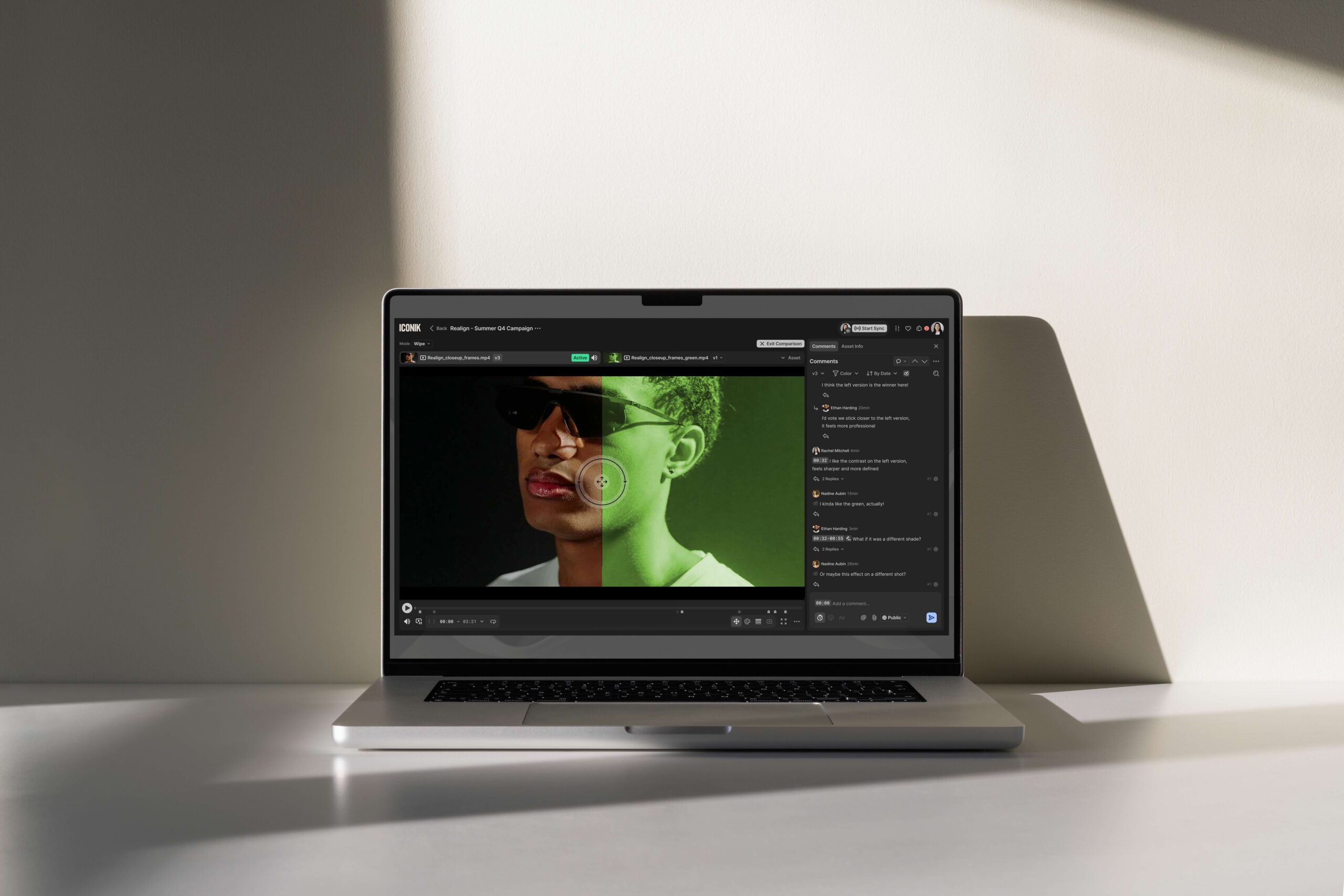
    Backlight will debut Iconik Review, a synchronized media review experience built on Backlight’s Academy Award® and Emmy®-winning Cinesync technology, giving creative teams the power to have live discussions that add value to assets in real time. This evolution unites professional-grade media management with high-fidelity synchronized review. In Iconik Review, every stakeholder sees the same frame at the exact same moment, whether a colorist is reviewing high-resolution masters on desktop or an executive is streaming optimized proxies on mobile while on the go, creating opportunities for collaborative creative decisions.

    With in-the-moment creative alignment, production teams can reduce review cycles from days to hours, eliminate costly rework, and collaborate seamlessly on assets stored anywhere. This release also introduces productivity and workflow enhancements, including intelligent facial recognition that automatically organizes footage by talent, a DaVinci Resolve integration to streamline editing, PDF review and annotation, and the launch of the Iconik iOS app, enabling mobile proxy review so teams can stay productive on the go.

    Wildmoka: AI-powered vertical, live, and channel-based content creation

    Wildmoka’s Vertical Content Editor enables creators to produce and publish mobile-optimized vertical clips directly from live streams in seconds, eliminating the need for third-party tools. This verticalization process is fully automated—users don’t need to manually reframe or crop, as the AI-powered solution intelligently selects the most suitable layout for each video. The Editor can reframe and crop horizontal video for mobile platforms, apply preset or custom subtitle styles, and publish in multiple aspect ratios, reducing the “live-to-social” window for higher engagement.

    Now generally available, Live Studiolets content owners re-stream and customize live events for specific audiences and markets. From a single feed, users can create multiple streams, add alternative shots, remote commentary, add monetization elements, and distribute anywhere, all from a browser-based interface. France Télévisions recently used the tool, along with Channel Studio, during Roland Garros to push exclusive live match content and drive new monetization throughout the entire event.

    Also generally available, Channel Studio delivers 24/7 or event-based digital channels that blend live, re-streamed, and on-demand content. This broadcast-style experience keeps audiences engaged longer, maximizes content libraries, and gives owners complete control over monetization and distribution.

    Backlight will also preview a new integration between Wildmoka and Iconik that allows data to be natively accessible between the two platforms. Users will be able to easily clip, reversion, and publish VOD assets from Iconik to any digital destination including social platforms such as Youtube, Instagram and Tiktok using Wildmoka, and the edited assets will be natively stored in Iconik for seamless management and archival.

    Zype: AI-powered accessibility and a next-generation video player

    Backlight will also highlight major advancements in Zype, its end-to-end video distribution and management platform. Zype’s new AI toolset enables users to transcribe both newly uploaded and preexisting video content, automatically generate accurate subtitles, and translate transcriptions into multiple languages. These capabilities improve accessibility, expand reach, and support compliance with industry standards while helping publishers localize content for global audiences.

    Zype’s redesigned web player offers faster load times, modular architecture, and a growing plugin ecosystem. Enhancements include Picture-in-Picture mode for uninterrupted viewing, thumbnail scrubbing and keyboard shortcuts for easier navigation, “Next Up” overlays to drive increased engagement and continued watching, improved accessibility features, and one-click social sharing to increase organic reach. The player is optimized for both short-form and long-form streaming across owned and operated applications.

    IBC2025 demos
    Attendees can see live demonstrations of these new capabilities at Backlight’s booth (#1.D09).

    In addition to Iconik, Wildmoka, and Zype, Backlight will also feature the latest innovations across its complete portfolio, including Ftrack and Celtx.

  • Audinate Brings Interoperability to the Intersection of Media Production and AV at IBC 2025

    Audinate Brings Interoperability to the Intersection of Media Production and AV at IBC 2025

    Audinate is bringing its latest solutions to IBC 2025 in Amsterdam (12–15 September). With broadcast and AV technologies increasingly converging, Audinate will show how Dante enables true interoperability, helping broadcasters, system designers, and IT professionals integrate diverse systems into one seamless platform. The company will highlight innovations in audio networking, remote production, cloud-enabled workflows, and secure management that simplify operations and scale across any environment.

    At Stand 8.A95, visitors will experience demos including Dante Virtual Soundcard Pro, Dante Connect for remote production, Dante AV for multicamera IP setups, and advanced tools like Dante Director and Domain Manager for secure network management. Audinate is also hosting a full day of Dante training on 13 September, covering interoperability, clocking, and advanced monitoring, giving IT and broadcast professionals the hands-on knowledge to future-proof their production workflows.

    As broadcast and AV technologies continue to converge, Audinate Group Limited (ASX: AD8), developer of the industry-leading Dante® AVoIP platform, will showcase its latest innovations from 12-15 September at IBC 2025, highlighting how Dante enables true interoperability across AV workflows.

    From broadcast and live performance to enterprise environments, organizations often face challenges integrating systems built on different brands, formats, and workflows that don’t naturally talk to each other. Dante addresses these hurdles by unifying diverse systems into a single, interoperable platform, removing the friction of format and vendor differences so users can work faster, adapt to changes and maintain a seamless audience experience.

    At the RAI Amsterdam, Stand 8.A95 in Hall 8, Audinate will showcase innovations designed for broadcasters of all sizes, including its latest technologies that are redefining the way content is produced, managed, and delivered. Visitors will see how Dante supports next-generation productions — from IP-based operations to cloud-enabled collaboration — by combining seamless integration, adaptable design, and precise control for today’s fast-changing production environments.

    “Broadcast and AV technologies are evolving faster than ever, and the future of production depends on platforms that can interoperate and scale across any application,” said Joshua Rush, Chief Marketing Officer at Audinate. “At IBC 2025, we’re excited to demonstrate how the Dante platform empowers broadcasters, system designers, and AV professionals to move beyond legacy infrastructure, simplifying network management, scaling productions across any environment, and delivering immersive audio and video experiences on-site, in the cloud, or across continents.”

    Demos include:

    Audio & InteroperabilityDante Audio’s upcoming enhancements to Dante’s AES67 and ST 2110-30 implementation will strengthen integration with third-party systems, support more flexible network designs, and keep broadcast workflows aligned with evolving needs. This makes Dante easier to adopt across the full spectrum of broadcast environments, from small mobile units to large multi-facility networks, while bridging Dante with other broadcast systems.

    Making its IBC debut, Dante Virtual Soundcard Pro brings higher channel counts and advanced configuration options to computers on Dante networks. It provides a straightforward way to integrate workstations for recording and playback, with flexibility for both traditional and virtualized production environments.

    Remote Production & AV: Dante Connect enables native Dante audio for remote talent contribution, production monitoring, and localization, demonstrated with SSL System T and Elgato Stream Deck Studio. Dante AV simplifies multicamera IP setups, delivering high-fidelity video at ultra-low latency. Visitors can also get a sneak peek at Iris camera control automating operations and redefining remote production workflows.

    Control & Security: Dante Director and Dante Domain Manager simplify network management and monitoring, offering secure authentication on-premises or in the cloud. The Dante Managed API and Media Encryption provide flexible control, integration with custom systems, and end-to-end secure signal transmission.

    Don’t miss a full day of Dante training at IBC! 

    Mark your calendars for Saturday, 13 September, at the RAI Amsterdam, room G105. Seats are limited and offered on a first-come, first-served basis.

    • Dante Interoperability with ST 2110 & AES67, 10:30-12:00
    • Dante Clocking Deep Dive, 13:00-14:30
    • Advanced Monitoring and Control with Dante Director and Dante Domain Manager, 15:00-16:30

    See all these technologies in action in Hall 8, Stand 8.A95, at IBC 2025.

  • RED Digital Cinema Brings Groundbreaking Cine-Broadcast Module to IBC V-RAPTOR [X] and KOMODO-X with Nikon Z Mount to make IBC Premiere

    RED Digital Cinema Brings Groundbreaking Cine-Broadcast Module to IBC V-RAPTOR [X] and KOMODO-X with Nikon Z Mount to make IBC Premiere

    RED Digital Cinema is set to showcase its new Cine-Broadcast Module at IBC 2025 in Amsterdam. The module brings cinematic, full-frame imagery into live broadcast workflows with advanced features like HDR/SDR 4K60P output, IP-based SMPTE ST 2110 streaming, and real-time 8K 120FPS R3D streaming. With seamless EVS server integration, producers can unlock powerful capabilities such as super-slow-motion, multi-camera color matching, and AI/ML-driven enhancements, all while maintaining broadcast reliability and compliance with industry standards.

    Alongside the broadcast innovation, RED will also debut its V-RAPTOR [X] and KOMODO-X cameras with Nikon Z Mount at IBC for the first time. The combination offers unmatched low-light performance, dynamic range, and autofocus capabilities, giving creators more flexibility in lens selection and cinematic storytelling. Visitors can explore RED’s latest solutions at stand #11C20A with partners Nikon and MRMC.

    RED DIGITAL CINEMA® will feature its latest breakthroughs in broadcasting technology at the 2025 International Broadcast Convention (IBC), held in Amsterdam from September 12–15. Conference-goers visiting RED (#11C20A) will see RED’s newest innovations demonstrated live and experience the unparalleled cinematic imagery of RED’s advanced camera lineup firsthand.

    RED’s Cine-Broadcast Module with Advanced Color Pipeline and EVS Integration Makes IBC Debut

    Bringing filmic, full-frame imagery to live-broadcast workflows worldwide, RED’s Cine-Broadcast Module supports live broadcasting of up to two channels of 4K 60P (HDR/SDR) via 12G-SDI and IP broadcasting compliant with SMPTE ST 2110 (TR-08) and up to a 4K 60P JPEG-XS feed. It features a robust LEMO SMPTE 311M/304M hybrid fiber optical cable connector linked to a rack-mountable 2U full rack or 4U half rack base station. The module further expands workflows with advanced slow motion, AI/ML enhancements, and real-time 8K 120FPS R3D streaming through the RED Connect license-enabled feature.

    Visitors to the stand will see the advanced Broadcast Color pipeline, which facilitates live painting of RED cameras in broadcast or streaming environments and allows for on-demand adjustments and multi-camera color matching using traditional broadcast controls. This latest functionality comes in a firmware update for RED’s V-RAPTOR XL and V-RAPTOR cameras and utilizes industry-standard RCPs to control painting parameters in real time over IP, while saving information per frame in the recorded file’s metadata.

    New this year, RED will showcase the Cine-Broadcast Module’s seamless integration with EVS’ XT-VIA® live production server, which allows broadcasters to enhance their workflows with up to 4x super-slow-motion at 4K and 8x at 1080p, while simultaneously delivering two baseband channels. This capability is powered by RED’s license-enabled RED Connect feature, which allows IP live streaming of R3Ds and unlocks advanced workflows, including real-time AI/ML augmentation and live-to-headset using 8K 120FPS R3Ds.

    The Cine Broadcast Module has recently been deployed on events broadcast by CBS Sports, NBC Sports Group, and MotoAmerica.

    “The evolution of RED’s Cine-Broadcast solution is redefining creative flexibility in live production,” said Jeff Goodman, vice president of product management. “Producers can now harness the visual power of large-format, cinematic storytelling within live content workflows—without sacrificing speed, reliability or standards compliance. It’s a seamless addition to the traditional broadcast ecosystem, offering a suite of advanced IP-based solutions within a single, integrated product. Whether it’s for sports, concerts, or live events, the Cine-Broadcast system opens new creative possibilities for productions around the world.”

    RED Cameras with Nikon Z Mount at IBC for the First Time

    IBC attendees will see the all-new RED V-RAPTOR [X] and KOMODO-X with Nikon’s premier Z Mount. The RED V-RAPTOR [X] features unmatched low-light performance, dynamic range, resolution, high frame rates, and an industry-leading 8K VV global shutter large-format sensor. RED’s KOMODO-X features a 6K S35 global shutter sensor and frame rates at 6K 80P and 4K 120P, all in a form factor measuring only 4x4x5 inches and 2.6 lbs. The Z Mount offers tremendous flexibility in lens selection and provides a comprehensive capture solution—from lens to sensor to codec. With a shallower flange depth and a wider diameter, the Nikon Z Mount supports lens designs with higher sharpness and superior aberration control. The Z lens delivers unrivaled low-light performance and edge-to-edge detail, as well as autofocus performance on both the V-RAPTOR [X] and KOMODO-X cameras.

    Visit RED on the show floor, stand #11C20A, alongside brand partners Nikon and Mark Roberts Motion Control (MRMC).