Category: IBC 2025

  • Banks Lead the Charge in AV Broadcast Convergence

    Banks Lead the Charge in AV Broadcast Convergence

    The line between broadcast and AV continues to blur, and for a growing number of global financial institutions, that shift is changing how they think about control systems.

    At IBC 2025, TSL CEO Matthew Quade described how three of the world’s largest banks are approaching interoperability in an era where AV and broadcast technologies increasingly overlap. The conversations reveal a common theme: end users want unified control without sacrificing flexibility or vendor choice.

    From Studios to Systems Integration

    AV broadcast convergence
    AV broadcast convergence

    TSL, long known for its interoperable broadcast control systems, has spent the past few years expanding into corporate AV, live events, and performing arts. Its latest offering, Hummingbird, is a modular suite of applications designed to unify control across multiple technologies.

    That modularity recently proved useful for a financial institution equipping its offices with new in-house broadcast studios. The company’s AV partner turned to TSL for control interfaces but discovered the client already had a Q-SYS infrastructure throughout the facility. Rather than introducing another proprietary layer, TSL integrated its broadcast systems directly into the existing Q-SYS panels allowing users to manage both AV and broadcast workflows from the same touch interface.

    The Closed-Ecosystem Dilemma

    Not every organization has that level of flexibility. Another major bank, also investing in in-house studios and an auditorium, wanted a unified interface capable of managing SDI, NDI, and SMPTE ST 2110 endpoints. According to Quade, the bank’s integrator sought an open, software-based interface rather than a “locked-in” system from a major control vendor.

    TSL’s approach allowed the client to configure a single soft-panel interface on their own enabling end users to manage mixed technology environments without needing to replace existing systems.

    Multiple Paths Toward Openness

    A third institution is reportedly considering a move away from its closed-ecosystem control provider altogether. Options on the table include switching to platforms like AMX or Q-SYS, with TSL managing the layers that fall outside those ecosystems.

    These scenarios illustrate how financial institutions, historically conservative technology adopters are now driving change in control system strategy. Their needs go beyond boardrooms and auditoriums, touching broadcast, signage, and even facilities infrastructure.

    Beyond Finance: A Wider Industry Shift

    TSL’s projects extend well beyond banking. The company recently collaborated with Fuse Technical Group on video routing for U2’s Sphere concert, supported IP routing for Berklee College of Music’s recording studios, and provided control layers for IHSE KVM systems and BrightSign digital signage networks.

    According to Quade, the industry’s growing comfort with mixed-vendor environments mirrors the transformation underway in broadcast itself. “Big broadcast systems used to be closed ecosystems,” he noted. “Now even companies like Grass Valley, which has its own Orbit control platform, are reselling interoperable solutions like ours.”

    That shift reflects a broader movement toward collaboration and flexibility values that resonate with IT leaders accustomed to open standards and API-driven architectures.

    As AV broadcast convergence continues to reshape enterprise technology strategy, the decisions of these financial giants may signal what’s next for the rest of the market: control systems built for interoperability, not isolation.
  • Atomos Previews Studio PRO-2710 Reference Monitor

    Atomos Previews Studio PRO-2710 Reference Monitor

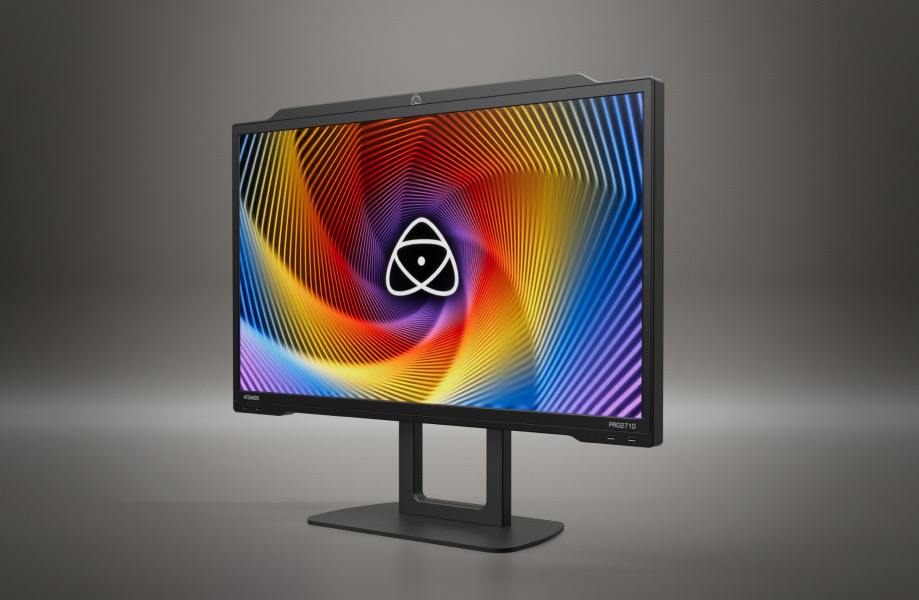
    Atomos has previewed its most advanced professional reference monitor yet the Studio PRO-2710 at IBC 2025. This new OLED-based monitor is designed to give colorists, editors, and imaging professionals unmatched accuracy, sharpness, and workflow integration in a slim and portable form factor. It moves beyond traditional bulky and costly reference monitors, offering true-to-life visuals with interactive 3D LUT previews and color management trusted at aerospace and eCinema levels.

    The monitor also introduces innovations like a patent-pending sensor-calibrated surround lighting system, touchpad-based controls, and a new spectral calibration probe for on-site accuracy. With front-facing I/O ports and built-in calibration presets, the Studio PRO-2710 makes it easier for distributed teams and clients to share the same color-accurate image across studios and remote offices, streamlining approvals and boosting confidence in cloud-driven workflows.

    Atomos (9.C05) announces a technology preview of the most advanced reference-grade monitor to date, setting a new benchmark in professional image accuracy, workflow integration, and user experience. Designed for colorists, editors, and image professionals who demand absolute fidelity, the Studio PRO-2710 integrates innovations that redefine what’s possible in professional visualization.

    For decades, true reference monitors have been bulky, fragile, and prohibitively expensive, often costing tens of thousands of dollars and occupying half a desk. The Studio PRO-2710 breaks that mold. By combining next-generation OLED panels, advanced image processing, and a calibration-first design, Atomos has made uncompromising reference-grade monitoring available in a slim, portable form factor that finally matches the needs of modern creative workflows.

    At the heart of the Studio PRO-2710 is an OLED panel with a vertically aligned subpixel structure, a design choice that eliminates color fringing, chromatic aliasing, and fine-detail distortion common to non-vertical QD-OLED layouts. The result is cleaner edges, more accurate typography rendering, pixel-perfect sharpness across the entire frame, and uncompromised accuracy in both color and detail rendering.

    Color management is elevated with true 33³ 3D LUTs and tetrahedral interpolation, the gold standard for precision rendering. Every hue, gradient, and tonal transition is mapped with uncompromising accuracy, giving creatives confidence that what they see is what the world will see. And unlike other monitors, the PRO-2710 makes these LUTs visual and interactive.

    Users can spin, preview, and analyze color transforms in real time via a groundbreaking patent-pending 3D LUT preview interface.

    “Having pioneered dual-layer mastering display technology for eCinema and contributed to the display systems inside SpaceX’s Crew Dragon spacecraft, I’ve been fortunate to work at the very edge of what’s possible in visualization,” said Martin Euredjian, Director of Advanced Imaging at Atomos.

    “The Studio PRO-2710 is the direct result of that journey. Every lesson learned, whether in mastering-grade eCinema or in aerospace-critical systems has been distilled into this monitor. The Studio PRO-2710 is more than a display. It is a reference environment, designed to give colorists, editors, and imaging professionals the confidence that what they see is what the world will see.”

    The STUDIO PRO-2710 also solves one of the biggest frustrations in grading suites: the viewing environment itself. It integrates a patent-pending sensor-calibrated surround lighting system, the first of its kind, ensuring that the ambient light in the room is part of the same calibration pipeline as the screen. Every session begins in a perfectly controlled reference environment, giving professionals the consistency they’ve always demanded but never had.

    The monitor comes pre-loaded with an extensive library of factory-calibrated presets, ready for immediate use across a wide range of professional environments. Users can also recalibrate on-site with the new Atomos Studio K-100 spectral calibration probe, ensuring accuracy from on-set dailies all the way through to final delivery. And when shared across multiple studios or locations, the PRO-2710 allows distributed teams and clients to view identical color-accurate images, making remote approvals faster and more reliable than ever.

    “With this monitor, we are redefining what reference-grade means,” said Peter Barber, Atomos CEO. “For the first time, creative professionals can have true reference quality in a form factor that fits naturally on a desktop or in a home studio, places where a traditional high-end broadcast reference monitor could never go.”

    “Just as importantly, the Studio PRO-2710 can be easily installed at a client’s office. That means as you send finished work, reviews, or works-in-progress, you can guarantee they are seeing exactly the same colors and the same quality of image you are producing. It makes approvals faster, cloud-based workflows more efficient, and gives everyone complete confidence that what’s on screen is exactly how it will be presented to the world. That consistency has always been one of the hardest problems in post-production, and the Studio PRO-2710 is designed to solve it.”

    The Studio PRO-2710 reference-grade monitor introduces:

    • Patent-pending sensor-calibrated surround lighting system that integrates the viewing environment into the monitor’s calibration pipeline for unmatched consistency.
    • Front-facing I/O ports, four integrated USB-C ports for peripherals, asset imports, and calibration probe connection, no more hunting for cables behind the desk.
    • Patent-pending 3D LUT preview interface, makes color transforms visual and interactive, enabling real-time exploration and analysis.
    • Touchpad-driven interface, a control experience inspired by modern mobile devices, enabling deep preset management, rapid switching, and fingertip precision.
    • The most advanced FPGA-based image processor, ensures every pixel is delivered with uncompromising precision for true reference accuracy.
  • NAGRAVISION and MediaTek Reinvent Streaming Security with Next-Gen DRM Protection

    NAGRAVISION and MediaTek Reinvent Streaming Security with Next-Gen DRM Protection

    NAGRAVISION and MediaTek have partnered to launch a next-generation DRM solution that enhances streaming security at the device level. By combining MediaTek’s hardware root-of-trust and NAGRAVISION’s secure in-field provisioning, the solution eliminates factory-level credential risks and allows service providers to renew credentials dynamically when threats are detected. This makes streaming platforms more resilient against piracy and ensures long-term protection for premium content.

    Showcased at IBC 2025, this new DRM model empowers MediaTek-powered devices with broadcast-grade security, typically seen in set-top boxes, to protect high-value content like live sports. The approach reduces reliance on aging TEEs and creates a future-proof system that adapts to evolving piracy threats, helping service providers deliver secure, high-quality digital entertainment experiences.

    NAGRAVISION, a Kudelski Group company and the world’s leading independent provider of content protection and media and entertainment solutions, and MediaTek Inc., one of the world’s leading semiconductor manufacturers, today announced a strategic partnership to set a new standard in next generation digital rights management (DRM).

    The collaboration will deliver an on-device security solution that enables renewable content protection and eliminates the risks of credential management applied at the factory level, ushering in a new era of trust, DRM robustness, and protection for digital entertainment. The joint solution will be on display at IBC 2025, from September 12 to 15, on NAGRAVISION booth 1.C81.

    As digital piracy surges, the joint solution strengthens market-leading DRM technologies using a hardware root-of-trust and key ladder architecture that dramatically reduces the reliance on Trusted Execution Environments (TEE) which often vary across devices and degrade over time.

    “Pirates are constantly probing for weaknesses at the DRM level,” said Sam Lee, Deputy General Manager, Smart Home BU at MediaTek. “Our partnership with NAGRAVISION enables a renewable, resilient security model that adapts to evolving threats and protects content long after a device has left the factory.”

    The enhanced DRM implementation uses NAGRAVISION’s secure in-field provisioning – allowing credentials to be managed dynamically and securely. This not only eliminates factory-level risks but also empowers service providers to immediately renew credentials when a compromise is detected. For consumer devices powered by MediaTek chipsets, service providers can now activate broadcast-grade security, comparable to that found in set-top boxes, to stream high-value, high-quality content such as live sports.

    “Robust on-device security is no longer a luxury but a differentiator for service providers looking to offer their subscribers the highest quality content possible,” said Stéphane Le Dreau, SVP Product Management and Sales Development at NAGRAVISION.

    “Together with MediaTek, we’re delivering a future-proof solution that meets the demands of today’s content providers and responds to tomorrow’s threats.”

    As service providers adopt device-specific content delivery strategies, MediaTek-powered devices equipped with NAGRAVISION’s enhanced DRM are positioned to support premium
    licensing requirements, secure investments in high-quality content and achieve premium security ratings to sustain long-term value.

  • Riedel Unveils Ultra-Light Bolero Mini Wireless Intercom Beltpack

    Riedel Unveils Ultra-Light Bolero Mini Wireless Intercom Beltpack

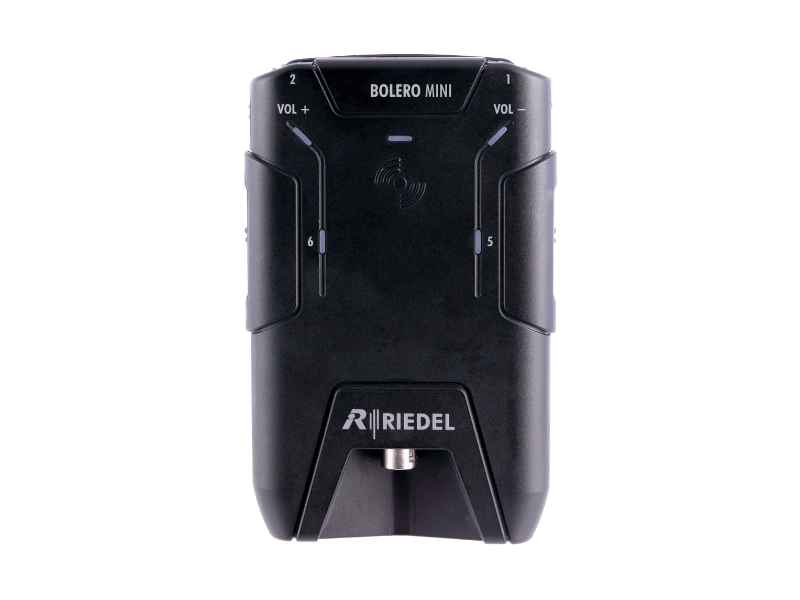
    Riedel Communications has introduced the Bolero Mini, its lightest and slimmest wireless intercom beltpack, at IBC2025 in Amsterdam. Weighing less than a smartphone and only 28mm thin, Bolero Mini is designed for professionals who need freedom of movement without compromising on audio clarity or reliability. It’s built to perform in challenging RF environments with advanced ADR and 5G filter technology, making it ideal for theaters, live events, and broadcast facilities.

    Despite its compact size, Bolero Mini delivers the full Bolero experience across all three network modes, Integrated with Artist intercom systems, Standalone Link for plug-and-play projects, and Standalone 2110 (AES67) for IP workflows. It supports up to 250 beltpacks, features Bluetooth connectivity, NFC Touch&Go registration, and four programmable buttons, giving crews, performers, and technicians a powerful but discreet communication tool.

    At IBC2025 in Amsterdam, Riedel Communications unveiled Bolero Mini, the company’s lightest and flattest wireless intercom beltpack to date. Designed to deliver maximum mobility with minimal footprint, Bolero Mini combines Bolero’s unmatched wireless performance and audio clarity with a discreet form factor that weighs less than a smartphone — making it ideal for stage talent, rigging crews, and anyone who values freedom of movement without compromise.

    “With Bolero Mini, we’re answering a growing demand from production professionals who need a beltpack that’s lighter, thinner, and easier to wear — without sacrificing capability,” said Wolfgang Fritz, Senior Product Manager, Riedel Communications. “Leveraging the heritage and innovation of Bolero, it is powered by our exclusive ADR technology ensuring reliability in challenging RF environments and optimal performance in high-pressure, visibility-sensitive settings like theaters, live music venues, and broadcast facilities. In addition, it incorporates advanced 5G filter technology for greater resilience in today’s crowded spectrum, mitigating interference from high output 5G cell towers.”

    At just 165 grams and 28 millimeters thin, Bolero Mini is a marvel of intercom miniaturization. Whether clipped to a costume, worn under a jacket, or strapped to a harness, its low-profile silhouette and black-grey housing help it stay out of sight and out of the way.

    Despite its compact size, Bolero Mini delivers the full Bolero experience and can be deployed in all three network modes for maximum versatility. In Bolero Integrated mode, it operates seamlessly within Artist intercom environments, unlocking the flexible routing, intelligent redundancy, and extensive I/O connectivity that power some of the world’s largest productions. This mode supports networks with up to 250 beltpacks, accommodating up to 10 beltpacks per antenna through intelligent bandwidth management. Bolero Standalone Link offers plug-and-play simplicity, ideal for smaller productions, temporary projects, or when Bolero needs to connect to other systems without an Artist matrix. For standards-based IP workflows, Bolero Standalone 2110 (AES67) allows users to build an SMPTE ST 2110/AES67 network with no Artist required. Connecting to standard Bolero IP-networked antennas, Bolero Mini integrates effortlessly into any Bolero wireless system and is available in both 1.9 GHz DECT and 2.4GHz versions.

    This streamlined Bolero features four programmable buttons, dedicated volume controls, and a small push-pull connector. It also includes Bluetooth for headset or smartphone connectivity, as well as intuitive Touch&Go NFC registration.

    “In many ways, Bolero Mini has been shaped by real-world feedback,” said Jake Dodson, Executive Director Product Management, Riedel Communications. “Based on the trusted architecture of the Bolero S, our specialized Managed Technology solution used globally by referees in professional sports, Bolero Mini brings that compact power to a broader range of live production environments.”

  • From MXA to DCA: Shure’s Next Chapter in Broadcast Audio | IBC 2025

    From MXA to DCA: Shure’s Next Chapter in Broadcast Audio | IBC 2025

    At IBC 2025, Tim Albright chatted with Shure’s Bill Oakley about the latest innovation, the DCA901, a powerful new addition to Shure’s portfolio designed specifically for the broadcast space.

    Building on more than a decade of proven MXA microphone technology, the DCA901 (Digital Capture Architecture) introduces advanced features tailored for professional audio engineers. Unlike the MXA, the DCA901 delivers eight direct outputs, a stereo automixer, and a dedicated PFL mix, giving engineers more flexibility, precision, and control, crucial for fast-paced live environments where audio can’t afford to go silent.

    From sports arenas and live events to broadcast studios, the DCA901 proves its versatility. Bill explained how the array microphone offers a high-quality backup or even primary solution for RF mics, ensuring reliable audio capture in mission-critical scenarios. With lobes that can be steered and monitored in real time, engineers can adapt instantly without interrupting the broadcast.

    But Shure isn’t stopping here. The DCA901 marks just the beginning of a roadmap aimed at pushing audio technology further for broadcasters, content creators, and live production teams. As Bill put it, “This is the first of many things to come.”

    Explore all the latest updates from IBC 2025 at AVNation.TV.

  • Inside Spectera: How Sennheiser is Redefining Wireless Performance | IBC 2025

    Inside Spectera: How Sennheiser is Redefining Wireless Performance | IBC 2025

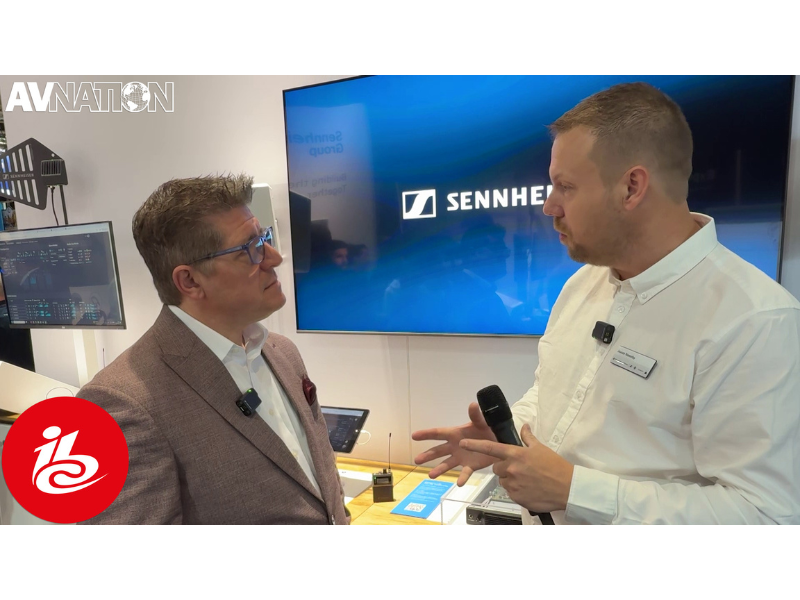
    At IBC 2025, AVNation’s Tim Albright talks with Sennheiser’s Jonas Naesby to explore Spectera, the Sennheiser’s wireless system powered by WMAS (Wireless Multi-Channel Audio System).

    For decades, professional wireless has relied on narrowband RF channels, one frequency, one device, all the time. Spectera changes that model completely. By moving to wideband RF channels, multiple devices can now share spectrum more efficiently, unlocking resilience against interference, higher throughput, and dramatically simplified setups.

    “Instead of dividing spectrum by frequency, we’re dividing it by time,” Jonas explained. “This approach gives us diversity, robustness, and the ability to scale up like never before.”

    What does that mean for professionals? In an 8 MHz block, operators can run up to 128 devices and 64 audio channels, all on a single rack unit, a single frequency, and even with a single antenna. Plus, two-way communication opens new possibilities for monitoring, remote control, and proactive problem-solving before issues reach the stage.

    Beyond reliability, Spectera brings data visibility and easier workflows. From IM pack volume levels to antenna coverage managed over Ethernet, operators gain unprecedented insight and control, all while simplifying deployment.

    And Sennheiser isn’t done yet. Alongside Spectera’s bodypacks, the company unveiled its first handheld transmitter at IBC 2025, with software updates like Command Mode and Engineer Mode on the horizon.

    Visit AVNation.TV for our full IBC 2025 coverage.

  • Absen at IBC 2025: Virtual Production for All

    Absen at IBC 2025: Virtual Production for All

    At IBC 2025, LED manufacturers were in the spotlight for how they are enabling immersive environments such as virtual sets, XR stages, and curved backdrops. For higher education institutions investing in media labs or corporate organizations looking to enhance brand communication, those capabilities are increasingly relevant. Absen, led in Europe by General Manager Emma Liu, arrived with a clear message: virtual production is not one-size-fits-all. Each application has unique requirements, and the difference between success and frustration comes down to matching technology, budget, and people to the right use case.

    Absen at IBC 2025

    Absen at IBC 2025 Virtual Production
    Absen at IBC 2025 Virtual Production

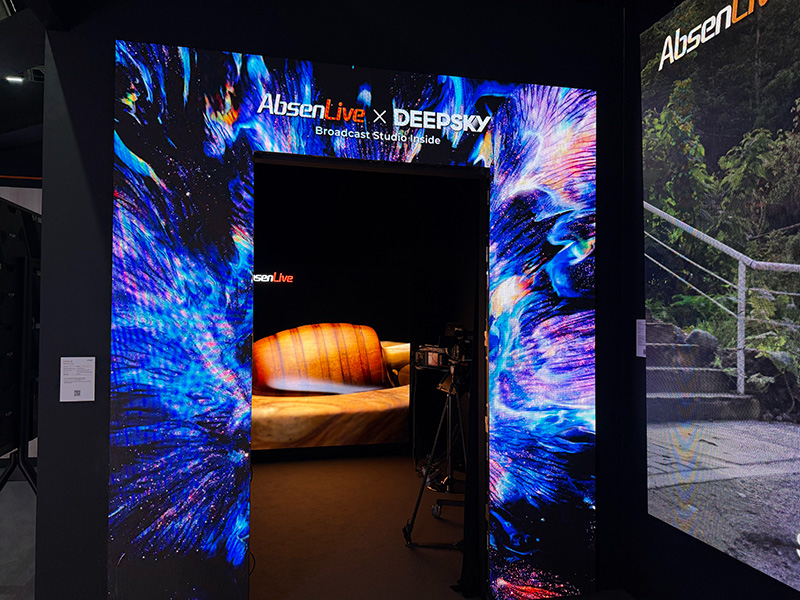
    Absen has built its global reputation by providing LED solutions across rental staging, fixed installation, and high-end virtual production. At IBC 2025, the company showcased its PR Series, designed specifically for the demanding world of virtual production. These panels are engineered to deliver the brightness, color fidelity, and refresh rates needed for XR and AR environments where content must look flawless on camera. Alongside the PR line, Absen displayed its Saturn (SA) Series in a curved configuration, demonstrating how flexible designs can create immersive environments for live events, theatres, or university performance centers.

    The booth itself was structured to guide visitors through distinct applications. One area highlighted virtual production, complete with LED backdrops and ceilings; another focused on rental and staging environments; and a third showcased conference and fixed installation options. The variety reinforced Liu’s point that different sectors and applications demand different specifications. What works for a corporate conference room will not be the same as what is required for a broadcast studio or an XR training environment.

    Education and Training

    One of the strongest themes in Absen’s IBC messaging was the role of education. Liu emphasized that installing LED walls is only the beginning. To unlock the full potential of virtual production, institutions must also invest in training students and staff to operate the systems effectively. Producing in XR or AR requires a professional level of expertise, spanning calibration, camera tracking, lighting design, and media content preparation. Without skilled people, even the most advanced technology will underperform. For universities, this challenge doubles as an opportunity: building LED-based production environments can prepare students for careers in rapidly growing sectors of media and entertainment.

    Budgeting Beyond Hardware

    Another reality that Liu raised is the complexity of budgeting for virtual production. The LED panels themselves are only one part of the investment. Institutions must also account for control systems, rigging, cooling, power infrastructure, and safety considerations, especially when working with curved or ceiling installations. In higher education settings, these costs must be weighed alongside the educational and reputational benefits of immersive facilities. For corporate AV teams, the return often comes in the form of more engaging content, stronger brand storytelling, and the ability to host events that feel world-class.

    Implications for Higher Ed and Corporate AV

    For decision makers, Absen’s IBC presence underscored several key insights. Virtual production technology must be carefully matched to the needs of the application; over-specifying wastes resources, while under-specifying leads to disappointing results. Success also requires ongoing investment in skills and training, as professional operators and content creators are the ones who will turn an LED volume into a functioning production environment. Infrastructure planning cannot be an afterthought, since issues like cooling, power, and structural support often determine whether projects succeed or stall. Finally, immersive LED environments carry value beyond pure functionality. For a university, a state-of-the-art XR stage can attract students and partnerships. For a corporation, it can elevate internal communications and external brand presence.

    Looking Ahead

    What remains to be seen is how quickly institutions adopt technologies like the PR Series in Europe and beyond. The decisive factor may be whether manufacturers like Absen can support training and integration programs that help organizations go from demonstration to real-world deployment. Questions about total cost of ownership will be critical in the months ahead. For now, Absen’s showcase at IBC 2025 made one thing clear: virtual production is maturing rapidly, and for those willing to budget appropriately and build professional teams, the rewards can be transformative.

  • Vizrt at IBC 2025 Powering Broadcast and Meeting Experiences

    Vizrt at IBC 2025 Powering Broadcast and Meeting Experiences

    Vizrt presented new tools and enhancements that make high-quality corporate production, virtual meetings, and hybrid presentations more accessible, especially for organizations with limited technical staff or budgets. Their product updates, workflow simplifications, and cloud-enabled features are squarely aimed at houses of worship, higher education, corporate communications teams, and any group that runs frequent, viewer-facing virtual or in-person events. Vizrt at IBC 2025 used their hardware history and software skills to increase broadcast and meeting experiences.

    Rev Up the Engine

    Vizrt IBC 2025 virtual production setup
    Vizrt IBC 2025 virtual production setup

    A central announcement was Viz Engine 5.4, which introduces several capabilities that reduce duplication of work and streamline output across multiple platforms. Corporate communicators often need to deliver content to internal town halls, external investor presentations, social media, and webinars, all with consistent branding. Viz Engine 5.4 allows “adaptive design,” so a graphic created once will adjust its aspect ratio automatically for mobile, web, broadcast, or large video walls, saving time and avoiding the need to rebuild assets for each output.

    HDR is now natively supported in Viz Artist, meaning that high-spec displays (LED walls, large corporate auditoria) can show richer visuals. The engine also includes Unreal Engine 5.4 / 5.5 support for virtual sets, which enables more immersive backdrops with realistic lighting and reflections useful in delivering polished environments for leader addresses, product launches, or virtual meetings.

    Automating Vizrt at IBC 2025

    Vizrt also emphasizes production automation and simplified workflows. Their “Automated Live Events” capability combines switching, graphics, and control of screens in a unified interface. A corporate comms manager at IBC told Vizrt that this helps “produce high-impact shows” with fewer resources. For virtual meetings or hybrid events, this means fewer live switching errors, more consistency, and less dependency on large production crews.

    Tools like TriCaster continue to play a role, especially in corporate settings. TriCaster-branded solutions are being positioned not just for broadcast studios but for enterprises that host webinars, executive announcements, and remote contributor setups. Integration with remote conferencing tools like Zoom and Teams is a feature Vizrt promoted at their stand. This enables hybrid meeting presenters to marry slides, video feeds, virtual sets, and real-time graphics in a more seamless way.

    Higher ED Production

    For higher education, where lecture capture, hybrid learning, and broadcasting of guest lectures are now standard, Vizrt’s cloud and remote workflows offer big benefits. Their platforms allow lecture rooms or halls to leverage virtual sets or AR overlays, create branded content, and publish to multiple platforms (university websites, streaming services, and social media), all from a central workflow. This reduces technical complexity and staffing load.

    Houses of worship, likewise, can benefit from these tools. Many congregations need engaging visuals, often volunteer-run studios, and frequently stream services or produce content for multiple platforms. Adaptive graphics, AR/virtual set integration, automation of switching and graphics, and remote control over media assets mean these organizations can produce more polished services without large crews. Vizrt’s messaging at IBC was clear: you can deliver branded, immersive, visually rich content even with minimal resources.

    Consistent Experiences

    Perhaps most importantly for corporate end users, Vizrt is addressing scalability and consistency. Features like HTML5 graphics pulled directly into real-time overlays, unified switching, and remote contributor workflows are all about reducing manual overhead and technical risk.

    Vizrt at IBC 2025 reinforced the idea that high-production value is no longer reserved for broadcast giants. Corporate institutions, educational bodies, and worship organizations can all now afford to raise their visual game, conduct virtual meetings that feel more engaging, and deliver live or prerecorded video that holds up visually across platforms, with fewer people in the control room.

    To see all of AVNation’s IBC 2025 coverage, go here.

  • Mavis at IBC 2025

    Mavis at IBC 2025

    At IBC 2025 in Amsterdam, Mavis made a strong case that mobile devices are no longer second-class participants in production workflows. With certified NDI (Network Device Interface) support, integrations with cloud platforms, and new monitoring tools, Mavis is positioning itself as an enabler for corporate teams, educational institutions, and live-event groups who need professional-grade video output without large crews or complex setups.

    NDI 6 Update

    One of the headline announcements is that the Mavis Camera app now supports NDI 6, including full NDI and the more bandwidth-efficient NDI HX3 when receiving streams. Users can send and receive NDI over their device, using broadcast-ready codecs such as H.264, HEVC, and 10-bit HEVC. The app can also handle up to eight audio channels via NDI, each recorded with timecode, providing more precise control for producers in post-capture workflows.

    This also means that Mavis Camera can act as an on-the-go NDI converter, bridging into existing cloud or streaming workflows via SRT, RTMP, or content-management platforms like Adobe Frame.io or Mavis’s own Camera-to-Cloud (C2C) tools.

    Ninja Mavis at IBC 2025

    Another important development is the integration with the Atomos Ninja Phone and with Grass Valley’s AMPP/Framelight X cloud/MAM systems. The Ninja Phone acts as a co-processor, letting mirrorless or DSLR cameras feed into the Mavis ecosystem over HDMI, which means higher image fidelity and support for 10-bit ProRes capture or other formats, while the mobile device also captures proxies or backups. From there, content can stream live (via 5G or WIFI) into AMPP’s cloud environment for switching, asset management, or distribution.

    For corporate production, this is especially relevant. Executives or communications teams who run webinars, all-hands meetings, virtual product launches, or branded internal content often want better video and audio fidelity, multiple sources, consistent branding, and sometimes remote presenters. Mavis reduces the barrier: rather than renting or deploying expensive cameras and switching rigs, organizations can invest in a small number of mirrorless or DSLR cameras plus mobile devices and leverage: NDI for source switching, cloud for remote participants, and mobile network/WIFI for field capture. Less hands needed on technical operation, because the app takes care of many of the signal, codec, monitoring, and transport details. The latency, flexibility, and audio-channel support are vital here.

    Volunteer Power

    In houses of worship and higher education settings, many of the same constraints appear: limited technical staff, reliance on volunteers, and multiple platforms (in-building screens, livestream, and archiving). Mavis’s approach lets a classroom or chapel capture multi-channel audio, combine different video sources, and feed them into existing IP/NDI-based infrastructure or into the cloud. A professor or worship leader can move away from fixed camera zones; monitoring can be handled via Apple tablets or screens, with scope tools and overlays (false color, waveform, etc.) to ensure signal/exposure/framing quality.

    One-time pricing (e.g. unlocking full NDI functionality via in-app purchase) keeps things transparent and accessible, which helps smaller organizations budget without surprises.

    Mobile Mavis at IBC 2025

    There are trade-offs: mobile devices still have limits in dynamic range, lens options, control, and stability, so while Mavis plus Ninja Phone gives a strong hybrid solution, it doesn’t entirely remove the need for good optics or lighting. But for many corporate, education, and worship use cases, the balance of cost, flexibility, and needed quality is shifting decisively in favor of mobile + NDI + cloud workflows.

    Overall, at IBC 2025 Mavis showed that for teams with constrained staffing or budgets, NDI isn’t just for big studios—it’s something corporate, educational, and worship groups can use now to elevate their virtual meetings, livestreams, and internal/external content with better audio, better visuals, more sources, and fewer complications.

    To see all of AVNation’s IBC 2025 coverage go here.

  • Telos Alliance at IBC 2025: Smarter Audio

    Telos Alliance at IBC 2025: Smarter Audio

    Audio is often the most overlooked part of media production, until it fails. At IBC 2025, Telos Alliance made the case that audio deserves to be front and center, whether for streaming broadcasters, lecture halls, or corporate events. Their booth emphasized tools that make dialogue clearer, metadata more useful, and compliance more manageable, all while reducing the footprint of the equipment required. For higher-ed and enterprise AV decision makers, Telos showed how professional-grade audio processing is becoming more compact, more intelligent, and more future-proof.

    Shifting Models for Broadcast and Streaming

    Telos framed their presence around the changing economics of TV and streaming. Traditional broadcast is still important, but streaming models dominate growth, and they bring with them new technical requirements. Live mixing, file-based media workflows, and personalized audio experiences are converging. According to your interview notes, Telos executives stressed that the key is adaptability: systems that can run in real time for events or process assets later in the chain without forcing operators to choose one or the other.

    Smarter Tools for Intelligibility

    One of the major themes was dialogue intelligibility. In both broadcast and streaming, audiences complain when voices get buried under effects or background noise. Telos highlighted solutions to “clean up the narrative track,” improving clarity automatically. Their systems also allow for metadata ingestion, where what a guest says can be auto-logged and stored. That capability has obvious implications for universities recording guest lectures or corporations producing panel discussions. Suddenly archives become searchable, and content can be repurposed far more easily.

    Studio Essentials: Power in a Small Package

    A big focus of the booth was Studio Essentials, which puts multiple Telos products into a micro-PC form factor. For around $3,500 (USD), including the software core, users can deploy a system on a small NUC device that can handle mixing, codec functions, and audio processing at once. This makes it possible to run several production tools simultaneously without racks of gear. In your conversation, Telos emphasized that Studio Essentials Live is already available, making it an attractive option for schools or corporate teams needing broadcast-level sound without broadcast-level infrastructure.

    Live Events and Next-Gen Audio

    For live events, Telos showed how their solutions could handle different audio processing tasks simultaneously, making it easier for small teams to manage complex productions.

    Telos Alliance IBC 2025 streaming PC
    Telos Alliance IBC 2025 streaming PC

    They also talked about the growing role of next-generation audio formats such as Dolby Atmos. Broadcasters are increasingly expected to deliver immersive sound, and Telos is positioning itself as the partner who can help manage those mixes without overwhelming engineers. For higher ed, that could translate into richer experiences for performing arts centers or hybrid events. For corporate AV, it could mean more engaging town halls or brand activations.

    To see all AVNation’s coverage of IBC 2025 go here

    Compliance on the Horizon

    One of the most pragmatic parts of the conversation was about compliance. California has already set a July 1, 2026, deadline for a “Calm Act”-style regulation on streaming and advertising loudness. That means producers of all sizes need tools that can keep levels consistent. That can be a broadcaster, a university media team, or a corporate communications department. Telos’s loudness management and file-based QC systems are designed to address that need now, rather than leaving users scrambling later.

    Telos in Corp or Higher ED

    Taken together, Telos Alliance’s IBC showcase demonstrated how audio workflows are evolving in ways that directly affect universities and enterprises. Real-time automixing reduces the pressure on small AV teams managing multiple microphones in a lecture hall or corporate boardroom. File-based media asset management tools mean that once a class or event is captured, it can be cleaned, logged, and archived in ways that make it more valuable later. Compact systems like Studio Essentials lower the barrier to entry, offering broadcast-quality tools in affordable, manageable packages. And on top of it all, compliance deadlines are coming that will make consistent loudness not just a preference but a legal requirement.

    At IBC 2025, Telos Alliance underscored that great audio is more than just amplification it’s about intelligibility, efficiency, and trust. By blending real-time processing with file-based workflows, shrinking products into micro-PCs, and preparing for regulatory changes, they showed a roadmap that aligns with both professional broadcasters and AV/IT teams in education and enterprise. For decision makers, the message was clear: the time to modernize audio workflows is now, before compliance deadlines and audience expectations catch up.