At IBC 2025, one clear theme was the continued march toward open standards and software-defined infrastructures. For higher education and corporate environments, that shift is not academic. It’s essential. Universities and enterprises are tasked with supporting live events, hybrid collaboration, and large-scale distribution of video across campuses and offices. Matrox Video, with a strong broadcast pedigree and a growing AV footprint, used IBC to spotlight how it is re-engineering live production and AV transport to meet those needs.
To see all AVNation’s coverage of IBC 2025 go here
The Matrox Legacy
Matrox has been part of the video technology ecosystem for decades, serving broadcast engineers, OEMs, and AV/IT managers with encoders, decoders, converters, KVM, and SDKs. Their strength has always been reliability, but the conversation in Amsterdam was about flexibility. According to Albierto Cieri, senior vice president at Matrox, the company’s approach now centers on giving developers and integrators the building blocks to design scalable, software-driven workflows that take advantage of commercial IT infrastructure.
ORIGIN Fabric: The IP “Highway”
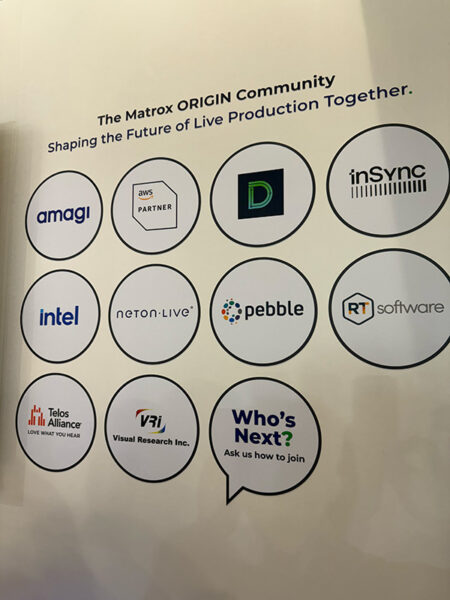
At the center of Matrox’s message this year was ORIGIN Fabric, a transport framework designed for asynchronous, IP-based media. Cieri described it as a kind of “highway”—a layer that sits underneath applications, ensuring video signals move efficiently across networks. Built to run on AWS as well as on-prem IT environments, Fabric allows DevOps teams to create live production solutions with the agility of software deployment rather than bespoke hardware builds.
By exposing this as a developer-friendly SDK, Matrox gives universities and corporations the ability to design applications that fit their unique needs—whether that’s live streaming lectures, distributing signage across campus, or managing complex multi-room corporate events. Running on commercial off-the-shelf IT servers also means institutions aren’t locked into proprietary appliances.
Open Standards First: Matrox at IBC 2025
A critical message at IBC was Matrox’s support for open standards. Cieri emphasized that campus and enterprise deployments will often begin with ST 2110 in central production environments. From there, content can be distributed more efficiently across the rest of the campus or corporate network using IPMX, the emerging standard tailored for AV. This staged approach reduces complexity: high-end workflows where they’re needed, lighter standards everywhere else.
Matrox also showed alignment with the MXL (Media eXchange Layer) initiative, a collaboration led by the EBU and Linux Foundation. MXL aims to harmonize how media applications talk to each other. For end users, that translates to fewer compatibility headaches and easier integration across multi-vendor systems.
Bridging Formats with VION
Another highlight was the VION gateway, which supports baseband input and IP in/IP out. The gateway’s role is to bring in a variety of IP transports and convert them seamlessly to IPMX. For large organizations juggling older gear alongside newer IP endpoints, this conversion layer is essential. It means that migration to IP doesn’t have to be a disruptive rip-and-replace process.
What it means for you
For AV and IT decision makers, Matrox’s IBC 2025 showcase carries several takeaways. ORIGIN Fabric reduces the need to manage multiple point-to-point paths. Instead, it provides a robust, software-defined transport that can adapt as networks scale. With ST 2110 at the core and IPMX at the edge, organizations can plan phased migrations that match their budgets and operational realities. MXL and IPMX support mean IT teams aren’t tied to one vendor’s proprietary ecosystem. In an era where AV and IT must integrate seamlessly, that flexibility reduces risk. VION ensures legacy baseband or non-IPMX transports can still be part of the workflow, easing transitions for campuses or corporations that can’t replace everything at once. The fact that ORIGIN Fabric is already running on AWS signals a readiness for hybrid and cloud-based deployments, whether for disaster recovery, overflow capacity, or remote production.
What to Watch Going Forward
Matrox’s announcements point to a pragmatic path: start with standards, add flexibility, and make migration less painful. For universities streaming lectures across multiple campuses or corporations managing global town halls, the value is clear. The question now is adoption. Will IT and AV teams embrace developer-friendly SDKs like ORIGIN Fabric to craft their own solutions, or will they wait for turnkey offerings from integrators? And how quickly will IPMX, still a developing standard, become the default in campus AV?
IBC 2025 confirmed that IP and IT workflows are no longer the future; they are the present. With ORIGIN Fabric, VION, and its alignment with IPMX and MXL, Matrox is positioning itself as both a bridge and a highway: connecting legacy formats to new standards while paving the way for scalable, resilient, and cost-efficient AV systems. For higher education and corporate decision-makers, that message resonates loud and clear.

Tim Albright is the founder of AVNation and is the driving force behind the AVNation network. He carries the InfoComm CTS, a B.S. from Greenville College and is pursuing an M.S. in Mass Communications from Southern Illinois University at Edwardsville. When not steering the AVNation ship, Tim has spent his career designing systems for churches both large and small, Fortune 500 companies, and education facilities.
- Tim Albright
- Tim Albright

- Tim Albright

- Tim Albright